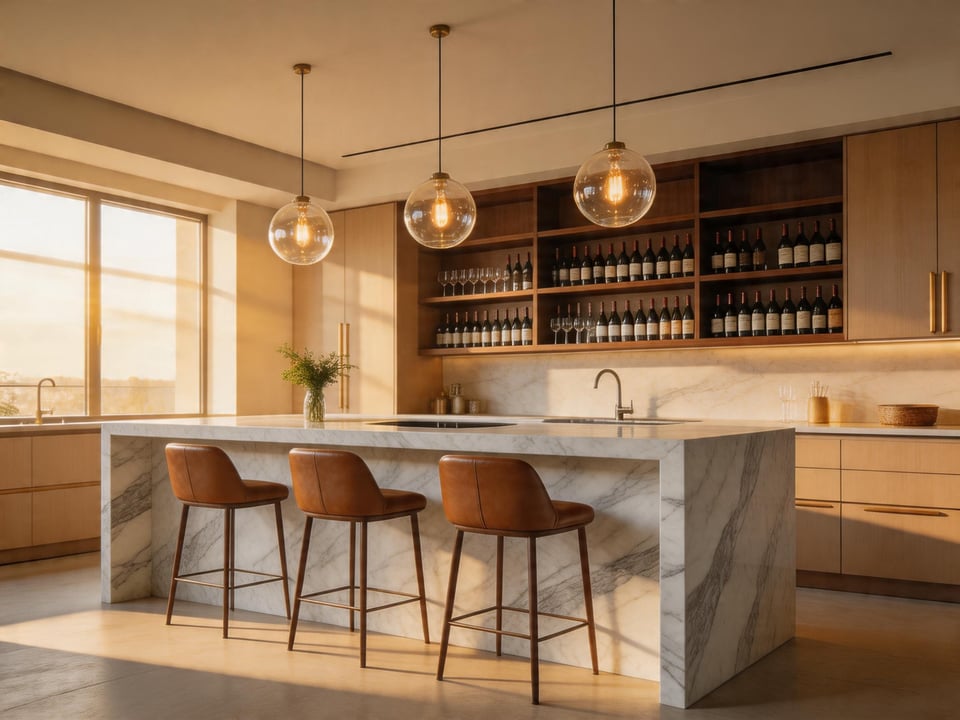
A kitchen bar is the difference between a kitchen that functions and one that becomes the gravitational centre of your home — the place where guests linger, wine gets poured, and conversations stretch past midnight. These kitchen bar ideas aren’t about adding counter space. They’re about giving your kitchen a social identity, a material story, and a zone with its own atmosphere. The surface a bar is made from changes how people feel sitting at it. The lighting above it determines whether guests want to stay. The storage inside signals whether this space was designed for spontaneous hospitality or reluctant obligation. Below, fifteen configurations examine the material choices, proportions, and specific decisions that make kitchen bars genuinely great — from waterfall stone counters to industrial pipe shelving, budget compact designs to full home bar ideas for dedicated entertainers. Each idea looks at why certain materials work in this context, what execution actually involves, and where the common mistakes happen.
1. Waterfall Quartz Countertop Kitchen Bar With Integrated Seating
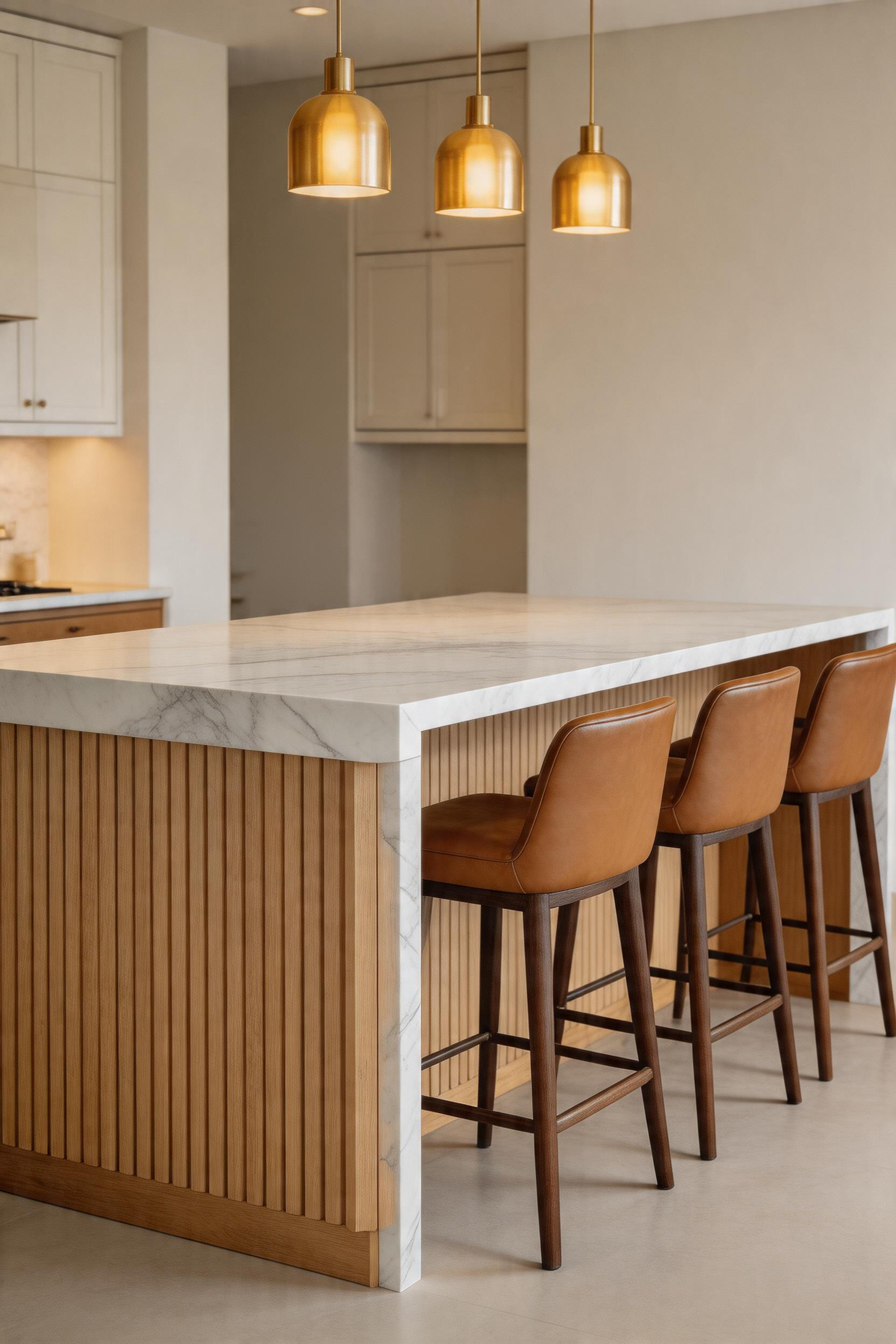
There’s a particular satisfaction that comes from a kitchen bar counter that reads as sculpture rather than carpentry. The waterfall quartz countertop achieves this by extending the stone surface vertically down one or both sides of the island, eliminating the visible cabinetry edge. The result turns the kitchen bar into something that looks placed rather than built — a single mass of material with the cabinetry as substructure rather than the dominant element.
Overhang Dimensions for Kitchen Bar Seating
For the seating overhang, choose 3cm (about 1.25 inches) quartz rather than the thinner 2cm option. Quartz supports up to 14 inches of unsupported overhang; beyond that, concealed steel corbels bear the load. For bar-height seating at 42 inches, a 15-18 inch overhang delivers genuine knee clearance. At standard counter height (36 inches), 12-15 inches is enough. The base beneath the waterfall is where personality enters: fluted oak panels create warm textural contrast against cool stone, welded steel reads as industrial-modern, and painted MDF in a contrasting colour makes the stone the clear hero. A bookmatched waterfall edge — where the slab is cut so veining mirrors on the vertical face — adds 20-30% to fabrication cost but produces a gallery-quality finish that announces itself from across the room. Explore the full range of kitchen countertop ideas if you’re still weighing stone options before committing to a fabricator.
2. Reclaimed Wood Planks as a Kitchen Bar Counter With Rustic Character
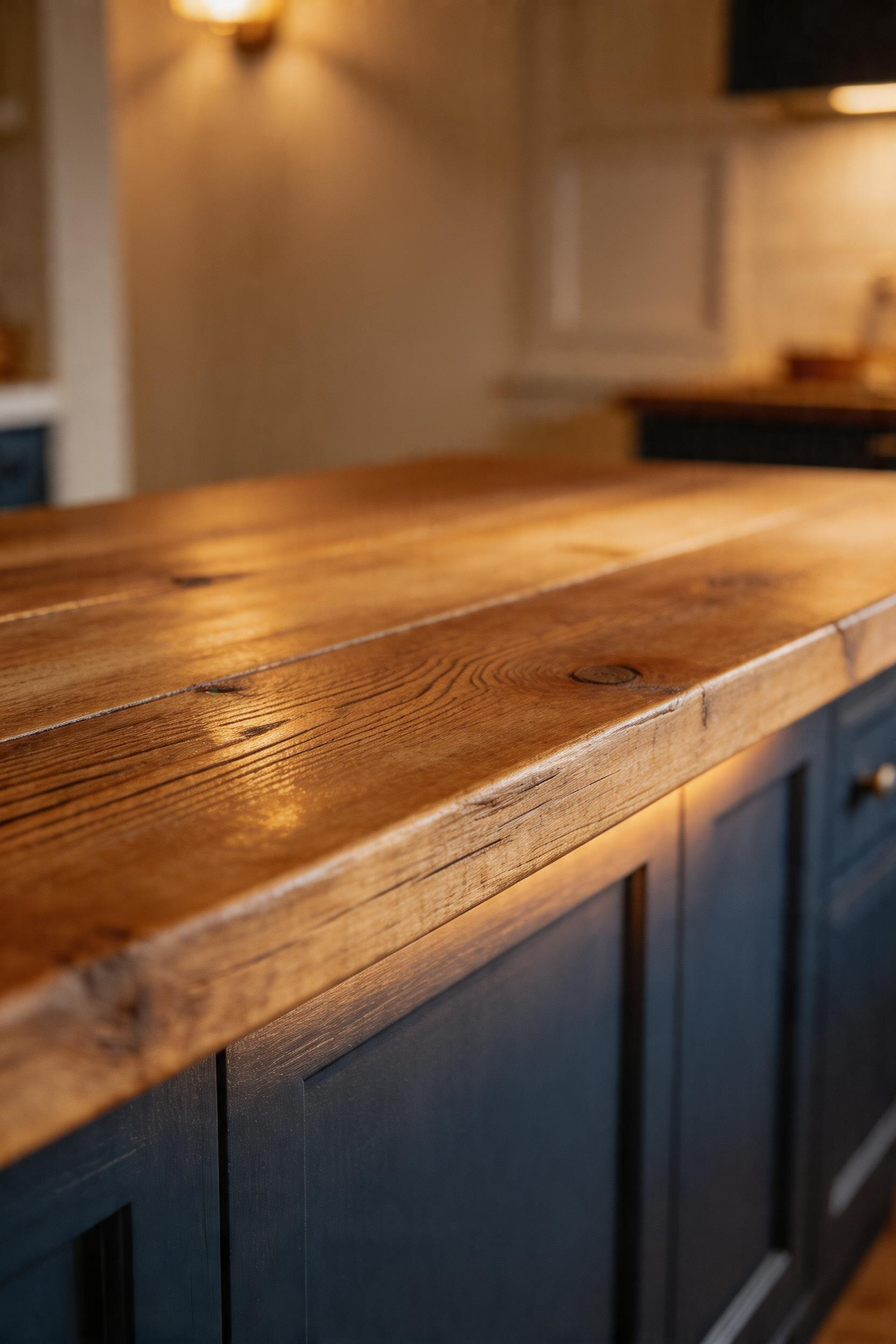
Every material tells a story, but reclaimed wood does it more overtly than almost anything else. The surface shows nail holes from previous lives in barns or industrial buildings, tight growth rings from old-growth timber, and colour that shifts from blonde to amber across a single plank. This variation is not imperfection — it’s the material’s accumulated history made visible, which is precisely what engineered surfaces spend significant money trying to simulate.
Sealing Reclaimed Wood for Kitchen Bar Use
Reclaimed Douglas fir is particularly well-suited to kitchen bars: old-growth fir has extremely tight grain, making it harder and more dimensionally stable than new-growth lumber. The sealing decision determines whether this kitchen bar idea is practical or problematic. Waterlox — a tung oil and resin blend — is the professional’s choice: it penetrates deeply, cures to a waterproof film, and is food-safe after 30 days’ full cure. Pure tung oil (4-6 coats applied over several days) produces a beautiful matte sheen and is fully renewable by sanding and re-oiling. Never use mineral oil as the primary sealer — it conditions wood fibres but creates no waterproof film, so a reclaimed bar with a sink will swell around the cutout over time. Pair the reclaimed counter with a painted base in dark navy, charcoal, or off-white. Wood-toned cabinetry below competes with the counter rather than grounds it. Specify at least 2-inch plank thickness — the chunky edge profile is the signature detail that reads as quality, not an afterthought.
3. Industrial Pipe Shelving Integrated Into a Kitchen Bar Design
The appeal of black iron pipe shelving in a kitchen bar comes from its honesty: it doesn’t pretend to be anything other than structural hardware repurposed for display. Open shelving suits the bar format because bottles, decanters, and glassware are visual assets rather than items to conceal. A bar where everything is behind doors is a utility zone; a bar where the tools of hospitality are on display is a destination.
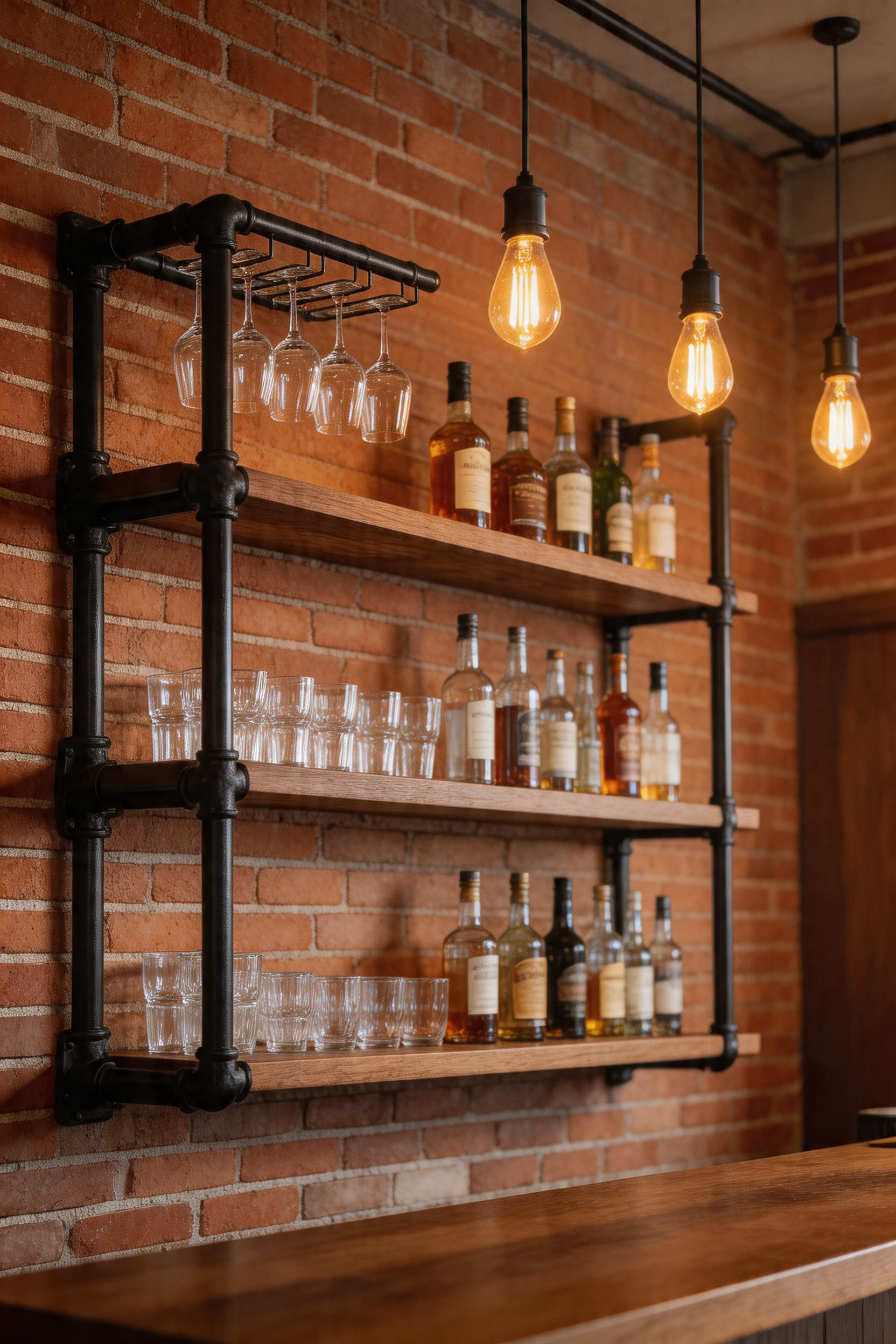
For bar applications, specify 1-inch diameter schedule-40 pipe rather than the thinner 3/4-inch option. The heavier diameter suits shelf runs over 36 inches, where lighter pipe looks spindly relative to the wall area it occupies. Load-bearing capacity: 1-inch pipe brackets rated for 120 lbs per pair handle bottles and glassware without issue. Bracket spacing should not exceed 32 inches for solid hardwood shelves at 1.5-inch thickness — beyond this, even dense hardwood develops a visible sag under bottle loads. The structural weak point in pipe shelving is almost always the wall connection: anchor brackets into studs at 16-inch centres or use toggle anchors rated for the full shelf load. Position the first shelf tier 18-24 inches above the bar counter for easy reach; a second display tier at 36-40 inches handles glassware and decanters. Warm shelf board material — walnut, white oak, or reclaimed timber — creates the industrial-warm hybrid that works across most kitchen styles. As kitchen bar ideas go, this one is among the most accessible: pipe hardware is inexpensive and widely available, and the shelf boards can be sourced locally. Avoid mixing chrome or polished nickel hardware with matte black iron pipe in the same zone; the finish conflict reads as an oversight rather than a layered choice.
4. Bold Backsplash Tile as the Hero of Kitchen Bar Ideas
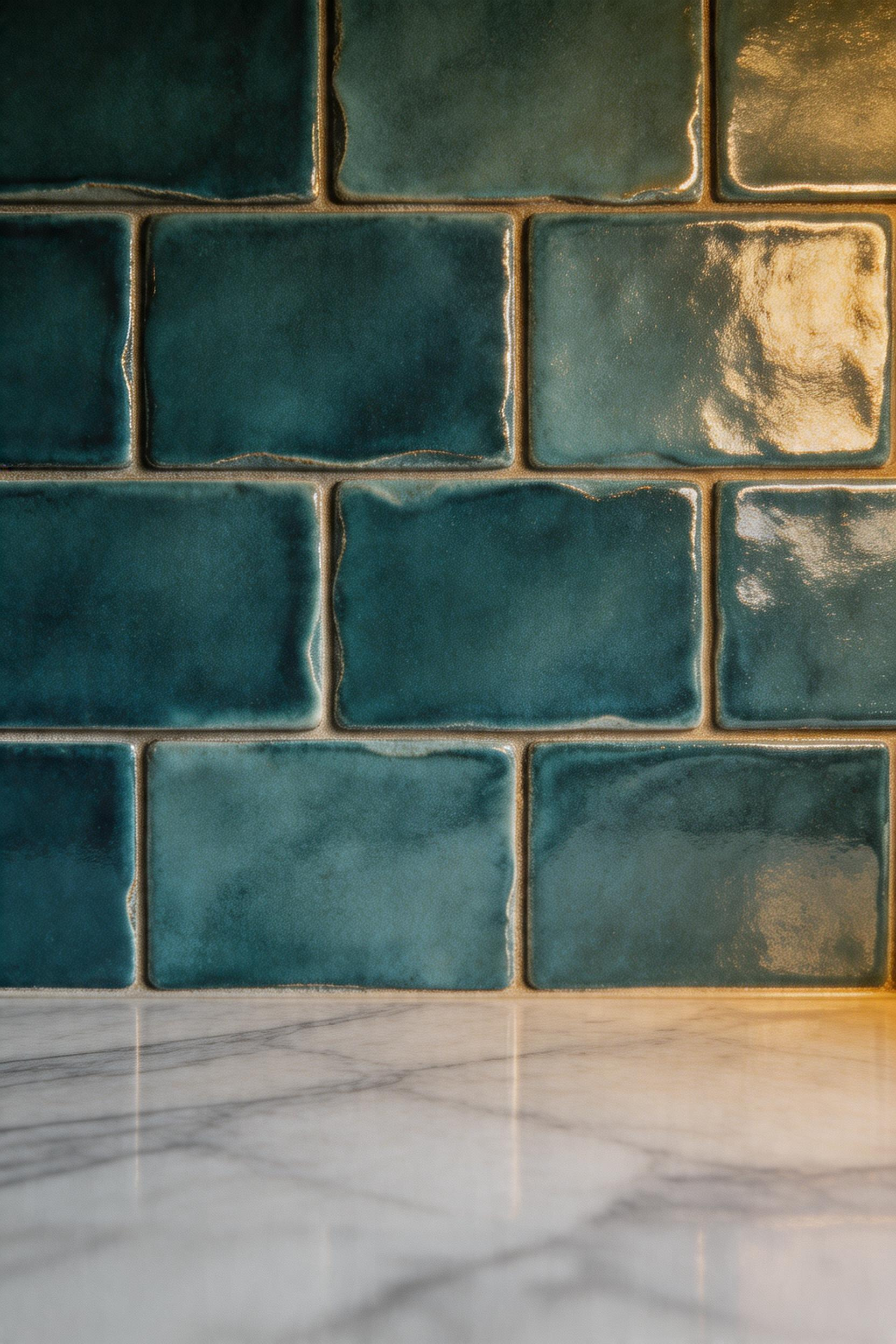
The backsplash zone behind a kitchen bar is, architecturally, a gift. It occupies a vertical surface at eye level for seated guests, in a contained area that may need only 8-20 square feet of tile. That economics makes premium options — zellige, handmade ceramic, stone mosaic — budget-feasible in a way they wouldn’t be across an entire kitchen. At that scale, even the most expensive handmade tile becomes achievable.
Installation Notes for Kitchen Bar Backsplash Tile
Zellige — handmade Moroccan fired clay tile — has irregular edges, varying thickness, and surface glaze variation that no machine-made tile can replicate. It requires medium-bed thinset (not standard thinset) to accommodate tile thickness variations, and a professional installer experienced with handmade tile. Budget 20-40% more for labour than a comparable subway tile installation, and order 15-20% extra material for waste from irregular sizing. For grout, match closely to the tile’s dominant tone — high-contrast grout amplifies every irregularity and creates a busy grid effect that fights the tile’s organic character. Explore the full range of kitchen backsplash tile ideas to see how zellige, handmade ceramic, and stone mosaic each perform behind a bar. The glazed zellige surface is easy to wipe clean; the main cleaning concern is the textured surface trapping grease over time, which a pH-neutral cleaner handles without stripping the glaze. Handmade ceramic at 4×4 or 3×6-inch formats offers similar surface variation at lower cost. Stone mosaic in 1×1 or herringbone marble suits a more classic, polished bar aesthetic. All three give the bar area a visual identity that signals it as a distinct zone.
5. Marble-Topped Kitchen Bar With Brass Hardware for a Luxe Finish
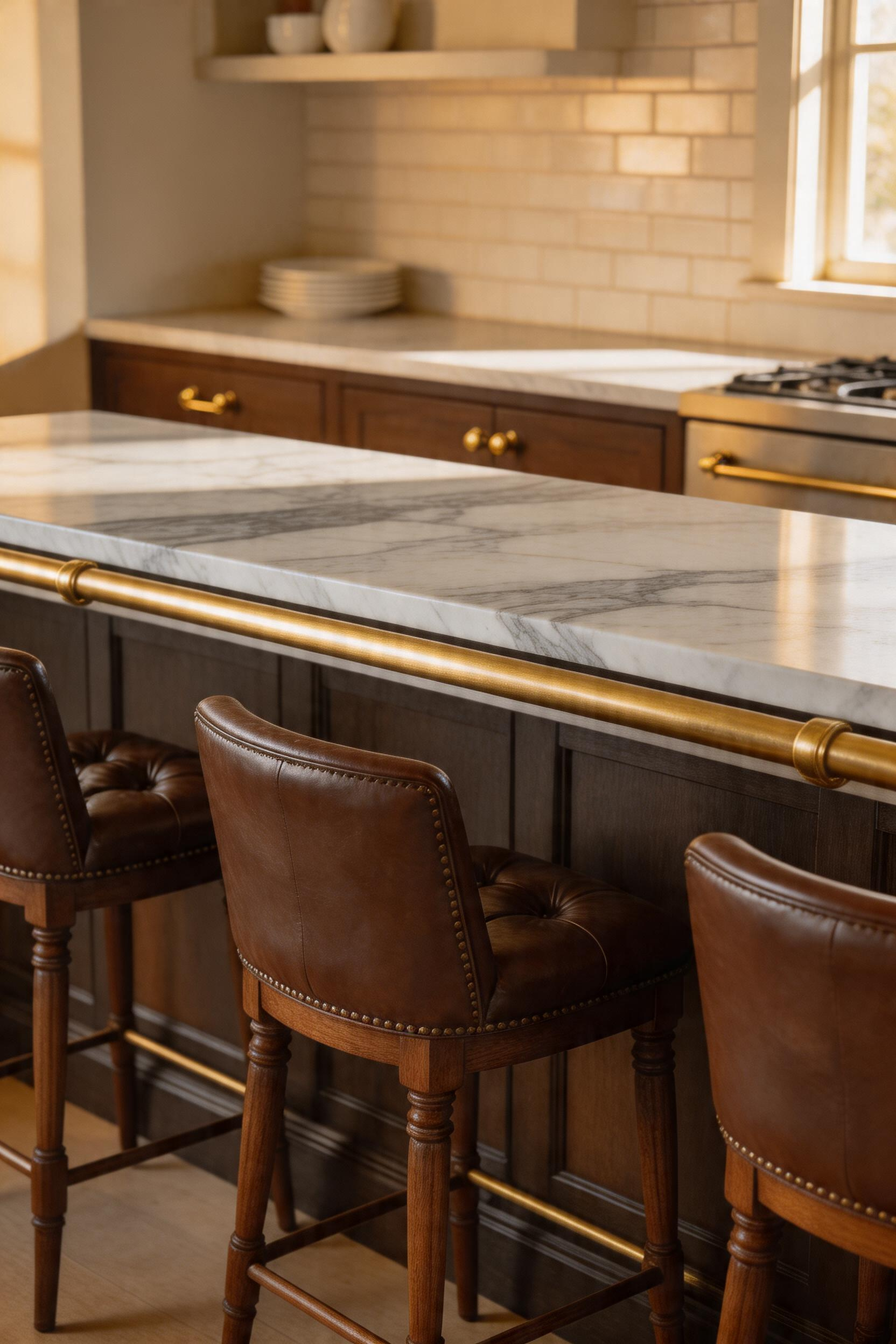
Marble is the material that photographs like nothing else and ages in ways no manufactured surface can replicate. The trade-off is maintenance, and understanding that upfront determines whether a marble kitchen bar becomes a source of pride or frustration. Marble sits at Mohs hardness 3-4, meaning acidic liquids etch the surface on contact. Wine, citrus juice, and sparkling water will leave dull marks if not wiped within minutes — these are chemical reactions, not scratches, and penetrating sealers cannot prevent them, only slow the staining around the etch.
Choosing Marble for Your Kitchen Bar
Carrara is the practical choice among the main marble varieties. Its blue-grey base with soft feathery veining hides everyday etching and wear better than Calacatta’s bright white field — making it the smarter option for an active bar counter ideas project where acidic contact is frequent. Calacatta — vivid white with bold, branching veins in gold or dark grey — is the more dramatic option, better suited to a bar used primarily for serving rather than prep. Of all the marble kitchen bar ideas in this list, the marble-plus-brass combination requires the most ongoing attention — but also rewards it. Seal marble every 6-12 months with a penetrating stone sealer (Tenax, StoneTech, or Bulletproof). Test the seal by placing water drops on the surface: if they bead, the seal holds; if they soak in, reseal immediately. For hardware — cabinet pulls, tap fittings, and bar rail — choose unlacquered brass over lacquered. Unlacquered brass develops a living patina alongside the marble’s own aging. Lacquered brass maintains a consistent appearance, but when the lacquer wears (3-7 years depending on handling), it patches unevenly and is difficult to restore. The bar rail itself — a horizontal footrest of 1.5-inch diameter brass tube at 8-10 inches off the floor — is the detail that most signals intentional bar design rather than a counter that happens to have stools.
6. Compact Kitchen Bar Ideas for Small Apartments and Open-Plan Homes
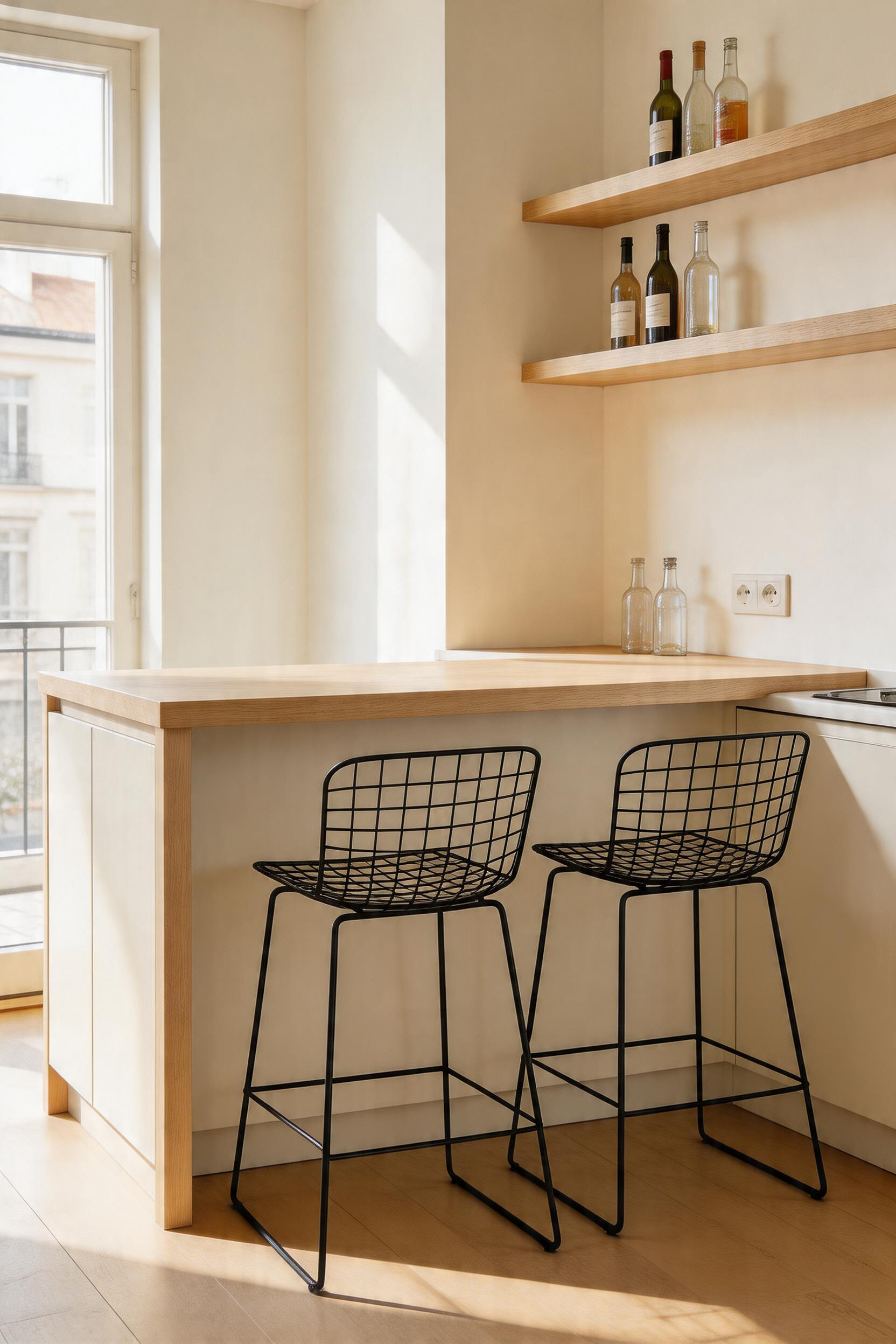
Small floor area is not the obstacle to a kitchen bar that it might appear. It changes the configuration options, but the best compact kitchen bar ideas exploit that constraint into advantages — creating bars that are more intimate, more efficiently organized, and often more considered than larger counterparts.
Storage for Compact Kitchen Bar Designs
The peninsula is the most space-efficient configuration: a counter attached to the wall or cabinetry on one end, requiring clearance only on the open sides (42-48 inches minimum for circulation). For studios and tight kitchens, a fold-down wall bar — a hinged maple or oak ledge at 12-16 inches deep and up to 6 feet wide — deploys as a two-person bar and lies flat when not in use. A cantilevered counter extension adds a 12-inch overhang to existing base cabinets: zero additional footprint, immediate bar function. For materials, choose surfaces that don’t create visual mass: pale quartz, light oak, or ash rather than dark stone. Backless armless stools in acrylic or wire-frame disappear visually when tucked under the counter. Toe-kick drawers — in the normally wasted 3.5-inch kick space below base cabinets — handle flat items (serving trays, cutting boards) without consuming drawer space needed for bar tools. See how these same principles apply in a full kitchen context with these apartment kitchen decor ideas that pair well with compact bar planning. Bar-height counters (42 inches) are counterintuitively better for small spaces than counter-height (36 inches): taller stools tuck further under, keeping the visual line higher and the floor below more visible.
7. Two-Tone Cabinetry Kitchen Bar With Contrasting Base and Counter
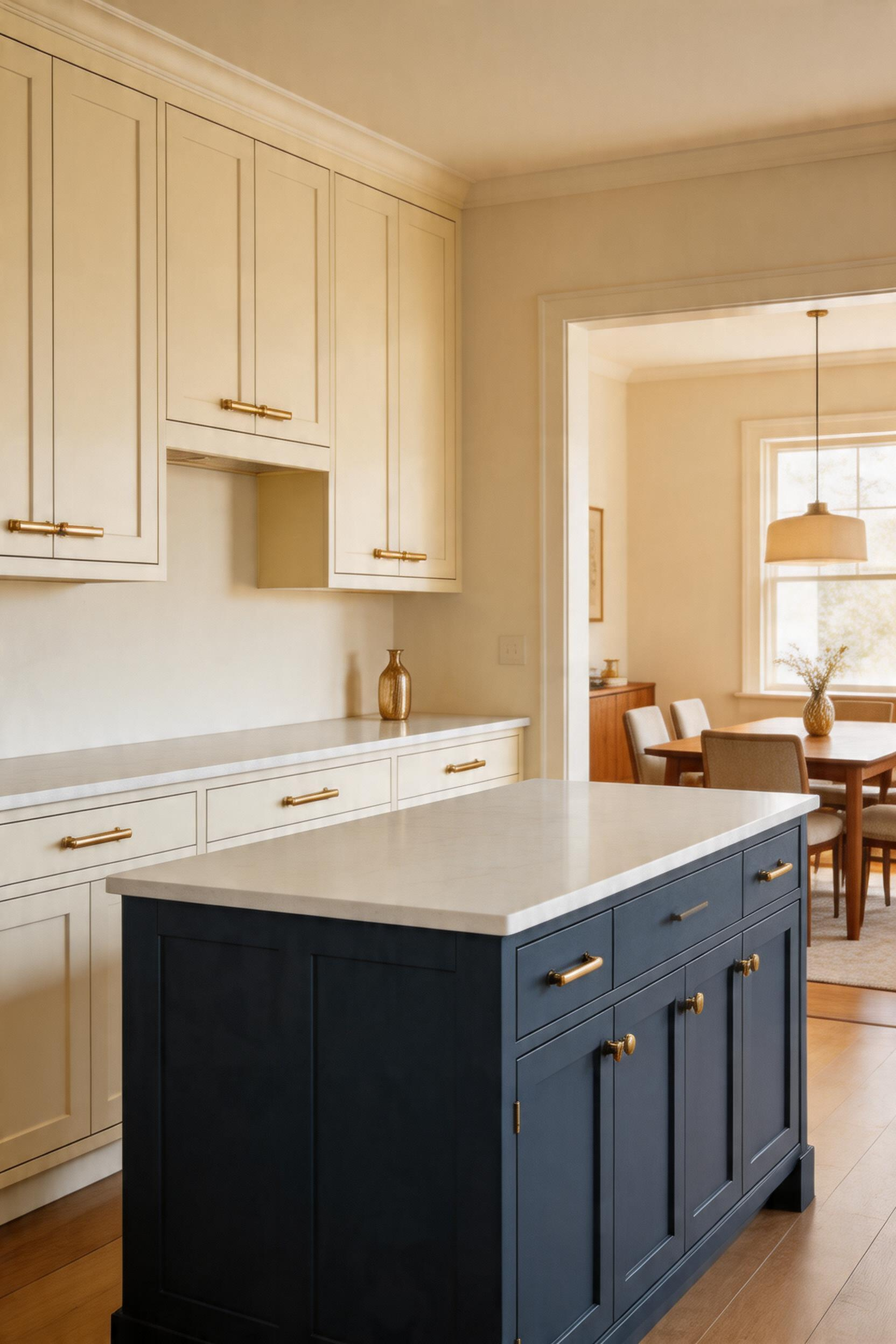
Two-tone kitchen cabinetry is a design logic, not a trend. Using contrasting colours on the bar island versus the perimeter cabinetry gives the bar visual identity that communicates its function before a guest sits down. The bar becomes a destination within the kitchen rather than a continuation of it.
Colour Combinations That Define the Kitchen Bar Zone
The dominant strategy in 2026 places lighter tones on upper perimeter cabinets and a deeper, more grounded colour on the lower cabinetry and bar island. Navy lower cabinets with white or cream uppers is the most enduring two-tone kitchen bar idea in this category: navy reads as grounded and sophisticated, white uppers keep the space feeling open. Sage green lower cabinets with warm cream or oak uppers is the 2026 cottage and farmhouse direction — the warmth of the green avoids the coldness that blue-based palettes can introduce in lower-light kitchens. Charcoal with pale oak is the minimalist-warm approach: the grey undertone prevents starkness while delivering strong contrast. For the practical details: order both tones from the same cabinet manufacturer and finish line — different manufacturers’ versions of “white” can differ by several shade points, creating an accidental mismatch rather than a choice. Hardware should be consistent across both tones; the pulls are what visually ties the two colours into a single intention. Light Reflectance Value pairing principle: the contrast between your two tones should be at least 30 LRV points to register as deliberate. Among two-tone kitchen bar ideas, the navy-and-white pairing has the widest LRV spread and the most proven track record.
8. Built-In Wine Rack Kitchen Bar for the Dedicated Entertaining Host
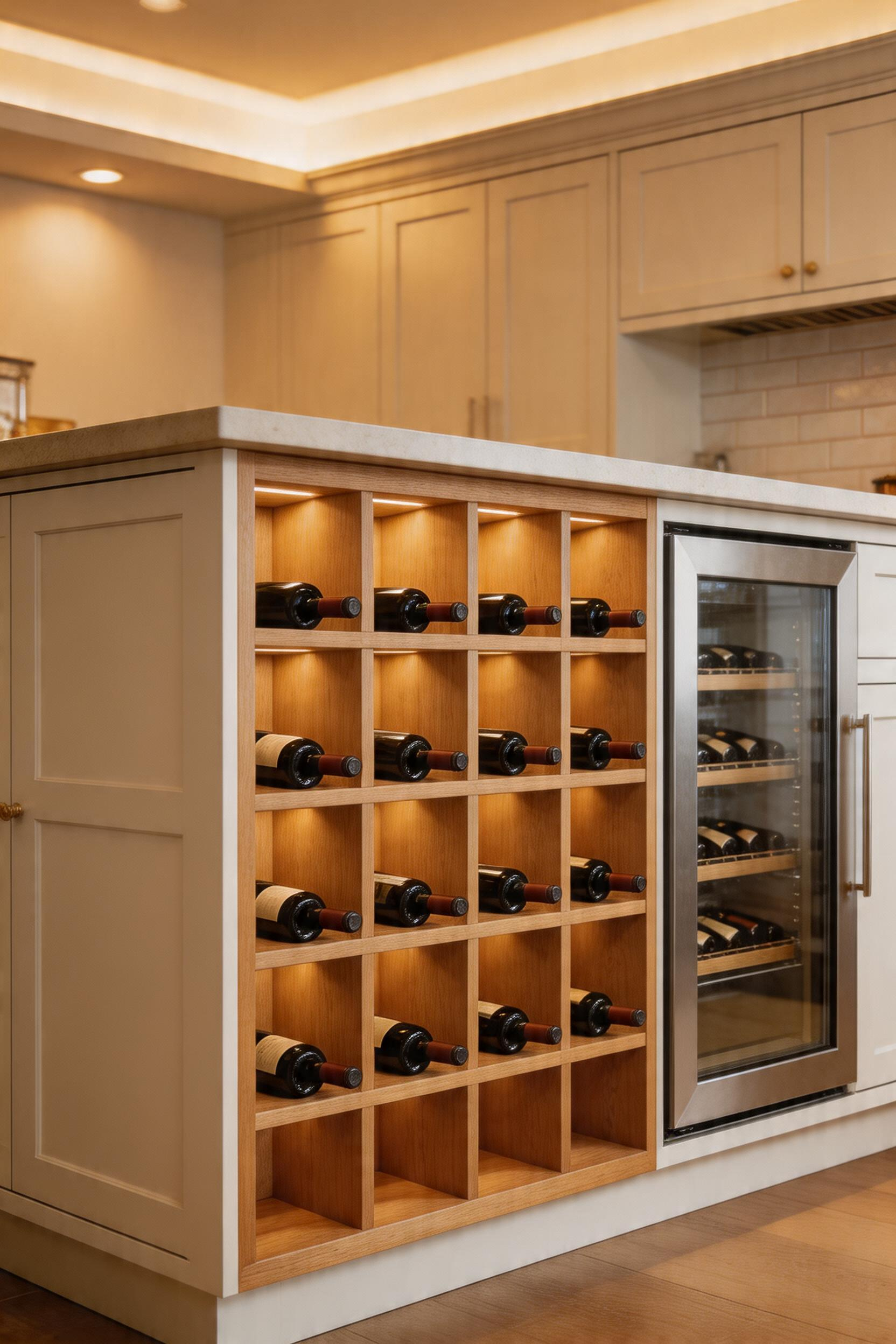
A wine rack integrated into the base of a kitchen bar is one of the clearest signals that this space was designed for hospitality. The storage is purposeful, visually compelling, and immediately communicates what happens at this bar — making it one of the more functional home bar ideas for those who entertain regularly.
Temperature and Wine Fridge Options for Your Kitchen Bar
Below-counter wine cubbies require only 6 inches of cabinet space per horizontal column. A 24-inch base cabinet accommodates a 4-wide by 3-tall grid of 12 bottle slots — a working inventory that lives within the bar. Size cubbies at 4 inches square internal minimum to accommodate Bordeaux (3 to 3.5 inches diameter, 12 inches long) and broader Champagne bottles. For wine to be consumed within 2-3 months, kitchen ambient temperature (68-75°F) is fine. For longer storage or premium bottles, a 15-inch under-counter wine fridge maintaining 50-55°F handles the working cellar. Position the unit away from the oven and dishwasher. For rack frame materials: painted timber matching the bar cabinetry integrates seamlessly; natural oak or walnut cubbies as a contrast element within a painted bar add depth; steel rod cradles (blackened or brushed) work in industrial and contemporary kitchens and pair naturally with pipe shelving overhead. The mistake to avoid: wine storage near any heat source — oven, dishwasher, or afternoon sun through a west-facing window — degrades bottle quality regardless of how beautiful the storage looks.
9. Butcher Block Kitchen Bar Ideas for Warm, Tactile Appeal
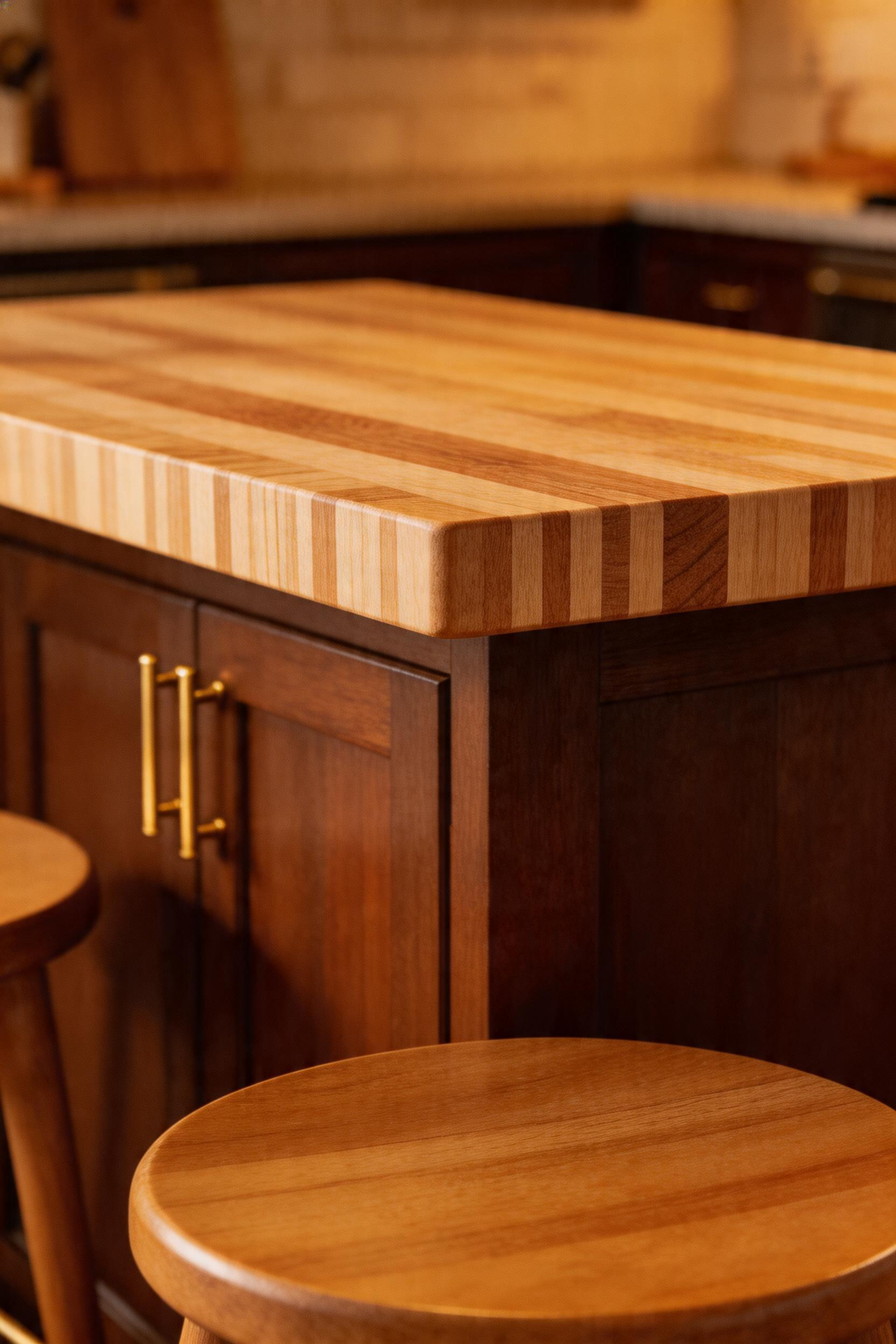
There is a thermal quality to butcher block that stone and engineered surfaces cannot replicate. Resting arms on a butcher block bar during a long conversation feels warm and yielding; the same gesture on marble or quartz registers as cool and resistant. This difference is not subtle — it changes how a space feels to inhabit, and for a kitchen bar designed for lingering, it matters more than most people expect.
Edge Grain vs. End Grain for Kitchen Bar Use
The species decision matters in butcher block kitchen bar ideas. Hard maple (Janka hardness 1,450 lbf) is the industry standard: extremely dense, resists denting from bar tools and bottle impacts. Teak (Janka 1,155 lbf) has natural oils that make it inherently moisture-resistant, requiring oiling every 3-6 months rather than monthly for maple in a wet environment — the best species for bars that see regular liquid exposure. Walnut (Janka 1,010 lbf) is softer but its rich chocolate-brown colour makes it the premium choice for visual impact, best for bars used more for serving than prep. Never oil butcher block with olive or vegetable oil — these go rancid inside the wood fibres over time, creating an odour no amount of cleaning resolves. Food-grade mineral oil or a dedicated butcher block conditioner with vitamin E are the right treatments. Edge grain butcher block — the long face of the wood plank visible — shows a consistent linear pattern and suits long bar runs: more uniform, easier to maintain, and less prone to seasonal movement than end grain. End grain (the cross-section visible) is self-healing for knife cuts and 40-60% more expensive. For a social bar where guests aren’t chopping food, edge grain’s stability and cost-to-quality ratio wins.
10. Floating Shelf Kitchen Bar With Dramatic Pendant Lighting Overhead
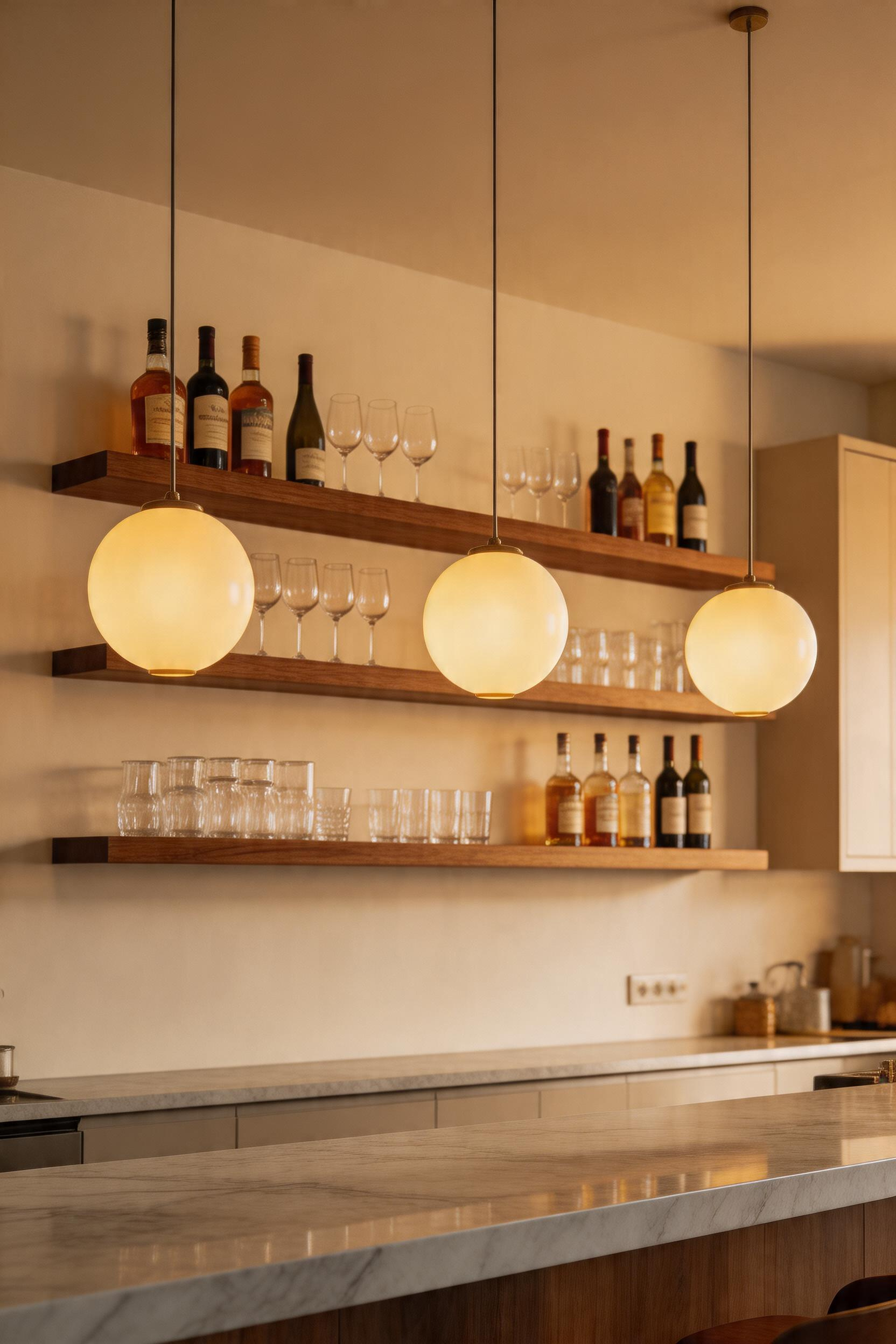
Floating shelves above the bar define its vertical territory without the visual weight of full upper cabinetry — and the combination of well-chosen shelves with precisely scaled pendant lighting is the formula that turns a kitchen counter into a space that reads as a bar. The differentiation is in the ceiling plane: lighting above a standard counter illuminates; lighting above a bar creates atmosphere.
Pendant Sizing for Your Kitchen Bar
The hidden rod bracket system creates the genuinely floating appearance: the shelf board is drilled with a channel at the back, then slid over protruding rods anchored to wall studs — no visible hardware. Standard floating bar shelf depth should be 10-12 inches for glassware and 14-16 inches for decanters and bottles. Solid oak or walnut at 1.5-inch thickness has visual substance; tempered glass (12mm minimum) is the right choice in compact bars where wood shelving would feel heavy. You’ll find a full hierarchy of kitchen lighting ideas that address how pendant, task, and ambient layers work together in kitchen spaces. For pendant sizing: hang fixtures 30-36 inches above the bar counter surface — approximately chest height for a seated guest, producing an intimate pool of light. For a 48-inch bar, a single pendant at 16-inch diameter is the sweet spot. For a bar 5 feet or shorter, one or two pendants; for 6-7 feet, two to three spaced approximately equal to their diameter. Anything above 40 inches from the counter surface becomes general room lighting rather than bar lighting. That’s the mistake: the intimate atmosphere that makes bar seating feel distinct from table seating disappears at the wrong hang height.
11. Concrete and Steel Kitchen Bar for a Modern Industrial Edge
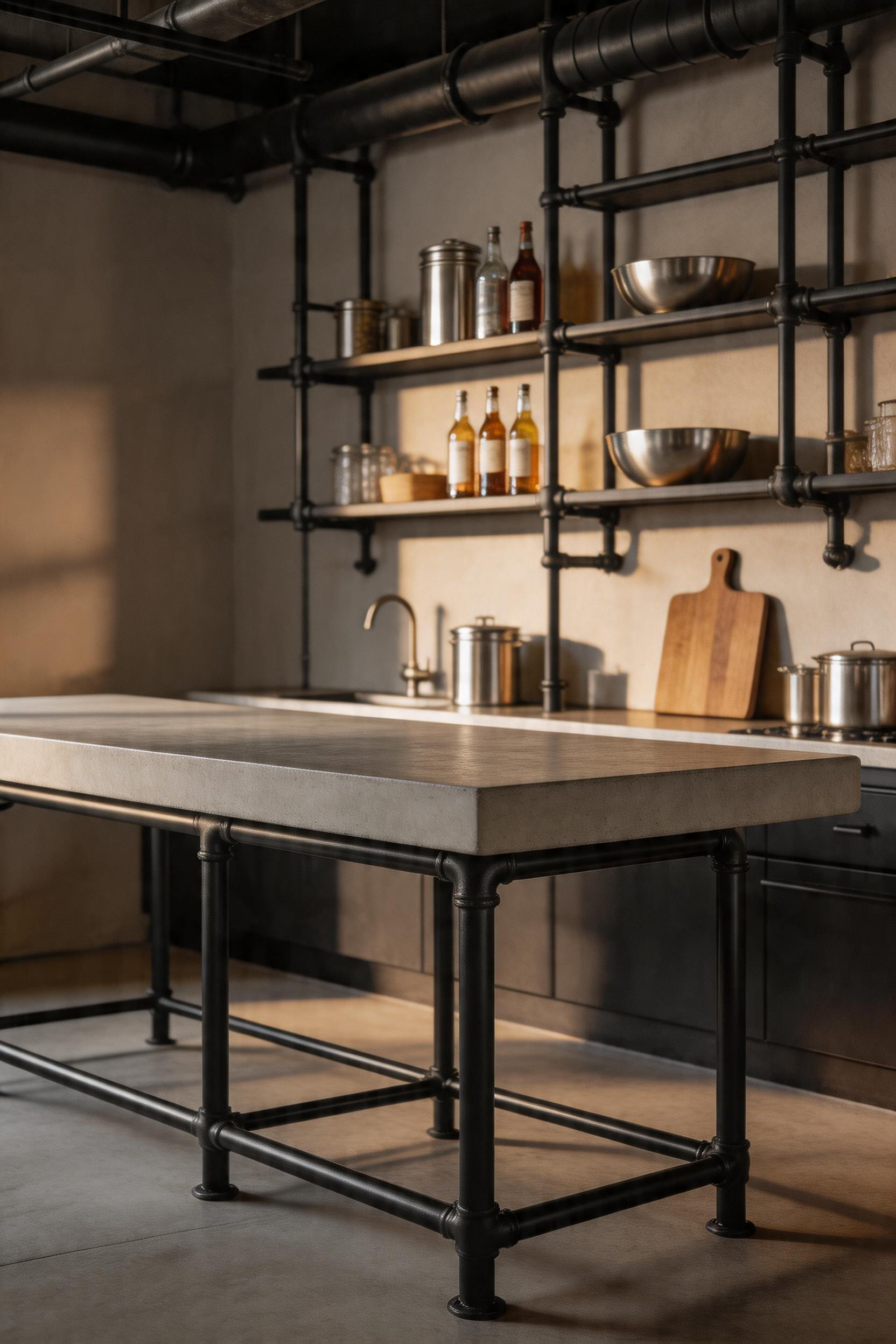
Concrete occupies a category of its own in kitchen bars: entirely bespoke, literally unique to the person who poured it, with a rawness that no manufactured surface can replicate. Every concrete bar tells you exactly what it’s made of — there’s no pattern printed onto an engineered substrate. The credibility of the material is built into its honesty.
GFRC: The Practical Kitchen Bar Concrete Alternative
The practical barrier to concrete kitchen bars — weight — is resolved by GFRC: glass fibre reinforced concrete. GFRC weighs approximately 8 lbs per square foot at 3/4-inch thickness, compared to 18-25 lbs per square foot for full precast concrete. Two people can move a GFRC bar counter; traditional concrete would require a small crew and structural assessment of the base cabinetry. The visual result is identical: the same colour, aggregate texture, and edge profiles are available in GFRC as in poured concrete, and the finish is indistinguishable at practical viewing distance. Custom GFRC kitchen bars typically run $75-$150 per square foot installed, depending on edge profile complexity. For the base, welded steel tube (40mm or 50mm square section, powder-coated black) is the most considered pairing — both materials share industrial credibility. Local metal fabricators are often more cost-effective than furniture manufacturers and allow exact dimensional matching. Seal steel frames with clear lacquer or furniture wax to prevent rust in kitchen humidity environments. For poured concrete specifically: always specify steel mesh or fibre reinforcement for any span over 4 feet. Unreinforced concrete over that length is vulnerable to stress cracking from kitchen temperature cycles.
12. Kitchen Bar Area With a Built-In Beverage Station and Appliance Garage
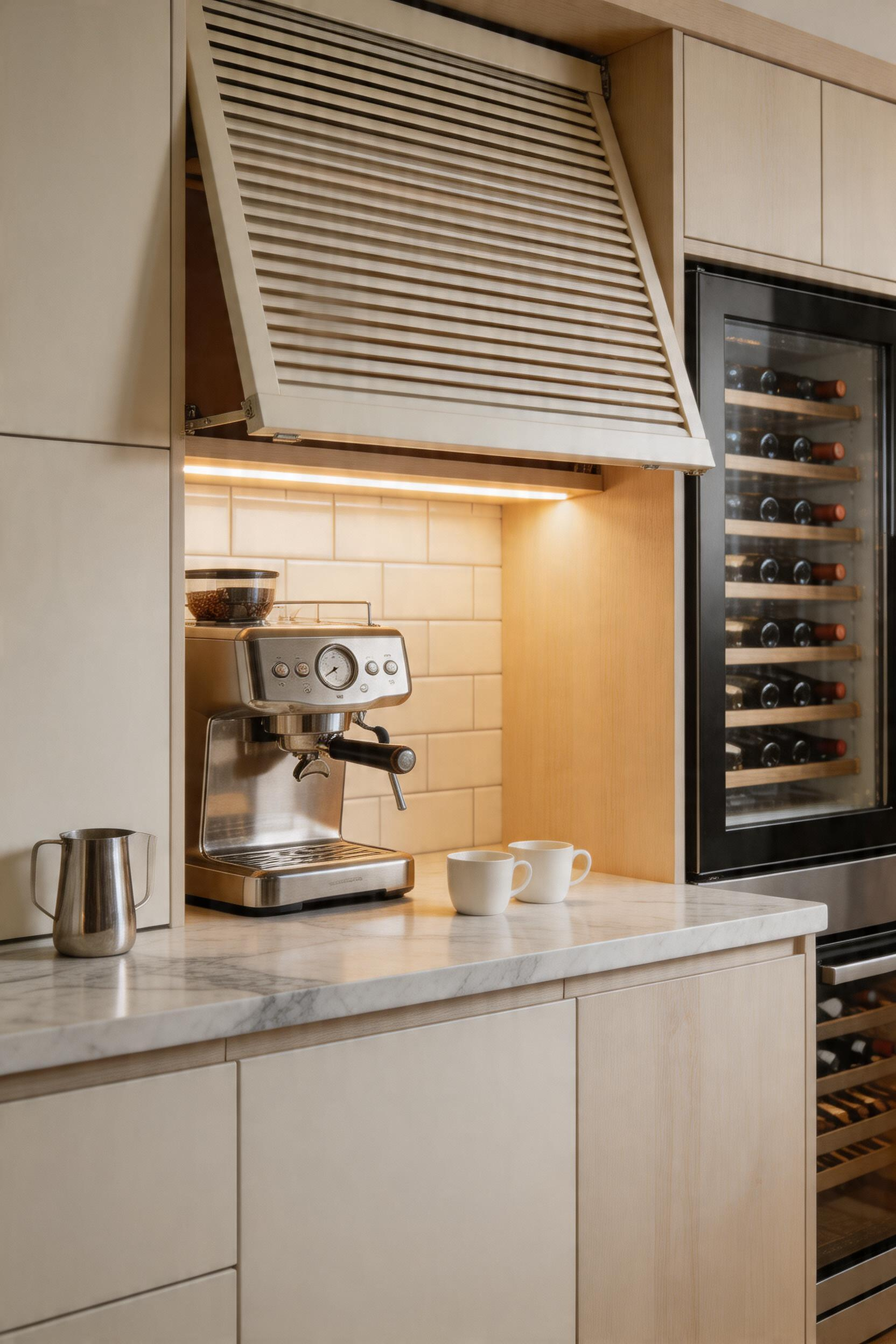
The beverage station converts the kitchen bar from a space that functions incidentally into one that functions deliberately. The distinction is between a bar with wine nearby versus a bar with a dedicated zone for coffee, a zone for cocktail preparation, and a zone for wine service — each with its own outlet, surface requirements, and storage logic.
Appliance Garage Design for Kitchen Bar Concealment
A 48-60 inch kitchen bar can accommodate three zones: coffee station on the left (near the electrical outlet for the espresso machine and grinder), cocktail prep in the centre (with a small bar sink if plumbing allows), wine and beverage service on the right, adjacent to the wine rack or under-counter fridge. Espresso machines run 12-16 inches wide; grinders add 5-7 inches: a 24-inch appliance garage houses both. Tambour doors — vertical-sliding wood slat doors that roll into the cabinet rather than swinging out — require zero clearance in front of the unit, which makes them ideal for compact kitchen bars where swing clearance is unavailable. Pocket doors give a cleaner look but require the cabinet to be at least twice the door width for full concealment. Install a dedicated 20-amp circuit for the beverage station: an espresso machine draws 1,200-1,500 watts, and sharing the circuit with other kitchen appliances risks tripping breakers when you need them most. Outlets inside the appliance garage (at the cabinet back) keep cords invisible; add a USB-C port alongside the standard duplex outlet — the bar counter is where guests inevitably put their phones.
13. Mixed Metal Kitchen Bar Ideas in Gold, Bronze, and Matte Black
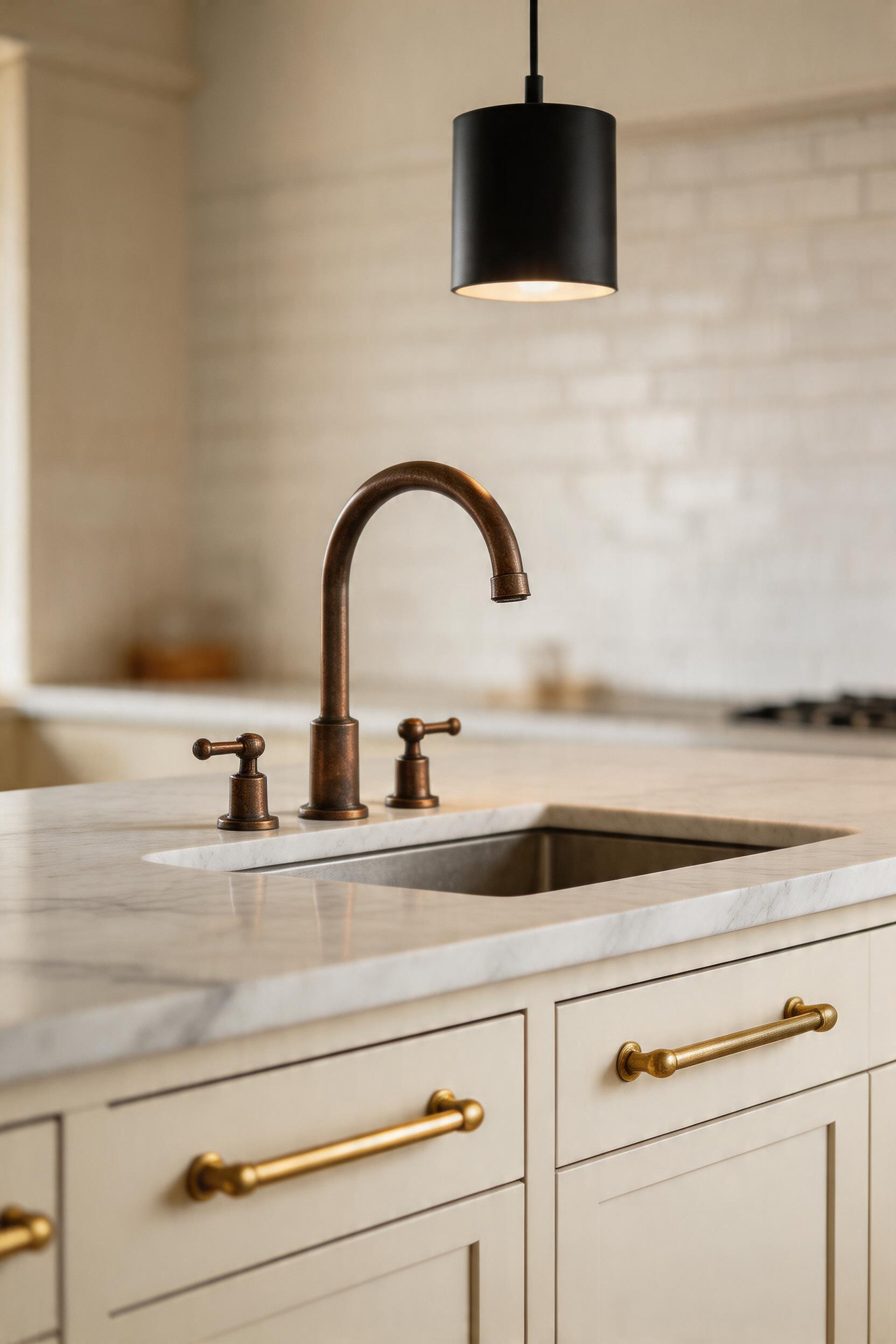
Mixed metals in a kitchen bar is the decision that most visibly separates an intentionally designed space from a well-furnished one. Done well, the layered palette reads as curated and confident. Done poorly — particularly with near-similar finishes in equal quantities — it reads as indecision made permanent. The difference is almost entirely in understanding the ratio before a single fixture is ordered.
Where Each Metal Finish Works in a Kitchen Bar
The 60/30/10 ratio: dominant metal occupies 60% of metal surfaces (typically cabinet hardware — with 8-16 pulls across bar cabinetry, this is the highest-count surface), secondary metal occupies 30% (pendant lighting, bar fixtures), accent metal occupies 10% (a single decorative element, a bronze cocktail strainer, a copper candle holder). Limit mixed metals to three finishes maximum in any kitchen zone — beyond three, the eye cannot resolve the relationship and the result feels accidental. Pairing warm metals (brass, gold, bronze, copper) with matte black is the most reliable formula: warm tones feel inviting in a social space and matte black provides grounding contrast without the visual aggression of chrome against brass. For role-specific placements: brushed or unlacquered brass on cabinet pulls is the warm, tactile choice for surfaces guests handle directly. Matte black pendant lighting creates the strongest visual drama overhead and pairs with almost any cabinet and counter colour. Bronze or antique copper works at the accent layer only — a bottle opener, a decorative element. Avoid mixing two warm metals of similar tone — gold and brass, or bronze and copper — in equal amounts. They’re too similar in temperature to read as a deliberate contrast. For detailed guidance on fixture selection above the bar, the kitchen lighting over island resource covers pendant choices across metal finishes.
14. Shaker-Style Cabinetry Kitchen Bar for Timeless Cottage Appeal
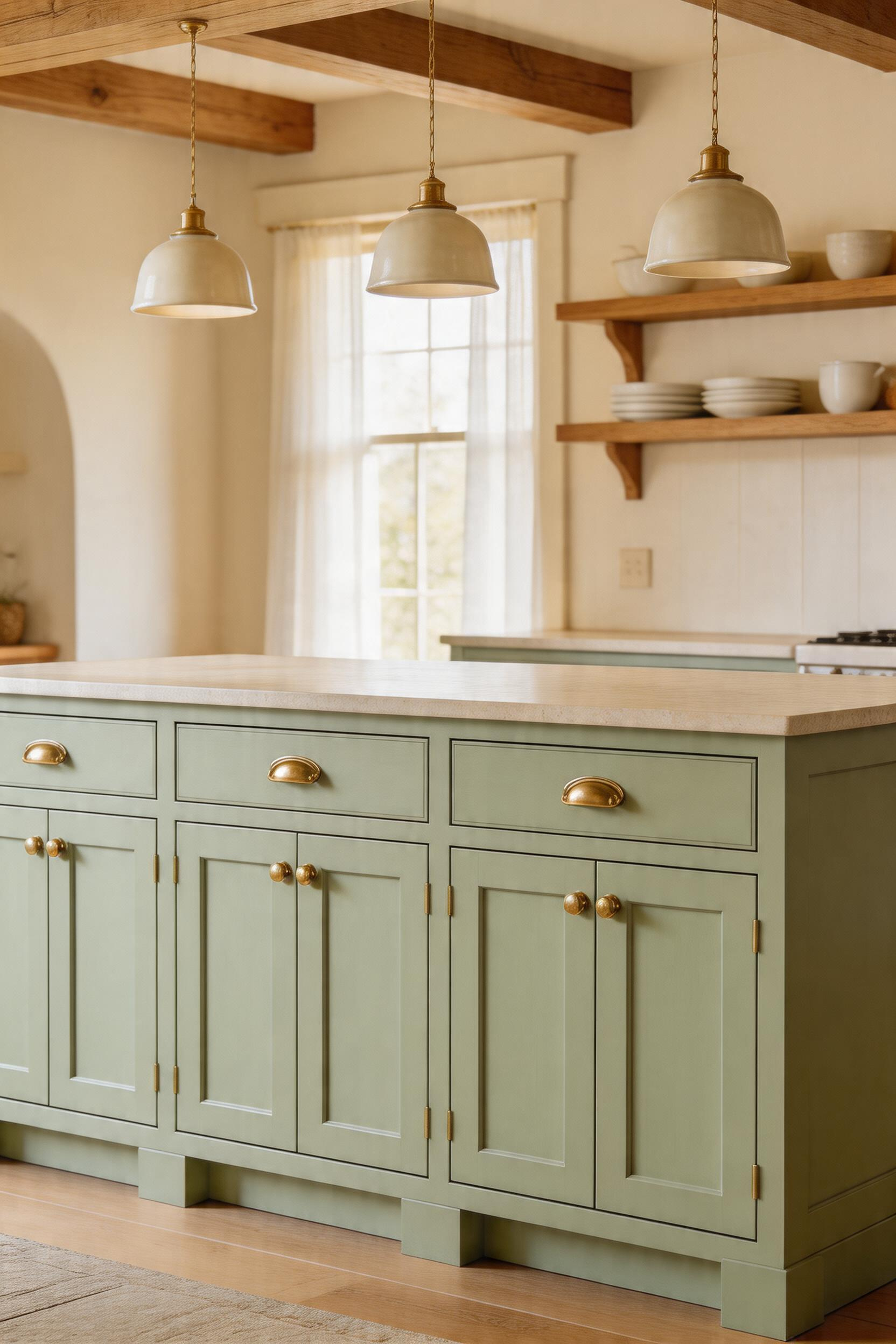
Shaker cabinetry accounts for approximately 50% of all cabinet styles installed in North American kitchens, and the reason is proportion rather than trend. The traditional Shaker door features a 2.25-inch rail and stile frame surrounding a flat recessed panel: simple enough to disappear into almost any style, substantial enough to read as designed rather than default.
Colour and Hardware for the Shaker Kitchen Bar
In 2026, the slim Shaker profile — 12-20mm frame widths — is gaining ground as the bridge between traditional and contemporary. The recessed panel remains, preserving the shadow line, but the reduced frame brings a pared-back quality suited to kitchens where full traditional Shaker feels heavy. For colour on a Shaker kitchen bar: creamy white (Benjamin Moore White Dove OC-17 or Farrow & Ball All White) is the classic palette — warmer than pure white, natural and unstudied rather than clinical. Sage green is the dominant direction for 2026: it connects the kitchen to the natural world and works with stone, linen, and warm timber tones, particularly effective for bars that face a garden window or adjoin a dining room. Soft grey-greens (Farrow & Ball Mizzle is the reference point) suit kitchens with less natural light where full sage can feel heavy. Hardware: cup pulls (a D-ring or arch of metal at 3-4 inch centres) are the most authentically Shaker choice. Ceramic knobs — handmade and slightly irregular — add cottage-artisanal quality to farmhouse interpretations. One pairing to avoid: slim Micro Shaker doors with ornate hardware. The profile’s restraint works best with equally composed hardware.
15. Statement Pendant Lighting That Defines the Kitchen Bar Zone
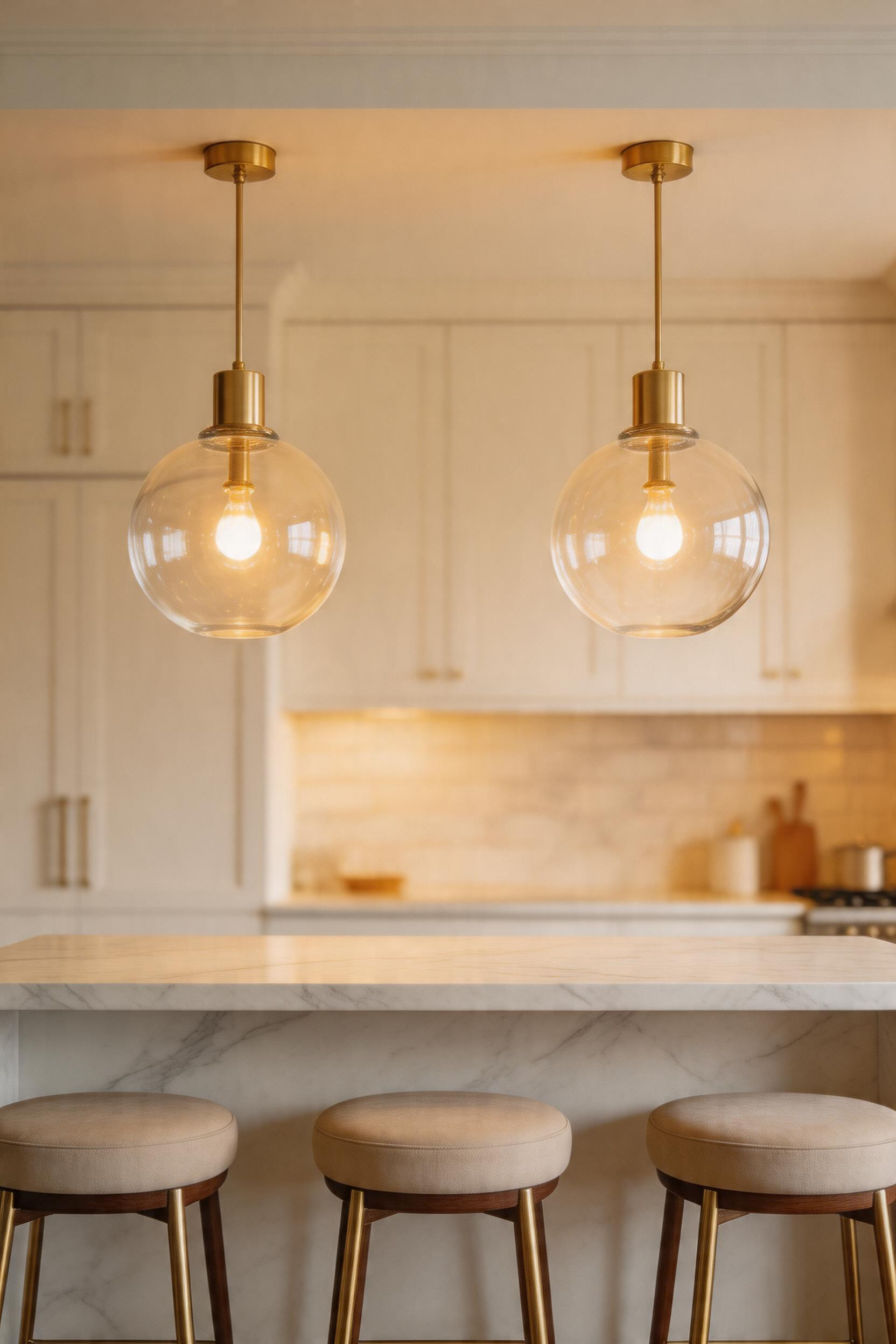
Pendant lighting above a kitchen bar doesn’t merely illuminate — it names the space. A well-chosen pendant set turns a section of counter into a destination with its own atmospheric character. The inverse is equally true: wrong pendants, or right pendants hung at the wrong height, flatten a kitchen bar into an expensive counter with lights above it.
Pendant Types for Kitchen Bar Lighting
Scale matters more than style. A pendant that is too small for the bar beneath it reads as timid and fails to anchor the zone — err toward larger. The practical sizing rule: pendant diameter should equal approximately one-third of the bar’s width for single or cluster configurations. A 42-inch bar calls for a 14-inch pendant; a 60-inch bar for a 20-inch fixture or a linear 36-inch pendant. But visual weight matters alongside diameter: a fine-wire cage at 20 inches reads lighter than a solid metal shade at 12 inches, so calibrate for visual presence rather than physical measurement alone. Globe pendants in clear or frosted glass (12-16 inch diameter) with brass or black hardware are the current favourite for hospitality-inspired kitchen bars: their omnidirectional light output is flattering for faces at bar height. Linear pendants (24-48 inch elongated fixtures hung centrally) are the most efficient choice for rectangular bars, providing even light distribution and a strong horizontal line. These are also the most versatile option across the kitchen lighting over table ideas explored in detail at kitchen lighting over table ideas. Standard drop height: 30-36 inches from the bar surface to the pendant’s bottom — approximately chest height for a seated guest, producing an intimate pool rather than a flood. For ceilings above 9 feet, add 3 inches of drop for each additional foot above 8 feet. Aim for 700-900 lumens per pendant: a decorative globe at 400 lumens looks right but leaves guests squinting at their drinks.
Choosing Your Kitchen Bar Style and Making It Work for Your Space
The fifteen kitchen bar configurations above cover the full material spectrum — concrete to marble, reclaimed timber to engineered quartz, open industrial shelving to concealed appliance garages — and that range reflects a genuine truth about this design element: there is no universal right answer, only the answer that fits your specific kitchen, material palette, and how you actually entertain.
Getting Started With Your Kitchen Bar Project
The most useful starting question for any kitchen bar ideas project is not “what style do I like?” but “what is my kitchen’s dominant character already?” The bar should extend that character or deliberately contrast it — and getting that call right is what turns the counter into a genuine kitchen entertaining space. If your kitchen is all-white or broadly neutral, the bar is the ideal place for a bold material choice — the marble waterfall, the zellige backsplash, the reclaimed wood counter. These read as deliberate design decisions against a restrained backdrop. If your kitchen already has strong material character — bold tile, dark cabinetry, patterned flooring — the bar should support rather than compete: butcher block, simple Shaker cabinetry, a two-tone palette that continues the existing scheme.
Consider sightlines. A kitchen bar visible from the living or dining room needs to work with those rooms’ material palettes too, not only the kitchen’s. The island that looks cohesive from inside the kitchen can look mismatched from the sofa if the two spaces weren’t planned together.
On budget: a cantilevered counter extension with pendant lighting is achievable for $400-$1,200 and transformative for a rental kitchen. A custom GFRC counter on a welded steel base with an integrated wine rack and beverage station runs $5,000-$15,000+. Both are valid kitchen bar ideas for different lives and different kitchens. The single most impactful upgrade for limited budgets is consistently pendant lighting: a well-chosen pendant set at $300-$800 transforms the atmosphere of any bar configuration, regardless of the counter material. If you’re working in stages, start there.