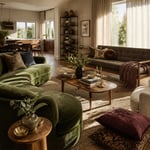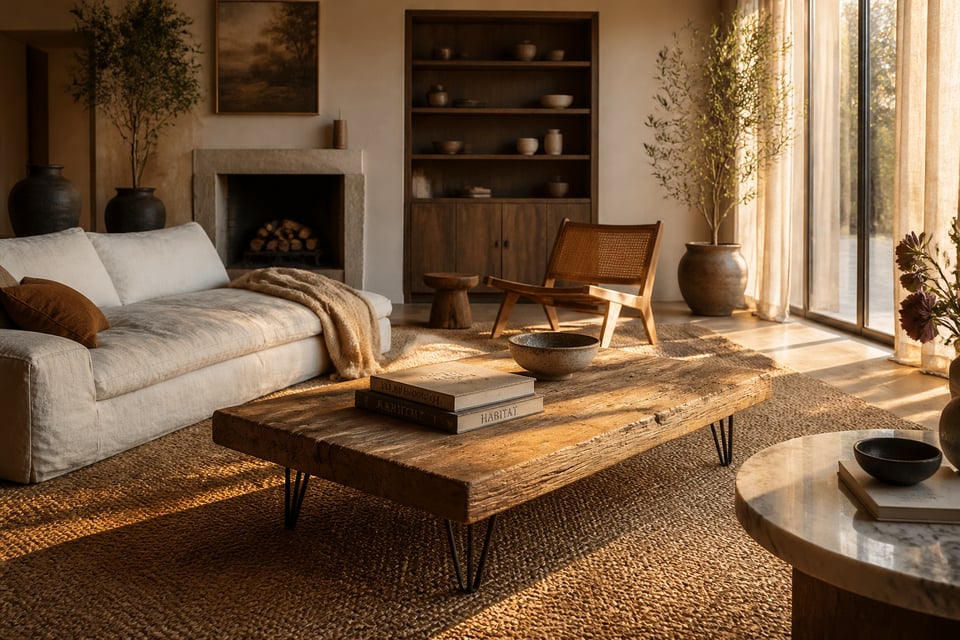
Most living rooms are defined by their sofa — the piece everyone chose carefully, maybe agonised over. The coffee table tends to happen by default. You needed a surface, something was on sale, it fit the space. Then it sat there, doing its job, never quite doing anything more.
That is a missed opportunity. The coffee table is the one object every pair of eyes lands on when they walk into a living room. It sits at the centre of the seating arrangement. It catches the light. It either adds to the room’s material conversation or interrupts it. After years working with surfaces and materials — understanding what wood does differently from stone, why glass reads differently from metal, how texture changes a room’s temperature — I’ve come to believe that the right coffee table ideas are among the highest-leverage design decisions a living room offers. These 15 coffee table ideas range from raw and handmade to sculptural and refined, with the material logic to help you choose what actually fits your room, your life, and what you’re trying to say with the space you live in.
1. Reclaimed Wood and Hairpin Legs: A Coffee Table Idea With Industrial Soul
There is something that happens when you set reclaimed barn wood on hairpin legs and let it sit in the middle of a living room. The material tells a story no showroom piece can — compression rings from decades of structural load, nail holes filled with age-darkened wood putty, saw blade marks that record the exact tool that cut the timber. From a materials standpoint, the surface oxidation on aged wood is not damage; it is a patina, a cross-linking of cellulose fibres through UV exposure that actually increases surface hardness slightly. You are not choosing imperfection. You are choosing earned character.
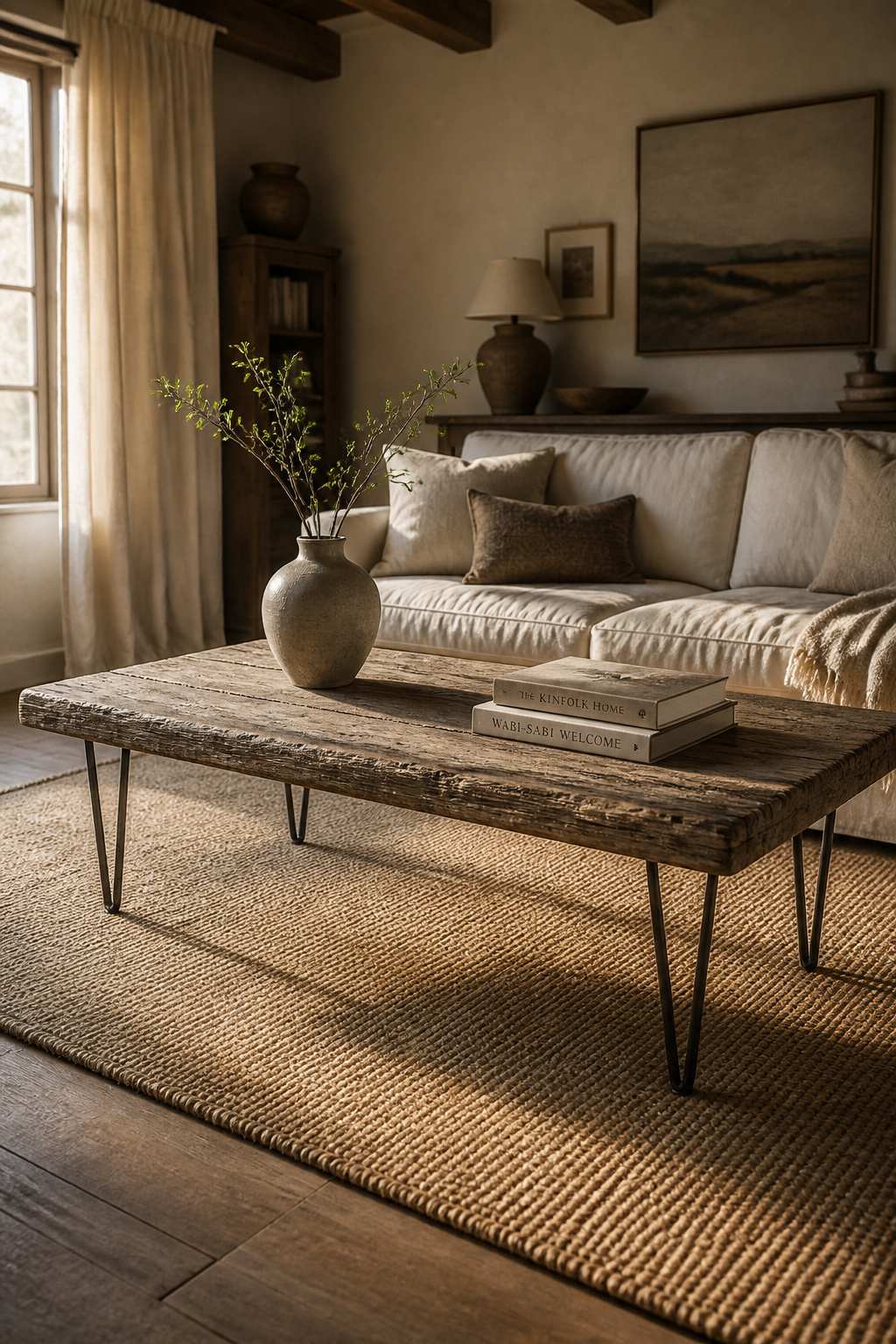
Common sources include barn siding (typically weathered Douglas fir or pine), factory flooring (often dense hard maple or oak, compressed by foot traffic into something closer to stone than softwood), and railway timber (treated hardwoods like jarrah or white oak). All of them have already completed the drying and movement that fresh-cut lumber still needs — which makes reclaimed wood inherently more stable as a flat coffee table top.
The leg choice shifts the mood considerably. Two-rod hairpin legs are lighter and more delicate; three-rod versions are stiffer and better suited to slabs over 50 lbs. Go with 16-inch height for standard sofa configurations. Powder-coated matte black is the dominant finish. If you want to push toward full industrial, steel pipe legs with flanges produce a completely different room personality from the same slab. Thickness should be 1.5 inches minimum for structural stability; 2.5-inch slabs are dramatically more impressive in person.
2. Marble Top, Metal Base — A Coffee Table Design for Modern Homes
Marble has been moving into living rooms, and it is not a trend. It is a material finding its correct application after years confined to kitchens and bathrooms. At coffee table height, a polished stone surface becomes the room’s quietly dramatic focal point — particularly in a space where surrounding furniture is upholstered, soft, and texture-neutral.
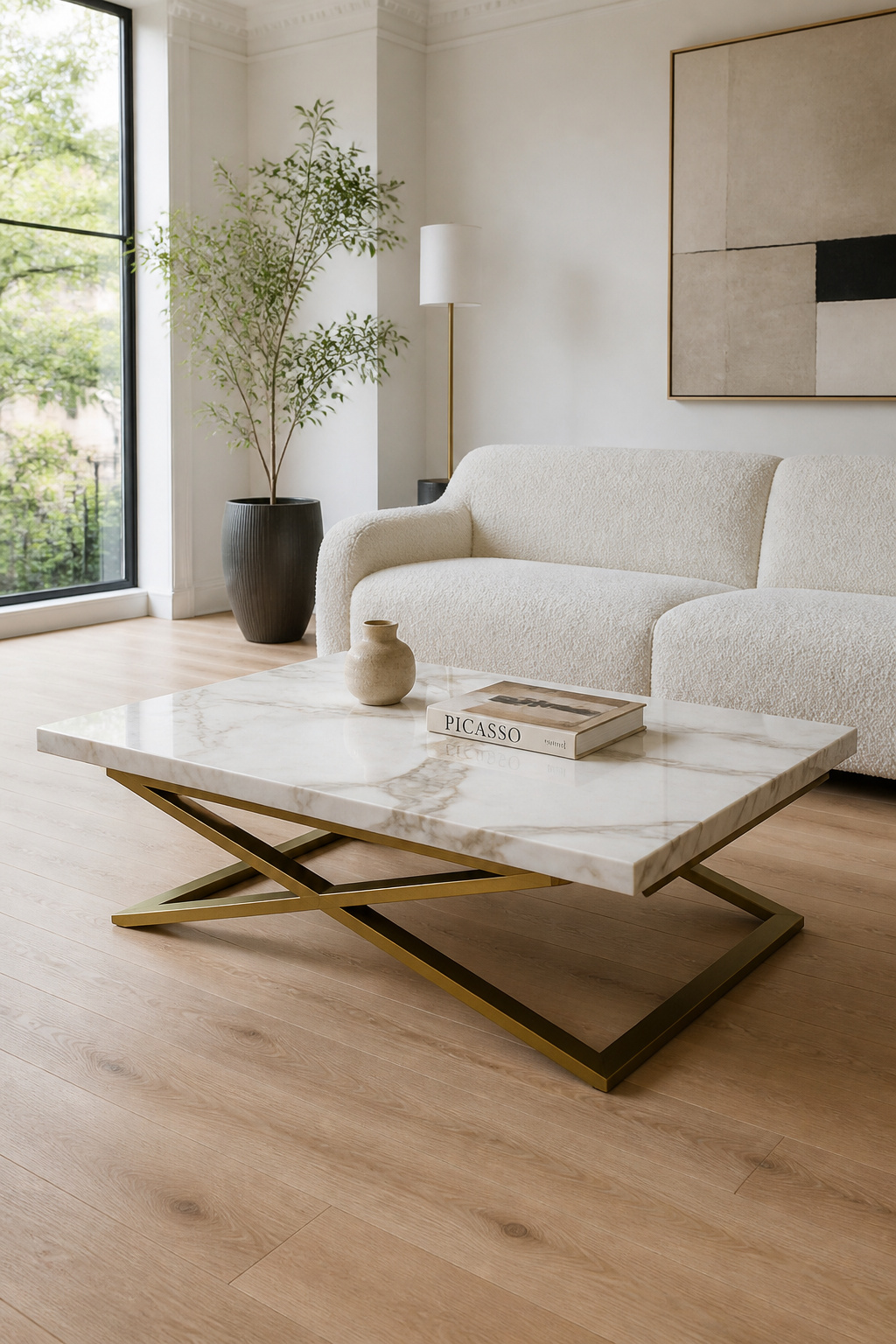
Calacatta marble has a pure white background with bold veining in gold or dark grey — quarried from the Apuan Alps in Carrara, Italy. It photographs dramatically and reads as confident in the room. Carrara marble has a softer blue-grey background with thinner, more linear veining — understated, easier to pair with existing warm-toned furniture. Both Calacatta and Carrara rate 3 on the Mohs hardness scale, meaning they etch from acids. Coffee rings, wine, lemon juice — all permanent without professional polishing. The material demands coasters. That is the honest trade-off before you fall in love with the sample.
Getting the Metal Base Right
Standard thickness for a coffee table top is 2cm (approximately 3/4 inch), adequate for spans up to 48 inches. A colour-enhancing penetrating sealer applied every 6-12 months deepens the veining contrast and protects the stone without changing its appearance. For the base: brushed brass against Calacatta reads as warm contemporary maximalism; matte black steel against white Carrara is the cleaner, more architectural choice. Brushed nickel against Nero Marquina (black marble with white veining, quarried in Spain) creates a sophisticated monochromatic grey-and-silver effect. If this material direction appeals, the elegant living room decor guide covers the broader palette that marble fits into — useful reading before committing.
3. Wicker and Rattan for a Boho Living Room Coffee Table
These two terms are used interchangeably in furniture retail, and they are not the same material. Rattan is a vine-like palm plant, harvested primarily in Southeast Asia, solid at its core. Once steamed, rattan poles bend into furniture frames; the peel is stripped and used for weaving. Wicker is a weaving technique — it can be applied to rattan, seagrass, bamboo, paper rush, or synthetic resin. When a retailer sells you a “wicker coffee table,” they typically mean a rattan-framed piece with wicker-woven panels. The distinction matters because the material you’re buying determines how the table holds up, not just how it looks.
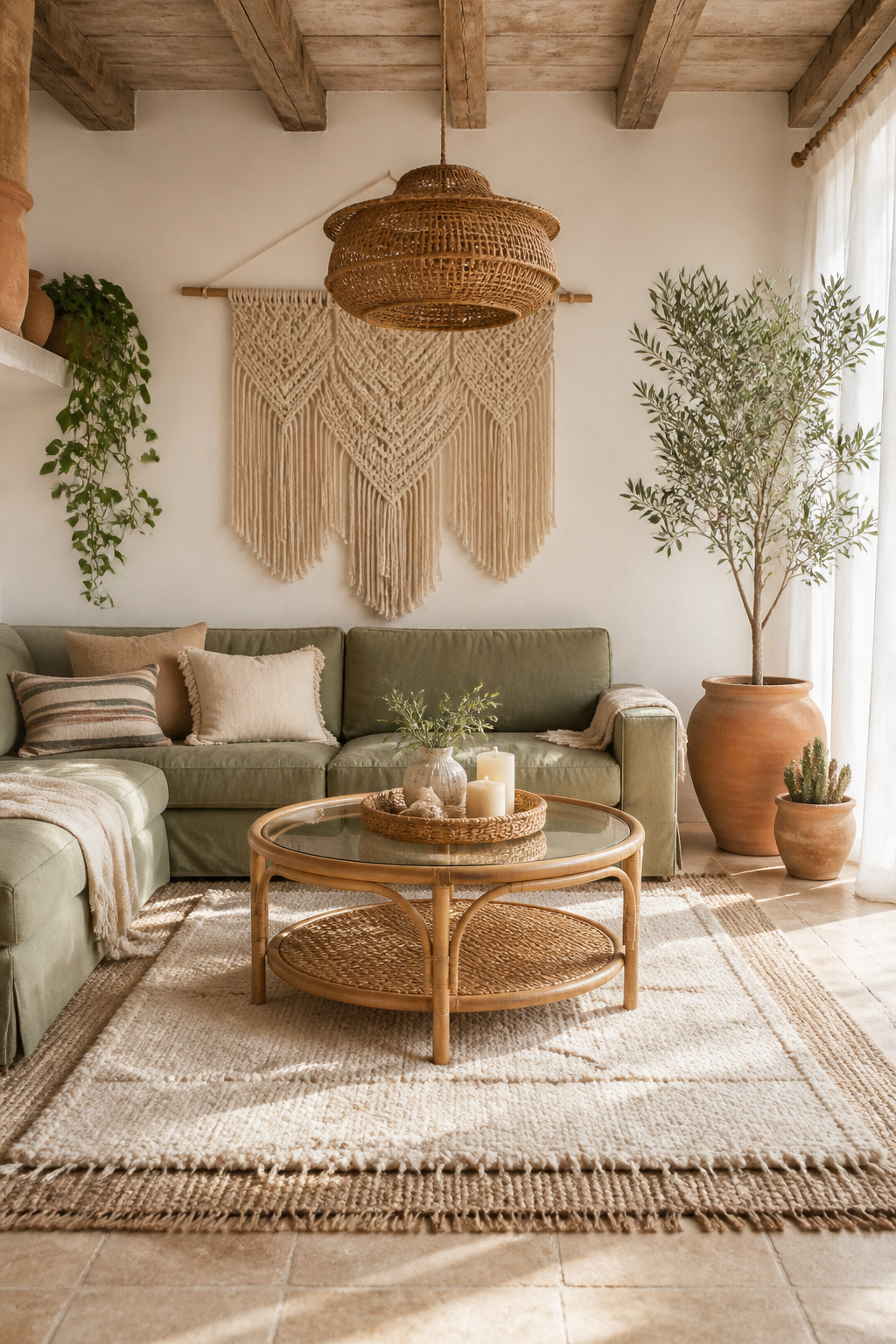
Natural rattan frames have a warm honey-to-tobacco colour range and a matte texture that no synthetic material replicates accurately. For households with high ambient humidity, outdoor-rated PE (polyethylene) wicker used indoors is the more durable option — the joints won’t loosen and creak the way natural rattan does when fibres absorb and release moisture repeatedly.
The Glass Top Upgrade
The most useful design move for rattan coffee table ideas is a glass top. A 6mm tempered glass panel over the rattan frame eliminates the surface fragility of woven material while letting the texture read visually beneath — the tension between hard clear glass and the organic weave is the design point. Use clear glass, not tinted. Allow 2-3 inches of overhang on each side. Round rattan frames with round glass tops read as softer and more boho; rectangular frames read as more structured. For the full picture of how rattan integrates into a curated living space, the boho living room decoration guide covers the layered approach in detail.
4. Lift-Top Coffee Table Ideas That Double as Storage
The lift-top mechanism has matured considerably from its early spring-loaded versions. The current generation uses gas-assisted (pneumatic) hardware that raises the top smoothly with one hand, slides it forward 8-12 inches toward the sofa, and holds at any height without the alarming crash potential of older spring mechanisms. At its highest point — typically 24-25 inches — the raised surface sits at comfortable lap-height for working or eating without hunching.
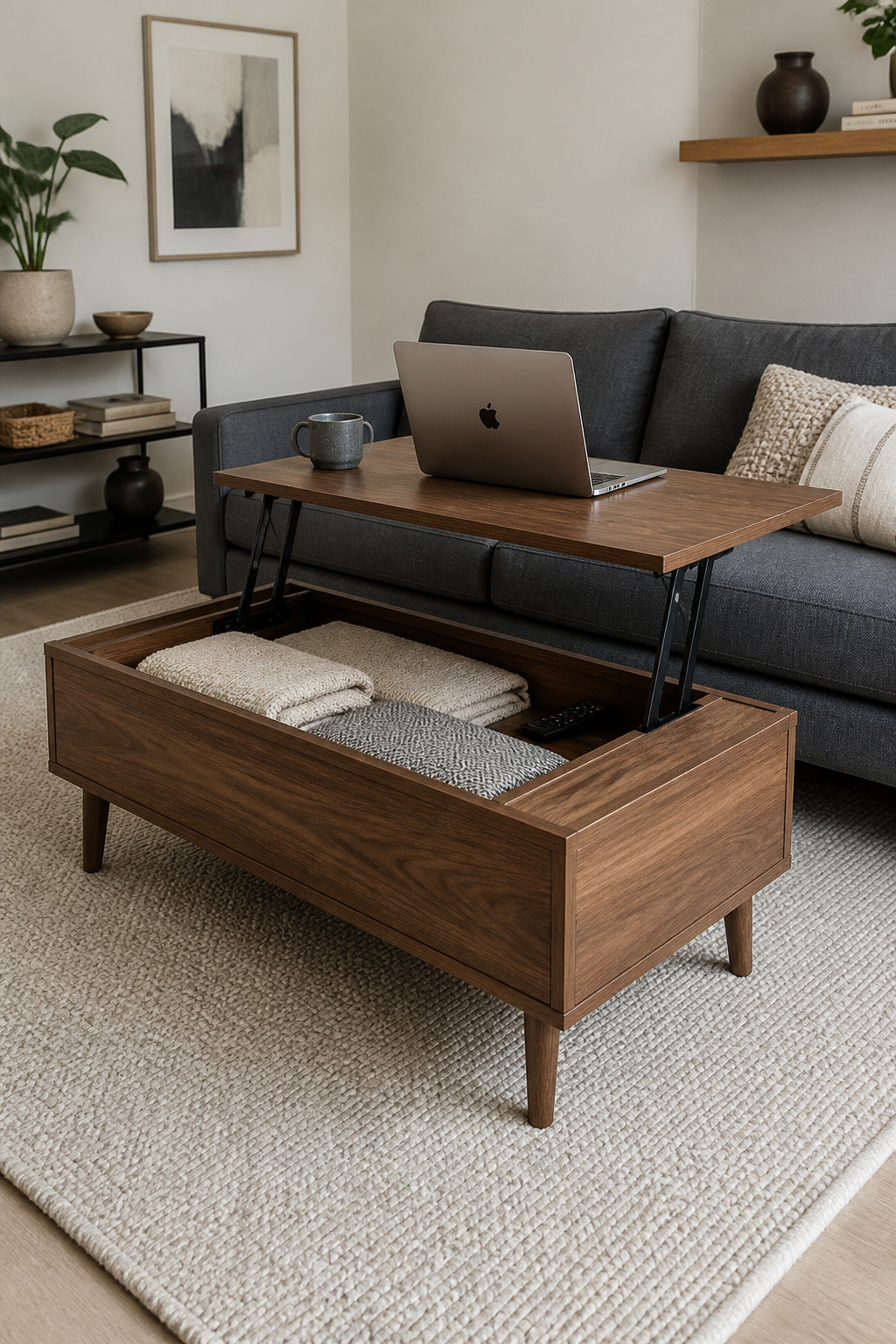
Weight capacity varies significantly and matters: quality mechanisms are rated for 75-166 lbs. For a surface that holds a laptop and a plate of food simultaneously, 75 lbs minimum is the practical threshold. Interior storage compartments typically run 30×18 inches and 4-6 inches deep — adequate for remotes, cables, a few magazines, and a folded throw. Many models include open shelving below the compartment for books or baskets.
The more honest lift-top coffee table ideas are built on solid wood or high-quality veneer — the difference between that and laminate woodgrain film becomes visible after two years of daily use. Benchwright from Pottery Barn demonstrates that this category can reach genuine furniture quality. At the practical mid-range, VASAGLE and Yaheetech offer gas-lift mechanisms in clean finishes that are functional and presentable. One practical note: the top slides forward 8-12 inches when lifted and needs 14-18 inches of clearance between the table’s front edge and the sofa at rest.
5. Nesting Tables: A Coffee Table Idea for Flexible Living
A standard set of three nesting tables gives a living room three separate surface heights — the largest typically at 18 inches, the middle at 21 inches, the smallest at 24 inches — creating a stepped visual rhythm that a single flat table cannot produce. During a dinner party, the two smaller tables pull out to flank the sofa as side surfaces for drinks and plates; after guests leave, they slide back underneath.
Three 16-18 inch diameter round nesting tables together occupy roughly the footprint of one 40-inch rectangular coffee table but offer three times the arrangement flexibility. In an apartment where a single large coffee table would overwhelm the space, one of the smaller tables lives elsewhere and only joins the set for entertaining. The size differential between tables needs to be meaningful — roughly 20-25% reduction per unit; tables that are nearly identical in size look accidental rather than designed.
Material combinations are where nesting coffee table ideas become interesting. Same material across all three (solid walnut, all-travertine) reads as formal and collected. Mixed materials — brass frames on all three with wood tops on two and marble on the largest — create deliberate visual tension. The 2/3 sofa-length proportion rule still applies to the largest table; the smaller tables follow from there.
6. Glass-Top Coffee Table to Open Up a Crowded Room
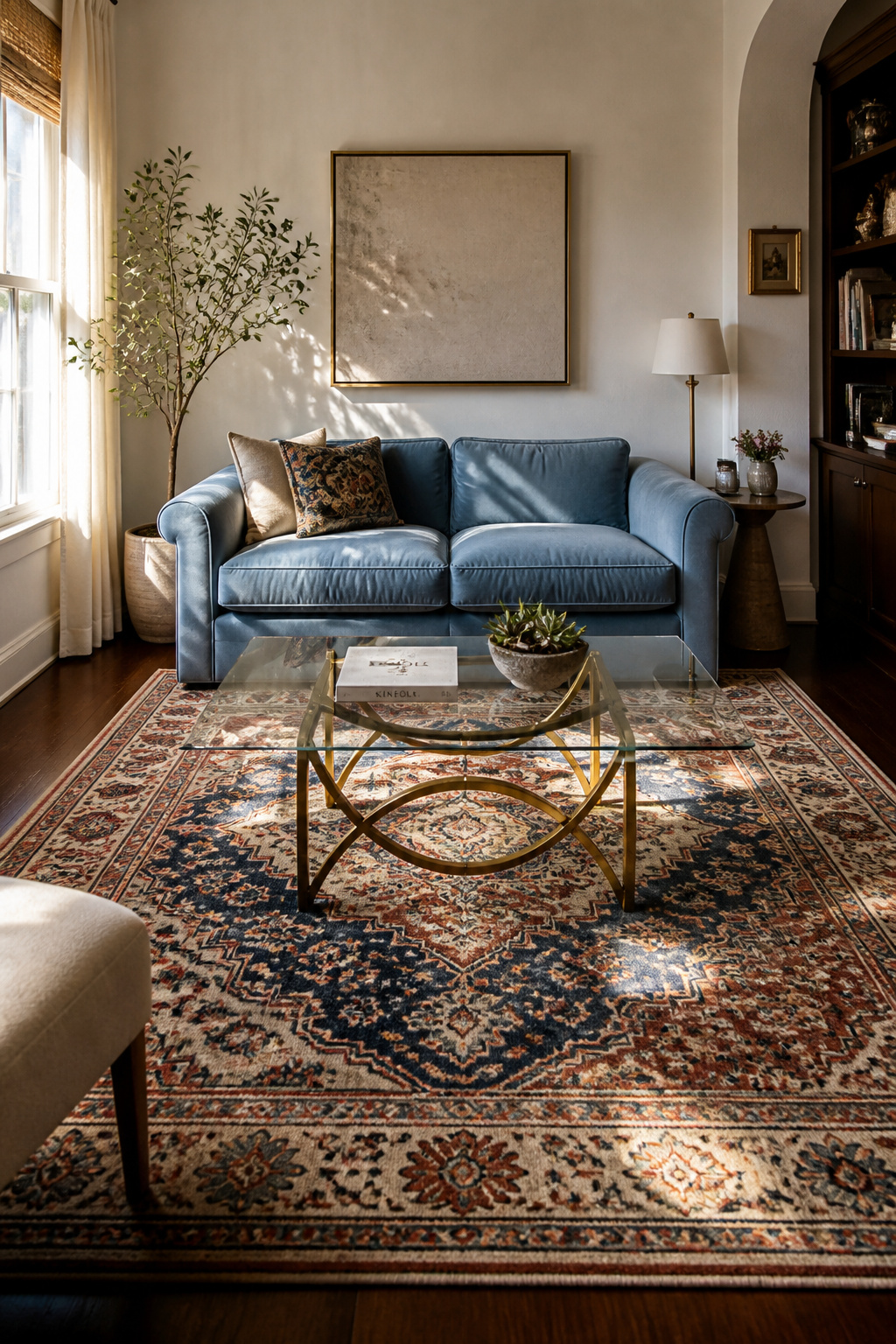
Glass works by optical subtraction. A transparent surface doesn’t register as occupied space in the brain’s peripheral processing — the eye reads the rug below as continuous floor, making the room feel larger than it measures. This effect is strongest when the base is also minimal: hairpin legs, thin metal rods, or a single pedestal. For rooms under 200 square feet, the right glass coffee table ideas can make the difference between a space that feels crammed and one that breathes.
Glass Thickness and Safety
Tempered glass is the only safe choice for furniture. When it breaks, it shatters into small pebbles rather than blade-like shards; annealed glass is a genuine hazard at the centre of a room. For tops up to 48 inches long, 3/8-inch (10mm) tempered glass is adequate; over 48 inches, 1/2-inch (12mm) adds meaningful stiffness and safety margin. Low-iron glass — sometimes called starphire — has no green tint and reads as truly water-clear; worth the premium if optical purity matters. Edge profiles change the personality: polished pencil edge is cleanest; bevelled reads traditional; flat polished with seamed corners reads industrial.
With a glass top, the base becomes the primary visual statement — the eye goes straight through to whatever structure is underneath. Combining glass with a live-edge wood base creates something hybrid: the warmth of natural material plus the lightness of transparency. If you’re working with a smaller room where every piece needs to earn its footprint, the apartment decor living room ideas for small spaces guide covers the full spatial strategy.
7. Concrete: A Raw Coffee Table Design With Urban Character
Concrete communicates permanence. Its thermal mass — cool to the touch, slow to change temperature — registers in a way that wood and metal don’t. And its surface range is extraordinary: steel-trowelled concrete is silky and nearly stone-like; sponge-floated concrete is rough and matte; acid-etched concrete reveals the aggregate beneath the paste layer as a field of pebbles and sand grains. No two pours are identical, which gives each piece inherent uniqueness without trying.
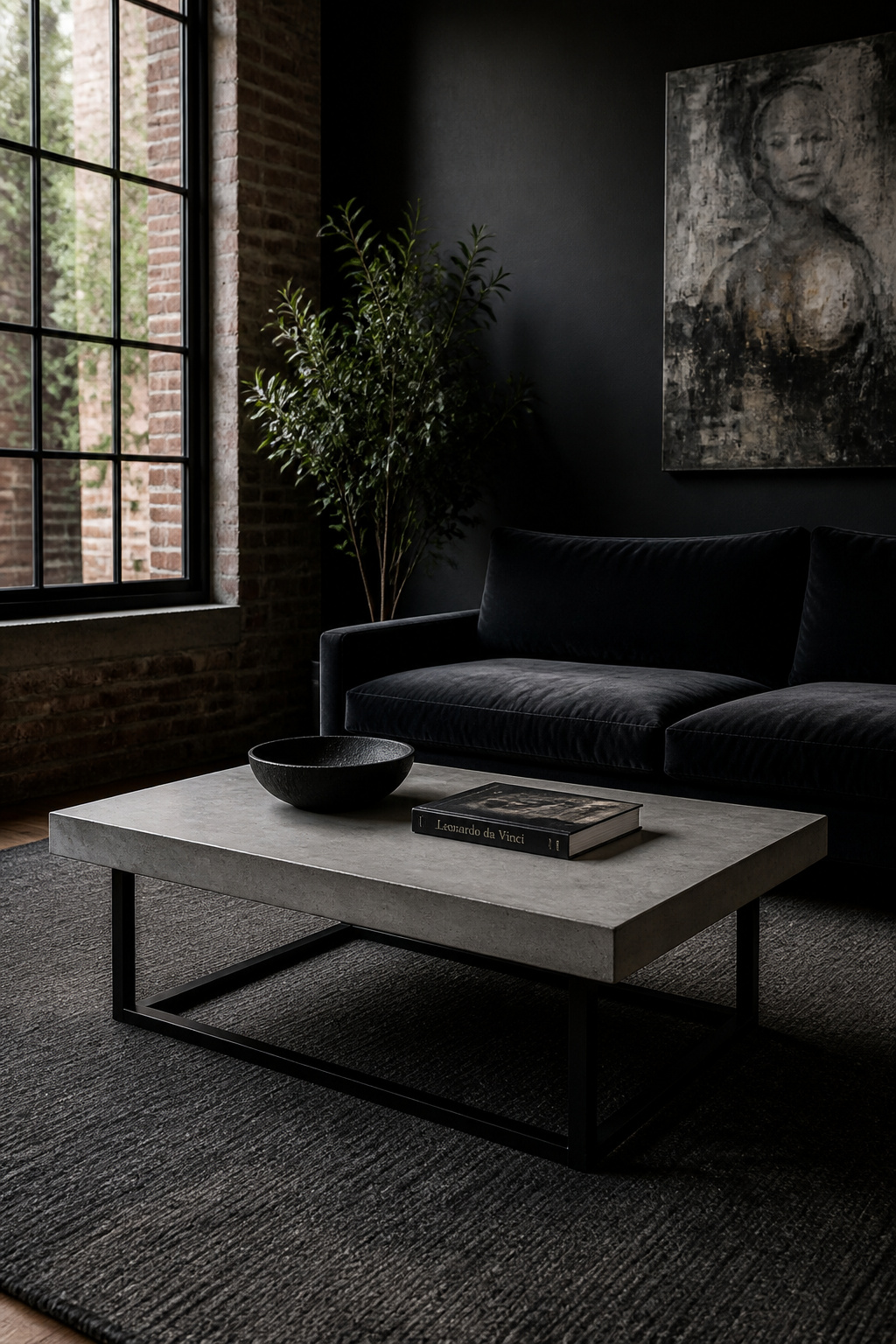
The weight problem is real and solvable. Standard concrete weighs 12-15 lbs per square foot at 1.5-inch thickness — a 40×22 inch top runs 55-65 lbs. GFRC (Glass Fiber Reinforced Concrete) reduces weight by up to 75% by replacing solid mass with glass fibre reinforcement and a thin-shell pour; a GFRC top of the same dimensions might weigh 20-30 lbs. The DIY approach uses melamine-lined forms with a rigid foam block cast into the centre to displace concrete volume and reduce weight without affecting the visible profile.
Sealing is non-optional — raw unsealed concrete absorbs a red wine ring within 30 seconds. A penetrating water-based sealer enters the pore structure and repels liquids without creating a surface film or changing the matte appearance. Topical sealers (polyurethane, epoxy) create superior stain resistance but add a gloss that contradicts concrete’s raw appeal. Even well-sealed concrete will etch from prolonged acid exposure; coasters remain advisable.
8. Vintage Trunk as a Rustic Coffee Table Alternative
A steamer trunk as a coffee table is a practical choice before it is a nostalgic one. The right trunk brings surface area, hidden storage, and material history that no manufactured piece provides at the same price. The requirement for success is specific: the trunk must sit at 16-20 inches tall — most steamer trunks fall naturally in this range — sit flat on all four corners without rocking, and have a lid that opens without swelling or resistance.
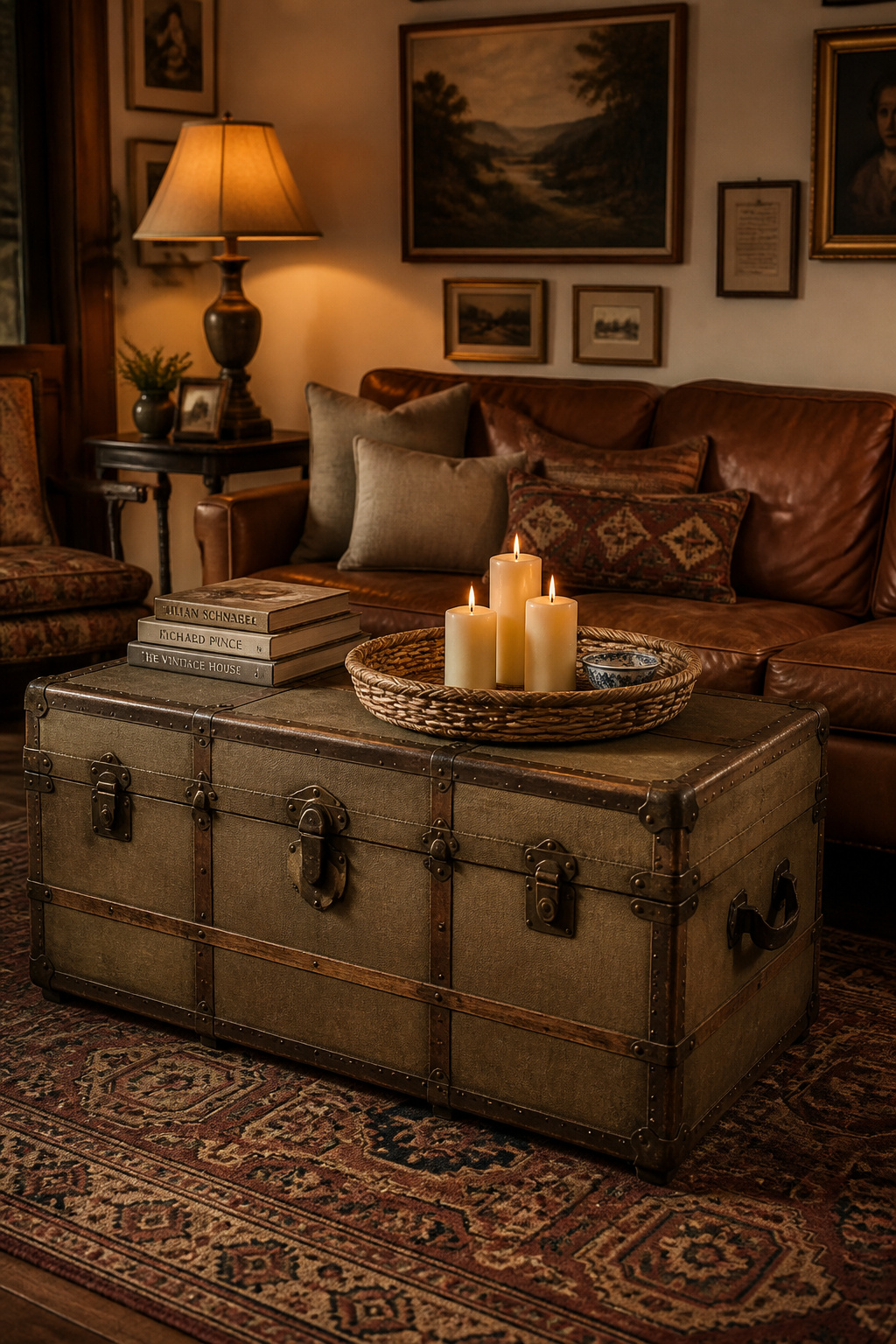
Surface area is the honest limitation. A standard steamer trunk runs 30-36 inches long and 14-18 inches wide — smaller than most purpose-built coffee tables. For a full-sized sofa, look for wardrobe trunks in the 40-48 inch range. These appear at estate sales regularly and are frequently underpriced because their size makes them harder to store. Estate sales consistently yield the best prices: $50-200 for a functional steamer trunk in fair condition. Avoid: visible black staining inside (nearly impossible to eliminate), a strong mildew smell, and bright paint that flakes. Prioritise: original brass tacks or steel banding, solid wood shell rather than chipboard, and hardware that actually operates.
A tray on the top surface converts the trunk functionally and makes it read as furniture rather than stored baggage. For similar coffee table styling ideas across different material types, the 16 Coffee Table Styling Ideas to Elevate Your Space guide covers tray arrangements and surface compositions that apply regardless of the table type. Keep any stacked objects low — 4-6 inches maximum — so the trunk’s own profile remains the primary visual statement.
9. Live-Edge Wood as a Natural Statement Coffee Table
Live-edge wood preserves what milling conventionally removes: the original boundary of the tree. The irregular, organic outer edge — with its natural curves, undulations, bark inclusions, and knot formations — transforms a flat timber surface into a piece of natural sculpture. No two slabs share the same profile. This is the fact that makes the best live-edge coffee table ideas genuinely irreplaceable.
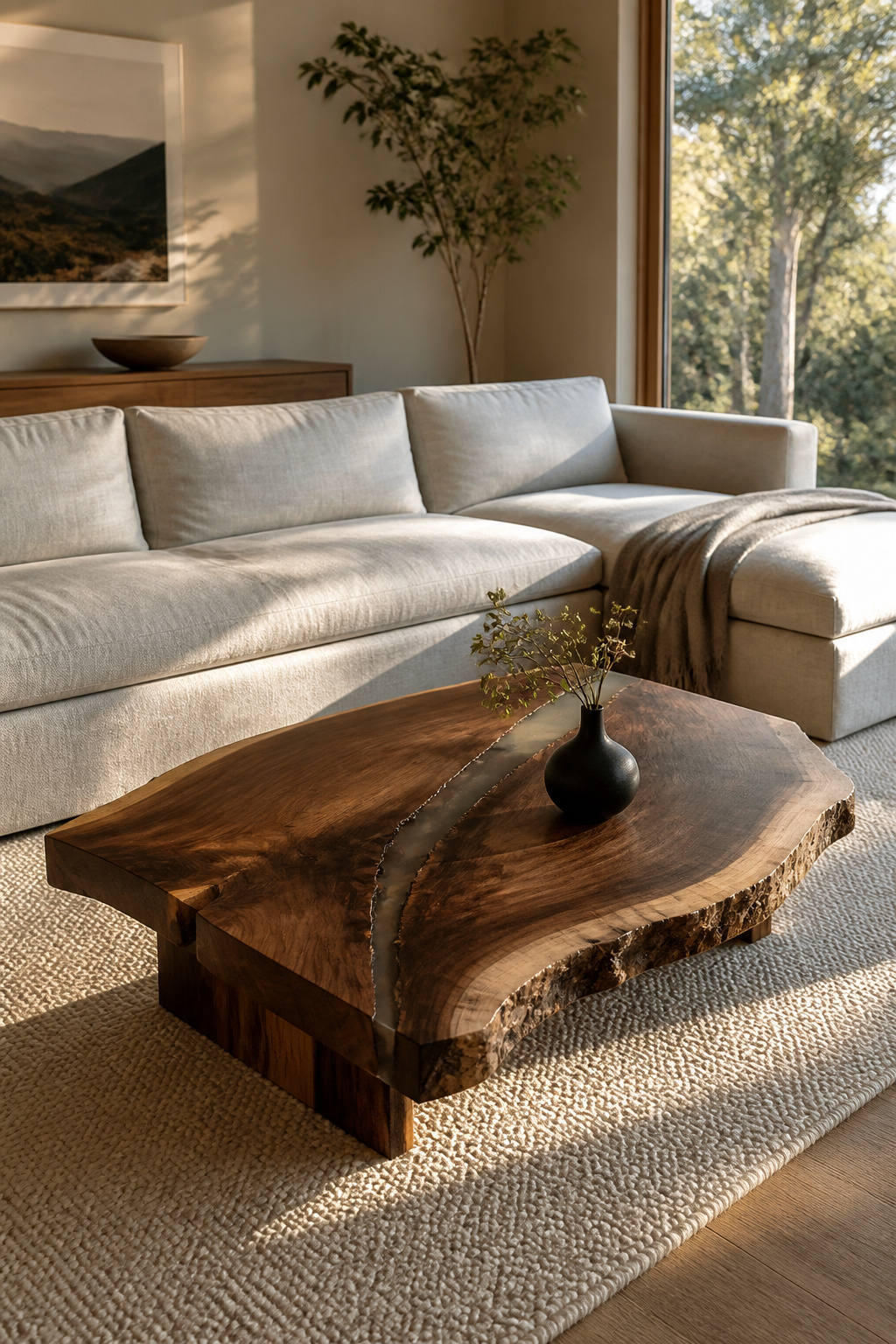
Black walnut is the material gold standard — chocolate-brown heartwood with cream sapwood, tight grain, exceptional dimensional stability. A coffee table slab in the 48×24-inch range at 2-inch thickness costs $400-900 from a quality slab dealer. English elm has dramatic, swirling figure caused by its spiral growth habit — more visually complex than walnut, more individual. Hard maple live-edge offers a pale, clean palette (creamy white to light amber) that suits modern and Scandinavian interiors. Cherry darkens significantly with UV exposure during its first year — light honey when finished, deepening to reddish-brown within 12-18 months. Plan the surrounding furniture colours with that darkened version in mind, not the showroom version.
Finish Choices That Define the Character
Epoxy void fill — poured into natural cracks and voids, cured and flattened — creates glass-like surface continuity. Tinted epoxy (teal, black, bronze) is popular; clear epoxy is cleaner and lets the wood dominate. Open-pore oil finishes (Rubio Monocoat, Osmo Polyx) leave the surface tactile and matte — no void fill, natural cracks open — more raw, more organic, more maintenance. Always confirm the slab has been kiln-dried to 6-8% moisture content before purchase; green-cut slabs warp in a heated indoor environment. For the design principles that support this direction, rustic living room decor ideas covers the material framework in depth.
10. Painted Wood Coffee Table Ideas for Bold Color Lovers
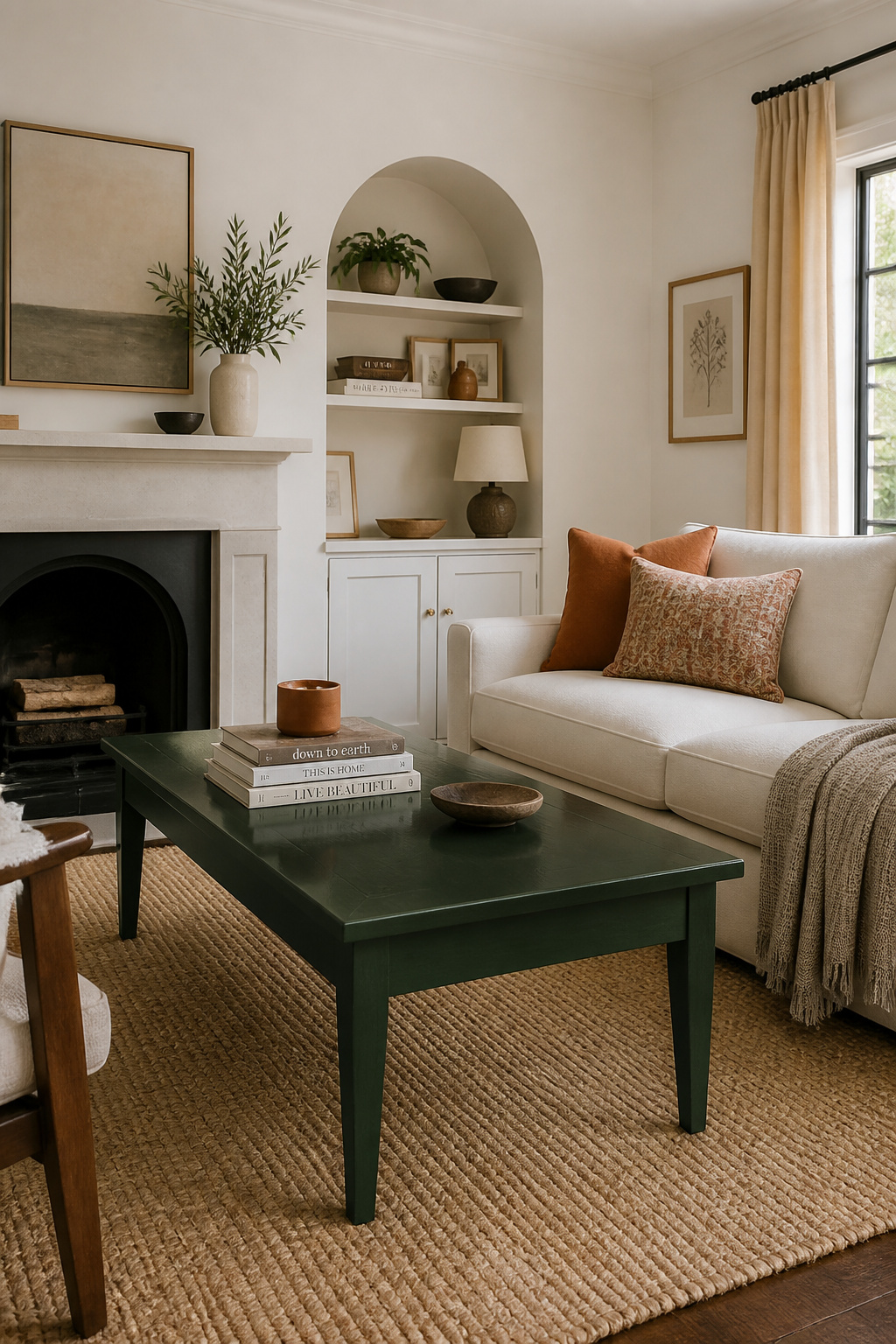
The case for colour in the living room has become considerably stronger. Deep forest greens, navy blues, terracottas, and saturated blacks are appearing on furniture across design publications — not as trend moments but as a deliberate move away from the all-neutral palette that dominated for over a decade. A painted coffee table in an unexpected colour — deep sage, dusty terracotta, slate blue — can function as the room’s accent piece without the cost of a statement sofa or rug. This is also a historically literate choice: Gustavian furniture from 18th-century Sweden was almost universally painted; English Georgian furniture used painted finishes on secondary pieces. Painted wood coffee table ideas are not a trend. They are a return.
Paint Selection for a Table That Will Last
Chalk paint (Annie Sloan, Rust-Oleum Chalked) adheres without primer and creates a beautiful matte surface — but it is soft, and a coffee table that sees actual daily use will mark and scuff within weeks unless topcoated with polyurethane or wax. Oil-based enamel is the most durable choice: it self-levels to a hard, smooth film, resists chips, and takes 24-48 hours between coats, which is worth the wait. Latex furniture paint (Benjamin Moore Advance) is the practical mid-ground — easier cleanup, faster drying, durable enough with a satin-sheen polyurethane topcoat. On raw or previously stained wood, two coats of shellac-based primer (Zinsser BIN) prevent bleed-through and improve adhesion dramatically.
Two-tone painted coffee table ideas give the colour moment without total commitment: paint only the legs and apron in the bold colour and leave the top as natural wood. The most versatile furniture colour of this moment is deep sage green — it works across warm and cool palettes and reads as sophisticated without being safe. If the painted table fits a room that layers several design influences, the eclectic living room ideas guide shows how individual statement pieces hold together across a mixed scheme.
11. Acrylic Coffee Table Design for a Minimalist Living Room
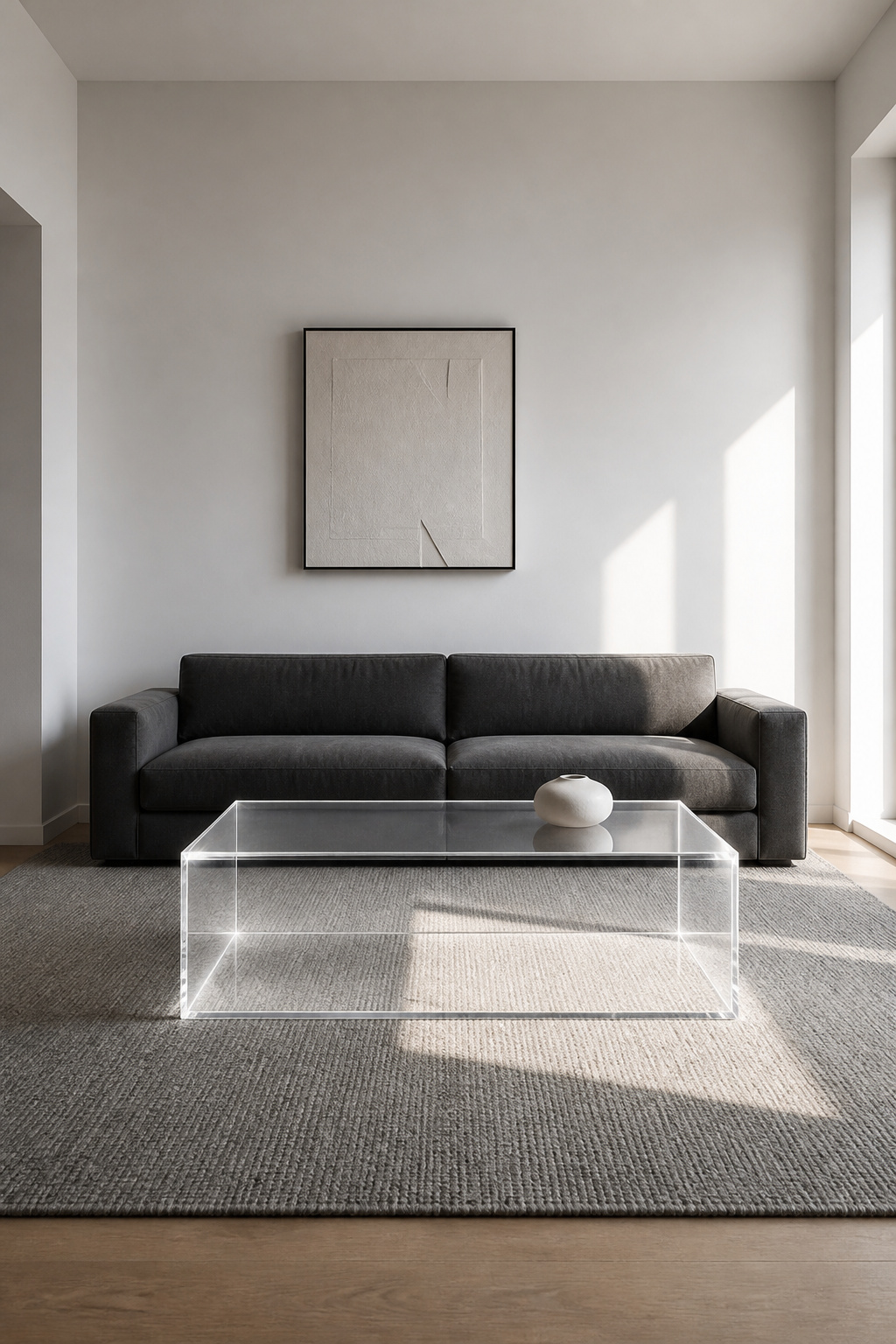
Lucite is a brand name — DuPont’s original trade name for a high-quality cell-cast acrylic, first developed in the 1920s and now used generically for premium clear acrylic furniture. The distinction between cell-cast and extruded acrylic matters: cell-cast production introduces no manufacturing stress into the material, yielding superior optical clarity (92% light transmission), higher surface hardness, and better resistance to crazing — the surface micro-cracking that afflicts cheaper acrylic over time. When you see an acrylic coffee table that genuinely looks like a solid block of water, it is cell-cast. When you see one with a slightly waxy, yellowish cast, it is extruded.
What to Look For in Acrylic Quality
For a coffee table, minimum thickness is 15-20mm for flat top panels (about 5/8 to 3/4 inch). Structural legs or columns need 25mm+. Never use glass cleaner containing ammonia on acrylic — ammonia causes crazing in the surface. Mild soap and water only. The table reads best surrounded by soft, matte materials — textured rugs, linen upholstery, woven throws — where the contrast between transparent geometric precision and organic softness creates visual tension. Position it to catch directional light without placing it in direct sun, which yellows the material over years without UV inhibition. For the full minimalist living room context, the minimalistic living room guide outlines the material palette this piece works hardest within.
12. Upholstered Ottoman Coffee Table for Family-First Spaces
The upholstered ottoman as a coffee table is the most honest design choice on this list. It doesn’t pretend the room is for looking at rather than living in. Soft edges mean no corner collisions for children. A surface that gives underfoot means no bruised shins. And feet go on it — comfortably, unapologetically — which no marble or glass table accommodates without performance anxiety.
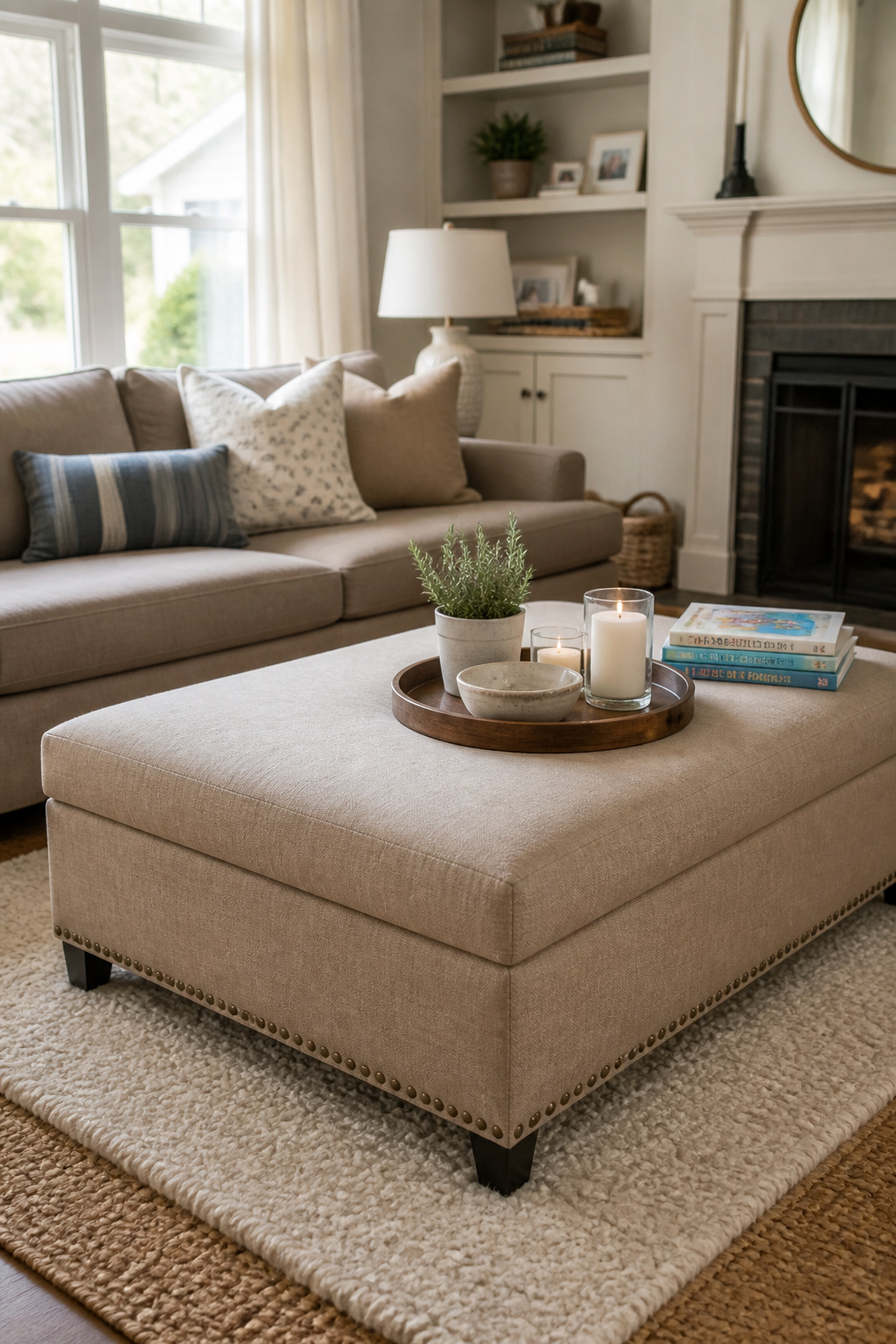
Fabric selection determines whether this is a 3-year or a 10-year purchase. Crypton fabric treats individual fibres at a molecular level, not the surface — spills bead off and the material can be cleaned with water and mild soap without damage. Sunbrella (originally a marine and outdoor fabric) offers exceptional fade and stain resistance with a slightly stiffer texture. High-density microfiber above 200 gsm is the budget performance option — reasonable stain resistance, available everywhere, but less durable than either of the above over multi-year use. Velvet is not recommended for a surface this actively used — directional nap records every footprint as a permanent texture change.
Tray Styling for Function
A tray on top converts the ottoman. The tray should be 60-70% of the ottoman’s top surface area — large enough to be useful, small enough to leave the upholstery visible. For a 48×32 inch ottoman, a 24×16 inch tray is the right proportion. A lip or rim is non-optional; glasses tip easily on a soft surface. Rattan tray with velvet ottoman creates texture contrast; lacquered wood tray with performance weave adds formality; hammered metal tray with linen upholstery creates material contrast. For the base foam, 1.8+ density high-resiliency foam provides a firm enough platform that the tray doesn’t sink and tip.
13. Hammered Copper for a Warm Metallic Coffee Table Style
Hammered copper is a material that changes over time, and that is precisely the point. The faceted surface — each hammer blow creating a slightly different angle — catches and redirects light from multiple directions simultaneously, producing a warm, animated surface that shifts throughout the day as light sources move. No other metal does this in quite the same way.
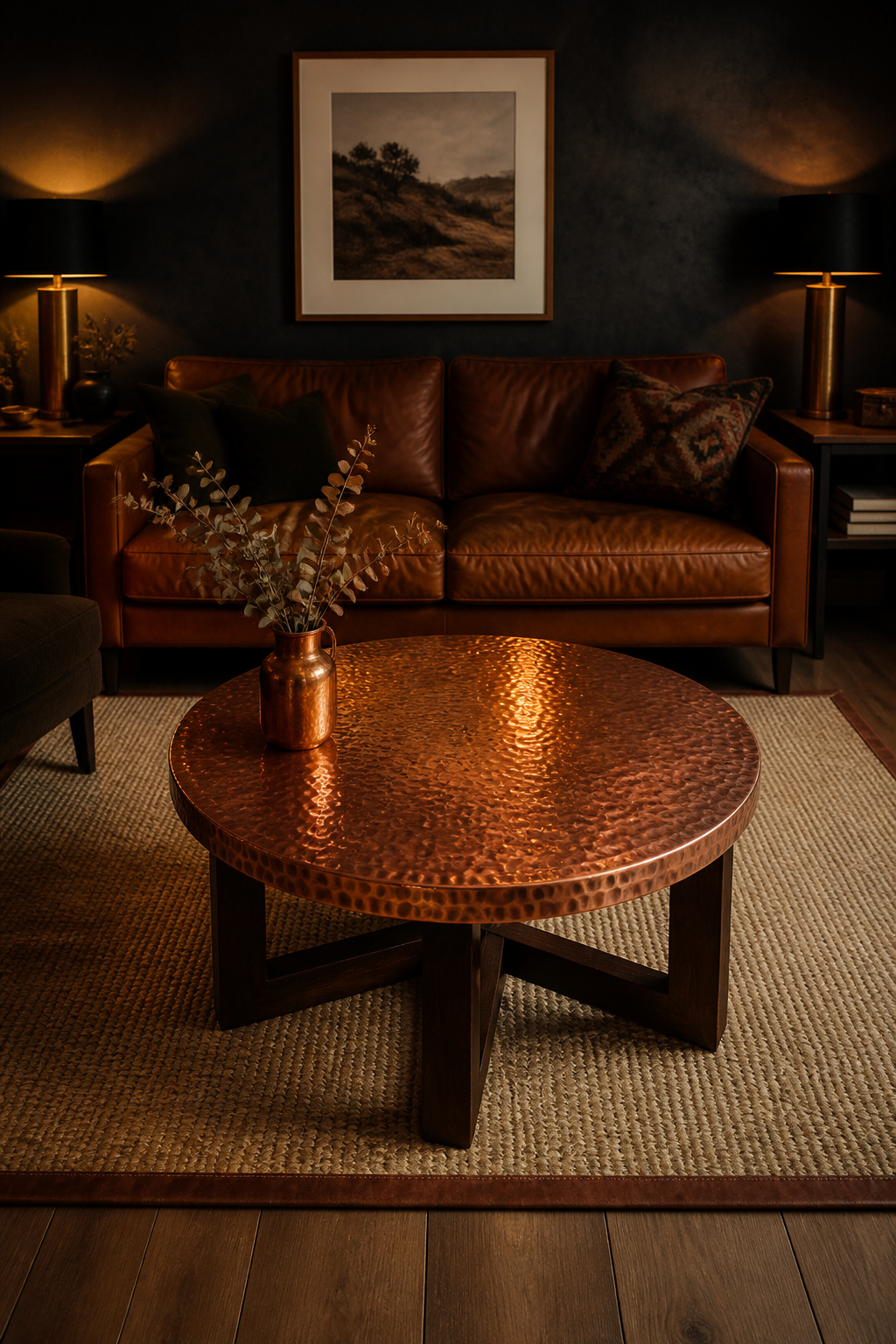
Standard hand-hammered copper furniture uses 16-18 gauge copper sheet formed over a hardwood substrate. Sixteen gauge is heavier, more dent-resistant, and worth the premium on a piece that sees daily use. Lacquered copper is sealed to preserve the original bright colour — requiring no maintenance beyond gentle cleaning but never developing the rich depth of an unlacquered surface. Unlacquered copper oxidises over months from bright amber to warm brown to dark chocolate, with the exact pattern determined by use and air exposure.
Caring for the Patina
Patina can be controlled. A diluted liver of sulphur solution accelerates darkening in hours rather than months — the result looks deliberately aged rather than naturally evolved. A coat of Renaissance Wax or carnauba after reaching a desired patina level slows further oxidation; reapply annually. For pairings: hammered copper’s warm amber read suits dark hardwood floors, leather upholstery, terracotta tile, and jute rugs naturally. Avoid placing it alongside polished gold hardware nearby — the two warm metals compete rather than complement. Aged brass, bronze, or matte black work better in proximity.
14. Terrazzo: A Modern Coffee Table Design as Art
Terrazzo was developed in 15th-century Venice as a method of using marble offcuts from construction — workers embedded chips of marble waste into a cement slurry, ground and polished the surface to a seamless finish, and produced a material that was both beautiful and economical. What is new is the colour range, the matrix options, and the application to furniture at a scale that makes each piece a designed object rather than a repurposed industrial material.
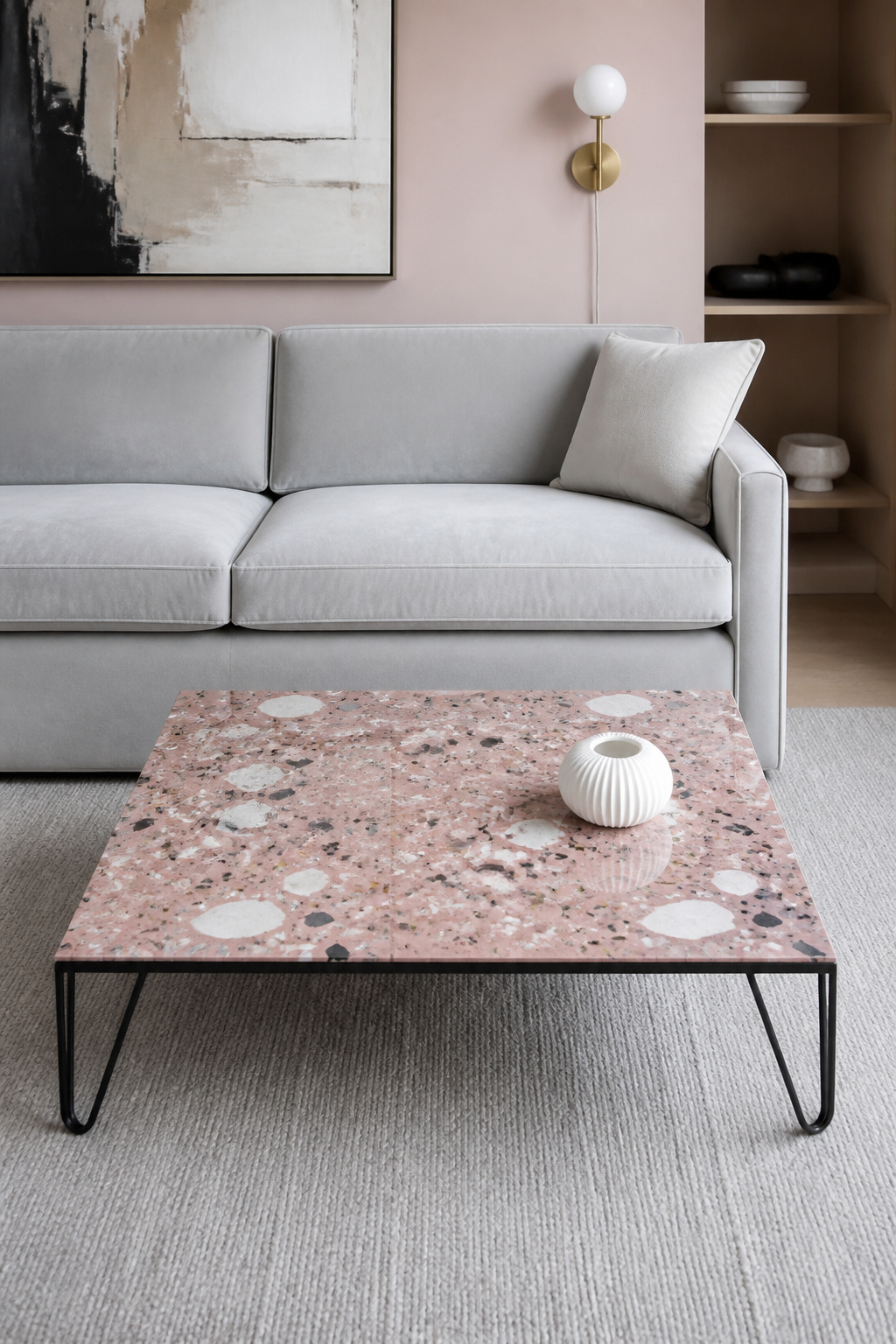
The matrix (the binding material surrounding the aggregate chips) determines the table’s overall colour read from a distance. Epoxy terrazzo — the dominant choice for furniture — offers a matrix pigmented to virtually any shade; it runs 1/4 to 3/8 inch thick, is non-porous, and bonds strongly to substrates. Cement-based terrazzo requires a penetrating sealer — pH-neutral only, as acid cleaners etch the marble aggregate chips. A 24×48 inch epoxy terrazzo coffee table top at 3/8 inch thickness weighs approximately 25-35 lbs — significantly lighter than marble at the same dimensions.
Chip Composition and What It Changes
Small chips (under 1/4 inch) create a fine, speckled texture — subtle from a distance, best for rooms where the table is not the hero piece. Large chips (1/2 to 1 inch) create a bold, graphic effect where individual coloured shapes are visible across the room. Mixed chip sizes are most common in contemporary furniture terrazzo — a fine matrix speckle with one or two statement aggregate types. The chip-and-matrix combination should match the room’s surrounding pattern load: a heavily patterned room benefits from a quiet single-aggregate terrazzo; a neutral room can carry the bold mixed-chip version.
15. Stone Pedestal as a Sculptural Living Room Coffee Table
A monolithic stone pedestal coffee table doesn’t blend in. It defines the room around itself. The design argument is not versatility but permanence: a well-chosen piece in travertine or onyx looks exactly right in 30 years. Trends move around it and through it, and the stone remains — dense, cool, unhurried.
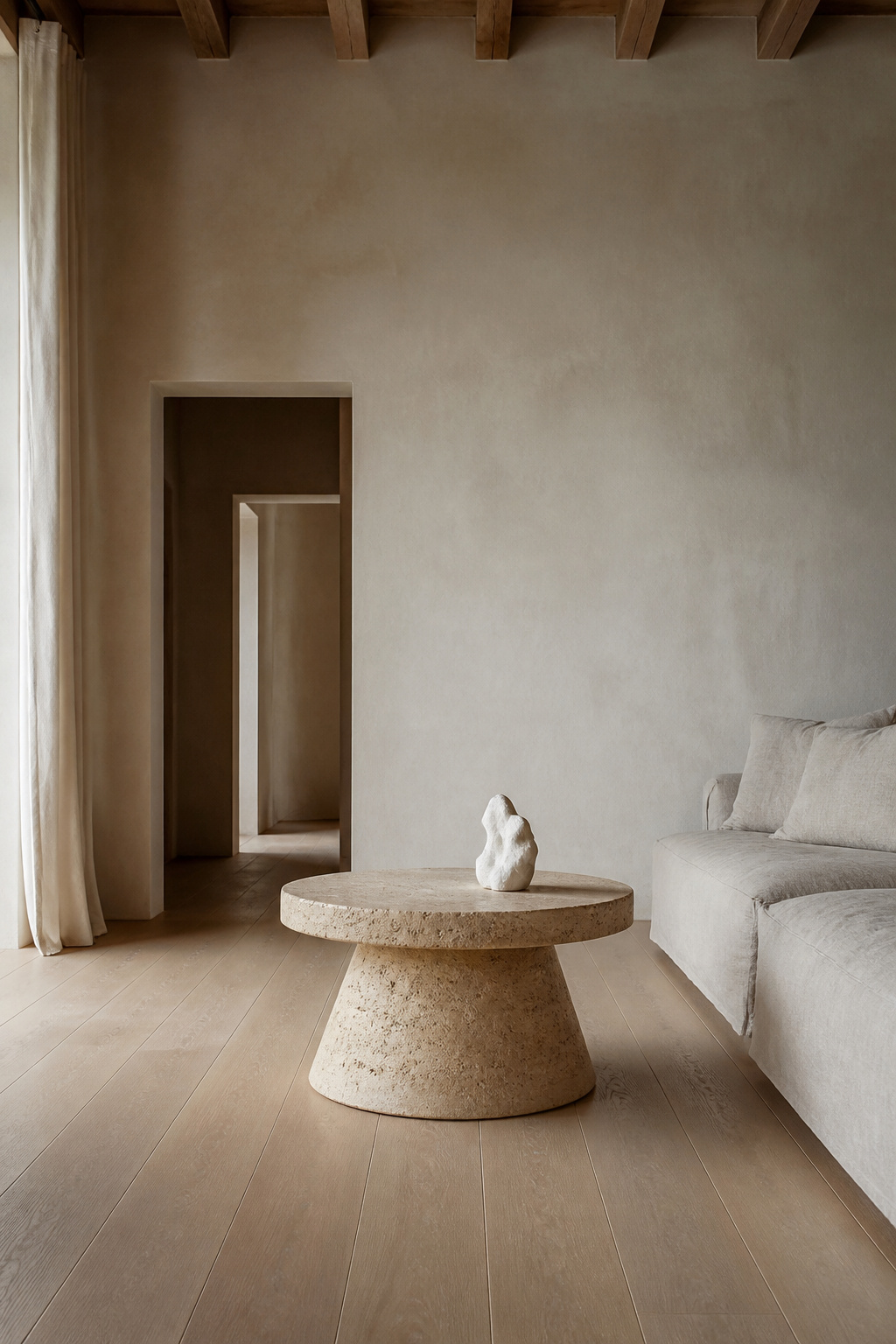
Travertine is the most approachable stone for indoor furniture: warm beige-to-walnut tones, natural pitting and hole structure, and a Mohs hardness of 4-5 — slightly harder than marble and less prone to etching. The unfilled travertine look, with natural voids visible in the surface, reads as natural and deliberately imperfect in a way polished marble does not; it is very current. Onyx is the drama option — translucent when backlit, with bold banding in green, orange, honey, or black. Some onyx coffee tables feature internal LED illumination to exploit the translucency, turning the piece into a light source. Limestone is the quietest choice: pale grey to cream, fine-grained, matte natural surface, suited to minimalist rooms that need mass without spectacle.
Weight and Floor Load Considerations
A solid travertine pedestal in a 30-inch diameter, 18-inch tall form weighs 150-300 lbs depending on slab thickness. Residential floor joists are designed for approximately 40 lbs per square foot live load — a 300 lb table concentrated on a narrow pedestal creates a point load that exceeds safe limits for many residential floors, especially upper levels. Solutions include positioning the table directly above a joist, using a wider base plate to distribute the load, or consulting a structural engineer for pieces over 200 lbs. Understanding living room furniture layout rules before purchase is especially important here — floor placement decisions matter more than usual when the piece cannot easily be moved.
How to Choose the Coffee Table Ideas That Work for Your Home
The material is the starting point, not the finish line. Before any of these 15 coffee table ideas become useful, the lifestyle questions come first — and they are worth answering honestly.
If the household includes children under 8 or dogs over 40 lbs, remove glass, marble, and acrylic from the list immediately. Not because those materials are unattractive, but because they don’t match the use. An ottoman or a sealed reclaimed wood table are genuinely better choices for an actively-used family room — not compromises, but correct answers. If the space is primarily for adult entertaining and considered living, the full range opens up, and the question shifts to which material best expresses what the room is trying to say.
Proportions come next. The coffee table should be approximately two-thirds the length of the sofa — for an 84-inch sofa, 54-56 inches is the target. Height should sit 1-2 inches below the sofa’s seat cushion; most sofas sit 17-19 inches at the cushion, so most coffee tables should be 16-18 inches tall. Leave 14-18 inches between the table edge and the sofa front, and at least 24 inches between the table and any adjacent furniture.
Where you buy matters as much as what you buy. Artisan and studio makers — local woodworkers, bespoke stone workshops — offer the highest design flexibility and custom dimensions at a 30-80% price premium over mass market. For a piece that occupies the centre of the room for decades, that premium is often worth it. Mid-market retailers (CB2, West Elm, Pottery Barn) offer reliable quality in well-executed standard dimensions. And secondhand sources — estate sales, Chairish, Facebook Marketplace — remain the best places to find vintage pieces at prices that reflect their original value. Whichever of these coffee table ideas you choose, match the material to the life you actually live in the room. That is the design principle that makes any of them right.