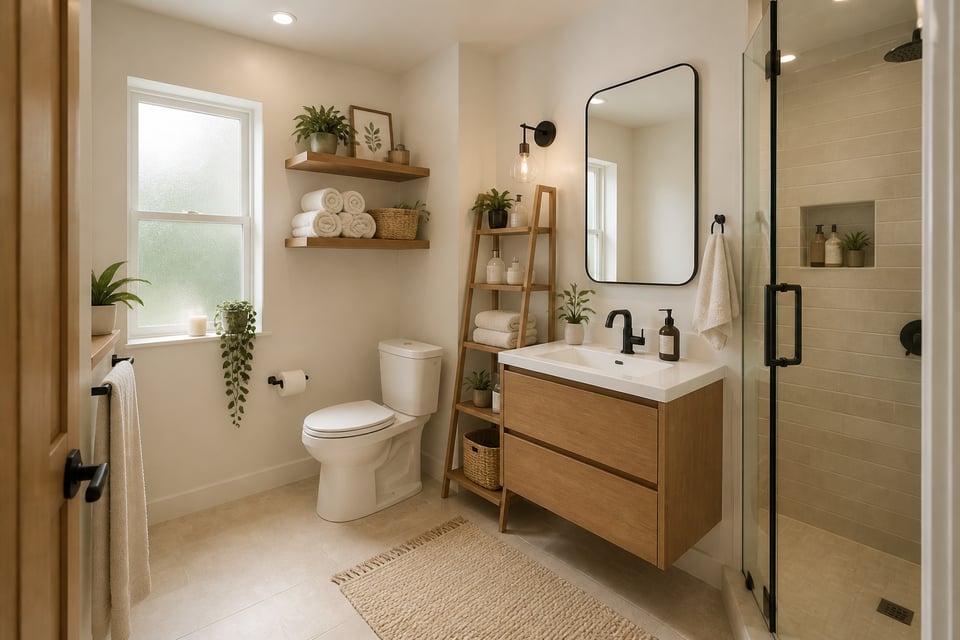
The drawer that won’t close. The counter that’s buried in products again. Every small bathroom storage problem comes down to the same root cause: the room was never given a system.
Eleven years of creating storage for constrained spaces has taught me something clearly. The problem is almost never a lack of creativity — it’s a lack of usable walls. Small bathroom storage isn’t solved by buying more organizers. It’s solved by restructuring how the existing geometry gets used. Vertical zones get claimed. Dead corners become purposeful. The back of the door finally earns its keep.
These 15 ideas cover the full range. Some work this afternoon. Others belong in a future renovation plan. Almost all apply whether you rent or own, and most work in a 35-square-foot bathroom as well as one three times that size — because tight is tight, and every inch rewards the right system.
1. Over-the-Toilet Bathroom Storage: Floating Shelves That Do the Heavy Lifting
The column of wall above your toilet is the most consistently wasted real estate in a small bathroom. It runs roughly 24 inches wide and the full height of the room. Nothing lives there in most bathrooms, and yet it sits perfectly positioned for one of the easiest vertical storage upgrades available.
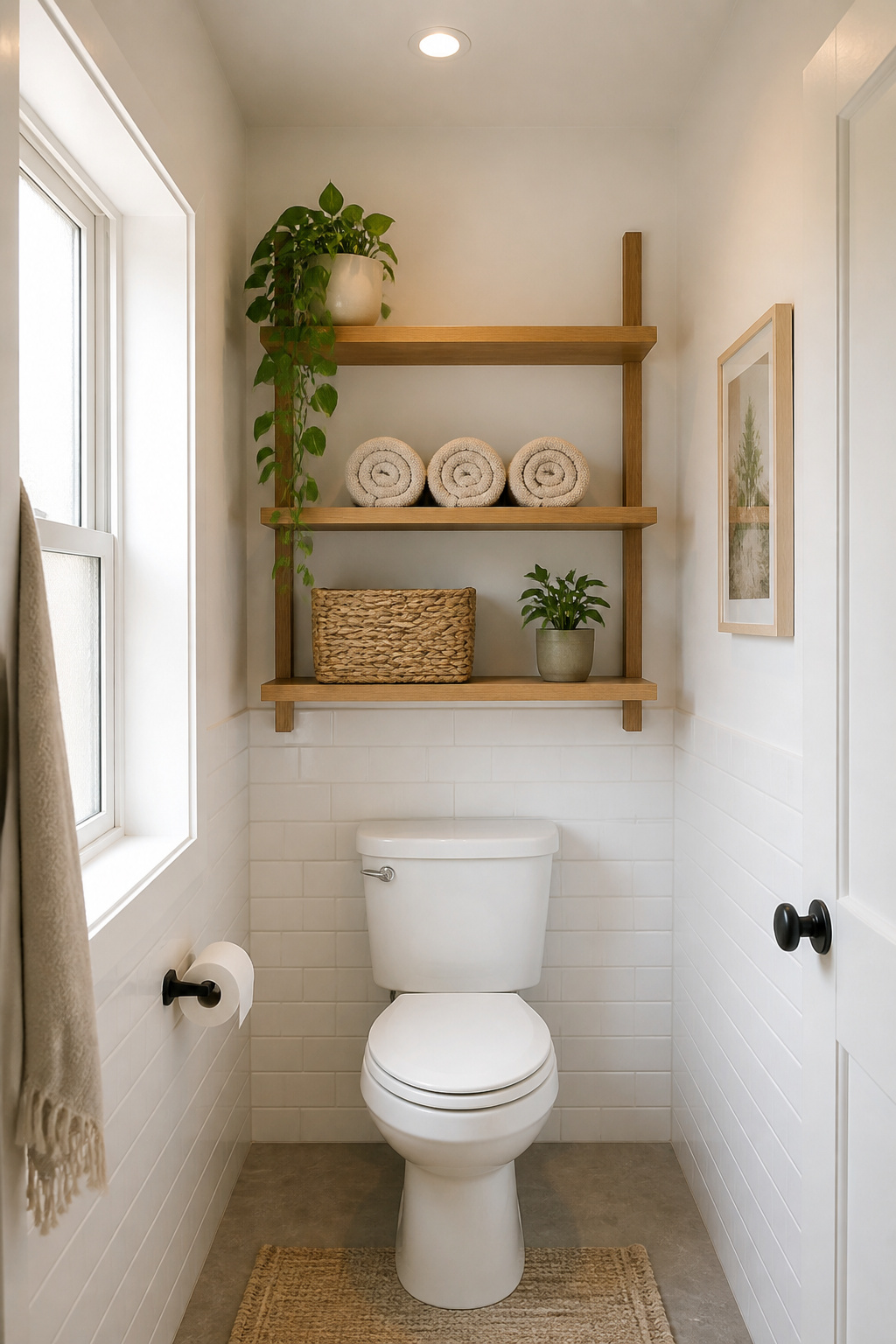
Dedicated etagere units designed for this zone typically stand 58 to 72 inches tall and 24 to 26 inches wide. They fit over virtually all standard toilet tanks without conflict. Target’s Brightroom line makes units as narrow as 26 inches, which helps when width is as constrained as depth. For floating shelf pairs, the advantage is full control over spacing and count. Set the lowest shelf at 18 to 24 inches above the tank lid so you can still open it freely.
What to Look For
Shelf depth matters more than most people expect. Eight to twelve inches works well: deep enough for standard shampoo bottles, close enough to the wall that you’ll never walk into it. Locate studs at 16-inch intervals before mounting. Most decorative loads stay under 20 pounds, but glass jars add up quickly.
Style choices determine whether the result looks deliberate or desperate. Keep purely utilitarian items in baskets or behind closed doors. Open shelves perform best with rolled towels, small plants, and decor in a consistent palette. A shelf that’s half-organized reads as disorganized. Commit to one category per shelf. For more on vertical bathroom cabinet systems, bathroom cabinet designs that maximize vertical space covers the territory well.
2. Recessed Medicine Cabinets That Vanish Into the Wall
A surface-mount medicine cabinet projects 3 to 5 inches into the room. In a bathroom where every inch matters, that projection is often what makes the space feel smaller than it actually is. Recessing the cabinet into the wall cavity solves this entirely — and it’s more achievable than most people realize.
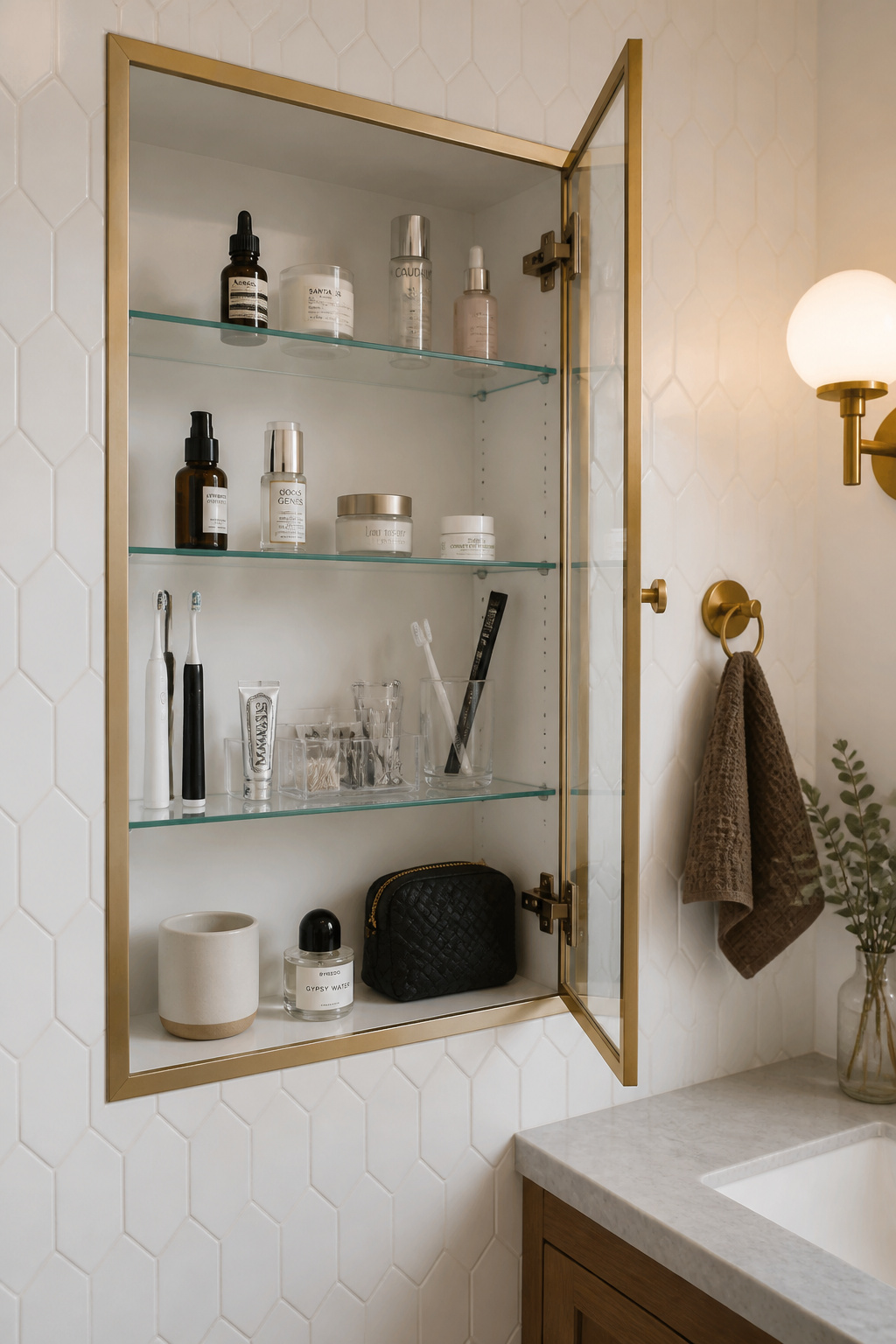
For small bathroom storage purposes, recessing is one of the highest-impact upgrades that adds zero floor space. The structural logic is already in the framing. Standard 2×4 walls have an actual stud depth of 3.5 inches — exactly the depth of most recessed cabinet bodies. Studs run at 16-inch centers, giving 14.5 inches of clear space between them. Most recessed cabinets are sized to this width. The installation sequence: locate studs with a finder that also detects pipe and wire, cut the drywall opening, add horizontal blocking, and set the cabinet. Scan for plumbing and electrical before cutting — bathroom walls frequently have vertical runs.
Wider cabinets at 18 inches and up require cutting one stud and installing a header. Kohler’s Verdera line (14.5 by 30 inches, $300 to $500) is a reliable mid-range choice. Robern’s M Series offers custom sizing for layouts where standard dimensions don’t align. For renters, surface-mount models in the 2 to 3-inch-deep range are the practical alternative. They look considerably more intentional than the boxier builder-grade versions they replace.
3. Under-Sink Tension Rods: A Small Bathroom Storage Hack Worth Knowing
Most under-sink cabinets fail at their job because of one structural problem: the plumbing pipe runs through the center. A flat shelf either requires cutting around the pipe or just stacking items on the floor. Tension rods work around this entirely. They hang above the obstruction and cost under $15 each.
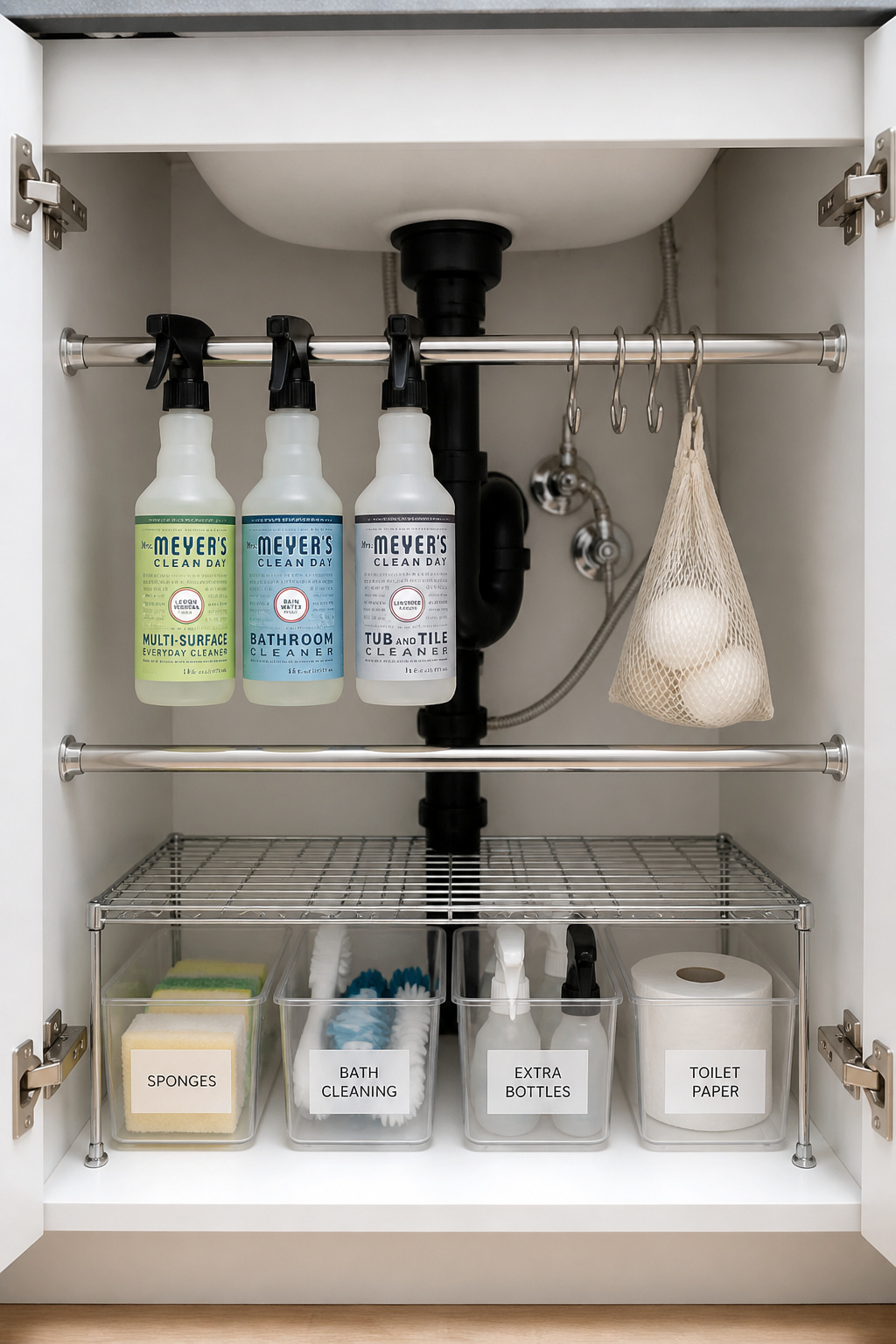
A single rod near the top of the cabinet becomes an instant hanging tier. Hang spray bottles by their trigger handles and the floor opens up completely. Add S-hooks to hang scrub brushes, loofah straps, or reusable gloves. A second rod halfway up adds a lower tier — useful in taller cabinets where the upper zone is otherwise dead space. This small bathroom storage fix requires no drilling and takes about ten minutes.
What to Buy and How to Layer It
Choose metal rods over plastic — metal holds tension significantly longer. Measure the cabinet interior width and buy a rod with 2 to 3 inches of adjustment on each side. After hanging spray bottles, the clear cabinet floor earns a second upgrade: a wire shelf riser that doubles the floor area into two levels, plus small pull-out bins for hair products or cleaning sponges. The complete system costs under $30. For broader cabinet-level approaches, bathroom organization ideas that work in any cabinet size extends the framework beyond the sink.
4. Floating Vanities With Integrated Drawer Systems
A floating vanity does something no floor-standing unit can. It lets the floor run visually from wall to wall without interruption. That unbroken sight line is the same principle behind floating TV consoles — visible floor reads as more floor, and more floor reads as more space.
Standard installation height is 30 to 36 inches off the floor. The clearance underneath also makes cleaning significantly easier. No base to mop around. Available widths start at 20 inches, with 24-inch units offering enough space for a single under-mount sink and a drawer bank. Soft-close hardware is worth prioritizing. Bathroom drawers get used throughout the day through wet hands, and self-closing mechanics prevent the hardware loosening that comes from years of slamming. IKEA’s GODMORGON system starts at $399 for a 24-inch unit with soft-close hardware included.
Retrofit Organizers for Existing Vanities
For existing vanities without drawers, bamboo expandable dividers (SpaceAid, $25 to $35) fit most drawers between 12 and 21 inches wide without cutting. Acrylic trays are the better call for drawers near the sink — they wipe clean and stay transparent. Organize by use frequency: daily items at the front on the dominant-hand side, weekly items in the center, backup stock at the back.
5. Mirrored Cabinets That Earn Double Duty in Tight Spaces
A mirrored cabinet solves two problems in the same wall footprint — grooming mirror and closed storage — without adding any visual weight to the room. In a genuinely tight bathroom, that double function is exactly the kind of efficiency that keeps the space from working against you.
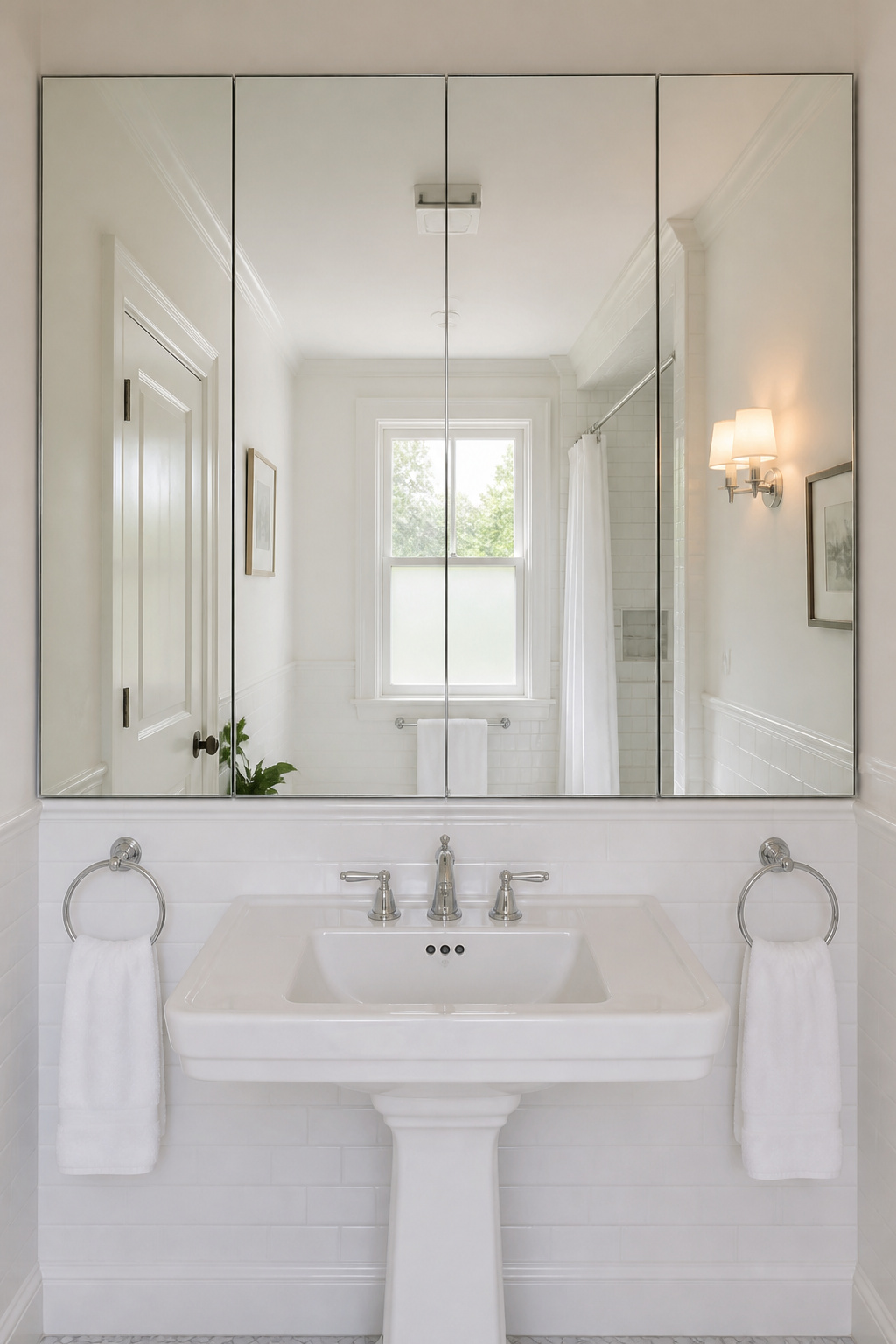
Mirrors deserve more credit than they usually get. A mirror effectively doubles the perceived depth of the wall it occupies. Positioning it opposite or adjacent to a window maximizes natural light reflection and reduces reliance on artificial fixtures. A cabinet that spans the full vanity width creates a cohesive wall rather than a utilitarian box. For those planning the lighting to complement this effect, vanity lighting that works with your mirror setup addresses how the two systems work together.
What Belongs Inside and What Doesn’t
Best uses: daily medications, contact lens supplies, toothpaste, floss, tweezers, nail clippers. Items that don’t belong: heavy bulk stock, cleaning products, anything with a strong smell. Inside the cabinet door, small magnetic strips or adhesive hooks add another storage tier without adding any depth.
Upgrading from a builder-grade frameless unit to a framed model with finish hardware transforms the vanity wall with minimal effort. IKEA’s LILLÅNGEN runs $79 to $129. Kohler’s Catalan steps up to $200 to $400 with better construction.
6. Corner Shelving That Converts Dead Angles Into Storage for Small Bathrooms
Every bathroom has two or more 90-degree corners, and most go unused for their entire life. Standard rectangular shelves can’t mount into a corner without complicated bracketing. Most people never solve the problem. Purpose-made corner shelves are built for exactly this geometry.
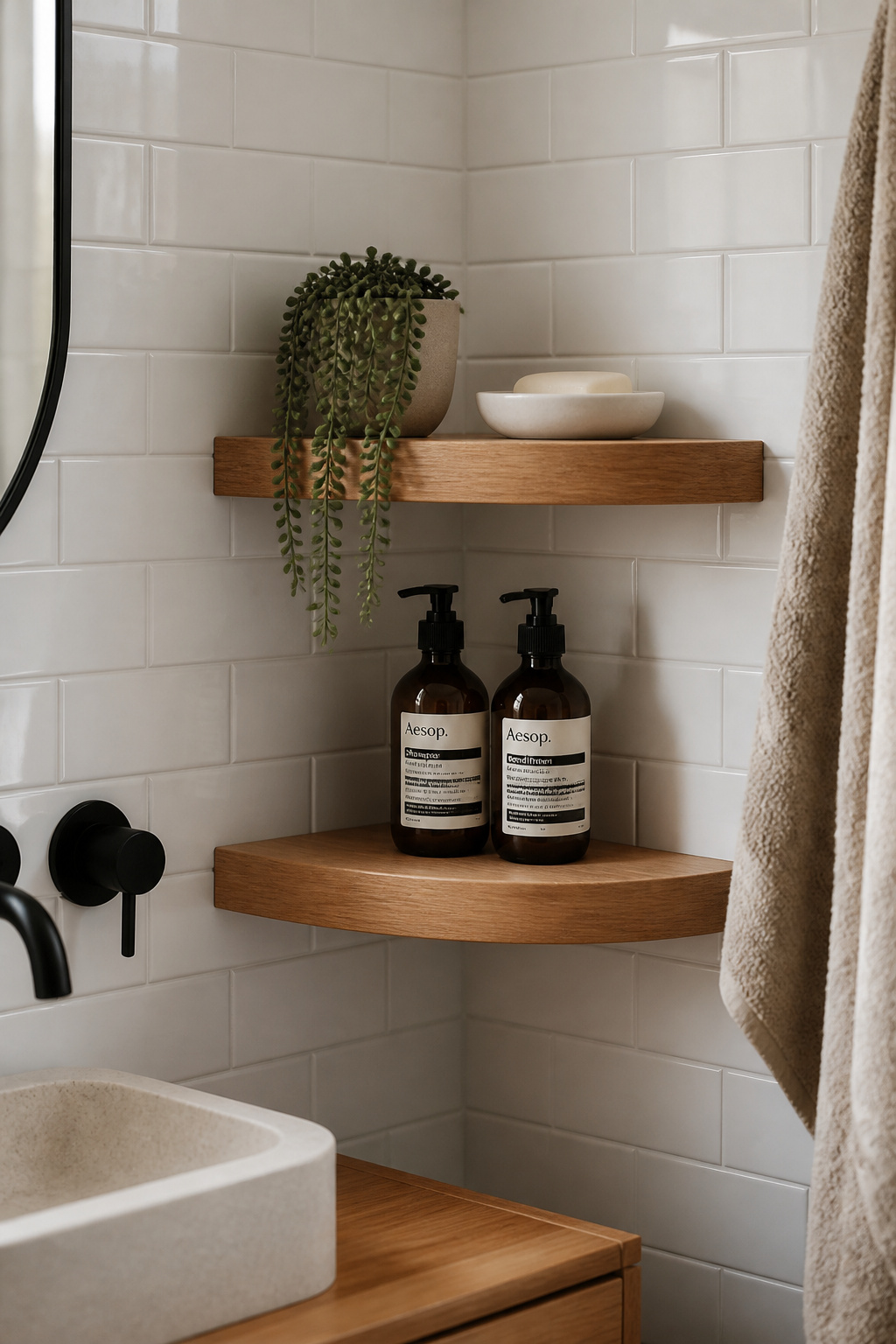
Each corner wall gives roughly 14 inches of usable depth on each side. That supports a triangular shelf with a 10 to 14-inch hypotenuse — enough for several toiletry bottles, a small plant, or a stack of towels. The corner nearest the shower is particularly valuable. It positions products exactly where they’re used, without the shower caddy rusting off the showerhead by month three.
For renters or shower walls where drilling risks cracking grout, floor-to-ceiling tension pole systems require no drilling and hold 20 to 30 pounds across all shelves. They disassemble entirely on moving day. Smedbo and Gatco make well-regarded stainless versions. Wayfair’s house brand offers wood-toned options at $25 to $80. Wall-mounted triangular floating shelves are the stronger permanent solution. Corner studs are typically doubled, making corner mounting more solid than mid-wall mounting.
One detail that separates a corner shelf from an afterthought: match the hardware finish to existing towel bars and faucets. Choose one metal family — chrome, brushed nickel, or matte black — and commit to it. A shelf in the same finish as everything else looks like it was always there.
7. Over-the-Door Organizers for the Space Nobody’s Using
The back of a bathroom door is usually 28 to 32 inches wide and 80 inches tall — roughly the same wall area as a narrow closet — and it sits completely unused in most bathrooms. Over-door organizers exploit this surface entirely. No drilling. Nothing that touches the wall.
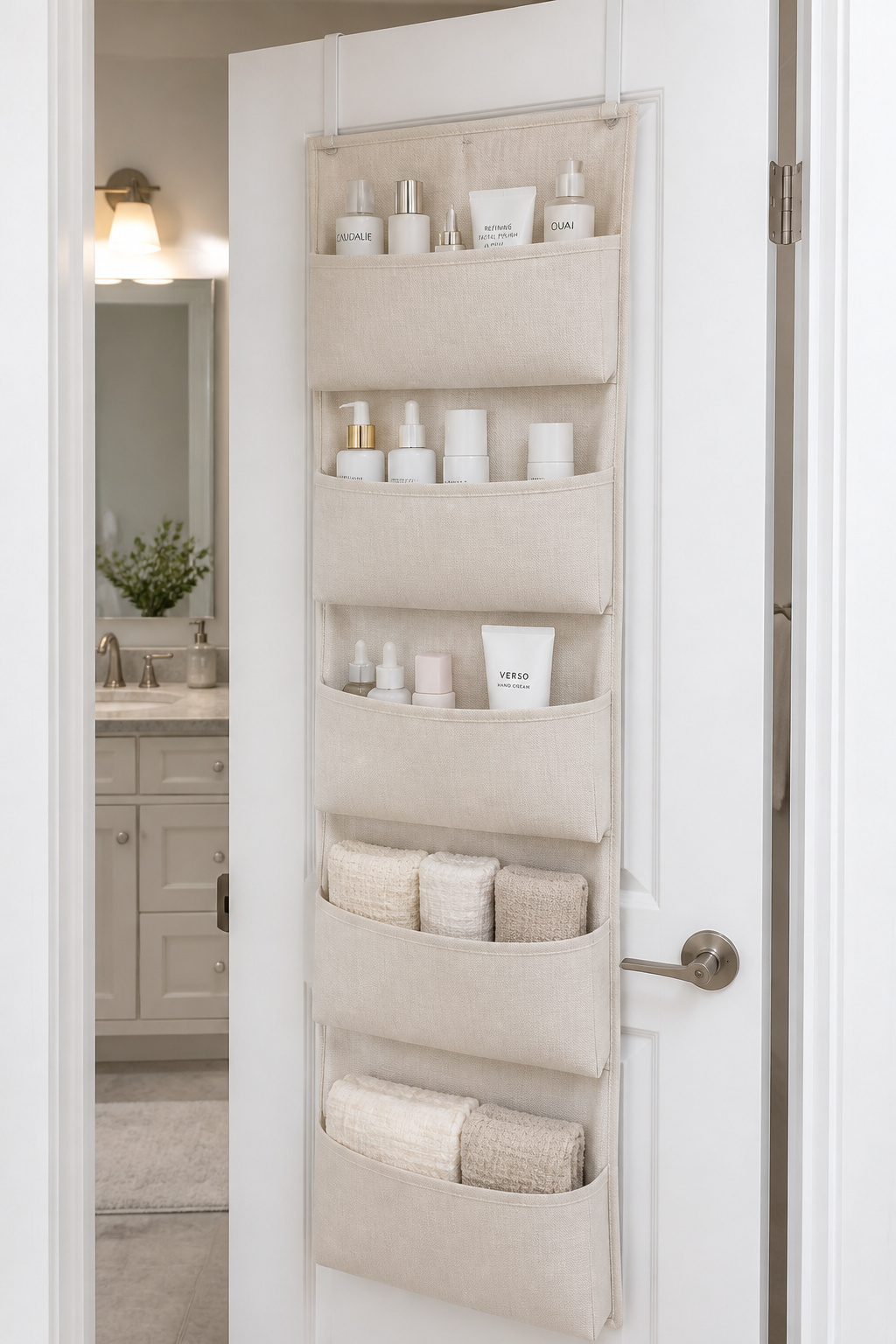
First, check clearance. Most over-door hooks require 1/2 to 1 inch of gap between the top of the door and the frame. Standard bathroom doors are 1.75 inches thick — confirm the hooks are designed for this thickness. Test that the door closes fully before loading anything.
Format choice matters. Fabric pocket organizers work well for skincare and small cosmetics — lightweight and tidier than wire alternatives. Hook systems with six to nine hooks handle bathrobes, towels, and cooled hair dryers. Bar-and-basket systems with two or three wire baskets handle heavier items like full shampoo bottles. Keep it to one format per door. Mixing formats creates visual chaos even when everything has a home. Apply a simple zone rule: eye level and above for daily use, lower zones for backup stock. That one rule keeps this small bathroom storage surface working consistently.
8. Ladder Shelves That Stack Vertically Without Stealing Floor Space
A ladder shelf takes up a footprint roughly 13 inches deep by 24 inches wide — about the same floor space as a small trash can — and gives back three to five storage tiers in exchange. That math alone makes it one of the highest-return additions available for small bathroom storage.
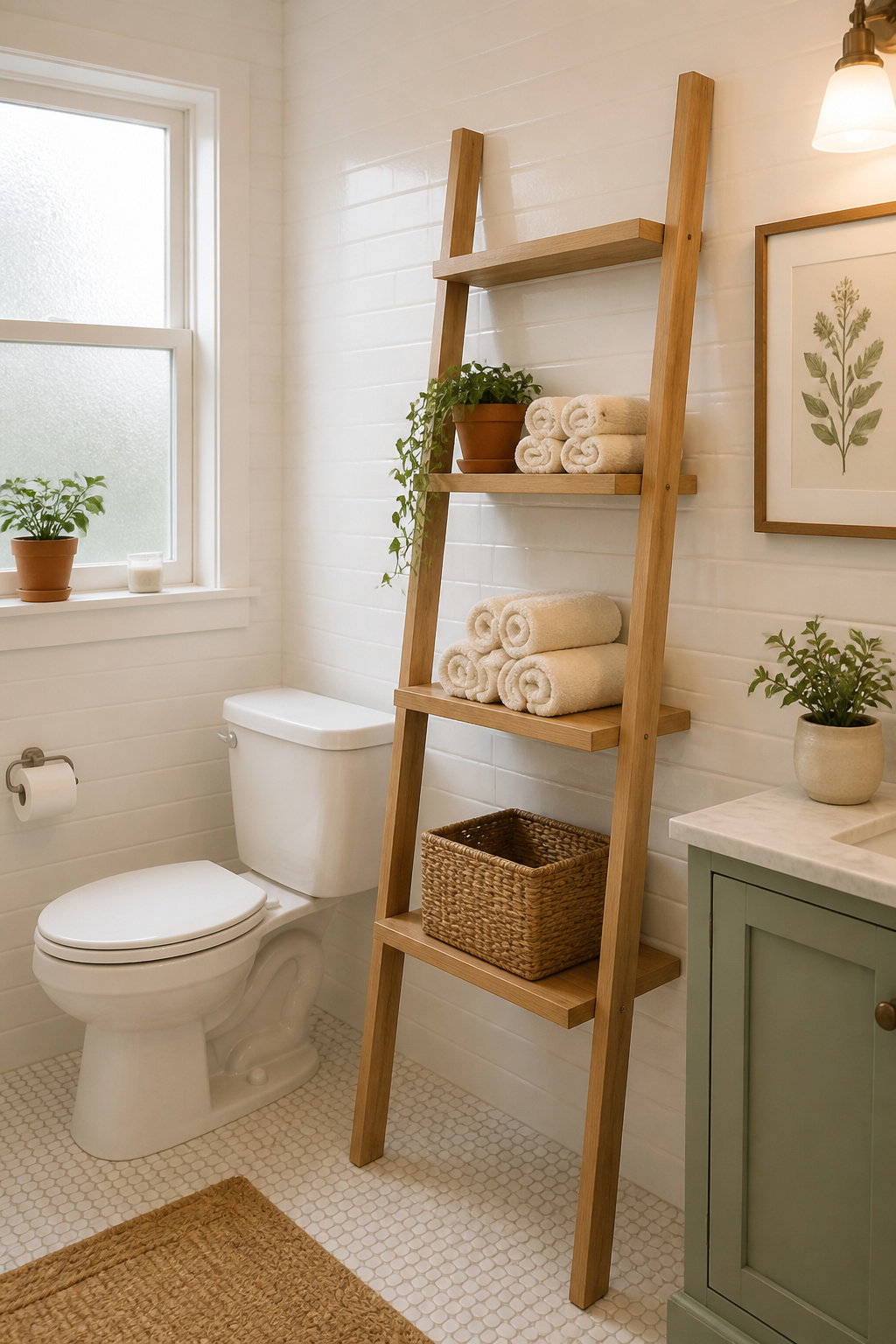
Standard 4-tier units run approximately 45 inches tall. Over-toilet ladder versions extend to 58 inches or more, with narrower rungs to straddle the tank. For bathrooms under 50 square feet, a 3-tier unit at 11.8 by 16.5 by 31 inches positions in a corner without interfering with movement. Keep the maximum shelf depth at 12 inches — anything deeper cuts into walking space in narrow rooms.
Styling and Safety
Most ladder shelves go wrong the same way: every rung gets filled until the shelf looks like a tidier version of the original problem. A better approach is one functional item per shelf — rolled towels or a basket with products — one small plant or candle, and one deliberately empty space. Rolled cotton towels in coordinating colors on the middle rungs are the easiest way to make the whole setup look styled rather than assembled. If you’re gathering ideas across the full room, small bathroom inspiration for tight spaces covers approaches that go well beyond shelving. Always use the included anti-tip wall anchor strap. VASAGLE and SONGMICS offer reliable options at $50 to $80 with anchoring hardware included.
9. Drawer Divider Inserts: The Small Bathroom Storage Upgrade You’re Overlooking
A disorganized bathroom drawer contains roughly three times more items than it actually needs. Things get buried, duplicates accumulate, and whatever’s closest to the front becomes the default for everything. A divider system fixes this in about twenty minutes for $20 to $40. That makes it the highest-ROI fix in most small bathroom storage situations.
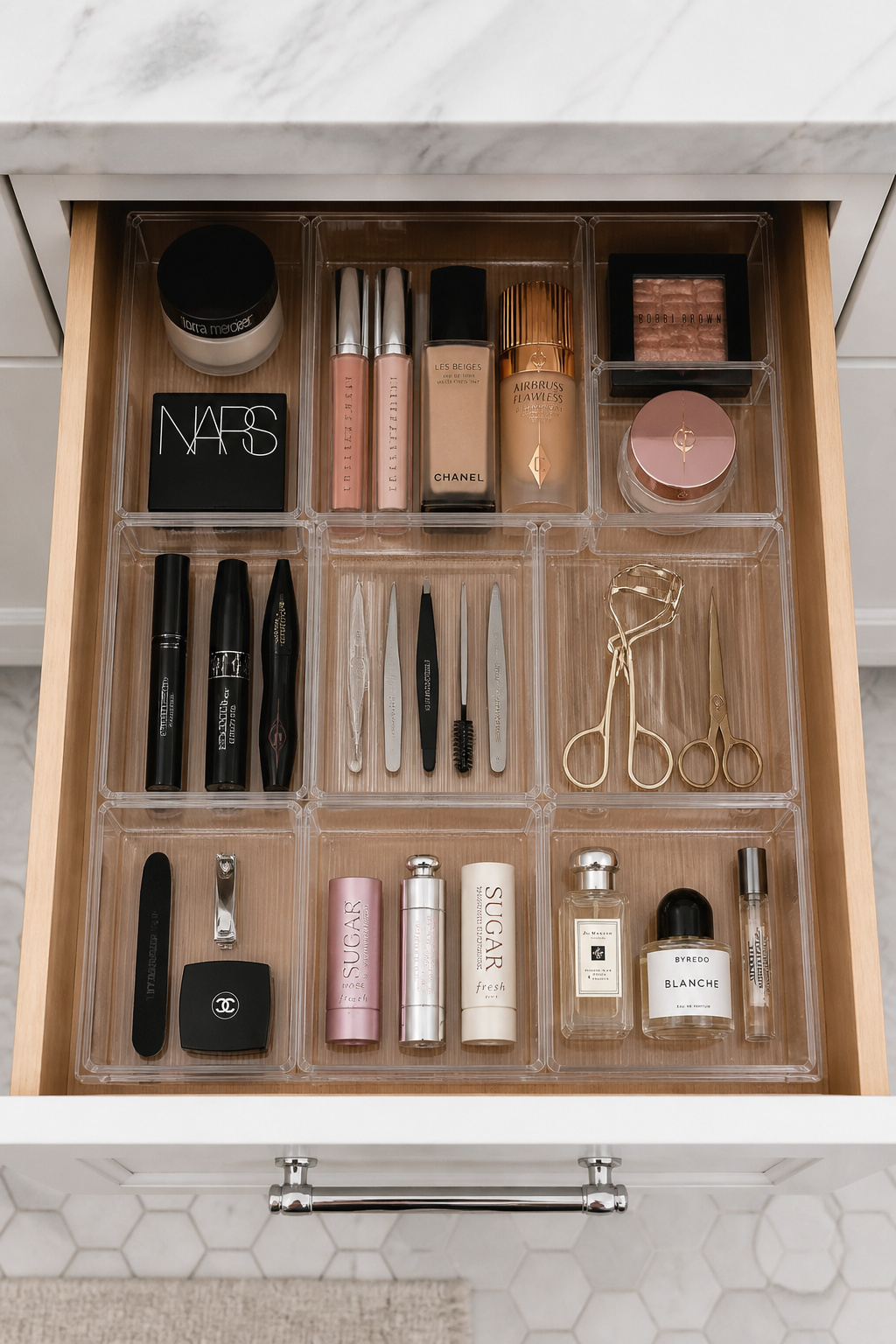
Without dividers, a flat pile forms in every drawer. Items shift with each opening, contents at the back disappear from practical use, and you end up buying a fourth lip balm because the first three are under the hair ties. Dividers create dedicated zones. You see what you have, you know where it lives, and the drawer stays organized because everything has a specific place to return to.
Materials and Mapping the Drawer
Acrylic trays are clear, antimicrobial, and wipe clean — water and cosmetic residue sit on the surface instead of absorbing. Bamboo expandable dividers (SpaceAid, Lipper International) hold up well under weight and any minor wear blends into the grain. However, bamboo can swell if the drawer gets wet regularly — a real concern for drawers near the sink. In practice: acrylic for drawers near the sink, bamboo for dry-storage drawers elsewhere.
Map the drawer by use frequency. Daily items — toothpaste, face wash, whatever your hands reach for every morning — go front on the dominant-hand side. Weekly items go center. Monthly-use backup stock goes to the back. If something hasn’t been touched in six months, it probably doesn’t belong in the drawer.
10. Pegboards and Hook Panels for Behind-the-Door Walls
Pegboards bring workshop-style reconfigurability to a bathroom wall. Any hook, shelf, or basket can move without new holes. The system evolves as needs change. The shift driven by IKEA’s SKÅDIS line is that they no longer have to look like garage equipment.
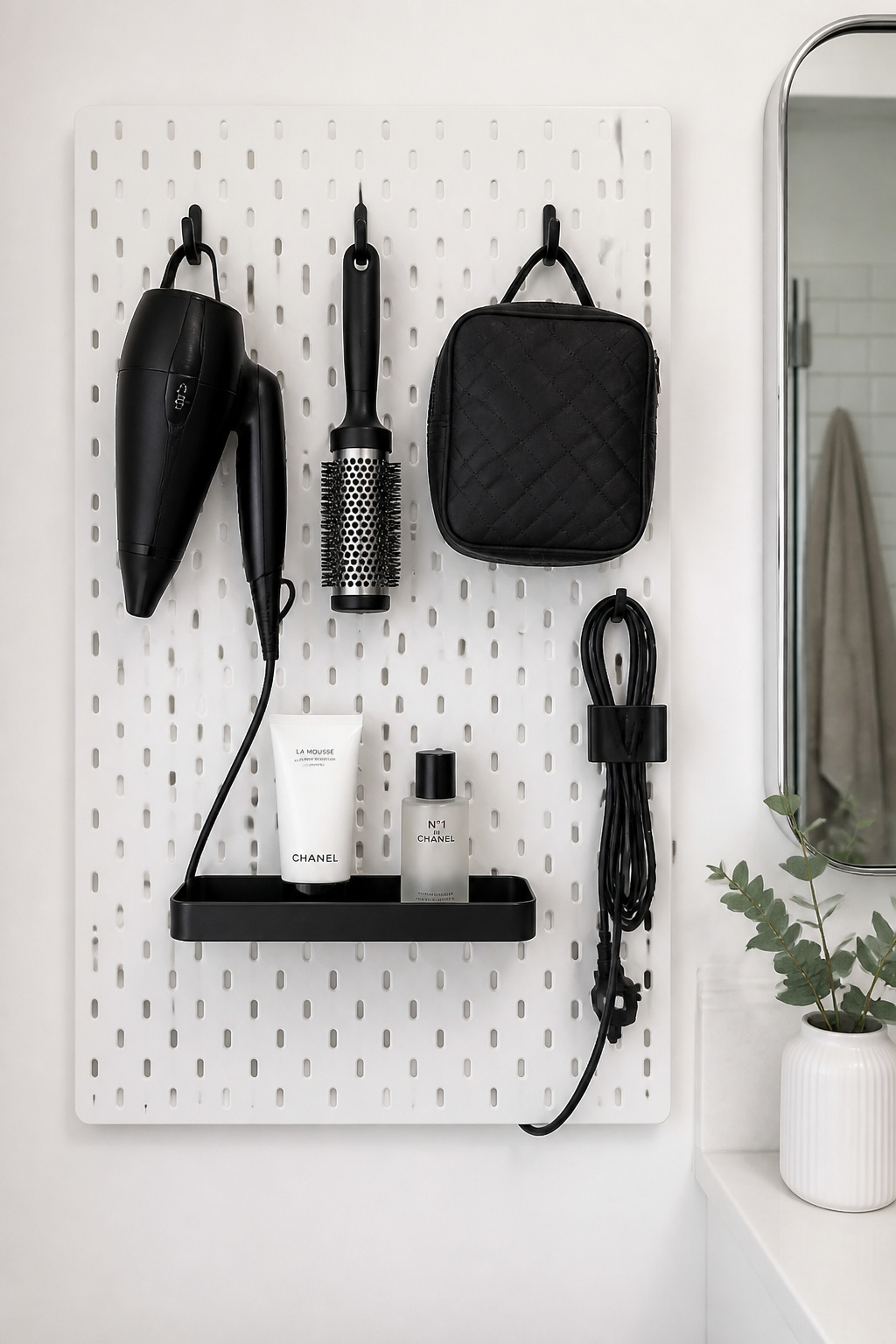
In a bathroom, the priority shifts from load capacity to moisture resistance. Standard 1/4-inch hardboard pegboard absorbs humidity and will swell without proper sealing. Two coats of exterior polyurethane or water-based primer plus semi-gloss paint protects it adequately. Reapply annually in bathrooms with poor ventilation. IKEA’s SKÅDIS is fiberboard with a painted or laminate layer — better in humidity than raw hardboard, but still best kept away from direct splash.
Choosing and Setting Up Your System
A 14 by 22-inch SKÅDIS retails for around $20. A 22 by 22-inch version is $25. Accessories run $3 to $15 each. Start with only the hooks you know you’ll use daily. A board with six hooks and two small baskets looks intentional. A board with twenty hooks in every hole looks frantic. For truly humid bathrooms, PVC pegboard from commercial suppliers ($30 to $50 per 2×4-foot sheet) never swells and wipes clean with a damp cloth. One installation note: all pegboard needs standoff blocks behind it to create a 1/2-inch air gap so hook arms can engage from behind. For ideas on how organizational wall systems fit into broader bathroom design, bathroom wall decoration ideas beyond the basics puts the context in place.
11. Woven Baskets and Rattan Crates That Tidy While They Decorate
Baskets solve the open-shelf problem elegantly. They reduce the number of visible decisions on a shelf from fifteen individual items down to three or four category containers. A bathroom with baskets reads as organized even when the contents aren’t perfectly arranged. The eye sees containers rather than chaos. That’s a psychological win worth taking.
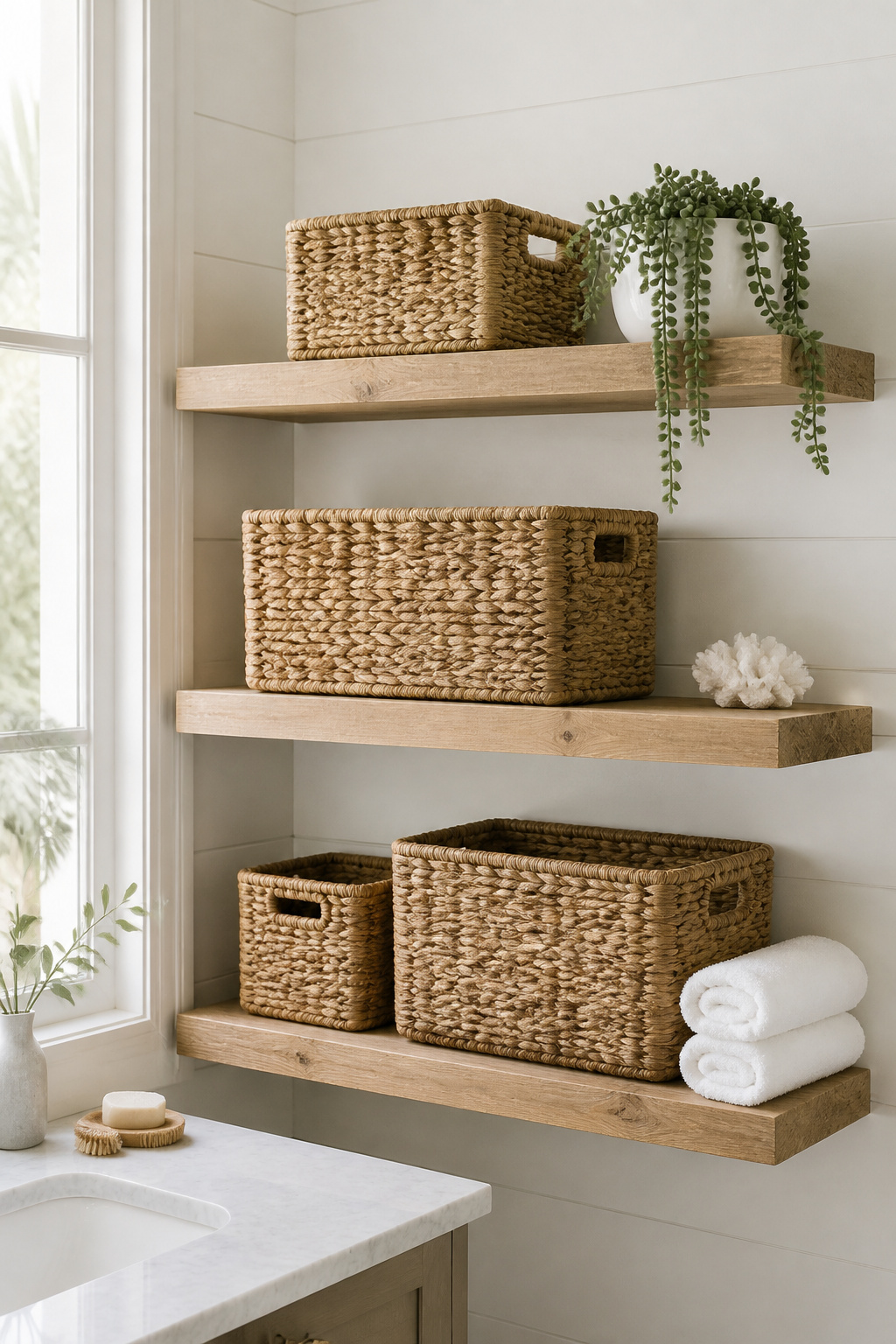
Each basket should hold one category. Hair products in one, skincare in another, cleaning supplies in a third, backup stock in a fourth. Mixing categories defeats the containment purpose entirely. If everything goes in the nearest basket, you’ve recreated the drawer problem at larger scale. Sizing before purchasing is non-negotiable. A 14-inch basket on a 10-inch shelf hangs over the edge and looks careless. General guidelines: small (6 to 8 inches wide) for cotton rounds and hair clips; medium (10 to 12 inches) for hair product collections or extra hand towels; large (14 to 16 inches) for backup supplies.
Keeping Natural Materials From Deteriorating
Seagrass and water hyacinth hold up better in bathroom humidity than rattan or natural wicker. Both benefit from two coats of exterior-grade polyurethane spray before first use, reapplied annually. Keep the bathroom well-ventilated — an exhaust fan running consistently keeps humidity below the 70% threshold where mold develops in even treated fibers. Wipe baskets monthly with a dry cloth. Spot-clean with mild soap when needed, then dry completely before returning items. And the one rule that prevents most basket problems: never store damp towels inside a closed basket.
12. Magnetic Strips and Wall-Mounted Rails for Small Bathroom Storage
The magnetic knife strip was designed for kitchen knives, but it may be most useful in a bathroom. Mounted inside a medicine cabinet door or on a small backsplash wall, a magnetic strip keeps small metal grooming tools visible, organized, and instantly accessible. It solves the specific frustration of items lost at the bottom of a drawer.
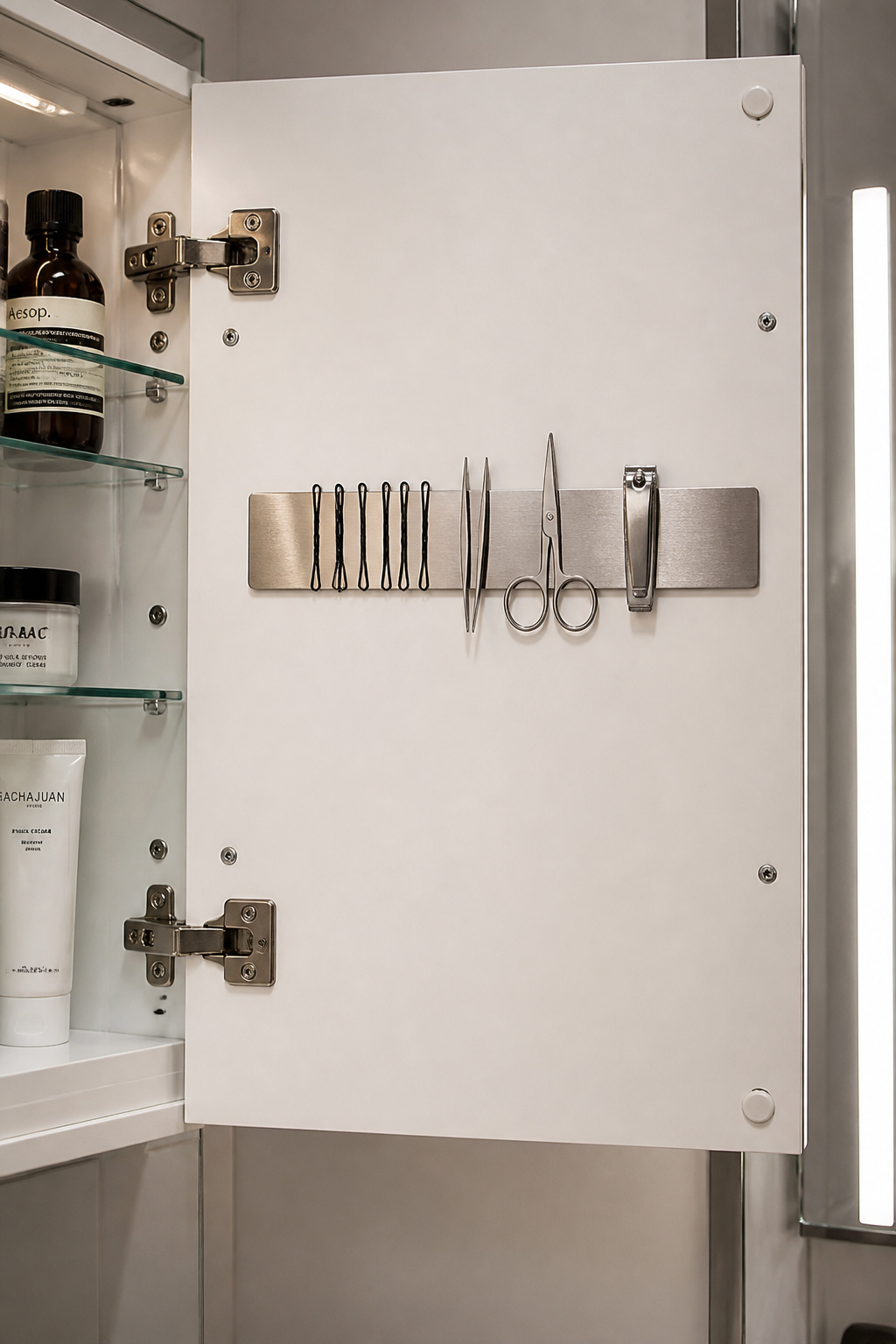
Best items for magnetic strips: bobby pins, tweezers, nail clippers, small scissors, metal-barreled eyeliner caps, cuticle pushers, safety pins. Industrial-strength strips hold 2 to 3 pounds — more than adequate for a full set of metal grooming tools. The inside of a medicine cabinet door is the optimal placement: hidden from view, protected from shower steam, and immediately accessible when the cabinet is open.
Material matters near water. Standard steel knife strips will rust in a bathroom. Stainless steel is the requirement. A 12-inch stainless kitchen knife strip ($10 to $20) performs identically to a purpose-built bathroom magnetic organizer. IKEA’s GRUNDTAL ($12 to $20) mounts with two screws and blends into modern bathroom finishes. For tile walls, adhesive strips work well if the tile is cleaned with isopropyl alcohol first and allowed 72 hours before loading. On painted drywall in humid bathrooms, screws into studs are the more reliable long-term solution.
13. Rolling Utility Carts for Flexible, Move-Where-You-Need Storage
Fixed shelving is the better long-term solution in most bathrooms. But fixed shelving requires knowing exactly what you need and exactly where you need it. Rolling utility carts solve the problem when that clarity hasn’t arrived yet. They’re also the right answer for renters who can’t install anything permanent.
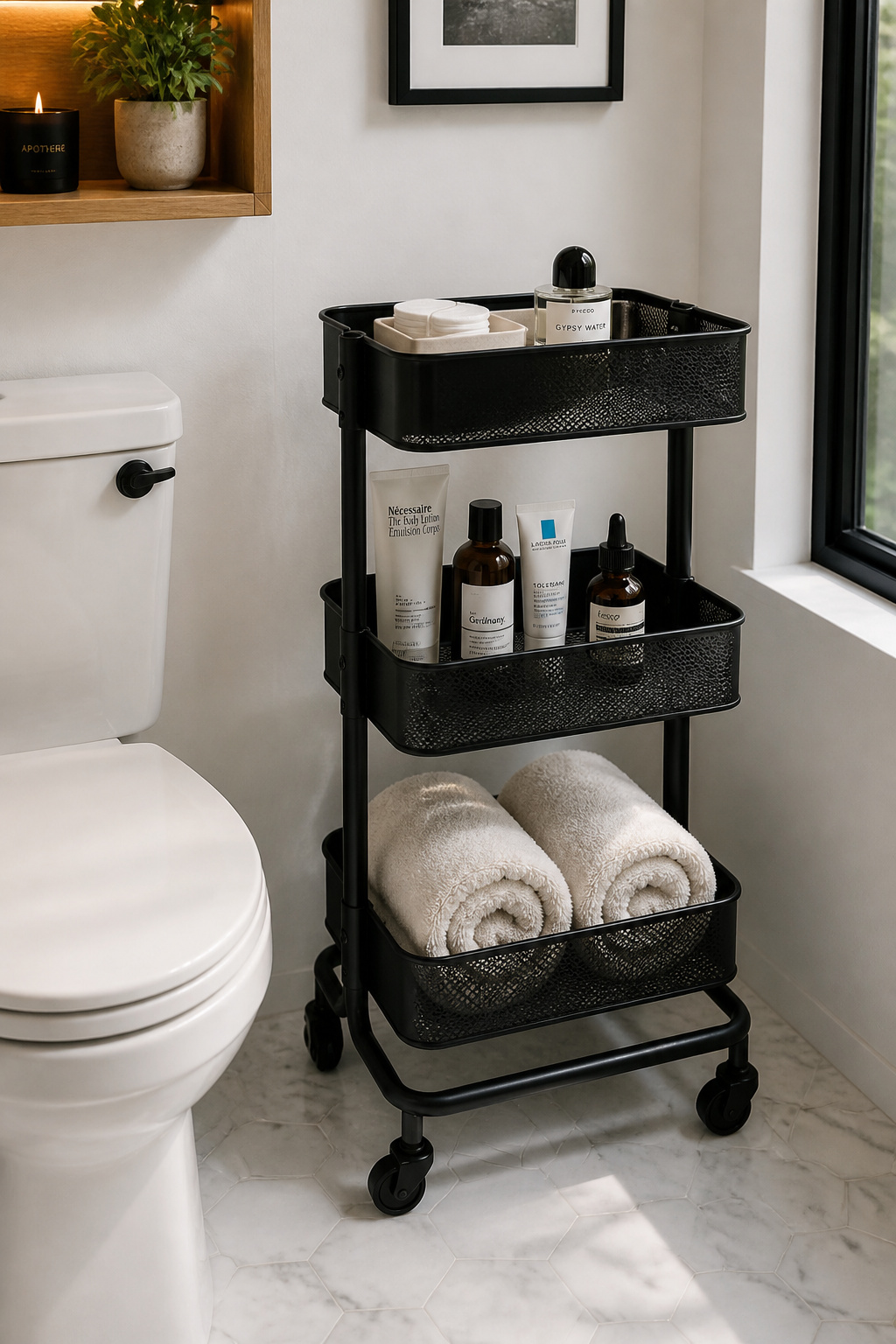
The IKEA RÅSKOG is the canonical example. At 13 3/4 by 17 3/4 by 30 3/8 inches, the standard version fits beside most toilets. A smaller sibling (11 by 15 by 24 inches) slides under some bathroom sinks — an unusual combination in its price range ($20 to $40). Wire mesh shelves allow air circulation and resist dust accumulation. The powder-coat finish comes in black, white, gray-blue, and red-brown. Lockable casters prevent drift when the cart is in a fixed position.
Caster Quality and Styling
Caster quality is the make-or-break spec on cheaper carts. Thin plastic swivel casters on tile floors scratch the surface and resist rolling. Look for rubberized or polyurethane wheels. Styling a utility cart as furniture comes down to one rule: top tier styled intentionally, lower tiers utilitarian. A small tray on the top tier corrals loose items so they don’t rattle on the wire shelf. Middle tier holds standing products. Lower tier holds rolled towels or backup stock. A cart that’s styled deliberately at the top reads as intentional furniture even when the bottom tier is entirely practical.
14. Built-In Shower Niches and Alcoves for Clutter-Free Walls
A shower niche is the small bathroom storage upgrade that a shower caddy only pretends to be. Recessed directly into the shower wall, it holds products at reach without a wire rack rusting off the showerhead. Done well, it’s also a design element — a contrasting tile rectangle in the shower wall that looks like it was always part of the plan.
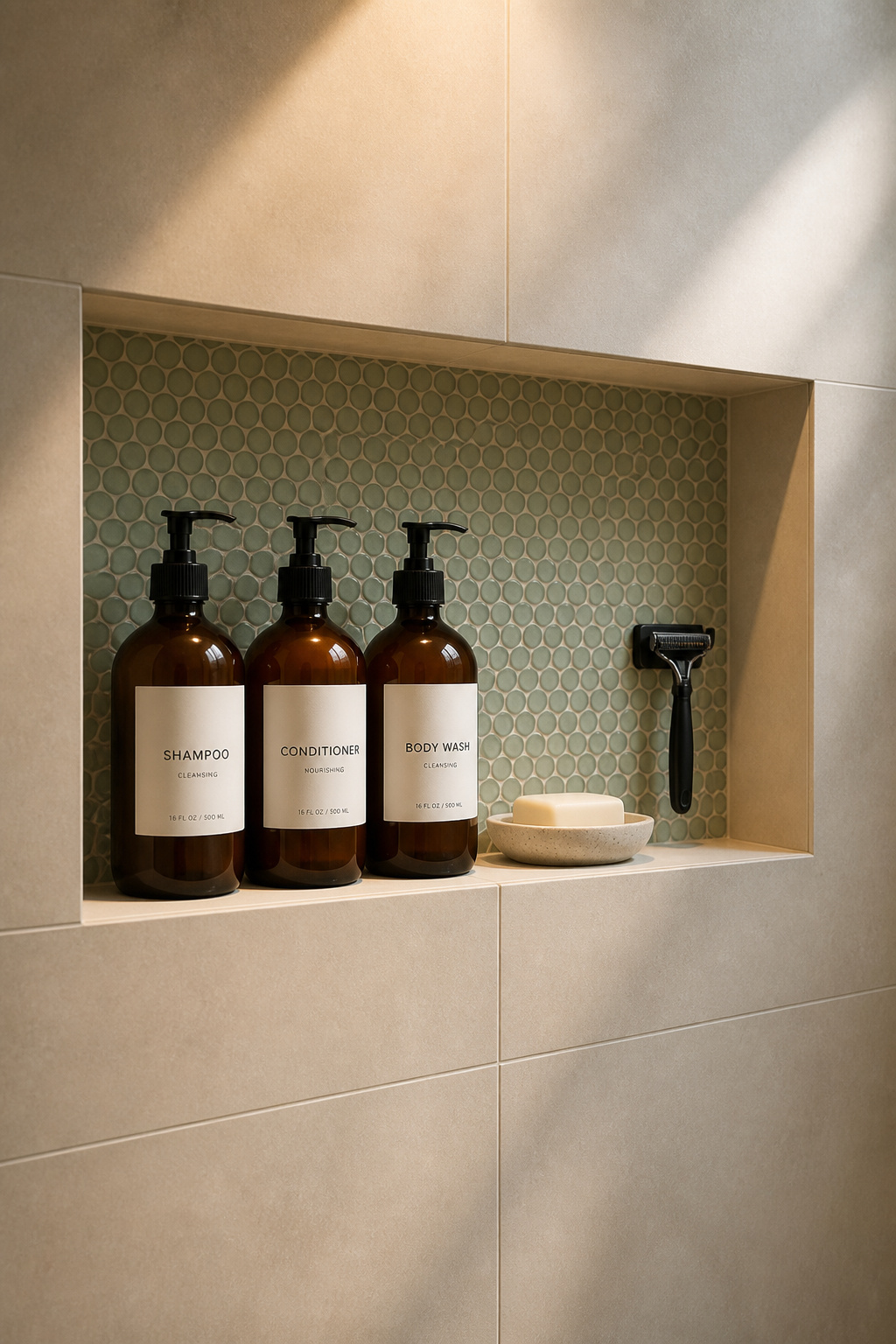
The window for building a niche at minimal cost is before backer board and tile go up. At that stage, the niche is a stud cavity already present. Frame it with blocking, set the depth at 3.5 inches (standard 2×4 stud depth), waterproof with two to three coats of liquid membrane, and tile the interior. Standard stud spacing gives a finished interior width of approximately 12 to 14 inches. For wider niches, one stud gets cut and a structural header gets added. For renovation projects where niches and other built-in storage are a core design element, farmhouse bathroom renovation ideas including built-in storage walks through how permanent features integrate into a full bathroom refresh.
Sizing and Retrofit Options
Most popular niche dimensions: 12 by 12 inches (single shelf), 12 by 24 inches (two products side by side). Tile the niche interior to match the surrounding shower tile, or use a contrasting accent tile to make it a visual feature. The niche bottom needs a slight pitch toward the drain so water doesn’t pool.
For already-tiled showers, Schluter KERDI-BOARD niche kits come pre-waterproofed and ready for direct tile application. Surface-mount retrofit niches attach to the tile face with waterproof adhesive, projecting 2 to 3 inches from the wall. They’re not recessed, but they add a functional shelf without touching a single tile.
15. Multifunctional Ottomans and Benches That Stow and Sit
In a small bathroom, every piece of furniture must justify its floor space with more than one function. A decorative-only bench consumes the same footprint as a storage bench that earns two uses. For bathrooms with enough room for a bench at all, the storage version is almost always the smarter call.
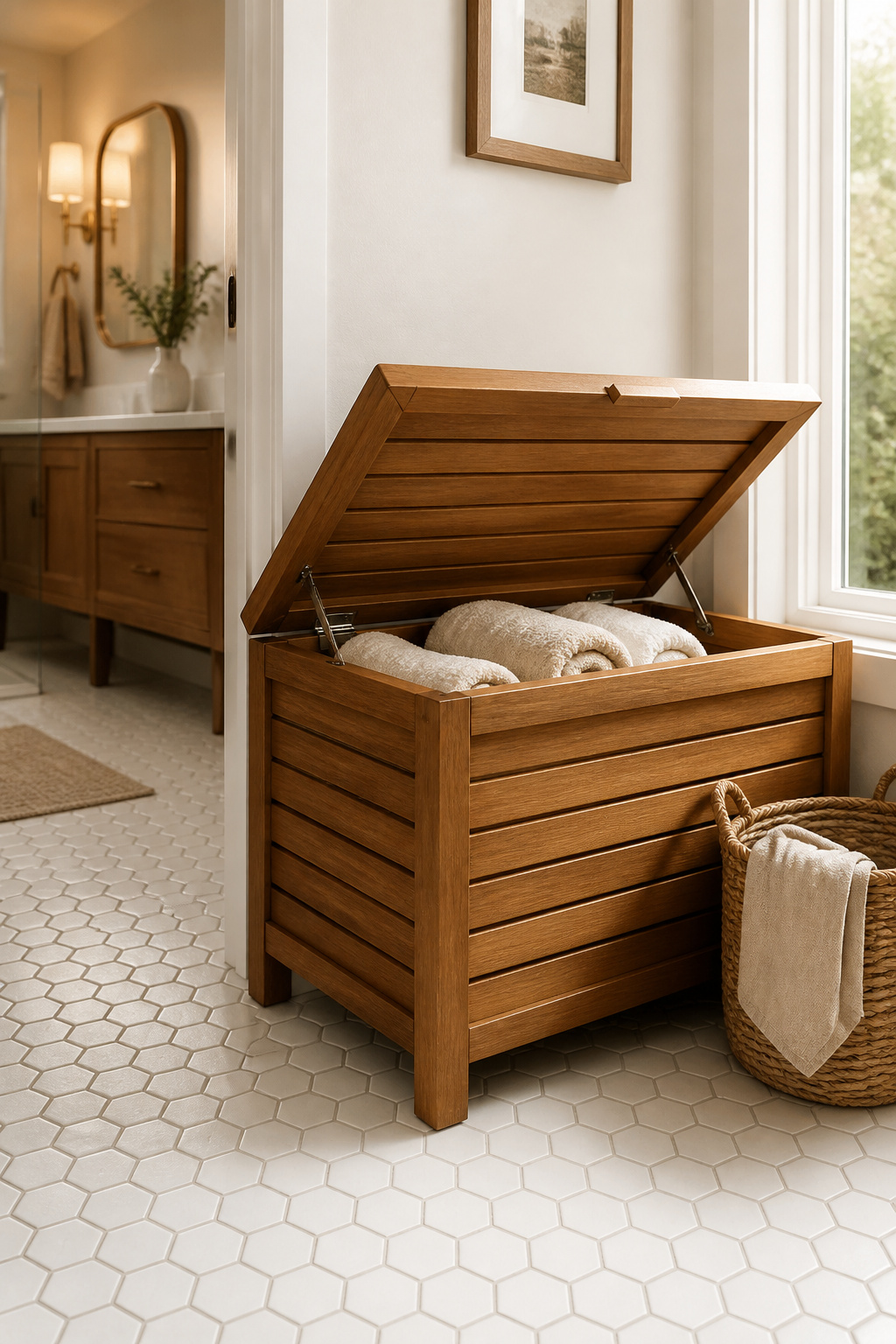
Storage benches work well near the bathroom entrance. A bench at the door provides seating and gives interior storage for extra towels accessible both before and after a shower. For bathrooms connected to a dressing area, a small upholstered storage bench provides grooming seating and stores beauty tools inside.
Moisture Resistance and What Goes Inside
Interior volume for most storage ottomans runs approximately 20 by 13 by 8 inches. That’s enough for four to six rolled bath towels, a set of guest linens, or a collection of hair tools. Teak’s natural oils make it dimensionally stable in consistently humid conditions — the same reason it’s used in outdoor furniture. Solid wood benches in other species need a waterproof polyurethane or Danish oil finish. Line the storage interior with a removable cotton bin so stored items don’t sit directly against the interior walls. Choose outdoor-rated fabric or vinyl for any upholstered seat: velvet and microsuede trap moisture and develop mildew smell over time. Store only dry items inside, and air out the interior periodically.
Choosing the Right Small Bathroom Storage Strategy for Your Space
No two small bathrooms have the same constraint. The right small bathroom storage system depends entirely on which constraint actually limits yours. Renters should focus on removable solutions: tension rods, rolling carts, over-door organizers, ladder shelves, and baskets all pack into boxes on moving day. Most permanent upgrades — recessed medicine cabinets, floating vanities, shower niches — require ownership. But they’re worth planning for if a renovation is on the horizon.
For owned bathrooms with a limited budget, order of operations matters. Start with the highest ROI per dollar: drawer dividers and under-sink tension rods fix daily frustrations for under $50 combined. Add magnetic strips and a pegboard panel next. Save the furniture-level additions for when the organizational framework is already working.
If a renovation is coming, build permanent storage into the plan while the walls are open. A shower niche is dramatically easier and cheaper to include during the tile phase than after. A floating vanity installs at the rough-in stage. Recessed cabinets get framed before drywall. Retrofitting any of these is possible — it just costs more time and money than planning ahead.
The system that works is never a single solution. The bathrooms that consistently function well layer three or four approaches: a primary storage zone, a secondary vertical tier, micro-organization inside drawers and cabinets, and containment on open shelves. Pick where you’re losing the most time every morning. Start there. The other pieces follow naturally.