There is a specific quality to a well-surfaced patio that no amount of furniture or planting can compensate for. The material underfoot sets the entire sensory register of the space — the sound of it, the temperature of it, the way it ages. Get the surface right and everything placed on it looks considered. Get it wrong and even expensive furniture looks like it landed there by accident.
These patio ideas aren’t about trends. They’re about materials: what they are, how they behave outdoors, and what they bring to a space that nothing else can replicate. I’ve spent years working with surface materials in residential design — stone, ceramic, composite, volcanic rock, recycled steel — and the patio ideas that hold up, literally and aesthetically, start with an honest understanding of material properties, not just appearance in a photograph.
Whether you’re working with a small courtyard, a broad suburban backyard, or a challenging sloped site, there’s a surface approach here that will outlast the seasons and improve with every one of them.
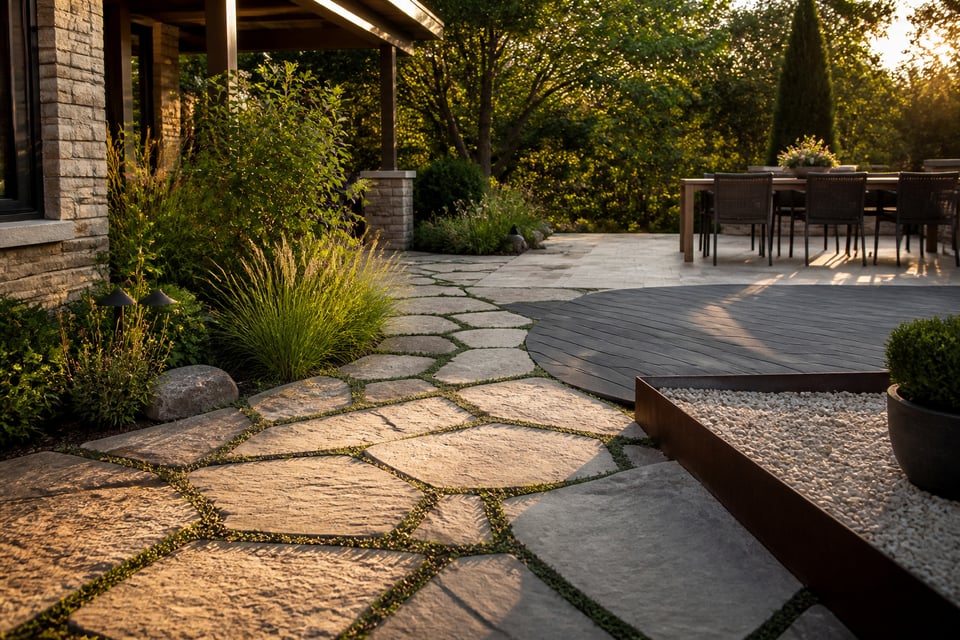
1. Flagstone With Creeping Thyme Joints for Organic Outdoor Texture
There is something deeply satisfying about a surface that is partly stone and partly living — the visual boundary between the hard and the organic blurs every spring when the thyme pushes into bloom. It looks like something grown rather than installed, which is exactly the point.
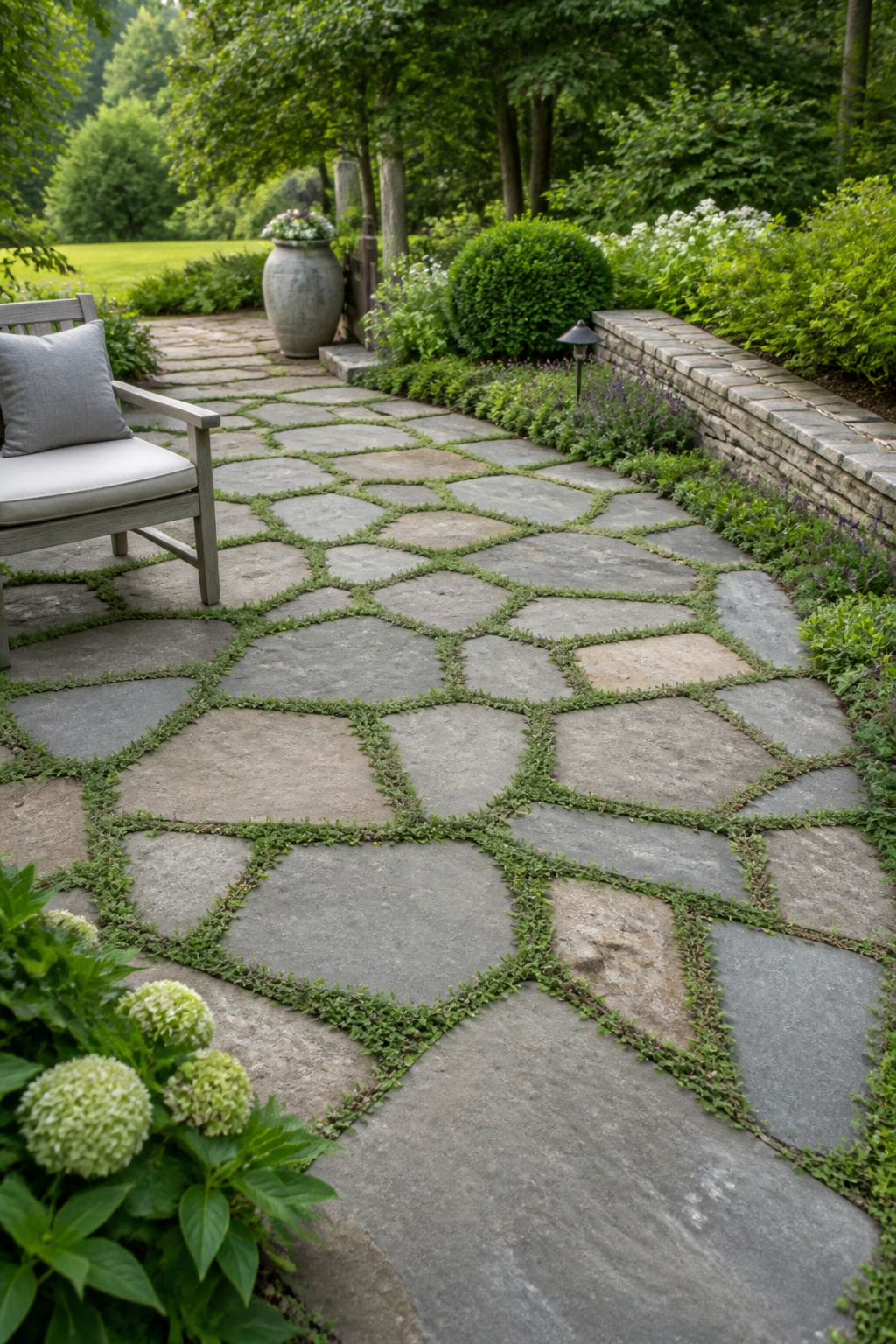
Pennsylvania bluestone, Arizona sandstone, and Tennessee crab orchard are the flagstone varieties worth considering for this approach. Each has a distinct colour story — the variegated blue-grey of Pennsylvania stone, the warm russet of Arizona sandstone, the earthy green-grey of crab orchard — and all three develop surface character with weathering rather than degrading. The natural cleft surface (stone split parallel to its stratification) gives you built-in grip and a texture that contrasts exactly right against the soft mat of thyme.
The joint width is the technical variable most people get wrong. Aim for 3/4 to 2 inches — wide enough for plant roots and seasonal growth, narrow enough to maintain cohesion underfoot. For joints under 1 inch, Woolly thyme (Thymus pseudolanuginosus) is the best choice: it stays compact where Pink Chintz or spreading varieties push aggressively then die back under foot traffic. Plant at 4-6 inch centres and make sure the soil depth in each joint reaches at least 6 inches — shallow compacted soil produces thyme that looks miserable rather than lush.
Getting the Planting Right
One thing patio garden ideas that mix stone and planting share: the surface needs to be designed for the plants, not just fitted around them. Thyme requires full sun and dry-to-well-drained conditions. If your patio is north-facing or catches roof drip, Irish moss or elfin thyme will handle the shade better. Keep irrigation systems away from the planted joints entirely — overwatering is what kills thyme between flagstones, not foot traffic.
2. Herringbone Concrete Paver Pattern That Adds Movement to Patio Ideas
Grid patterns tell you where you are. Herringbone tells you where to go. The 45-degree angle of the V-pattern creates a directional pull across the patio surface that guides the eye toward a focal point — a firepit, a seating area, a garden view — with considerably more visual energy than running bond or stack patterns.
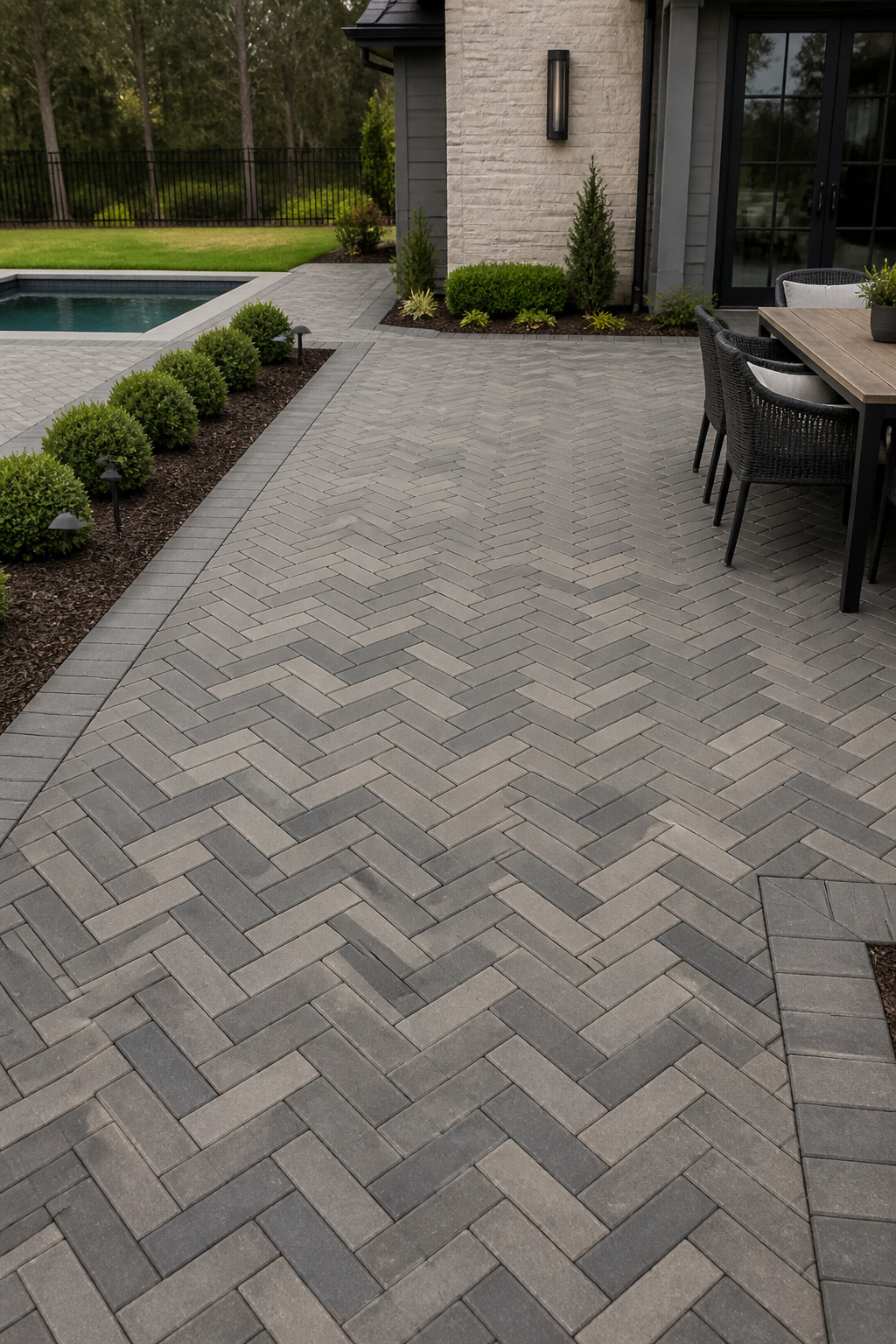
The geometry requires the right paver dimensions. Standard 8×4 inch concrete pavers rest on a 2:1 ratio — the geometric foundation of a clean herringbone interlock. Also worth knowing: the pattern distributes load across more pavers under pressure than grid layouts, which is why herringbone is the default choice for driveways and commercial pedestrian surfaces. On a residential patio it delivers the same structural benefit with a dramatically higher design dividend.
Colour mixing is where most herringbone patio ideas succeed or fail in execution. Ordering your entire patio from one pallet batch produces a banded, monolithic result. Instead, order 70% of your primary tone and 30% of a complementary tone, and blend from multiple packs as you lay — pulling one from each pack alternately prevents banding. The visual result reads as naturally varied, like old brick, rather than factory-uniform.
One installation detail that cannot be negotiated: edge restraints. Without them, the pattern spreads laterally within 2-3 years as the interlocking geometry fails at the perimeter. Plastic or aluminium edge restraints secured with 8-inch spikes at 2-3 foot intervals contain the field; a soldier course border (pavers set perpendicular to the main pattern in a concrete haunching bed) combines structural restraint with visual framing. Order 8-10% excess material — herringbone’s edge cuts generate more waste than any straight-run pattern.
3. Recycled Brick Surface With Weathered Mortar for Aged Character
New brick imitating old brick is one of the most easily spotted design deceptions in residential landscaping. The colour variation within a genuine reclaimed delivery — slight differences in oxidation, firing history, and surface wear from a demolished Victorian terrace or industrial warehouse — is what separates it from machine-made product designed to look aged.
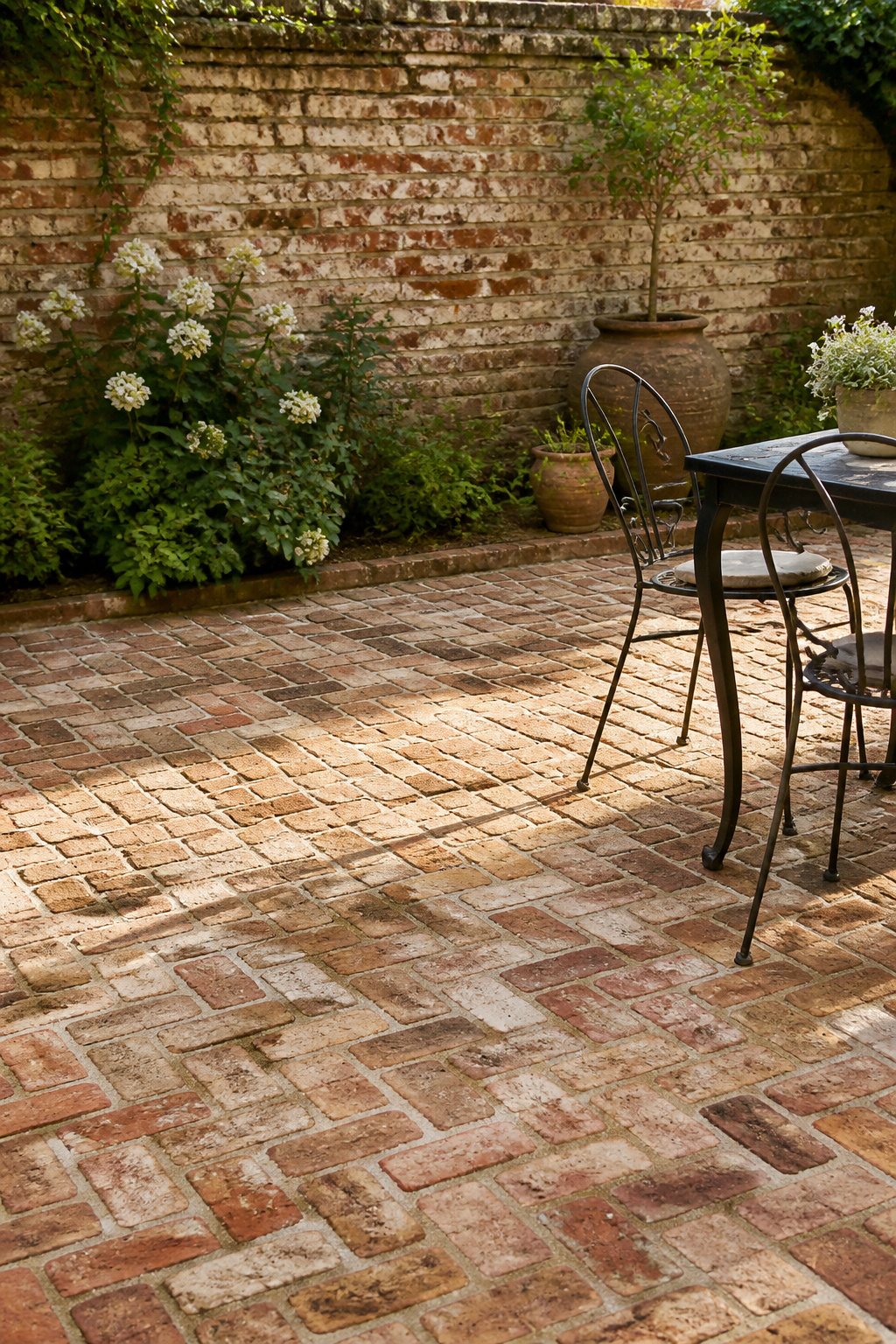
Genuine reclaimed brick comes from architectural salvage yards, demolition contractors, and specialist reclaimed material suppliers. The dimensional variation in older brick — slightly different widths, thicknesses, and corner profiles — is a feature rather than a tolerance issue. It’s precisely this variation that creates the honest, handcrafted surface that new brick lacks. Source locally where possible: it reduces transport costs and the brick’s history aligns with the local building vernacular.
The joint style decision has more visual impact than most people expect. A raked joint (slightly recessed below the face of the brick) sheds water better than a flush joint and creates more pronounced shadow lines — the shadow depth gives the surface its three-dimensional quality. Sand joints (jointing sand brushed into gaps between dry-laid bricks) offer the additional advantage of flexibility: the surface accommodates ground movement, and individual bricks can be replaced without cutting mortar. For patios not adjacent to a house foundation, sand-jointed reclaimed brick is both easier to maintain and easier to repair.
One warning for cold-climate projects: not all reclaimed brick is frost-resistant. Soft-fired Victorian brick — common in early 20th-century English and Northeastern US construction — spalls badly in freeze-thaw conditions. Always confirm frost resistance before purchasing, or specify new handmade brick from manufacturers like Ibstock Beacon or Michelmersh, which replicates reclaimed variation with guaranteed performance. As patio ideas go, this one rewards patience in sourcing — the right brick makes everything.
4. Polished Bluestone Tiles for a Sophisticated Outdoor Patio Feel
Bluestone earns its place as the most reliable premium patio stone not through visual drama but through consistent quality across every performance criterion: hardness, durability, weather resistance, and the kind of natural colour variation that reads as designed rather than random.
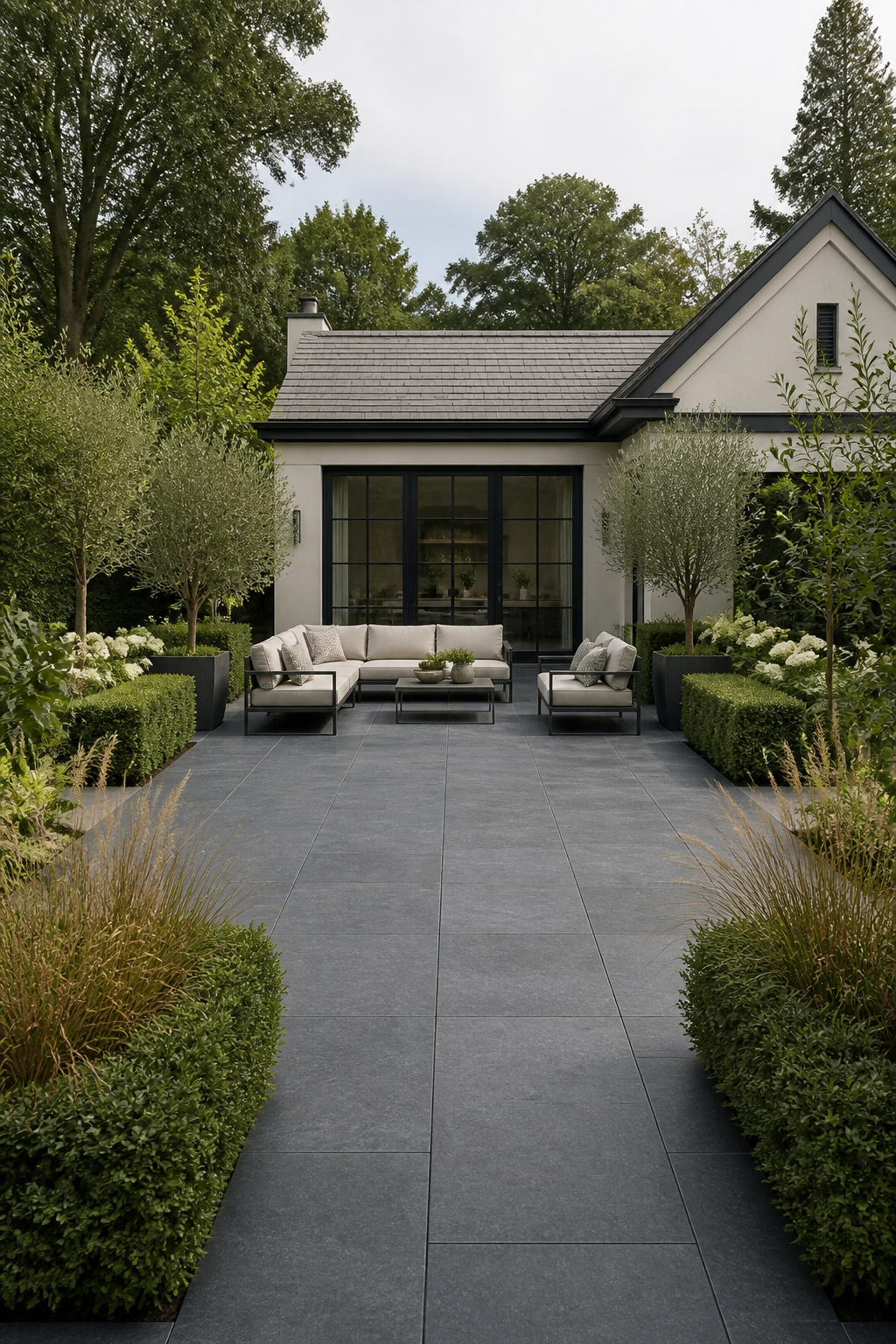
Pennsylvania bluestone is the most visually complex variety — the same quarry delivers pieces ranging from deep blue-grey to warm tawny-brown within a single order, and the variation across a laid outdoor patio surface moves between cool and warm tones as the light changes through the day. Australian bluestone (basalt-based) is the opposite: consistently charcoal throughout, with a restrained uniformity that suits contemporary and minimalist palettes. Chinese bluestone sits between the two in colour consistency and significantly below both in price.
For outdoor use, the finish choice matters more than the stone variety. Thermal (flamed) finish is the professional default for residential patios and pool surrounds: the intense flame treatment causes surface minerals to expand at a micro level, creating a lighter, more matte appearance with enhanced grip in wet conditions. Natural cleft — stone split parallel to its stratification, producing an irregular but inherently tactile surface — is the better choice for informal garden aesthetics where dimensional consistency is less important than character. Avoid specifying honed bluestone for any main outdoor patio surface unless it’s covered and shaded; the smooth finish loses meaningful slip resistance in wet conditions.
Sizing and Joint Planning
Sizing: 18×18 and 24×24 inch formats read as most premium because the reduced number of grout lines lets the stone dominate. Expansion joints (1/4 inch wide, filled with flexible sealant) are required every 8-10 feet — thermal bluestone in direct sun moves with temperature cycles, and joints that are grouted rigid will crack. It’s a surface that improves for 30 years without asking much of you in return.
5. Decomposed Granite for a Low-Maintenance Desert-Style Ground Cover
Decomposed granite is the most underrated patio surface material in residential design — and the most dramatically underpriced. Where premium stone paving runs $20-45 per square foot installed, stabilised DG covers the same area for roughly $3-5 per square foot total. The visual quality is genuinely different — not lower quality, just a different aesthetic register — and for naturalistic, Mediterranean, and desert garden styles this patio idea is actually more appropriate than any cut stone.
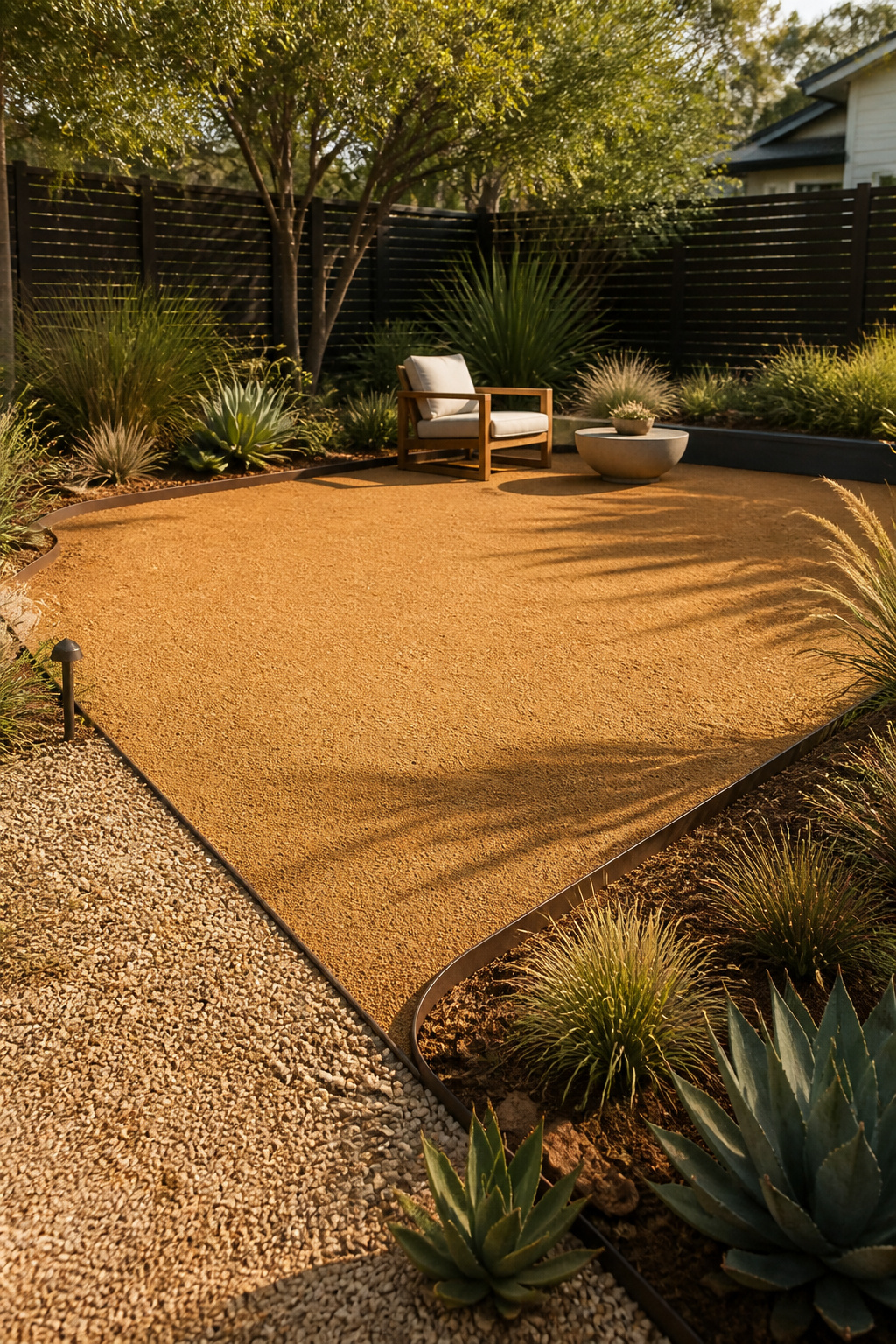
The key word is stabilised. Unstabilised DG without strong compaction kicks around underfoot, tracks indoors relentlessly, and looks untidy within a season. Stabilised DG has been mixed with a polymer binder (typically 4-6% by weight) before compaction — moisten it, compact it with a plate compactor, and it firms into a surface with real structural integrity that still looks and feels like ground rather than pavement. The colour range runs from warm gold and ochre (California granite sources) through reddish-brown (Southwest quarry granite) to grey (cooler granite origins). California and Southwestern DG in gold and amber tones complement warm stucco and timber exteriors; grey DG works with contemporary architecture and black steel details.
Installation depth: 3-4 inches of stabilised DG over a 2-3 inch compacted aggregate base, totalling 5-6 inches of excavation. The crushed aggregate below prevents the DG from sinking into soft soil over time. Fine-grain material (3/8 inch minus) compacts most firmly and feels most finished underfoot.
Containment is non-negotiable. Without solid 4-inch steel or aluminium edging, DG migrates into surrounding lawn and planting beds within one season. The edging also defines the patio geometry — in a material with no inherent edge detail, the containment profile IS the design.
6. Composite Decking in Charcoal Paired With Powder-Coated Steel Furniture
The charcoal composite and powder-coated steel pairing works because both materials share a visual language of precision and restraint. Neither has knots, colour variation, or unpredictable weathering. The consistency reads as intentional design, and it creates a contemporary outdoor palette that has held up well across multiple trend cycles rather than dating to a particular year.
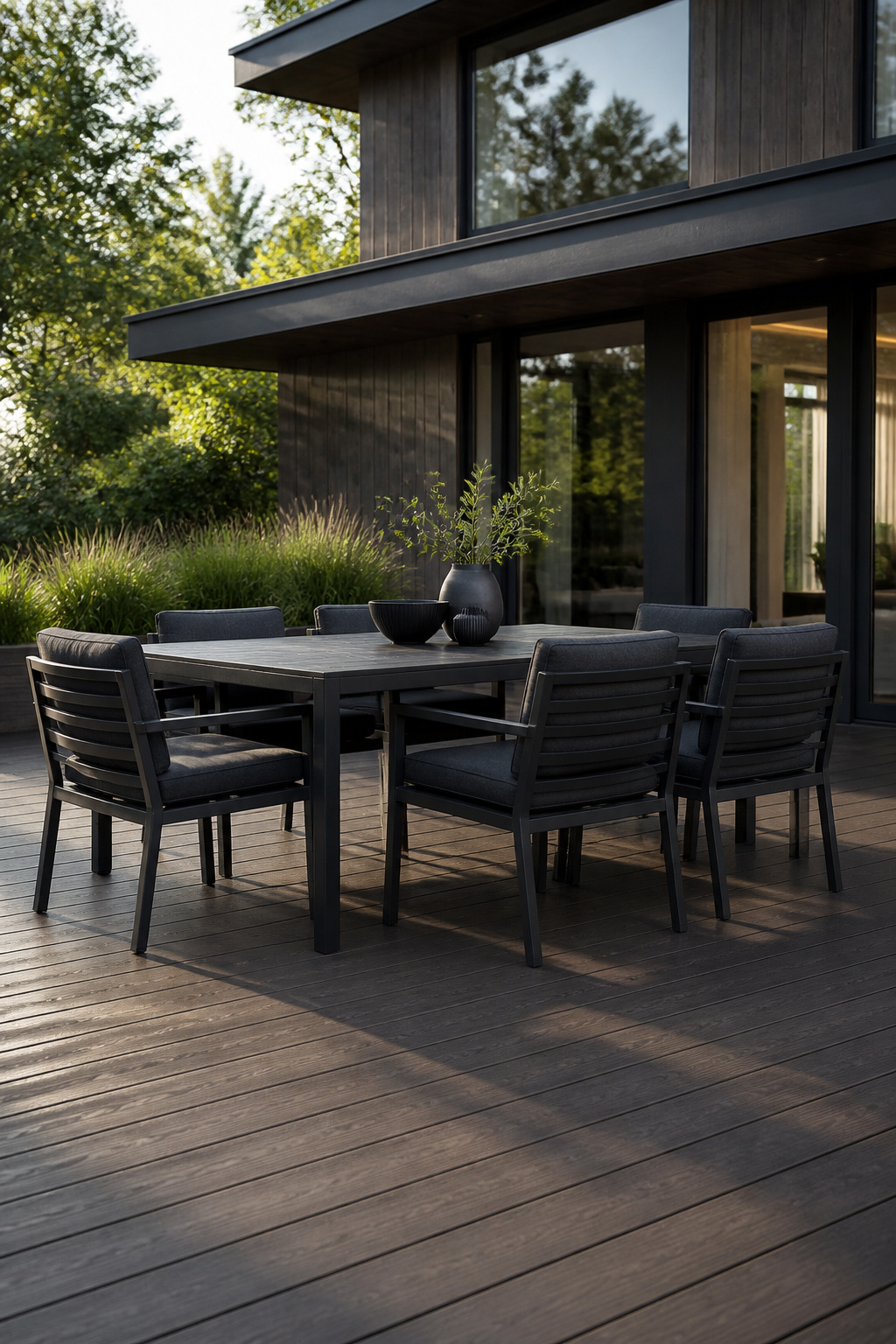
Capped composite is the standard specification for this patio idea. The protective polymer shell over the wood-fibre core delivers stain resistance, fade warranties (typically 25 years), and moisture performance that uncapped boards cannot match. Leading products: Trex Transcend (Gravel Path and Island Mist for cooler greys), TimberTech PRO (Antique Leather and Weathered Teak for warm charcoal-browns), and Fiberon Sanctuary in Coastal Cedar. The charcoal range spans near-black to warm grey-brown depending on the line — confirm the decking tone before specifying the furniture finish.
The heat retention trade-off in dark capped composite is real and worth planning around. Dark capped composite in direct summer sun can reach surface temperatures of 150°F — hot enough to be uncomfortable underfoot barefoot. For patios in hot climates: specify lighter charcoal tones rather than near-black, or look at MoistureShield’s CoolDeck Technology, which reduces heat absorption by up to 35% compared to standard capped composites. The aesthetic difference between deep charcoal and charcoal-grey is minimal in photographs but significant in mid-afternoon performance.
For furniture: deck design ideas that use composite materials effectively consistently pair the decking with aluminium-frame furniture rather than steel — aluminium is lighter to reposition and won’t rust through any scratched powder coat. Specify TGIC polyester powder coat (the thermosetting formulation with best UV stability) for any furniture that will live in an exposed outdoor position year-round.
7. Travertine Tiles With Tumbled Edges for Sun-Soaked Patio Design
Of all the stone surfaces available for outdoor patio design, travertine is the one that most consistently makes people stop and photograph it. Its palette — cream, ivory, gold, walnut brown, and silver-grey — has a warmth that no other stone achieves at this price point, and the tumbled edge profile (stone tumbled in a drum with abrasive media to round corners and create a naturally worn surface) adds the sense of centuries of use that no manufacturing process can replicate.
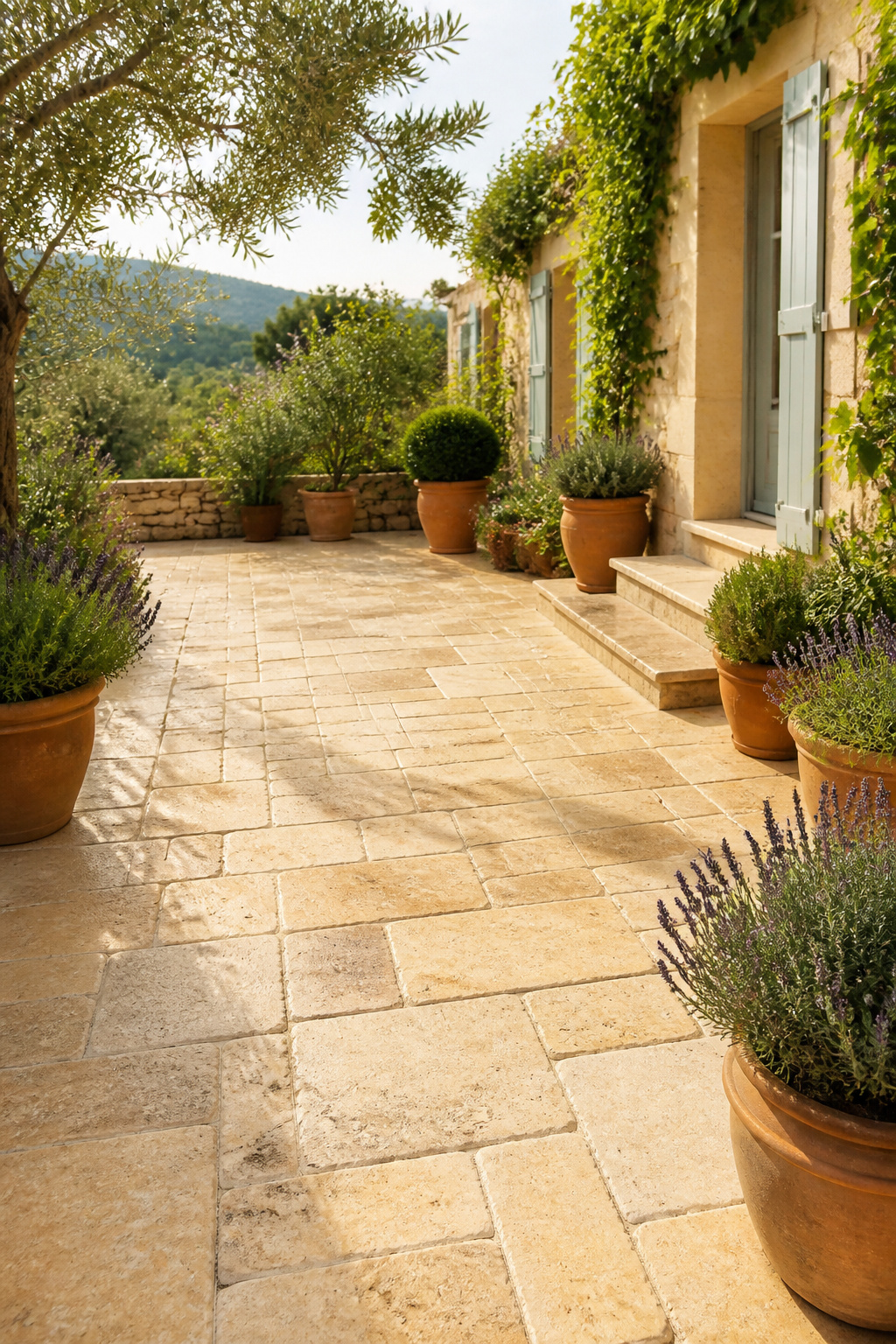
Travertine is formed in hot springs and river deposits, which explains the distinctive cross-cut pattern of voids and banding — the material carries a literal geological narrative in its surface. Filling those voids with cement grout or epoxy resin (filled travertine) reduces water absorption significantly and makes the stone appropriate for most outdoor residential applications in all climates. Unfilled travertine retains the natural pitting and void texture that makes it so rich and tactile — beautiful in dry climates (Southern California, the Southwest, Mediterranean regions) but a liability in freeze-thaw climates where retained water cracks the stone from within.
For USDA Zone 6 and colder: always specify filled travertine with frost-resistant grading. Italian and Turkish quarries rate specific lots for exterior use down to -10°F without spalling or cracking — request this grading documentation from your supplier. The outdoor schemes that work best around travertine stay within the same warm palette: terracotta, warm grey stone, and aged timber, rather than the cool steel-and-concrete palette that fights the stone’s natural warmth.
Sealing and Long-Term Care
Sealing is the ongoing commitment travertine requires. Apply a penetrating impregnating sealer at installation, reseal every 1-2 years, and clean with pH-neutral stone cleaner only. Never use vinegar, citrus-based products, ammonia, or bleach — the calcium carbonate surface etches on contact with acids and the damage is irreversible without professional refinishing.
8. Exposed Aggregate Concrete for a Textured Non-Slip Outdoor Surface
Exposed aggregate is concrete that doesn’t pretend to be something else. The standard broom-finish concrete patio conceals its composition behind a grey surface; exposed aggregate reveals what the mix actually contains — pea gravel, crushed granite, river rock, coloured glass — and makes that material the design element. The result is a surface with built-in texture, built-in non-slip performance, and a visual character that varies by aggregate selection in ways no stamped or coloured concrete can match.
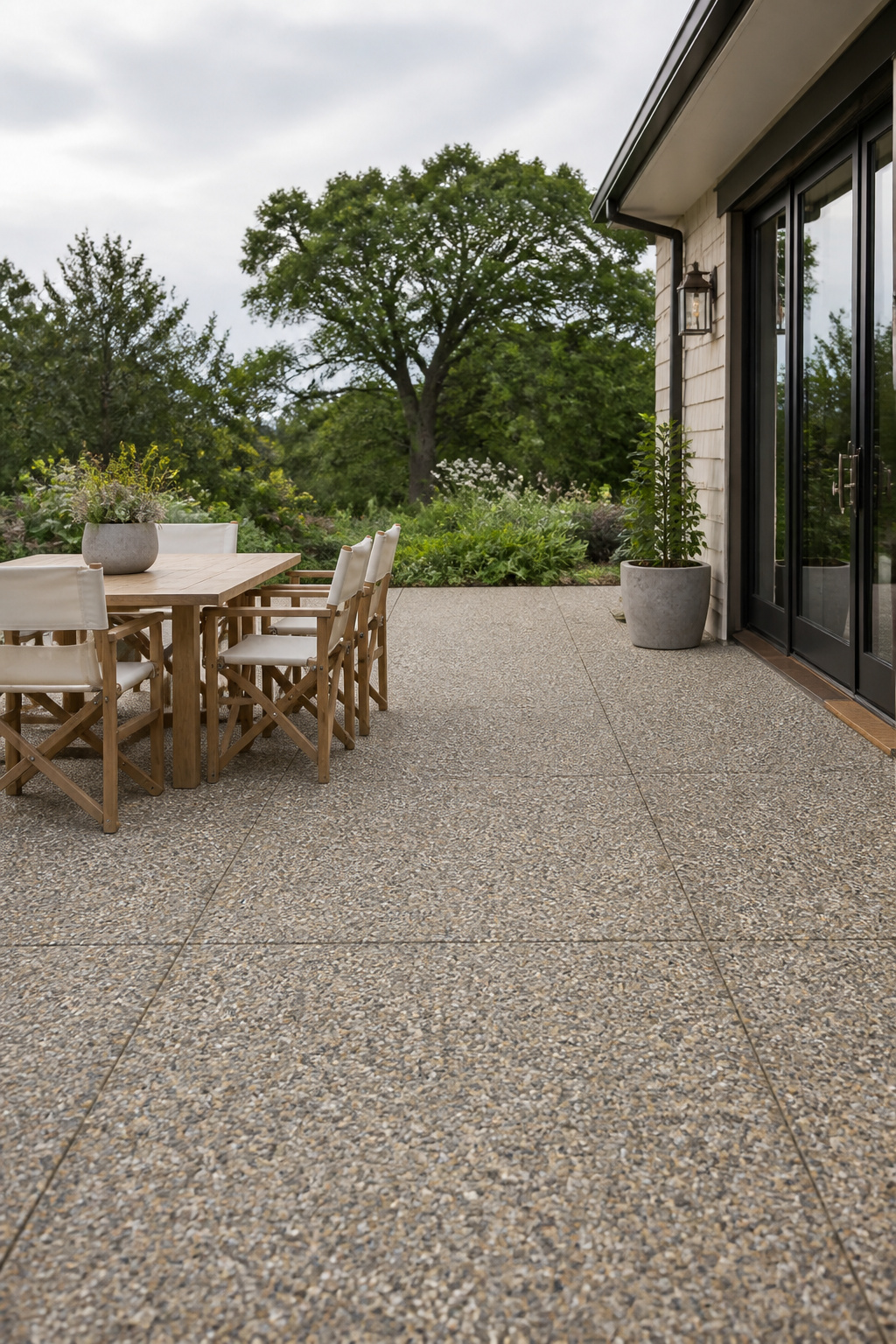
The process involves applying a surface retarder to fresh concrete (typically 3-24 hours after the pour, depending on ambient temperature) and then pressure-washing at 100-150 bar to remove the thin layer of unset cement paste and expose the aggregate below. Shallow exposure shows aggregate tips only; deeper exposure reveals more of each stone and creates a more dramatically textured surface. The depth is controlled by retarder concentration and wash timing — a skilled contractor manages this precisely, which is why the quality of exposed aggregate work varies more than most concrete finishes.
Choosing Your Aggregate
Aggregate choices drive the aesthetic entirely. Pea gravel (3/8 inch rounded pebble in grey-tan tones) is the most common choice — neutral, comfortable underfoot, naturally organic-looking. Crushed granite aggregate (more angular, available in grey, red, and black) provides stronger slip resistance and more visual drama. Recycled coloured glass aggregate — blues, greens, amber — catches light differently throughout the day; it suits pool surrounds and feature areas where the light quality changes with the sun. In terms of cost, expect $7-18 per square foot installed, substantially more than plain broom-finish concrete but less than premium stone paving. As patio ideas go, exposed aggregate sits at a sweet spot between value and performance.
Crack control joints (saw-cut or formed into the pour every 8-10 feet) are essential. Exposed aggregate concrete without adequate jointing will crack, and once it does, repairs are nearly impossible to match — the aggregate colour and distribution can’t be replicated. Seal the surface on completion and reseal every 2-3 years.
9. Reclaimed Wood Deck Boards Beside Concrete for a Warm Patio Idea
The reclaimed wood and concrete combination works because the two materials are genuinely different from one another — not in a contrived way, not forced together for the sake of ‘material contrast’, but because they do different jobs and those jobs complement each other. Wood is warm, organic, dimensionally variable, and soft underfoot. Concrete is cool, industrial, precise, and unyielding. Placed side by side in a patio design, both materials read more intensely than either would alone.
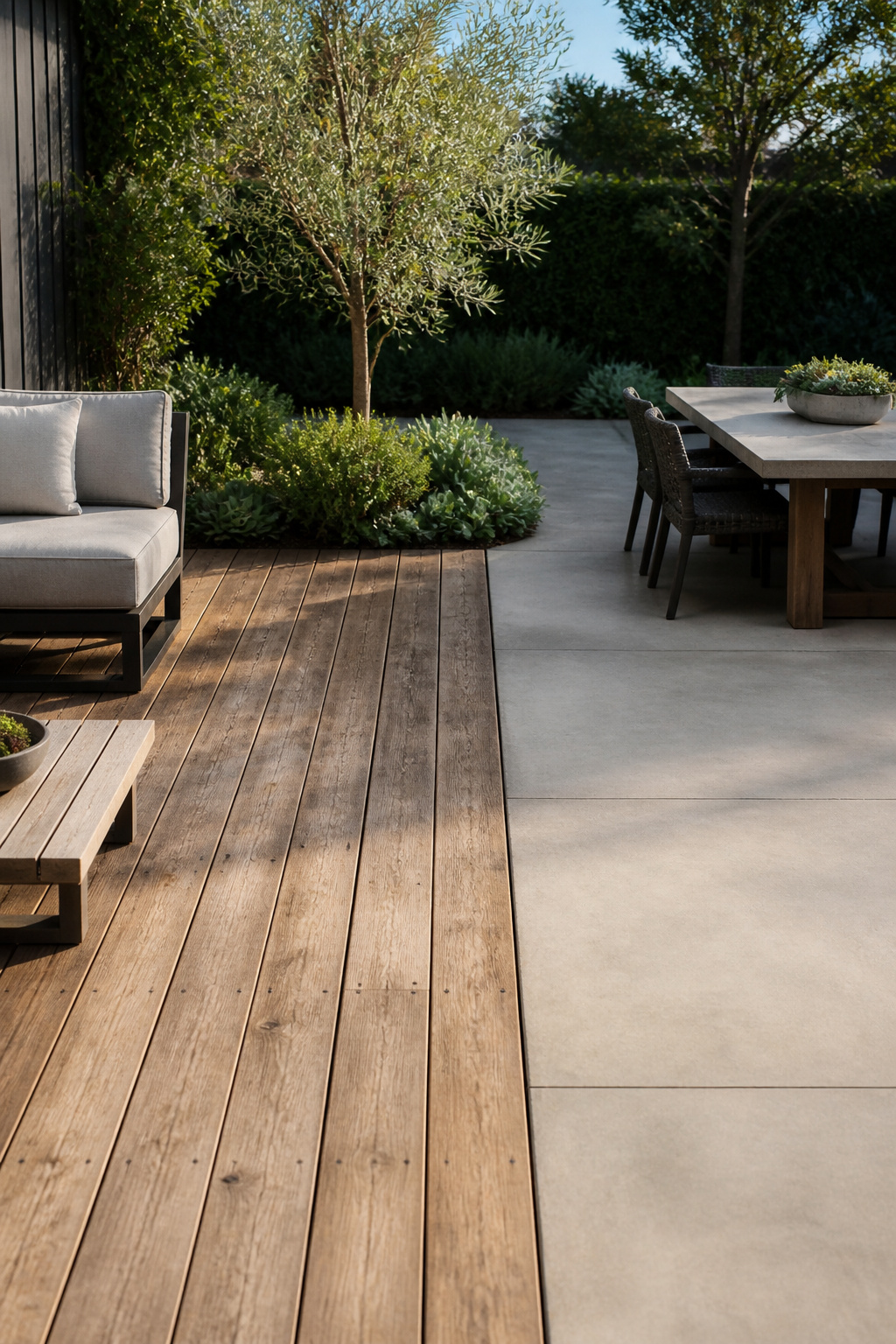
The patio decorating ideas that combine hard and soft surfaces that get this right always resolve the transition between materials cleanly. The wood zone should sit within 1/4 to 1/2 inch of the concrete level — ideally with the decking 1/4 inch proud to shed water away from the junction. A drainage gap of at least 1/4 inch between the wood frame and any adjacent concrete prevents moisture from being trapped and causing rot at the interface.
Species Selection for Outdoor Decking
Reclaimed ipe (Brazilian walnut) is the professional benchmark — Janka hardness of 3,684 lbf, naturally resistant to rot and insects, virtually maintenance-free for the first decade. Reclaimed teak carries natural oils that repel moisture and insects; left unfinished it develops a silver-grey patina that many find more beautiful than the original warm honey tone. Reclaimed Douglas fir, salvaged from old-growth barn beams and warehouse rafters, is considerably softer but carries a tight grain density that modern kiln-dried Douglas fir never achieves — the history is visible in the grain.
For reclaimed hardwood like ipe or teak, use hidden fastener systems (Ipe Clip Extreme, DeckWise) with a 5/32-inch spacing gap — the angled screw through the clip into the joist leaves no face-screws visible and allows the board to expand and contract naturally. Pre-drilling is essential: driving screws into ipe without pilot holes splits the board.
10. Mixed Material Zones Combining Gravel, Pavers, and Timber Decking
An outdoor space divided into distinct material zones does the same work as an open-plan interior with a rug, a sofa grouping, and a dining area — it creates places without walls. The material underfoot communicates zone before any other design element does, and the transition between materials signals movement in a way that a continuous surface cannot.
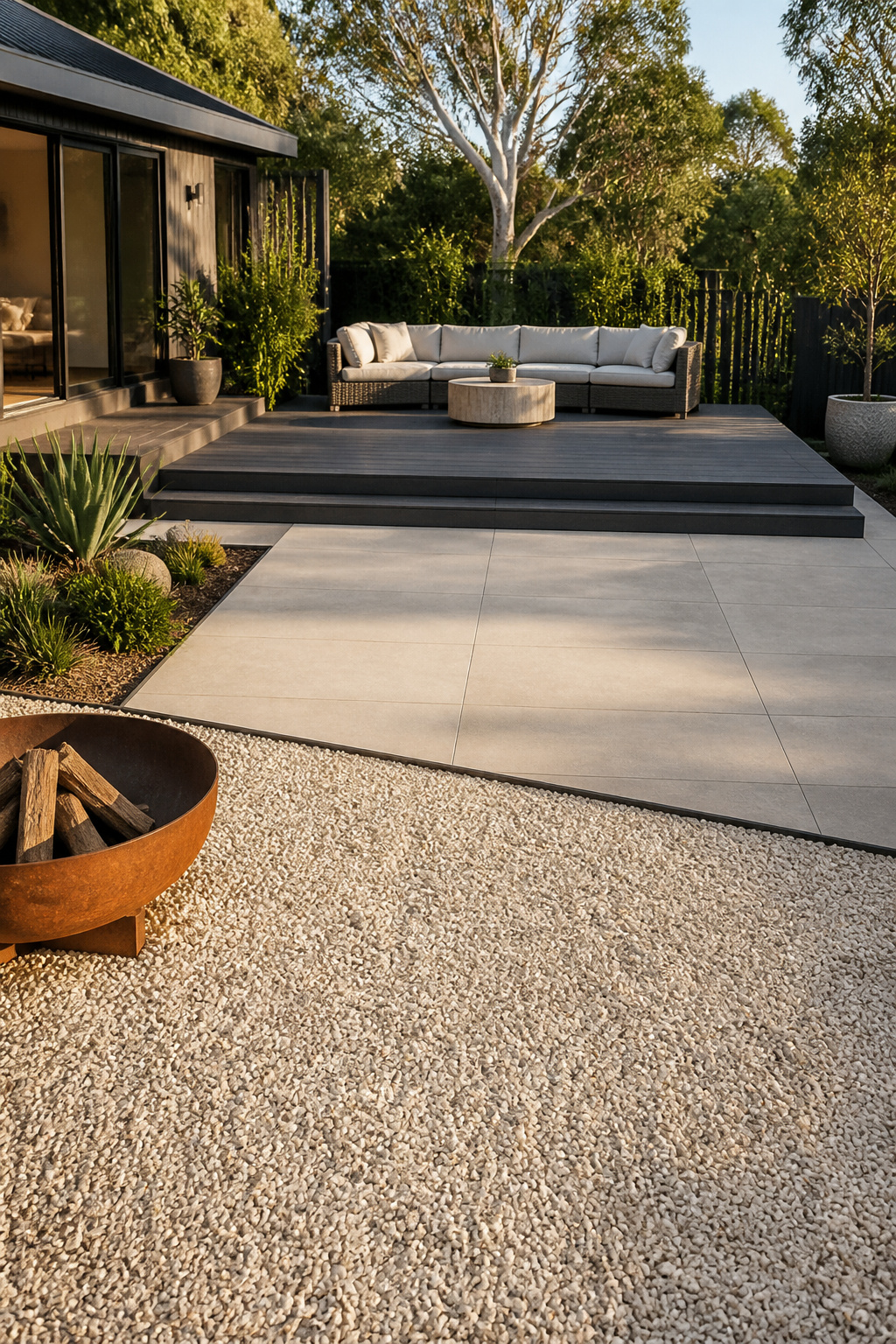
The logic of fire pit landscaping ideas to anchor a multi-zone backyard applies directly here: define a focal point, then organise material zones around it. Gravel works as the transitional material — it reads as ground rather than flooring, connecting the structural paver zone and the elevated timber platform without competing with either. Composite or hardwood decking on a raised platform (even 6 inches above the patio level) creates a destination — the physical step up signals arrival at the social core of the garden.
Height management is where this patio idea succeeds or fails. All three surfaces should sit within 1/4 inch of each other across transitions — even small height differences become trip hazards when people are navigating with drinks or plates in hand. Steel or aluminium edging profiles (16-gauge, 4-inch height) provide clean transitions between gravel and pavers; a timber fascia board handles the paver-to-decking transition without an awkward gap.
Colour Coherence Across Materials
Colour coherence across three materials is the design discipline this approach demands. A neutral binding tone — warm grey, warm buff, or deep charcoal — should appear in all three materials for the composition to read as intentional. Warm travertine pavers against cool grey composite decking creates visual discord rather than designed contrast. Test all three material samples together in outdoor light before committing — stone and composite colour relationships look entirely different under overcast sky than under direct afternoon sun.
11. Large-Format Porcelain Pavers Mimicking Marble for an Elevated Look
Porcelain is the material that changes most people’s opinions when they encounter it in person rather than in a specification sheet. The standard assumption — that it’s a cheaper substitute for natural stone — is wrong, and it’s expensive to discover this after buying real marble for an outdoor patio and watching it stain and fail within two seasons.
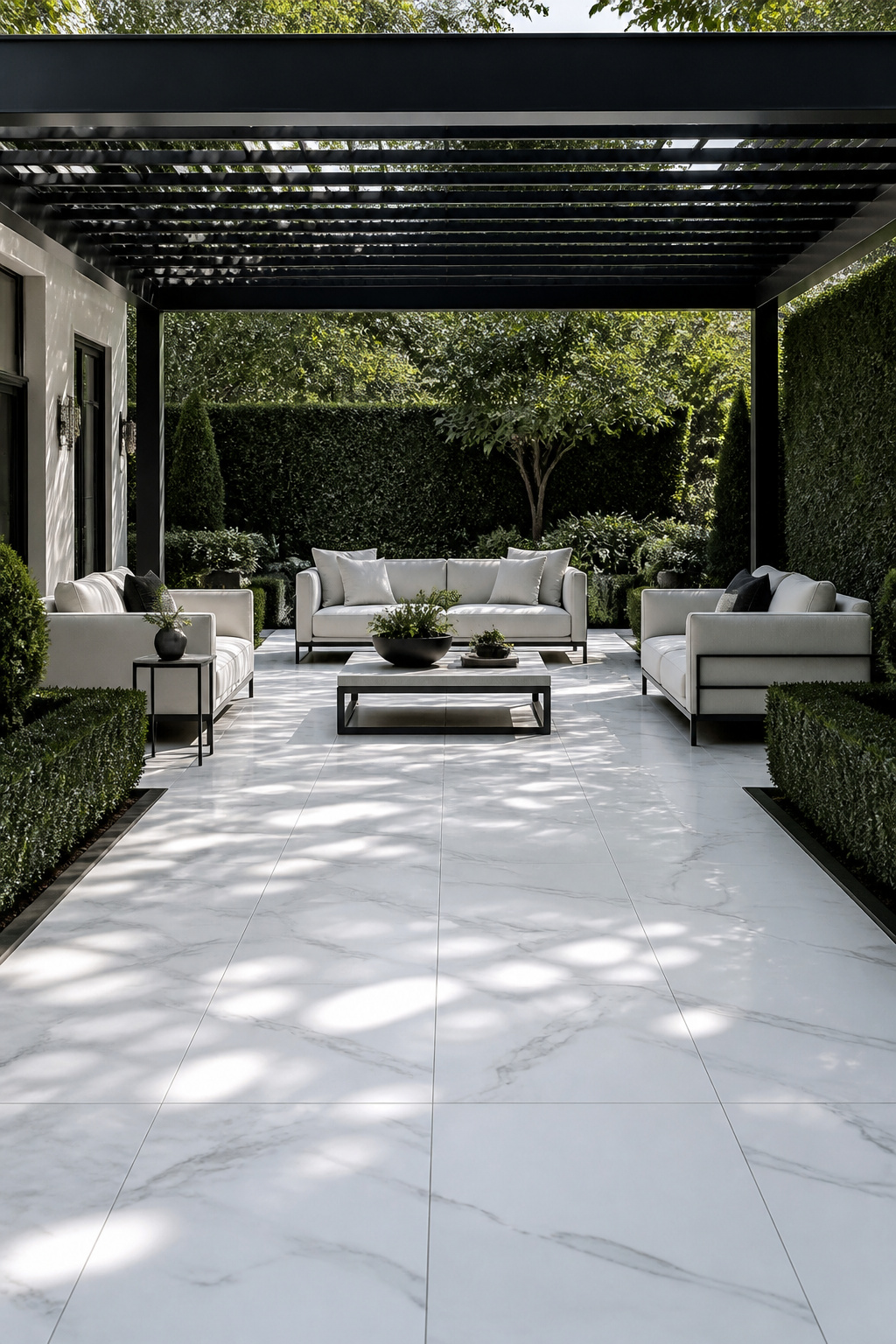
Fired at over 1200°C, outdoor-grade 20mm porcelain pavers absorb less than 0.5% water by weight. That near-zero porosity makes them frost-proof, stain-resistant, and dimensionally consistent in a way that natural stone — including marble — simply cannot be. The marble-look range (Calacatta, Statuario, Carrara vein pattern options) replicates the aesthetic of polished Italian marble with none of marble’s outdoor maintenance liabilities: no etching from acid rain, no staining from organic matter, no freeze-thaw failure. This is one of those patio ideas where the practical case is as strong as the aesthetic one.
Large-format sizes — 24×24, 24×48, and 32×32 inch — create the clean, near-continuous surface appearance that makes a patio read as premium. Rectified edges (machine-cut to precise tolerances) allow tight grout joints of 1/4 inch or less, and the reduced number of visible grout lines is what makes the format so effective. The installation requirement is rigid: porcelain cannot bridge voids. A fully supported mortar bed or pedestal system is non-negotiable — any unsupported section will crack under load.
For slip resistance: R11 is the minimum for a residential outdoor patio surface. R12 is appropriate for pool surrounds and steep slopes. The ‘structured’ or ‘bush hammered’ surface treatment achieves R12 ratings while maintaining a sophisticated appearance that reads as textured limestone rather than a safety floor. Specify this finish for any uncovered patio area where wet-condition traction is a priority.
12. Quartzite Stepping Stones Set Into River Pebbles for a Natural Flow
Quartzite stepping stones through a river pebble ground is a patio idea that almost always works — the hard, crystalline surface of the quartzite against the smooth, rounded pebbles creates a textural relationship that feels organically composed rather than deliberately designed. The materials come from different geological processes but arrive at a visual harmony that reads as naturally as gravel and moss.
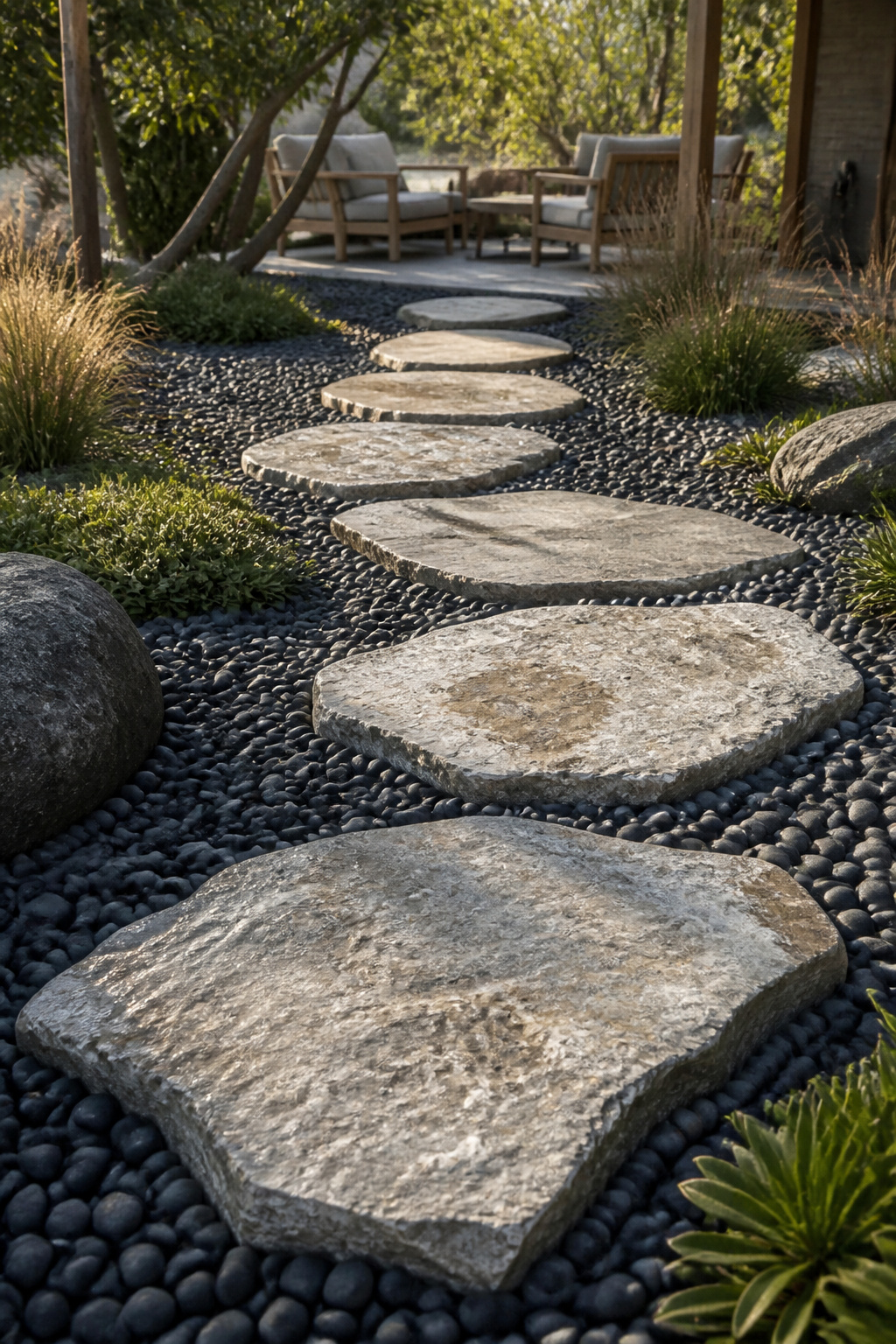
Quartzite’s characteristic surface is formed under metamorphic pressure from sandstone — the crystalline restructuring creates a shimmer in sunlight that no other stepping stone material replicates. In grey or buff tones it works in the widest range of garden palettes; the multi-colour varieties (gold, rust, and white in the same stone) suit naturalistic plantings where the complexity of the stone surface mirrors the complexity of the planting.
Stone Thickness and Setting Technique
Two to three inches is the professional standard for permanent installations — anything under 1.5 inches risks cracking under a concentrated step load. Set each stone into a 1.5-2 inch sand or stone dust base over a 2-4 inch compacted gravel sub-base. Space stepping stones at natural walking stride distances (roughly 18-24 inch centre-to-centre) — the spacing should be tested by walking the proposed path before any stone is set.
Mexican beach pebbles in the 1-3 inch size range are the most effective fill material: their weight prevents scatter underfoot, and their smooth rounded form and dark grey-black colour contrast strongly with light quartzite. Fill depth should sit 1/2 to 1 inch below the top face of the stepping stones — you want the stones clearly proud of the pebble field for visual definition and practical step clarity. Managing the planting edge to prevent grass or groundcover creeping into the pebble zone keeps the composition clean season after season.
13. Corten Steel Edging With Crushed Stone Fill for Bold Patio Ideas
Corten steel edging against pale crushed stone is among the highest-contrast material pairings available for outdoor design — the orange-rust of the weathered steel against white limestone or grey granite creates a palette defined by elemental opposition. There is no subtlety to it. That’s the point.
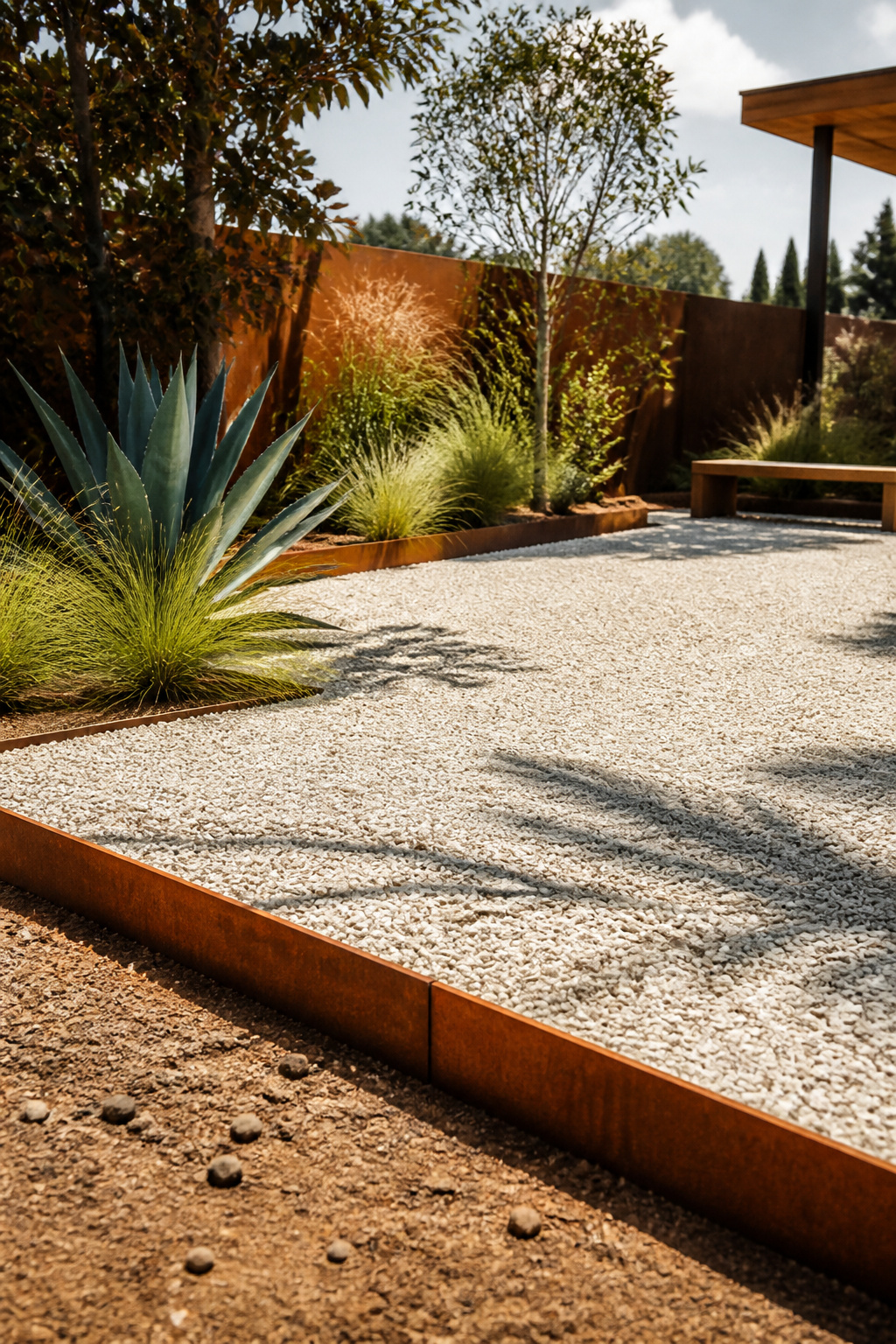
Corten (weathering steel) develops a stable rust-like patina through a specific alloying process involving copper, chromium, and nickel. Unlike ordinary steel that rusts through, the patina is self-regenerating and non-porous — it shields the material underneath from further corrosion and stabilises within 2-3 years of weather exposure. One early-phase note: corten produces rust-coloured runoff as the patina forms. Seal any adjacent light-coloured stone or paving before installation begins, or design the layout so runoff drains away from permanent surfaces.
Standard landscape edging runs 14-gauge (1/16 inch) — appropriate for defining a gravel patio perimeter, containing a stone pathway, or framing a raised planting bed. For taller applications (4-6 inches acting as a structural border around a raised stone area), 10-gauge (1/8 inch) provides the rigidity to resist lateral soil pressure without bowing over time. Individual strips are hammered directly into the ground with a rubber mallet — no adhesive, no concrete required — and connector clips join strips at length for continuous runs.
Choosing the Stone Fill
Stone fill options: white crushed limestone (1/4 to 3/4 inch) delivers maximum visual contrast — the brightest palette against orange corten — but shows algae and organic debris more readily in shaded positions. Grey granite chippings (1/2 to 1 inch) are lower-maintenance, more forgiving of organic accumulation, and work with both warm and cool architectural palettes. Plant partners that reinforce the corten aesthetic: ornamental grasses, Agave, Stipa gigantea, and structural succulents — the rust tone anchors the wild, architectural planting style that corten naturally complements.
14. Lava Stone Surface That Brings Volcanic Texture to Outdoor Spaces
Basalt lava stone is not a material that asks for anything from the design around it. The volcanic process that creates it — rapid cooling of lava, trapping gas bubbles in a dense fine-grained matrix — produces an inherently textural surface that carries its own visual authority. Dark charcoal-black, porous-looking (though actually low-absorption), and with surface depth that no manufactured tile can replicate, basalt reads as geologically serious in a way that ceramic, porcelain, and even most natural stone does not.
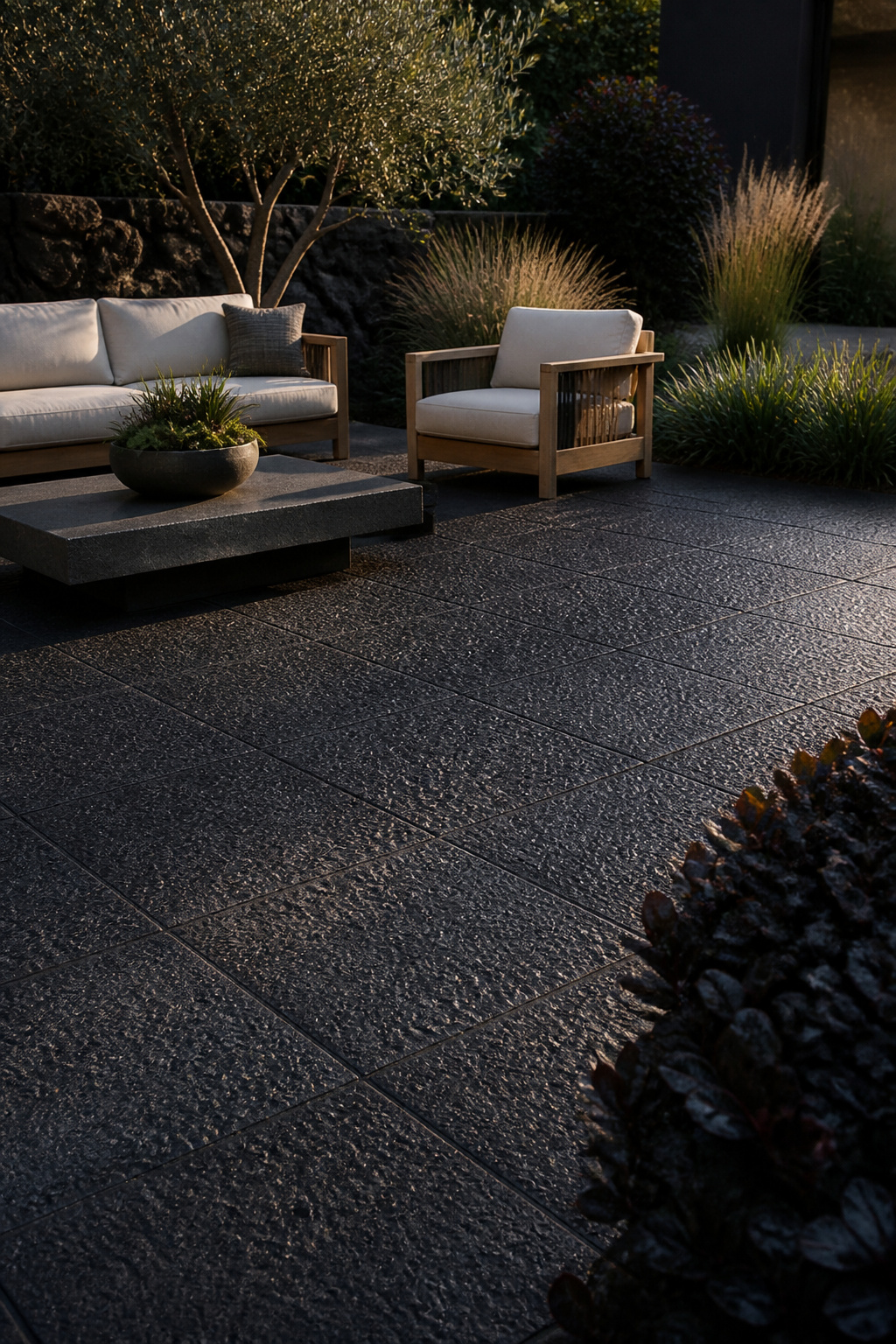
The bush-hammered finish develops this texture further — mechanical impact creates uniform indentations across the surface that provide exceptional grip in wet conditions. A non-slip performance achieved not through surface treatment but through the material’s own physical character. For porch furniture ideas that complement dark stone surfaces, the basalt palette suits natural linen, aged teak, black powder-coated frames, and woven rattan — materials that either echo or contrast its elemental quality without competing with it.
Performance and Sealing
Practical performance: basalt’s water absorption rate is below 1% despite its textured appearance — this is a dense volcanic rock, not a porous sedimentary stone. It handles freeze-thaw cycling without spalling, drains efficiently around each textured indent, and is available in outdoor-grade 30mm (1.18 inch) thickness at 12×12, 12×24, and 24×24 inch formats. The 30mm specification is the non-negotiable outdoor standard — thinner formats risk cracking under furniture leg loads.
Sealing: a penetrating impregnating sealer applied at installation protects against staining and biological growth without altering the matte volcanic aesthetic. A colour-enhancer formulation (penetrating, breathable) can intensify basalt’s natural black-charcoal tone for a richer appearance. Reseal every 3-5 years — basalt’s low absorption rate means sealer isn’t consumed as quickly as in more porous stones. Water beading on the surface confirms the protection is still active.
15. Permeable Pavers Over a Gravel Sub-Base for Eco-Conscious Patio Design
The environmental case for permeable paving is straightforward: every square foot of conventional impervious paving converts precipitation into runoff that overwhelms drainage systems, erodes adjacent soil, and bypasses the natural groundwater recharge cycle. A PICP (Permeable Interlocking Concrete Pavers) system returns water to the ground on-site, reducing peak stormwater flow by up to 90% compared to solid paving. But the practical case is equally compelling — no standing water, no puddles, no ice formation on the surface in winter, and in many municipalities, an exemption from regulations restricting the area of new impervious surface coverage.
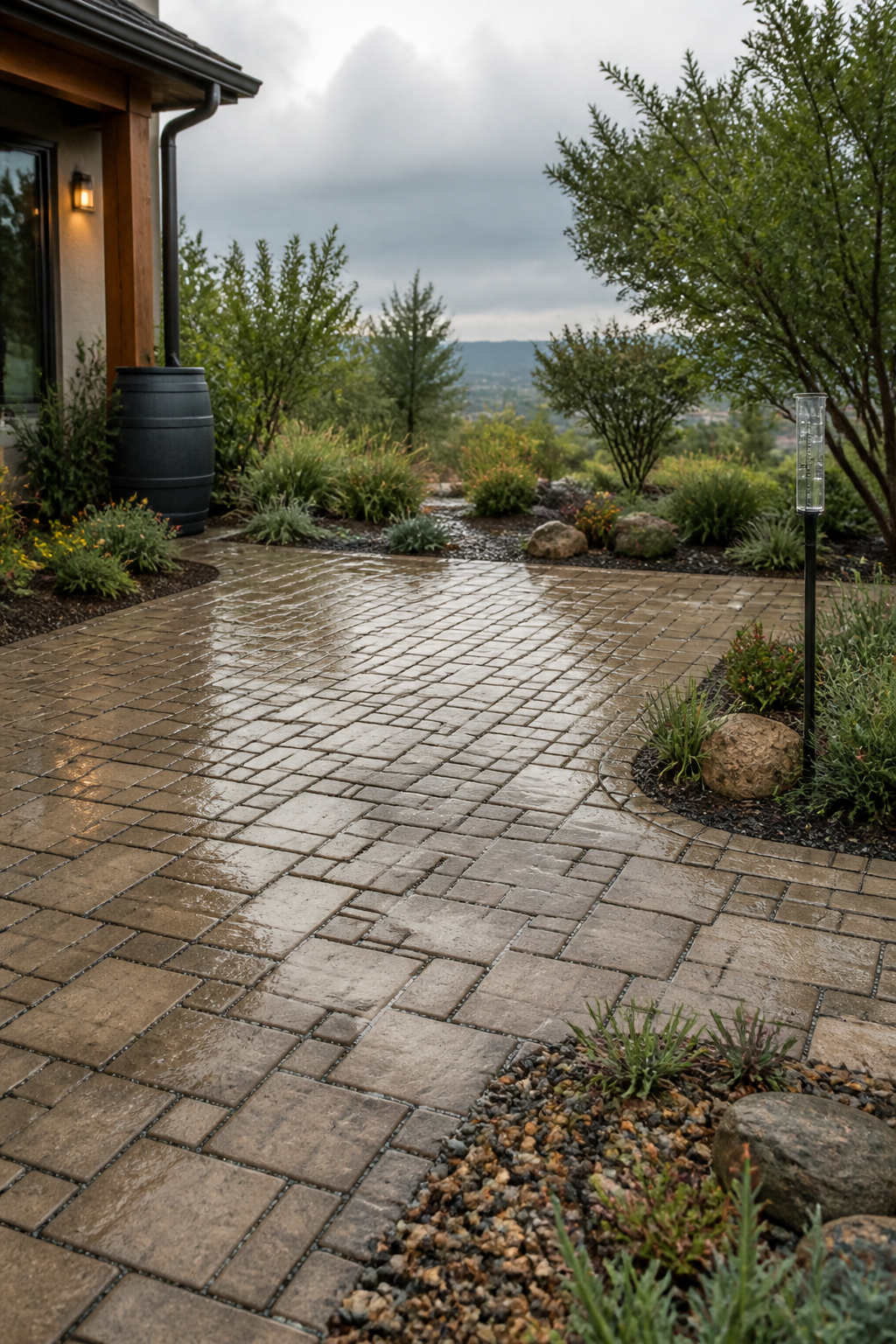
PICP systems are conventional-looking concrete pavers installed with specifically sized gaps filled with clean angular aggregate (typically 3/8-inch granite or limestone). The water passes through the gaps, into a clean aggregate sub-base (6-12 inches of uniformly graded 3/4 to 2.5-inch stone), and releases slowly into the ground below. Belgard, Unilock, and Techo-Bloc all offer load-rated PICP systems suitable for both pedestrian patios and vehicular driveways. For a purely pedestrian application, plastic grid systems (GravelRings, EcoGrid) filled with decorative gravel are a DIY-friendly and less expensive alternative. This patio idea also reduces erosion risk and eliminates the standing water where mosquitoes breed.
Sub-Base Construction
The sub-base aggregate specification is where most DIY installations fail: use uniformly graded angular stone only. Rounded pea gravel rolls under load, collapses the sub-base structure, and causes the surface to sink and shift. Clean angular stone interlocks under compaction and provides both drainage capacity and structural support simultaneously.
Maintenance is modest but not zero: joint aggregate refilling every 3-5 years as fines compact and settle, occasional vacuum or pressure-wash to clear sediment from joints in high-organic-matter environments. The upside — that standing water simply does not exist on a well-installed permeable system — makes this the right choice for any patio that currently collects puddles after rain or sits under tree canopy with heavy leaf fall.
Choosing Materials That Make Your Patio Ideas Work for the Long Term
Start with climate. Freeze-thaw cycles eliminate several options from the shortlist immediately: unfilled travertine, soft-fired reclaimed brick, and any natural stone without confirmed frost-resistance grading are poor investments in Zone 6 and colder. Thermal bluestone, 20mm porcelain, basalt lava stone, concrete pavers, and exposed aggregate concrete all handle freeze-thaw reliably. In hot arid climates, the concern reverses — decomposed granite, flagstone with planted joints, and exposed aggregate thrive, while dark composite decking needs a cooler-tone specification to avoid uncomfortable surface temperatures.
Then consider use pattern and maintenance willingness honestly. High foot traffic with young children or pets pushes you toward exposed aggregate and thermal bluestone — both provide non-slip performance through material texture rather than applied coating. Reclaimed wood and loose DG require annual maintenance commitment. Large-format porcelain and bluestone need periodic sealing but otherwise ask very little. Each patio idea listed here has a different maintenance profile, and the one you’ll actually maintain is the right one for your situation.
Finally, the budget reality: decomposed granite ($3-5/sq ft total) and exposed aggregate concrete ($7-18/sq ft installed) cover large areas for relatively modest investment. Herringbone concrete pavers ($10-18/sq ft) and composite decking ($15-25/sq ft with framing) represent the mid-range. Thermal bluestone, travertine, and large-format porcelain ($20-45/sq ft) are premium investments amortised over 20-30 year lifespans. The calculation that makes sense for a terrace you’ll use every evening for decades doesn’t make the same sense for a side passage you cross twice a day.
The surface is the foundation. Get that decision right and everything else placed on the patio — the furniture, the planting, the lighting — settles into place.