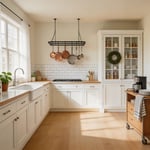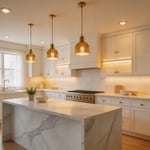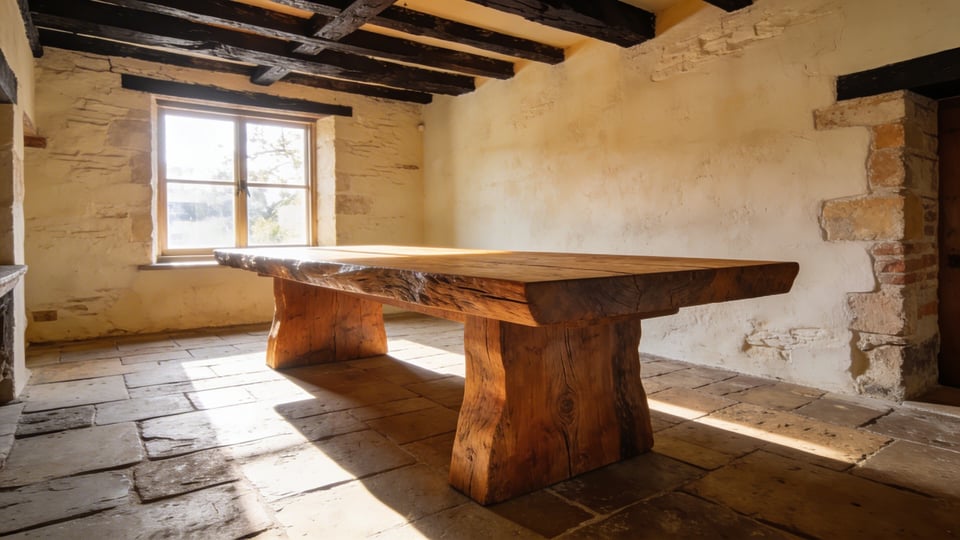
The farmhouse dining table is far more than mere furniture. It grounds the entire home. Early builders crafted these pieces using local timber, so the design always reflected the nearby woods. English makers favored massive elm or oak planks, while French artisans utilized warmer walnut or cherry. Scandinavian designs, however, relied on pale, scrubbed pine. Because these tables lacked delicate veneers, they offered absolute material honesty. Indeed, every deep gouge became a permanent family record.
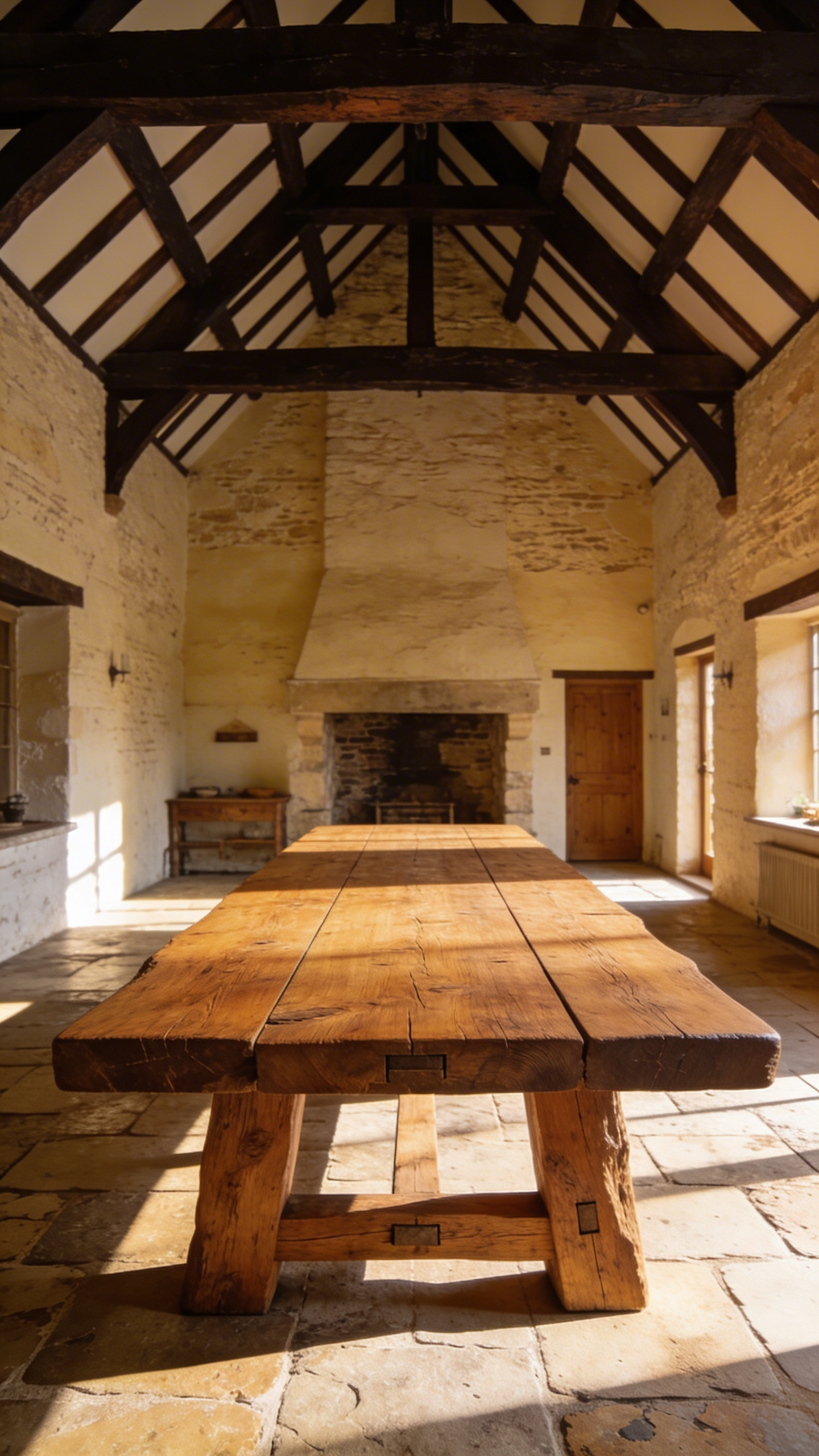
Nineteenth-century movements deepened this design philosophy. Shaker communities, for instance, introduced the elegantly tapered leg because they believed excessive ornamentation was sinful. Later, the Arts and Crafts movement championed visible joinery. A through-tenon joint proved the craftsman’s absolute integrity.
I always appreciate the sensory archive embedded in these pieces. Traditional tables feature a pegged mortise and tenon joint. Driving a wooden peg creates a hollow, resonant thud. Over time, this joint actually grows stronger as the wood breathes. Authentic antique tables also possess a distinct, tactile patina. Hand-planing leaves micro-undulations that catch the light beautifully. In fact, raw or oiled tops absorbed everyday household scents, capturing faint traces of beeswax and lavender.
These heavy tables originally lived in the working scullery. Eventually, they migrated into the center of the modern home. Now, we place these rugged pieces in formal rooms. This shifts the mood of Dining Decor: From Casual Eats to Formal Feasts toward a more grounded experience. We proudly signal that participation outvalues presentation. A solid-wood table provides essential gravitas. It remains a touchstone of continuity in our digital times.
1. The Evolution of Agrarian Utility: Why the Farmhouse Table Endures in Modern Design
The farmhouse dining table began as a crude work surface. However, it now anchors modern interior design. This endurance relies heavily on clever, low-tech material engineering. When choosing your perfect modern dining table, you will find that traditional breadboard ends allow thick wooden planks to breathe safely. These joints prevent wide surfaces from cupping during seasonal humidity changes. In fact, owners often hear a distinct pop during these transitions as the organic wood safely expands and contracts.
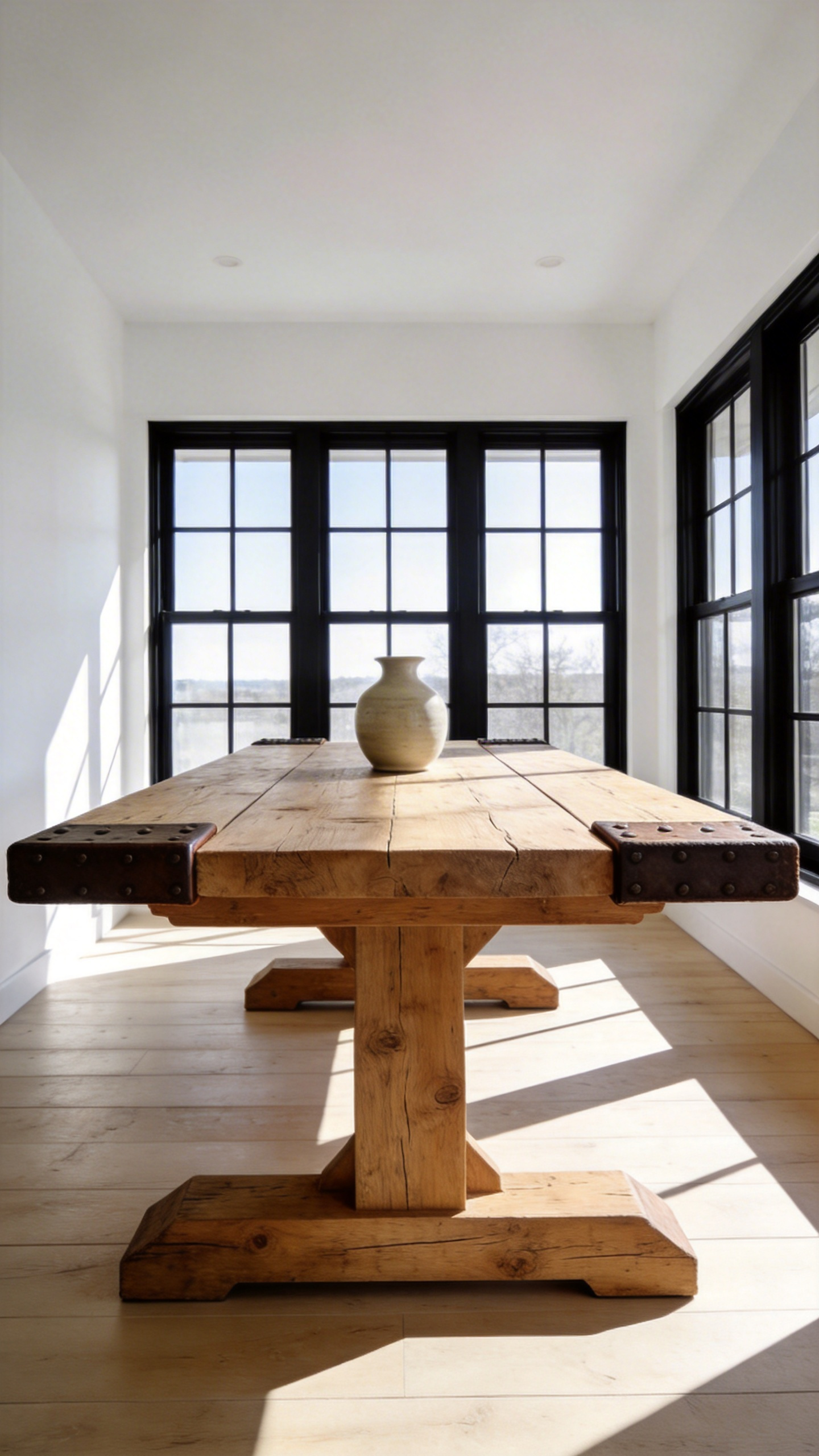
This natural movement creates unmatched tactile authenticity. Today, we crave sensory grounding to offset smooth glass screens and synthetic plastics. The intentional retention of knots and tool marks becomes a true design asset. Over time, every wine ring or scratch adds to a rich patina. This visual biography transforms simple lumber into a cherished family heirloom.
A massive table provides heavy visual weight in airy spaces. For example, pairing a salvaged oak table with sleek metal chairs creates structural tension. This juxtaposition beautifully blends rugged agrarian history with a refined minimalist future. As a result, the room feels thoughtfully collected rather than hastily decorated. Decades ago, designers favored bright orange pine. Modern iterations, however, feature reclaimed timber finished with matte oils. These organic finishes preserve the essential, living texture of the raw wood.
2. Identifying True Heirloom Quality: The Anatomy of Authentic Joinery
To identify heirloom quality, one must look past the rustic surface. Authentic bespoke joinery acts as a sophisticated engineering solution. It manages the living, breathing nature of solid wood. Mass-produced tables often rely on weak metal brackets. A true heirloom, however, uses the drawbore mortise and tenon. Visually, you can spot a wooden peg on the leg. Running your thumb over it reveals a slight crown. This offset peg acts as a wedge to pull joints incredibly tight.
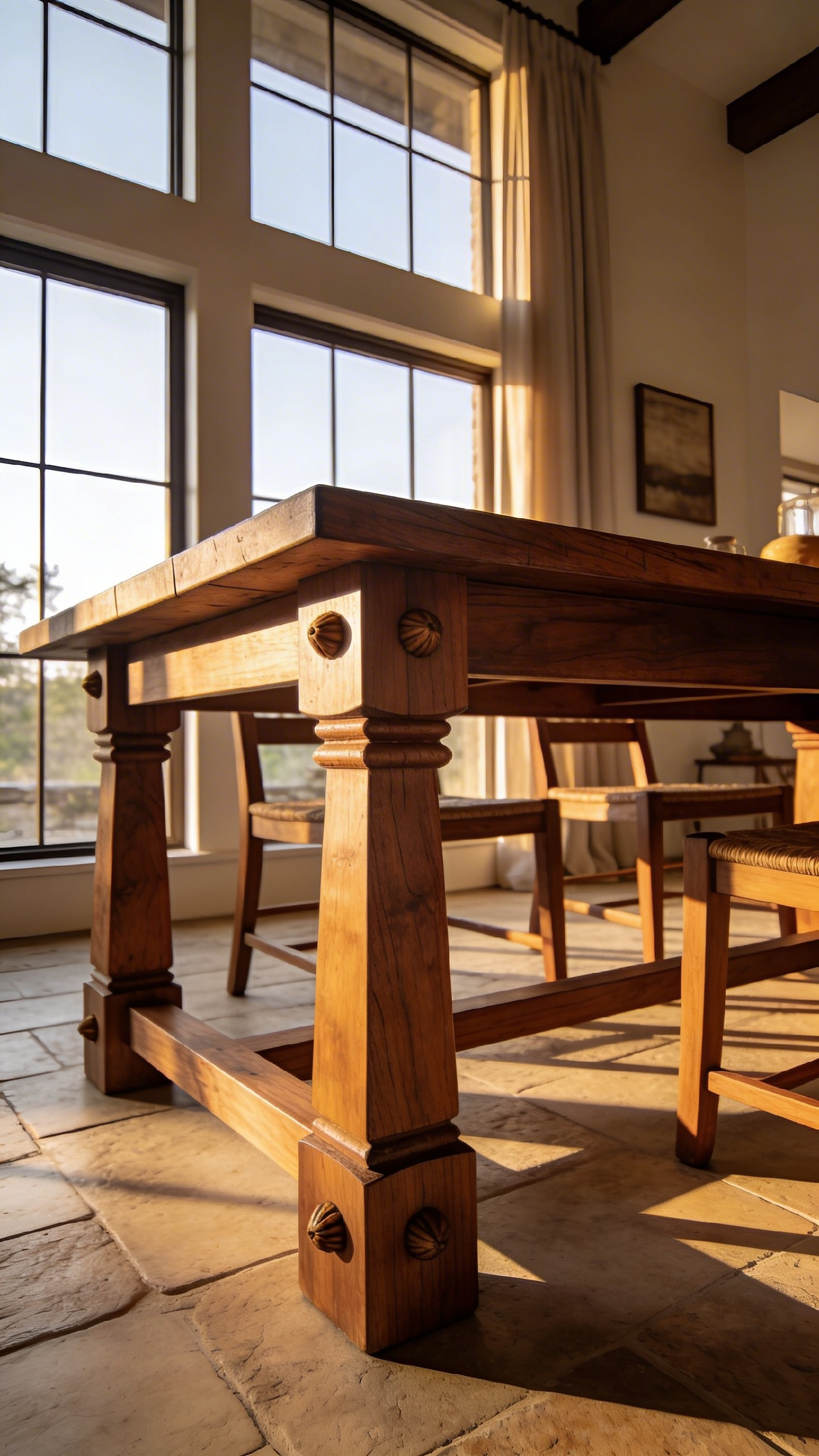
Wide farmhouse planks are prone to cupping over time. Artisans use a breadboard end to keep tops flat. Crucially, an authentic breadboard is only glued in the center. The main tabletop can shrink and expand naturally. In fact, this creates a beautiful, shifting edge between seasons. Central trestle tables require housed joinery for hidden strength. The horizontal beam is recessed directly into a shallow socket. As a result, weight transfers safely into the solid wood.
True heirloom pieces carry the fingerprints of their makers. You might notice razor-thin scribe lines near joints. Slight chisel marks often remain inside the flat joint cheeks. Together, these subtle textures create a rich, layered aesthetic. These authentic details ensure the furniture feels beautifully alive.
3. The Trestle vs. Pedestal Debate: Understanding Structural Integrity and Flow
Choosing between a trestle and pedestal involves more than aesthetics. It balances communal engineering with neoclassical intimacy. Heavy oak slabs require immense support, so the trestle utilizes a stretcher beam. This stout timber converts lateral force into rigid tension. This aligns with 7 Timeless Trends to Elevate Your Dining Room Style by focusing on permanent, structural beauty. The heavy table feels incredibly rooted and still. The dense wood grain effortlessly absorbs unwanted micro-vibrations. This low stretcher also provides a beloved ergonomic footrest. It beautifully elevates your feet above chilly floors during long dinners. Additionally, the trestle’s visual gravity anchors a large, airy kitchen perfectly.
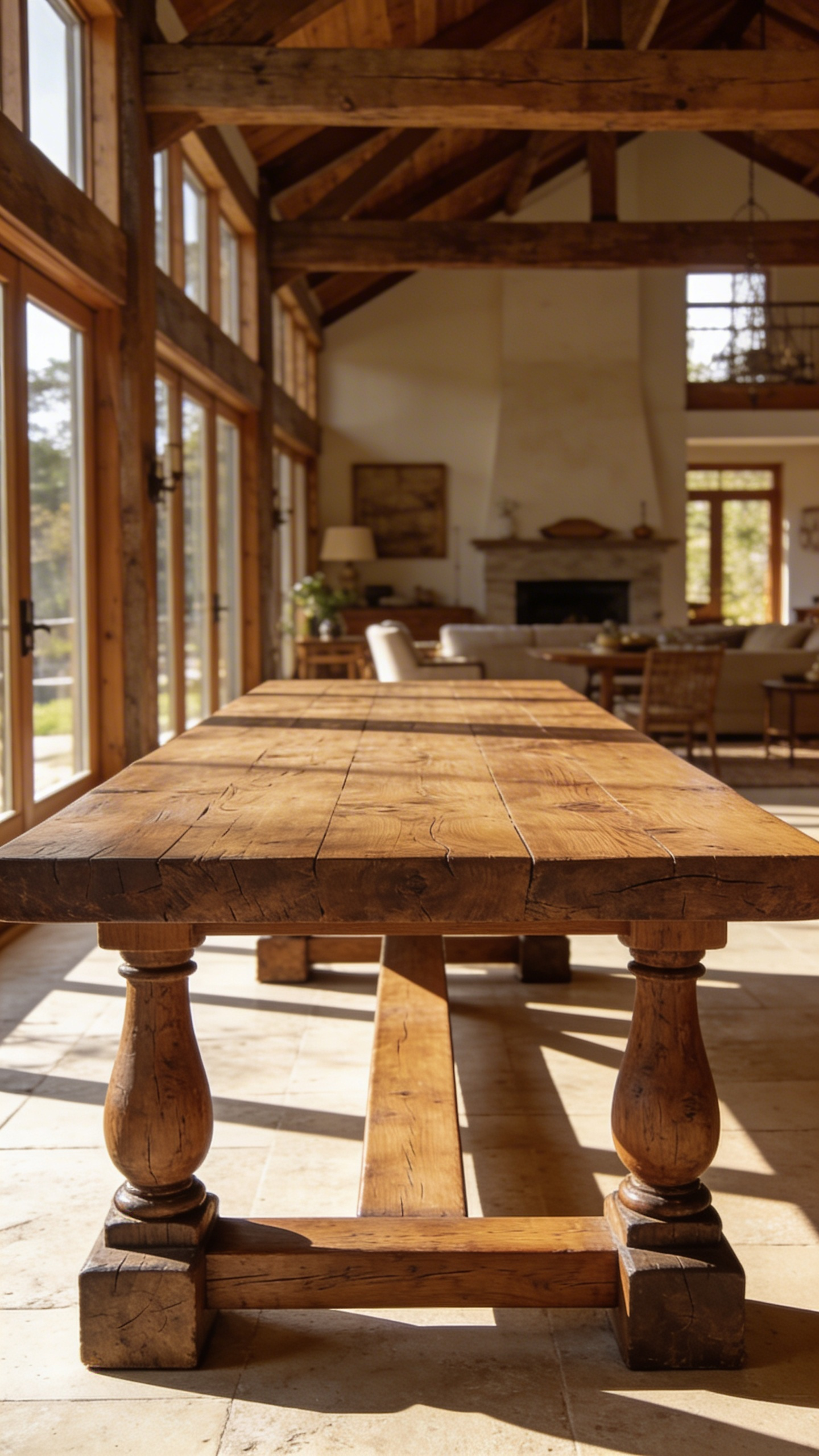
A central pedestal base, on the other hand, liberates the room’s spatial flow. You maximize seating flexibility around the entire perimeter. This open architecture encourages warm, intimate conversational energy. However, large pedestals demand precise base-to-top ratios for basic stability. Otherwise, the wide tabletop can dangerously act like a tipping lever. Stylistically, a chunky, hand-turned pedestal acts as a standalone sculpture. This condensed footprint creates vital negative space around the base. Your rich, wide-plank flooring shines without visual interruption. Thus, the entire dining space feels much larger and delightfully airy.
Your structural choice dictates how guests interact within the environment. A sturdy trestle delivers a grounded, utilitarian homestead atmosphere. Meanwhile, an elegant pedestal brings a curated, hospitable manor aesthetic.
4. Proportions of Gathering: The Golden Ratio of Table Size to Room Dimensions
Designing a farmhouse dining space requires balancing heavy materials with spatial air. The Golden Ratio dictates how these solid wood pieces interact with room dimensions. Modern designers translate this mathematical ideal into the 60/40 rule. A chunky oak table and chairs should occupy just sixty percent of the floor. The remaining forty percent acts as visual breathing room. Otherwise, the rustic charm of thick timber curdles into a feeling of being trapped.
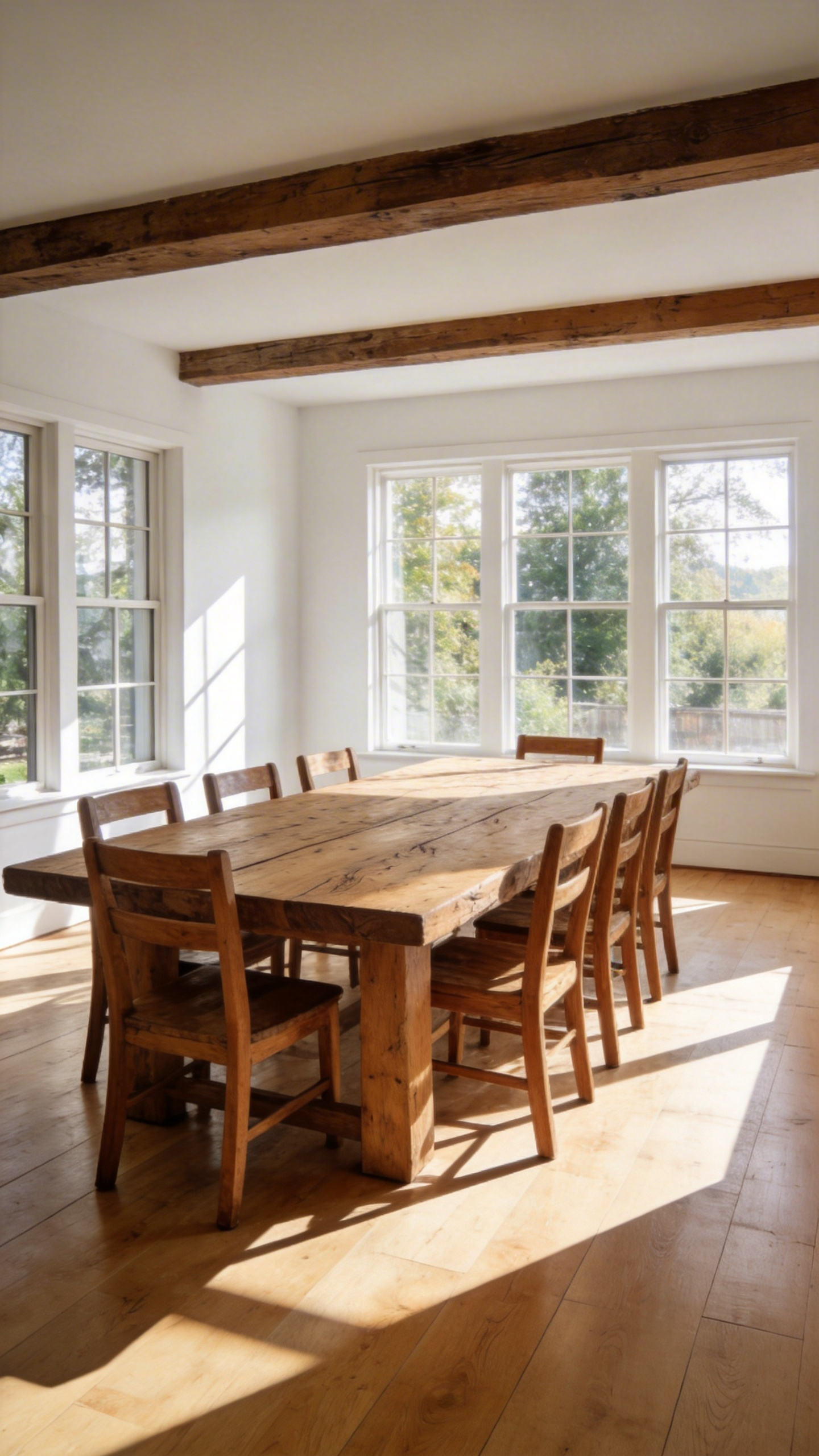
Visual weight also relies heavily on the table’s structural proportions. Pairing a delicate one-inch tabletop with massive five-inch legs looks clunky. Instead, experts recommend substantial tops measuring nearly two inches thick. These thick planks pair beautifully with sturdy three-inch legs. Together, this material harmony creates a quietly monumental presence. You physically sense the permanence of the solid wood anchoring the room.
Practically, custom furniture makers employ the room-minus-six heuristic for layout. You simply subtract six feet from the room’s length and width. This leaves a functional three-foot clearance around the heavy wooden edge. Early agrarian harvest tables were built long and narrow as primary workspaces. Today, this lean rectangular shape beautifully divides open-concept home layouts.
You can intentionally break these scaling rules for sensory impact. Forcing an oversized wooden table into a small room creates sudden intimacy. Because the natural wood grain feels incredibly warm, the tight space becomes a cozy jewel box.
Phase 2: Material Exploration (Wood, Finishes, & Metals)
Designing an authentic farmhouse table requires bridging utility and artistry. We must explore the complex alchemy of timber, finishes, and structural metals. Early tables often utilized old-growth Eastern White Pine. This antique wood is noticeably harder and denser than modern plantation pine. High-end designs frequently favor quarter-sawn white oak. This specific milling technique reveals beautiful medullary rays across the grain. These reflective ribbons indicate superior dimensional stability. Similarly, a walnut surface offers stunning visual chatoyance. This holographic shimmer creates a living surface that changes depth as you walk around it.
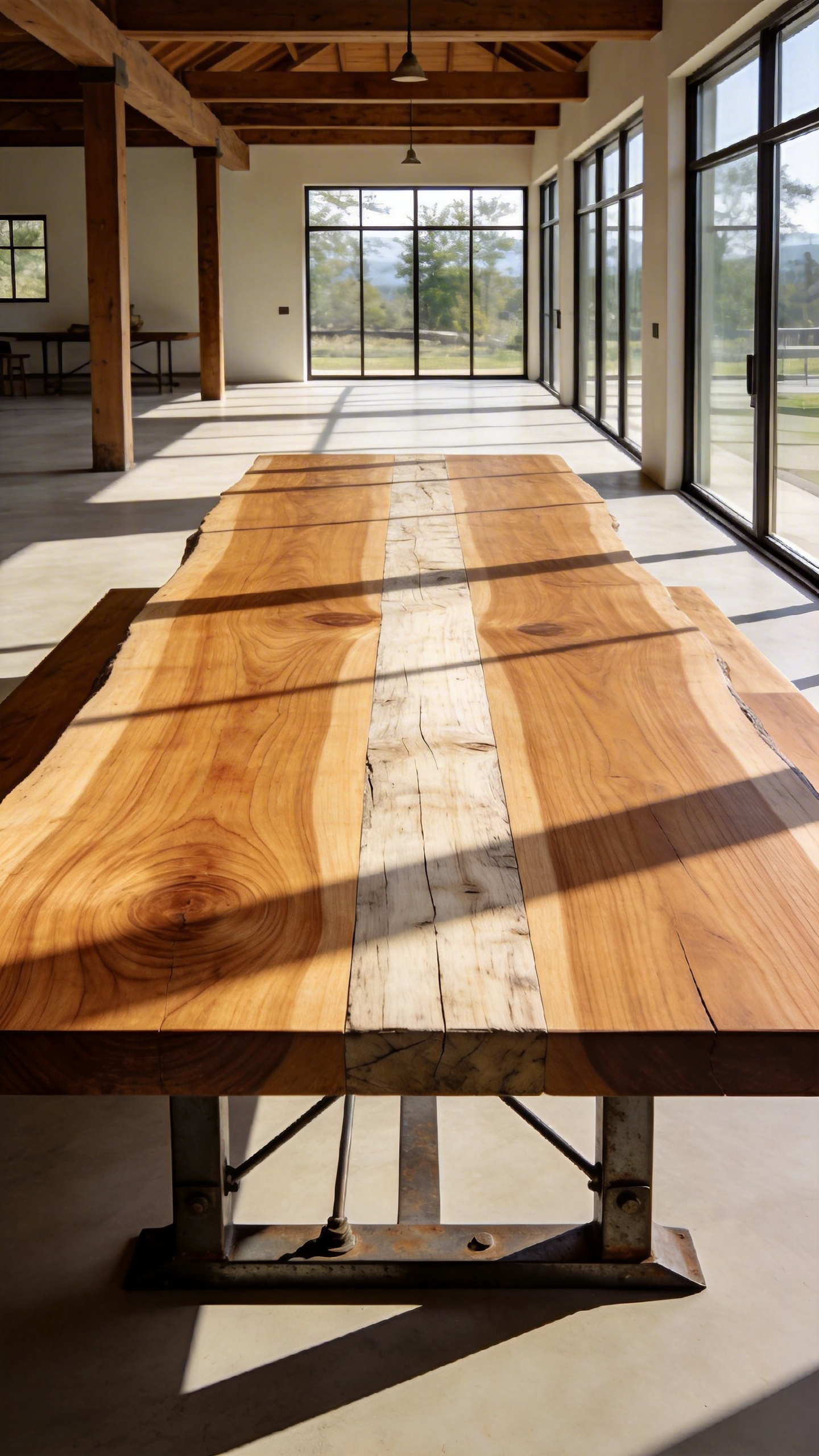
The chosen finish deeply impacts the overall tactile experience. Decades ago, ammonia fuming darkened white oak entirely from within. This chemical alchemy simulates centuries of aging in mere hours. Today, luxury tables often utilize molecular bonding oils instead. These plant-based oils bond directly with the cellulose fibers on a molecular level. Consequently, the surface retains the natural warmth and breathability of the timber.
Structural hardware is equally essential to managing wood movement. Breadboard ends use pinned joints to allow expansion without cracking the frame. Hand-forged rosehead nails clinch the wood for permanent bonding. These blackened steel or aged brass accents provide beautiful living finishes. Over time, they develop a unique patina alongside the aging wood.
An authentic table delivers a profound sensory footprint. Setting down a heavy glass produces a resonant, low-frequency thud. Dense hardwoods convey a distinct sense of lasting permanence and security. Reclaimed pine often releases a faint resinous scent when humidity rises. Thus, the dining space remains intimately connected to its remote forest origins.
5. The Science of Reclaimed Wood: Density, Cellular History, and Tactile Character
Reclaimed wood transforms a simple farmhouse dining table into a tactile masterpiece. This lumber originates from historic old-growth forests. Ancient trees competed for limited sunlight and grew incredibly slowly. This slow growth produced exceptionally tight rings and dense fiber structures. In fact, reclaimed timber scores up to forty points higher on the Janka scale. It easily resists daily scratches and heavy impacts in bustling dining rooms.
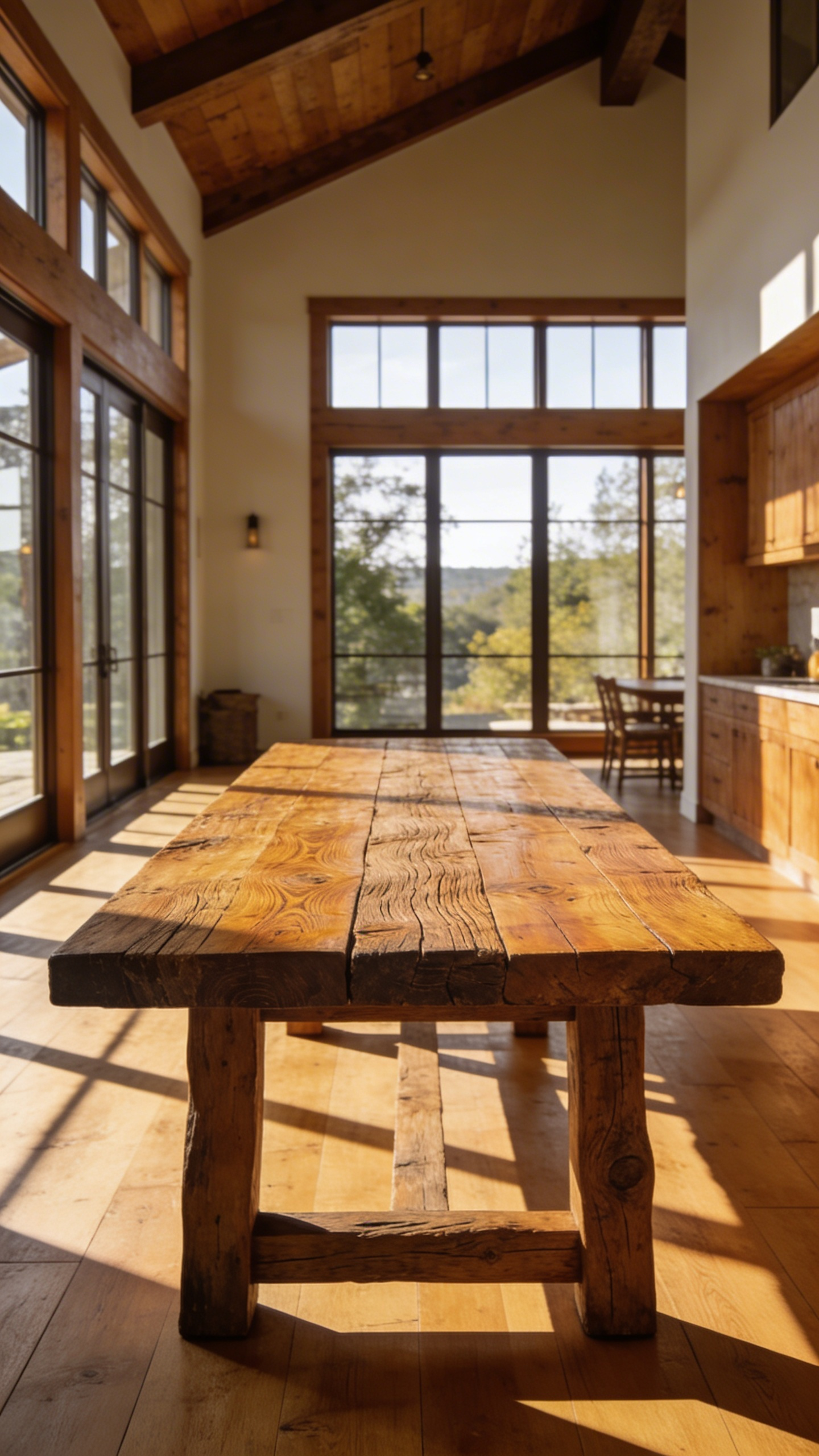
A century of service alters the internal chemistry of the wood. Gradually, volatile hemicellulose degrades inside the cellular walls. Stabilizing lignin effectively fossilizes the remaining wood fibers. As a result, the table feels much more rigid and solid to the touch. This aged material possesses a unique hygroscopic memory. The lumber has relieved its internal stresses after enduring countless seasonal cycles. Your dining table remains remarkably stable without warping during dry winter months.
Aesthetically, reclaimed wood offers a profoundly warm haptic experience. Decades of surface oxidation soften the micro-cracks along the grain. Historic iron nails react with natural tannins to create deep, indelible stains. Rhythmic kerf marks from nineteenth-century saws leave a rich micro-topography. These subtle scars stimulate the hands while the dense wood dampens sound. Placing a heavy glass down yields a deep, satisfying thud. Together, these scientific nuances create an engaging sensory atmosphere.
6. Distressed by Design: Distinguishing Authentic Patina from Artificial Antiquing
Understanding the difference between authentic patina and artificial antiquing requires a keen eye. True distressing represents a tension between natural decay and calculated factory mimicry. The most significant differentiator lies in the visual logic of the wear. Authentic marks follow the chaotic patterns of daily human labor. Genuine burnishing occurs naturally where elbows rested over decades. Mass-produced tables, however, often suffer from obvious pattern fatigue. You will frequently spot symmetrical clusters of identical wormholes.
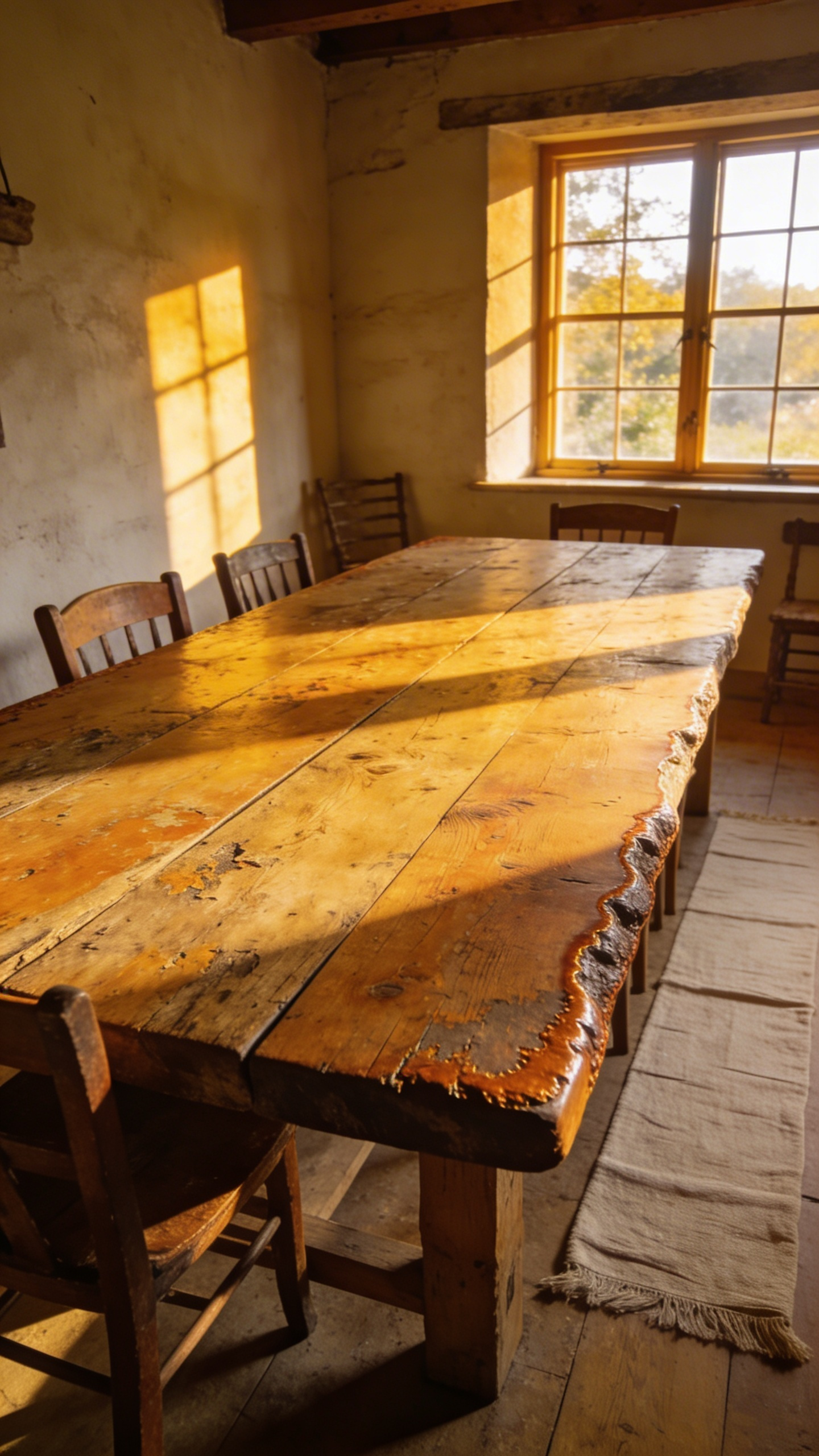
Authentic patina relies on a bone-deep chemical transformation. As wood ages, UV light and oxygen react with natural tannins. This creates a silvery-gray depth that glows from within the grain. Modern reproductions typically use surface-level pigments and heavy glazes. Structural evidence easily separates real antiques from modern builds. Over a century, natural wood shrinkage alters historical joinery. Once-round wooden pegs compress into distinct oval shapes.
Beyond visual cues, authenticity boasts a rich sensory profile. An old farmhouse table carries a sweet scent of aged beeswax. A newly distressed piece often off-gasses sharp chemical solvents. The physical texture of a genuine antique feels remarkably soft. Decades of friction compress the wood fibers into a smooth, leather-like finish. Authentic wear is a beautiful biography written directly into the wood.
7. Oak, Walnut, or Pine: Selecting the Right Timber for Your Family’s Lifestyle
To choose the right farmhouse table, we must look beyond basic color swatches. The timber dictates your family’s daily interaction with the piece. White Oak serves as a stoic guardian for spill-prone households. Its unique cellular structure contains microscopic plugs called tyloses. These plugs seal the wood’s pores against invisible moisture threats. The wood resists liquids much like historical ship hulls. Visually, quartersawn Oak reveals shimmering, ribbon-like ray flecks. This distinct texture signals immense architectural integrity.
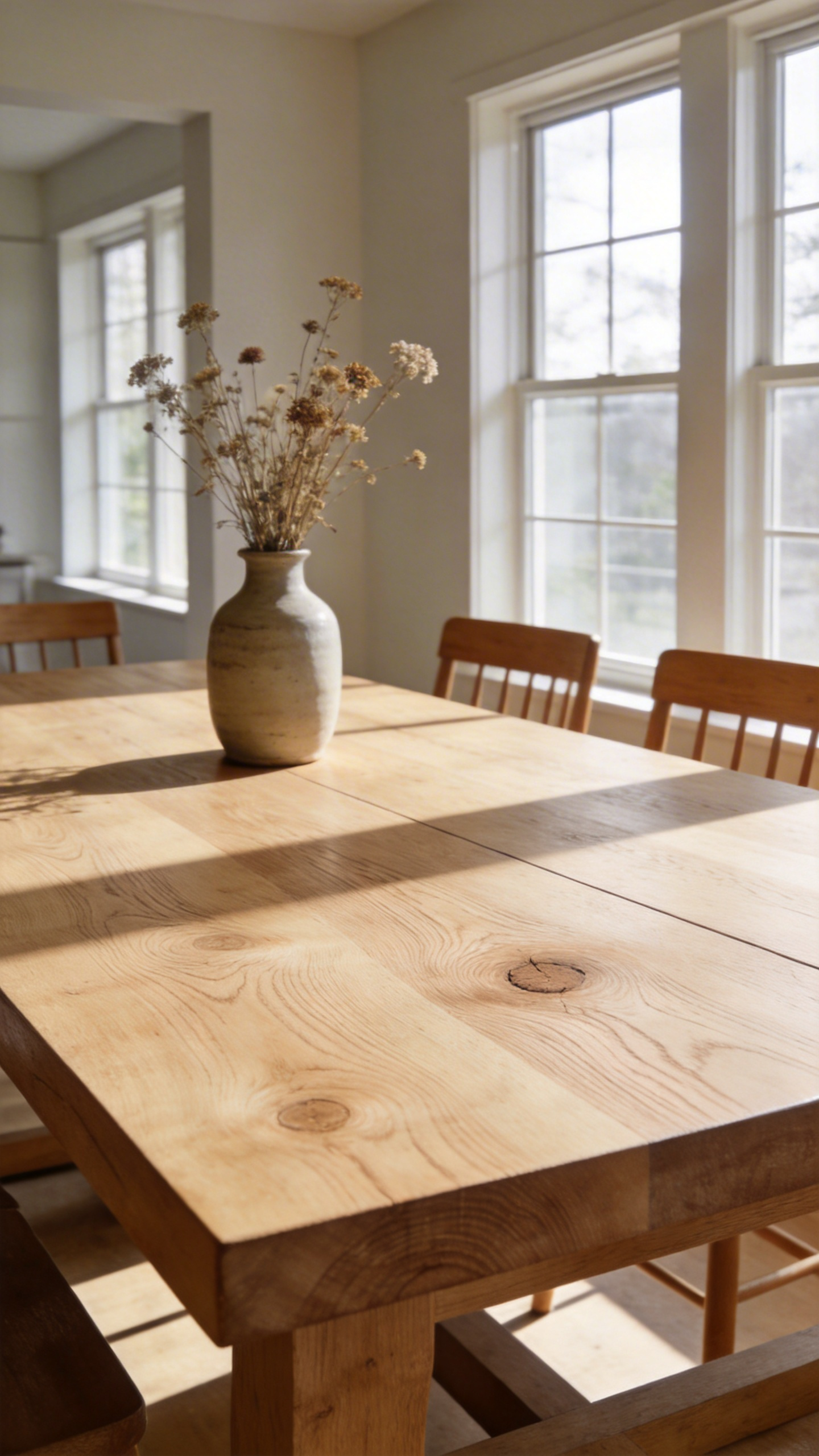
American Black Walnut acts as a living heirloom. This timber undergoes photo-oxidation over time. Instead of darkening, it actually lightens into a honey-golden brown. Its tight, chocolatey grain gracefully hides minor scratches. It brings a refined, rustic warmth to any dining space.
Reclaimed Heart Pine embraces the wabi-sabi philosophy of beautiful imperfection. Unlike soft modern pine, this old-growth wood features incredibly dense rings. Pine is thermally warm to the tactile touch. It invites long mornings of cozy coffee and conversation. It will certainly dent over decades of heavy use. However, these marks create a beautiful diary of family history.
Your finishing choice completes this sensory lifestyle narrative. Hardwax oils bond directly with the raw wood fibers. They preserve the organic, woody feel of the table. A polyurethane film creates a thick, plastic-like surface shield. While highly protective against stains, it removes your sensory connection.
8. The Modern Mix: Marrying Warm Timbers with Hand-Forged Iron Bases
The pairing of warm timber and hand-forged iron defines modern farmhouse design. This combination creates a deliberate play on visual weight. Traditional chunky wooden legs often make tables look bottom-heavy. A slender iron base creates a beautiful floating effect. Designers achieve an aesthetic known as “rough luxe.” Industrial iron cools down the rustic warmth of the wood.
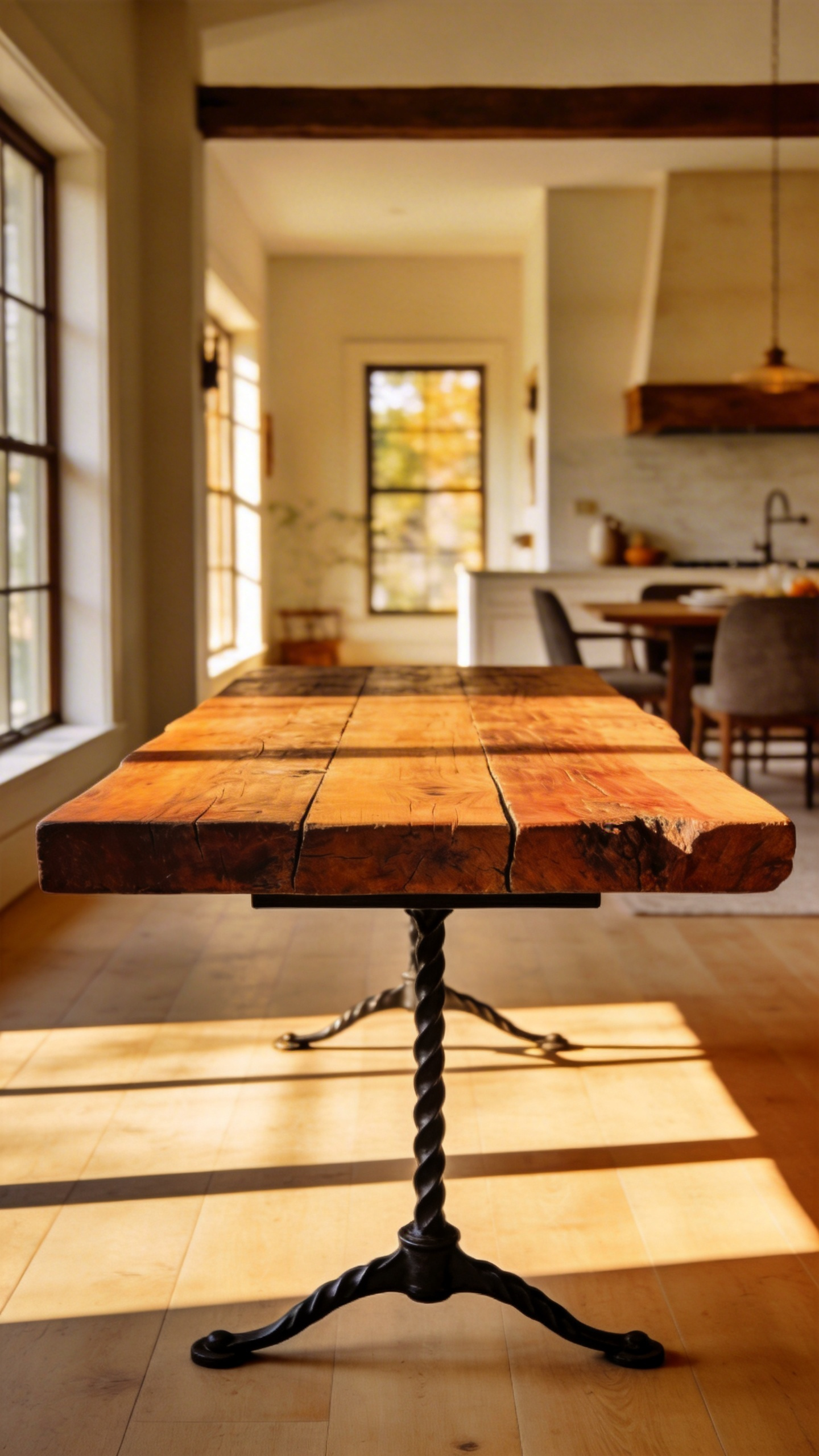
Authentic tables rely on the sensory narrative of the forge. Unlike machine-bent steel, hand-forged iron features rhythmic hammer marks. These subtle indentations catch the light beautifully. They perfectly echo the organic irregularities of the wood grain. Artisans often treat the metal with a hot beeswax dip. This creates a living finish that feels warm to the touch.
Marrying these distinct materials presents a major technical challenge. Solid wood is a living material that constantly expands and contracts. The iron base, however, remains entirely rigid. To prevent the timber from splitting, master builders use slotted fasteners. These clever Z-clips allow the wood to slide across the metal frame. The choice of timber completes this structural bridge. White Oak offers golden tones that contrast sharply with dark iron. Deep Black Walnut absorbs light and develops a rich patina over time. Together, these materials transform industrial history into a stunning modern centerpiece.
9. Live Edge Integrations: Bringing Raw Organic Movement into Structured Spaces
Modern farmhouse architecture often relies on sharp, rigid lines and high-contrast color palettes. Introducing a live edge dining table provides essential psychological relief. The natural fluidity of the wood breaks the visual monotony of structured rooms. This organic approach echoes George Nakashima’s philosophy of giving timber a spiritual rebirth. The visual contrast between creamy sapwood and dark heartwood creates a grounding gradient.
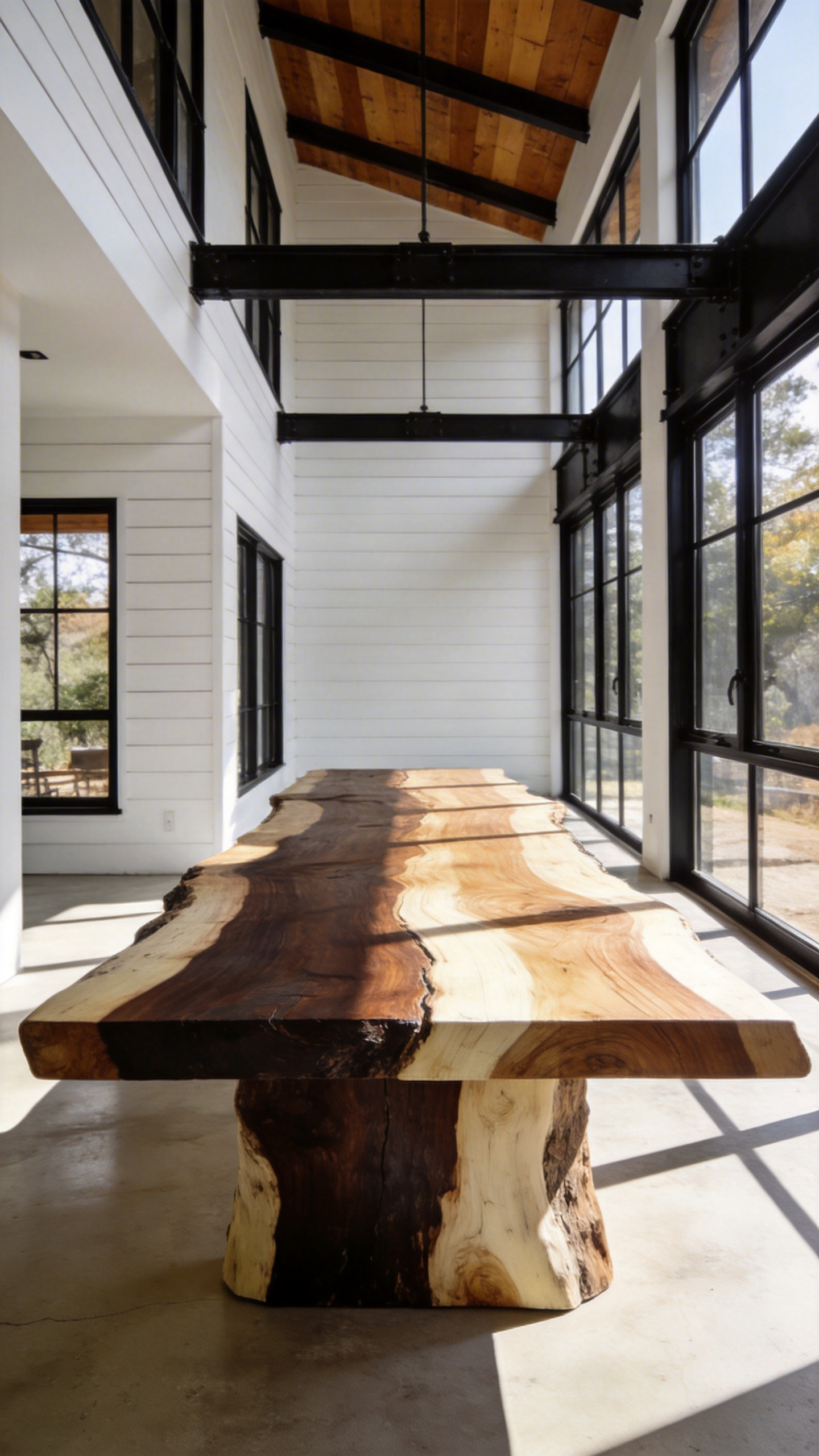
This beautiful unpredictability requires rigorous technical mastery. Because the wood remains essentially alive, craftsmen must dry the slab carefully. Internal moisture must sit below twelve percent to prevent violent splitting. Artisans use structural butterfly joints to stitch natural fissures together. These joints transform inherent structural vulnerabilities into celebrated narratives of resilience. For material selection, Black Walnut offers a sophisticated, chocolatey tone. White Oak provides an exceptionally durable, open grain for busy families.
To anchor these heavy pieces, designers pair the raw wood with industrial metal bases. Linear chandeliers overhead act as minimalist frames for the table’s irregular silhouette. These sustainably salvaged slabs invite active tactile engagement during everyday meals. No two people sitting at the table share the exact same physical experience. The organic edge naturally fosters the informal, communal atmosphere essential to farmhouse living.
10. Advanced Surface Treatments: Protective Sealants That Preserve Tactile Warmth
To achieve a true farmhouse aesthetic, tables must feel inherently like wood. Standard thick-film polyurethanes create a plastic-like barrier. These heavy layers increase the material’s thermal effusivity. Essentially, they conduct heat away from your hands rapidly. Heavily lacquered surfaces feel incredibly cold and sterile. Modern artisans prefer advanced treatments that preserve natural tactile warmth.
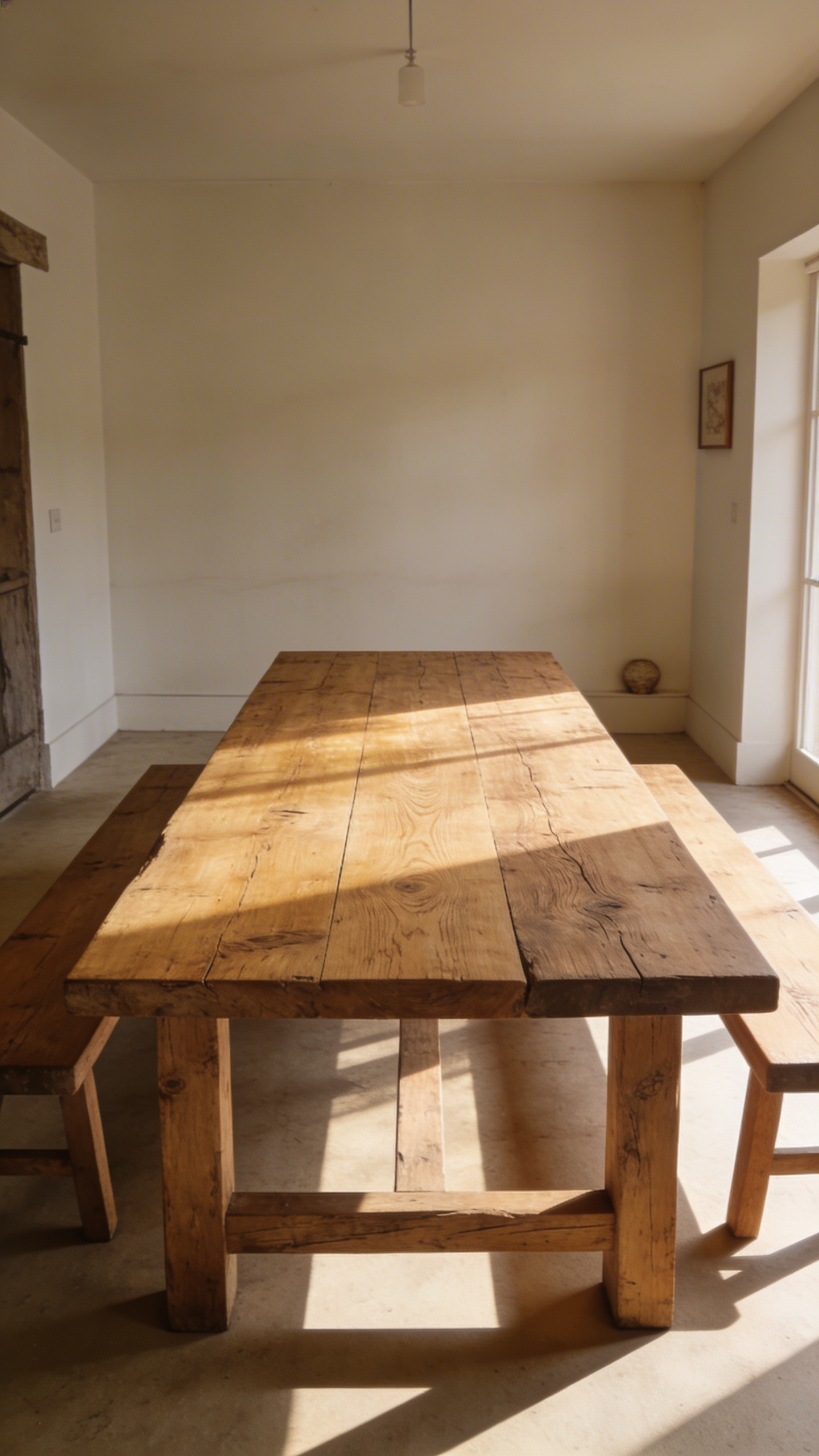
Hardwax oils represent the current professional gold standard. Makers use molecular bonding to integrate wax directly into the grain. This allows users to feel the organic ridges of oak. Designers often apply nano-ceramic topcoats over these natural oils. These ultra-thin silicon dioxide layers are just a few molecules deep. They provide a diamond-hard, hydrophobic shield against wine stains without altering the texture.
Historical purists might choose a traditional Danish soap finish. High-fat soap flakes saponify directly inside the open wood pores. This old-world technique leaves a uniquely velvety, chalky-soft texture behind. High-traffic commercial environments require maximum durability without sacrificing touch. In these cases, dead-flat 2K polyurethanes offer the perfect optical illusion. Microscopic silica matting agents scatter light evenly across the table’s surface. They deliver a dry hand-feel mimicking raw, uncoated timber. Keeping protective coatings under five mils guarantees a warm, engaging sensory experience.
Phase 3: Spatial Application (Layering & Context)
A farmhouse table is not just furniture. It serves as a powerful sensory anchor. We must carefully layer its hard wooden surface. Soft organic textiles become absolutely essential here. Belgian linen runners gracefully dampen room acoustics. This creates a highly inviting tactile contrast. Lighting introduces another crucial spatial layer. Warm 2700K illumination highlights the timber’s three-dimensional texture. A fixture spanning two-thirds of the table perfectly frames this zone.
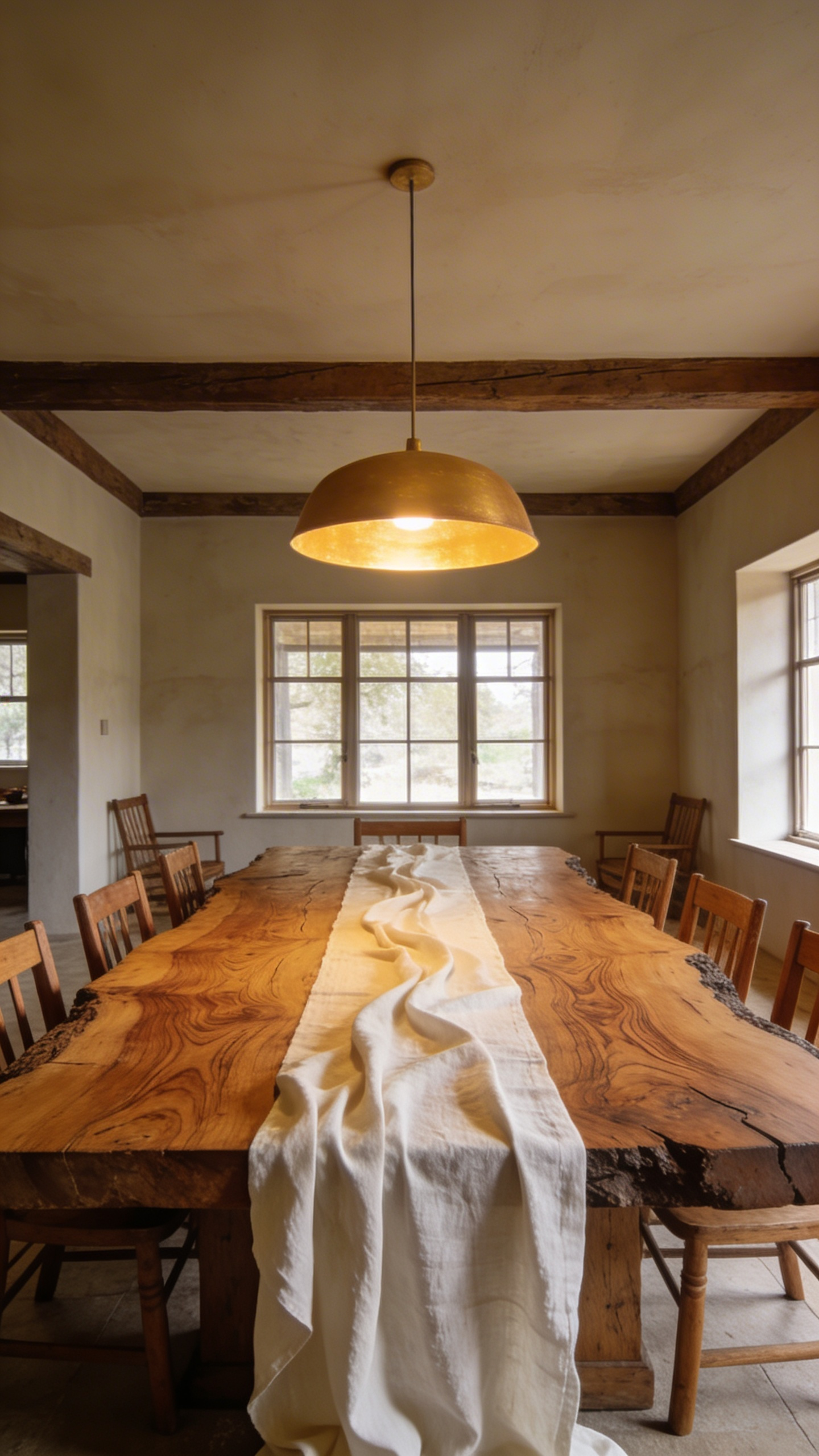
Beyond aesthetics, spatial application involves intentional behavioral design. The table’s physical setup dictates the social temperature. Utilizing a long bench creates a highly communal context. This removes the rigid boundaries of traditional chairs. Informal seating increases mealtime engagement by roughly 33 percent. Proper placement also requires a standard 36-inch circulation buffer. The table functions perfectly without obstructing home traffic.
Historically, these heavy tables sat near the warming hearth. Today, we place them in modern open spaces. This reclaims their beautiful, multi-functional soul. The resulting layering heavily depends on your architectural framework. A Belgian farmhouse context deeply embraces raw authenticity. Minimal decorative layering lets the heavy rustic wood speak. A New Nordic approach creates beautiful visual tension. Pairing weathered tables with sleek mid-century chairs feels curated. This solid wood physically grounds bright, modern homes. Embracing intentional wabi-sabi imperfections encourages a slower daily pace.
11. Curating the Mismatched Seating Look with Material Intentionality
Curating mismatched seating requires intentional imperfection. This look emerged naturally from practical agrarian life. Designers now recreate this layered narrative through thoughtful material choices, often starting with 18 transformative ideas for farmhouse dining room decorating. Combining unexpected textures creates a rich tactile conversation. Pairing rough reclaimed wood with cold-rolled steel chairs creates a beautiful dynamic tension. This metallic shock perfectly balances the warm, organic thrum of the table. Distressed leather seating allows these materials to age at different rates. Over time, the leather develops a soft patina against the deepening grooves of the wood.
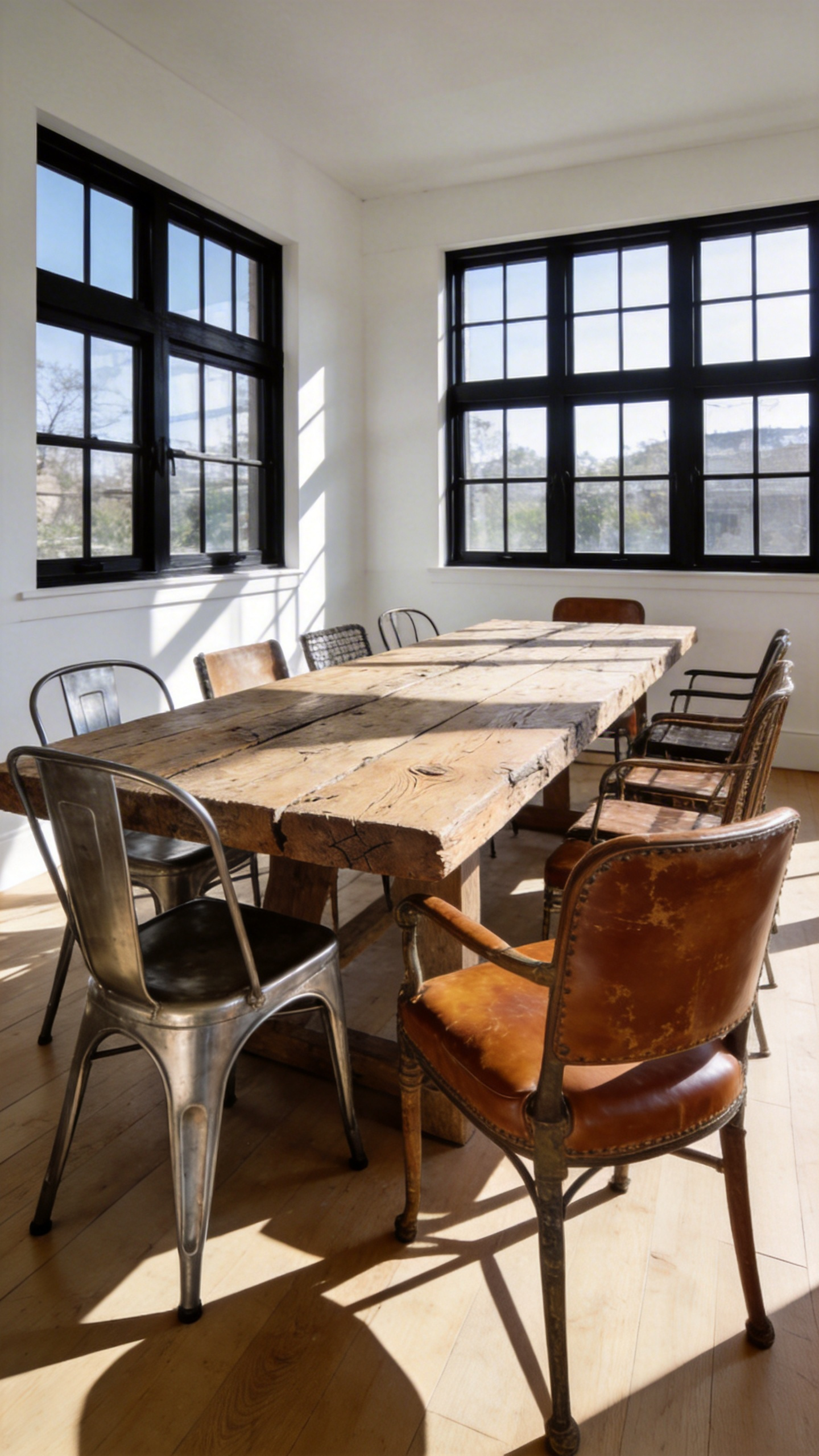
Preventing visual chaos requires a strict structural grammar. You must maintain a consistent seat height of 18 to 20 inches. This uniformity preserves the social flow. Visual mass also plays a crucial role in your chosen seating. A chunky trestle table demands weighty seating like substantial ladder-back chairs. Spindly chairs would simply look like forgotten afterthoughts. You can also utilize the popular two-two-two seating rule. Arranging three distinct pairs of chairs brings a rhythmic visual order to the dining space.
Dramatic textural shifts work beautifully at the heads of the table. Slipcovered linen armchairs visually hug the hard lines of a raw wood base. Technical synergy matters deeply when mixing wood species. Avoid pairing warm honey-oak chairs with a cool black walnut table. Instead, select grey-stained maple to keep the sensory experience perfectly cohesive.
12. Bench Seating Dynamics: Space-Saving Utility vs. Ergonomic Comfort
Bench seating introduces a classic tension between communal efficiency and individual comfort. These long wooden seats served as multifunctional workhorses for generations. Modern designs often feature dense, reclaimed materials like White Oak. These high-hardness woods absorb the dents and scratches of daily family life. Recently, European rustic finishes have replaced rough-hewn timbers with satin-smooth surfaces. Sliding onto the seat offers a refined, splinter-free sensory experience.
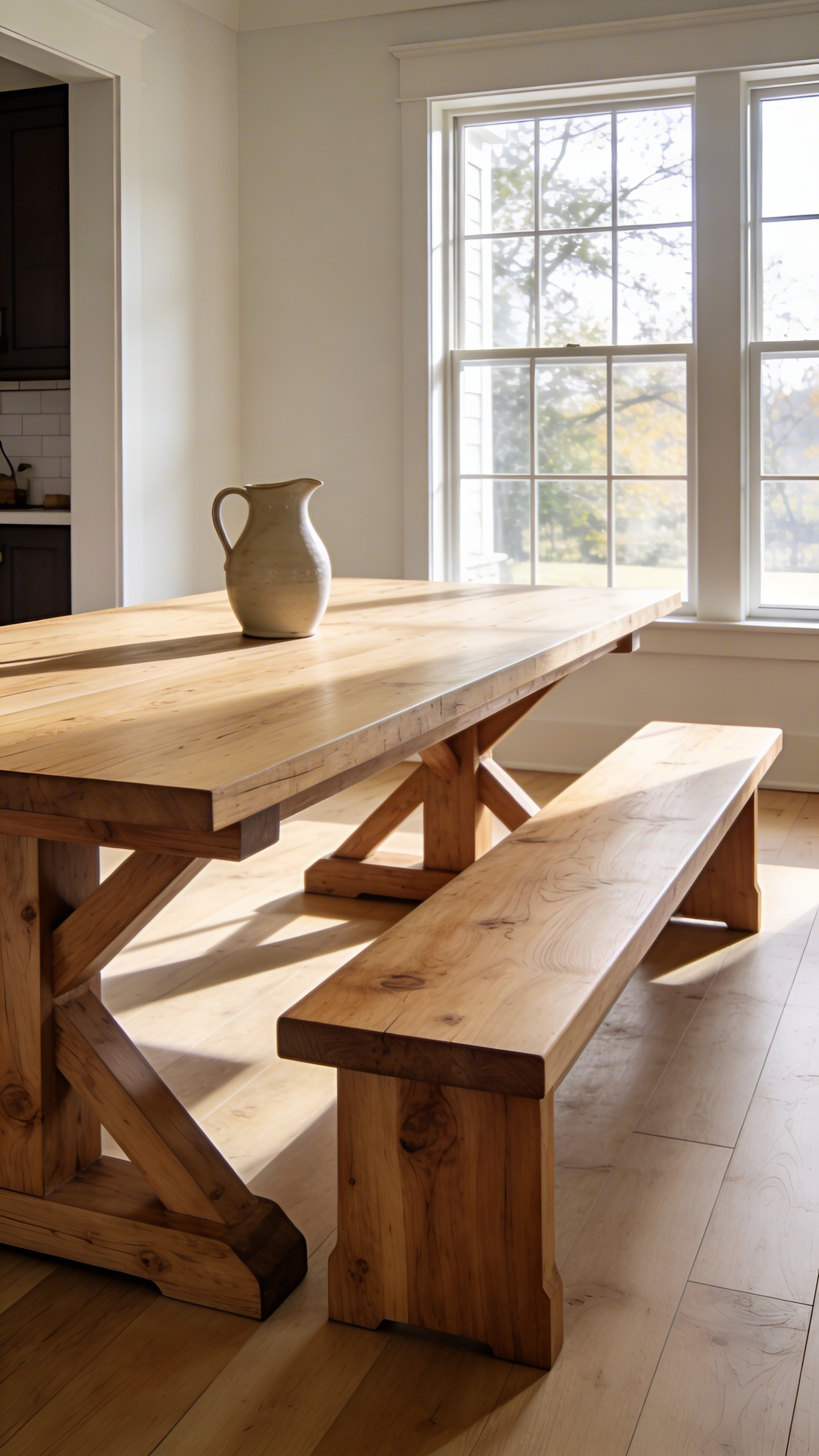
Visually, a bench paired with a trestle table is incredibly efficient. The seat can slide completely over the central stretcher beam. This simple tucking action immediately reclaims up to 36 inches of floor space. Traditional four-legged tables block the bench, neutralizing this spatial advantage entirely.
Beyond space, benches change the social and physical atmosphere. The continuous wooden beam creates a shared kinetic vibration. Every movement is transmitted, fostering a grounded, highly connected dining experience. This design forces a communal choreography known as the tandem scoot. Diners must move in unison to adjust their proximity to the table. This elastic capacity squeezes personal space from 24 inches to 18 inches. Ergonomically, backless benches lack lumbar support for passive, lingering comfort. They encourage active sitting and high-energy engagement over relaxed, multi-course dining.
13. Textural Anchors: Selecting Rug Fibers That Complement Raw Wood Grain
In interior design, pairing wood grain with rug fibers creates a vital sensory bridge. This textural anchoring grounds heavy furniture physically and visually. Natural fibers like jute share a cellular similarity with raw wood. They provide a biophilic continuity that instantly calms the mind. A heavy wire-brushed oak table can look untethered on thin synthetic rugs. Such thin materials simply slide visually off the matte-rough profile of timber. Thick chunky-knit wool or braided jute is absolutely necessary. A half-inch thick rug acts as a sturdy pedestal. It prevents the dreaded floating table phenomenon through tactile density.
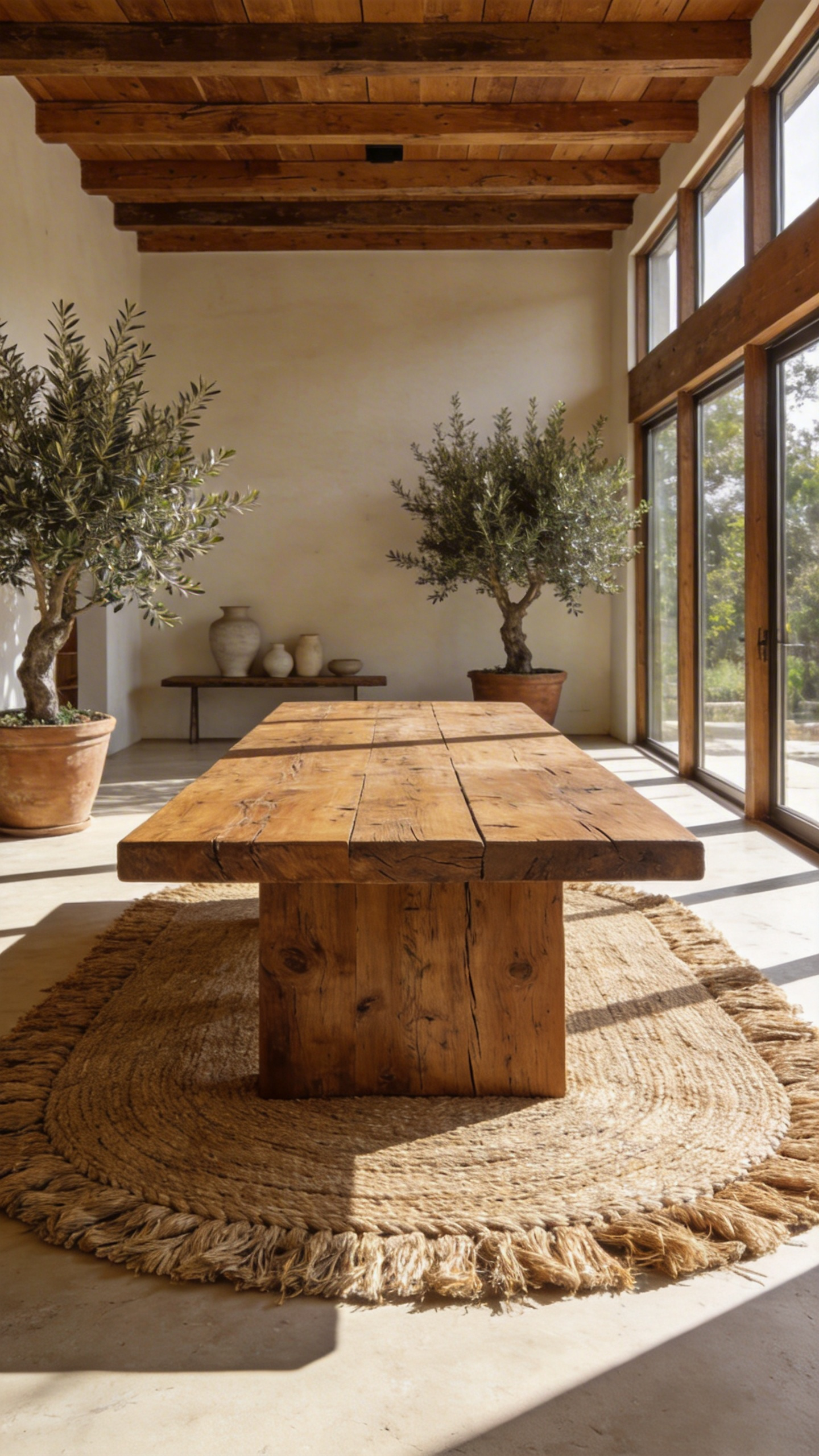
The specific wood species dictates your ideal fiber choice. Open-grain woods like oak feature a rugged, mountainous surface. They are best anchored by the crisp ridges of flat-woven sisal. Closed-grain woods like maple feel smooth and almost liquid. These smooth tables desperately need high-low pile wool rugs. This height variation provides the sensory topography that the wood lacks. Tables with swirling burl grains require a quiet anchor. A tight bouclé weave prevents visual chaos under complex patterns.
Natural fiber anchors perform brilliantly in high-traffic dining spaces. High-quality wool features a natural lanolin coating. Moisture simply beads on the protective surface. The mottled tonal variations in jute beautifully hide everyday crumbs. Matching grain to fiber ensures your space feels both permanent and inviting.
14. Overhead Harmony: Lighting Materials That Reflect and Enhance Wooden Surfaces
The relationship between overhead lighting and a farmhouse dining table depends heavily on spectral reflection. Warm-toned metals like unlacquered brass and copper actively absorb blue light. They reflect warm, amber hues downward. This bathes the wood in a golden glow, enhancing its three-dimensional chatoyancy. These living finishes develop a natural patina over time. This simultaneous aging beautifully mimics the maturing of reclaimed wood.
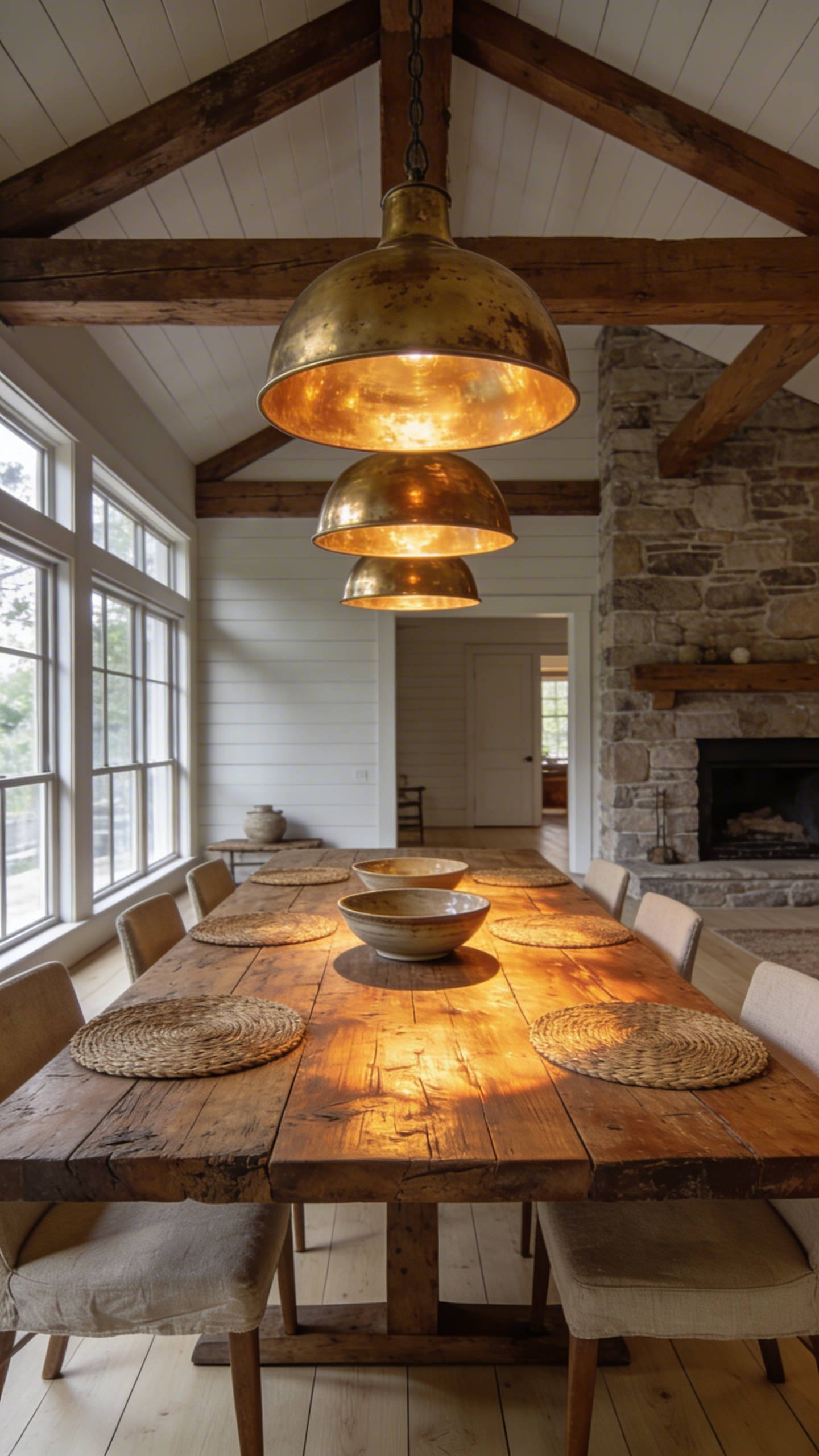
You might consider the honest imperfection of seeded glass. These tiny air bubbles act as a refractive diffuser. The fixture casts soft, dappled shadows instead of harsh, oily glares. This dappled light perfectly highlights the hand-scraped grooves of the table.
The physical material of the fixture must provide visual weight. Hand-forged iron acts as a strong, high-contrast anchor for heavy wooden furniture. A matte charcoal finish complements the natural grit of the wood perfectly. High-gloss metals would severely clash with a simple waxed tabletop.
The light source itself must technically support these materials. You need bulbs with a high Color Rendering Index, particularly the R9 value. A 2700K light ensures the rich red undertones in the hardwood truly pop. Together, these carefully selected materials transform a simple table into a multi-sensory centerpiece.
Phase 4: Lifestyle Integration (Longevity & Gathering)
A farmhouse table evolves beyond mere furniture. It becomes a deeply functional heirloom. These tables historically served as a hardworking utilitarian surface. Today, they act as a multi-hyphenate living space. The wood transitions naturally from morning workspace to evening social hub.
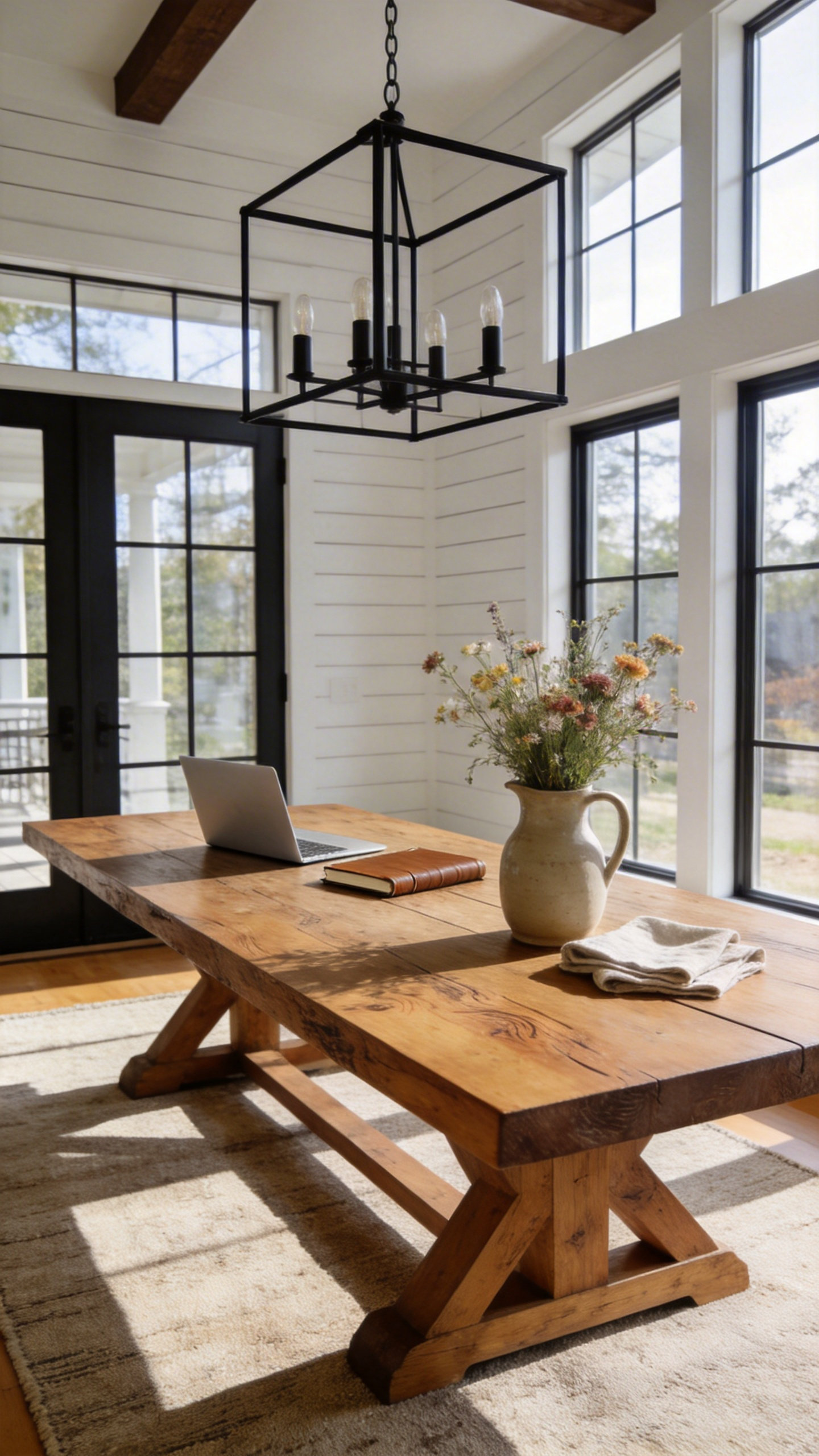
Its incredible longevity relies on brilliant material engineering. Solid wood is a living material that constantly breathes. Master craftsmen utilize authentic breadboard ends to accommodate this. These narrow edge strips feature specially elongated dowel holes. The main tabletop can expand and contract without cracking. Classic wood-to-wood mortise-and-tenon joinery completely avoids rigid metal screws. The structural bond actually strengthens over decades.
This daily participation creates a beautiful living finish. Every nick and scratch develops into a rich, organic patina. Tactile natural oil finishes beautifully enhance this sensory warmth. Setting down a heavy glass produces a reassuring, solid resonance. Psychologically, the table’s generous proportions anchor the room naturally.
A classic trestle base maximizes crucial legroom. This smart structural design removes bulky corner legs entirely. Families can easily squeeze together during holiday meals. Utilizing reclaimed barnwood weaves an embedded historical narrative. The weathered timber brilliantly bridges past harvests with future memories.
15. Embracing the Patina: The Psychology of Allowing Daily Use to Enhance Beauty
A farmhouse table possesses a unique material psychology. Porous woods like reclaimed pine absorb daily life rather than rejecting it. Every hot mug ring or faint pencil mark creates a topographical map of family history. This transforms the wood into a physical journal. This natural aging process relies on actual chemistry. Over time, oxidation and UV degradation alter the cellular structure. Thousands of microscopic touches physically compress the wood fibers. Trace amounts of natural oils burnish the surface into a low-luster sheen. Light refracts through these compressed layers instead of bouncing off a flat finish. The table feels noticeably warmer and silkier to the touch.
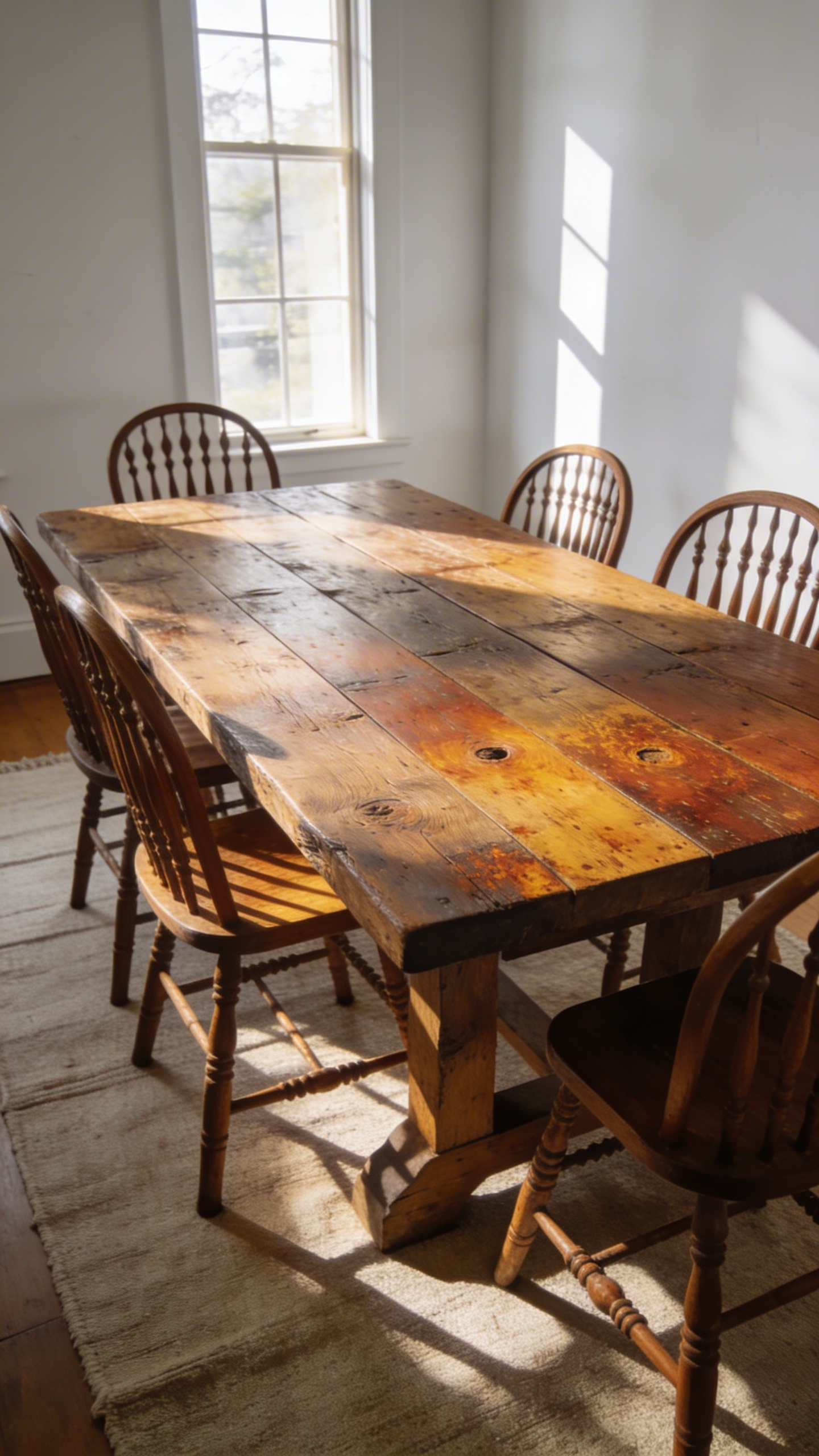
This organic texture fosters deep psychological safety. Instead of inducing perfection anxiety, a farmhouse table is remarkably antifragile. It actively gains beauty from disorder. Each new scratch dilutes previous blemishes to create a complex, forgiving texture. Human intuition easily separates this authentic patina from factory-made distressing. True wear always follows a logical pattern of human interaction. Wooden edges soften exactly where arms comfortably rest. By embracing these imperfections, you elevate a mere commodity into a meaningful heirloom. The dining space becomes a rich, sensory-driven environment that welcomes messy modern living.
16. Eco-Conscious Sourcing: Decoding Sustainable Practices in Farmhouse Furniture
True sustainability in farmhouse furniture goes beyond a simple rustic aesthetic. Sourcing reclaimed timber reduces a dining table’s carbon footprint by up to 95 percent. This salvaged material bypasses highly energy-intensive harvesting and industrial kiln-drying processes. Century-old wood offers a rich, sensory patina that new timber simply cannot replicate. This aged, hardened surface naturally possesses a profound tactile warmth and distinct durability.
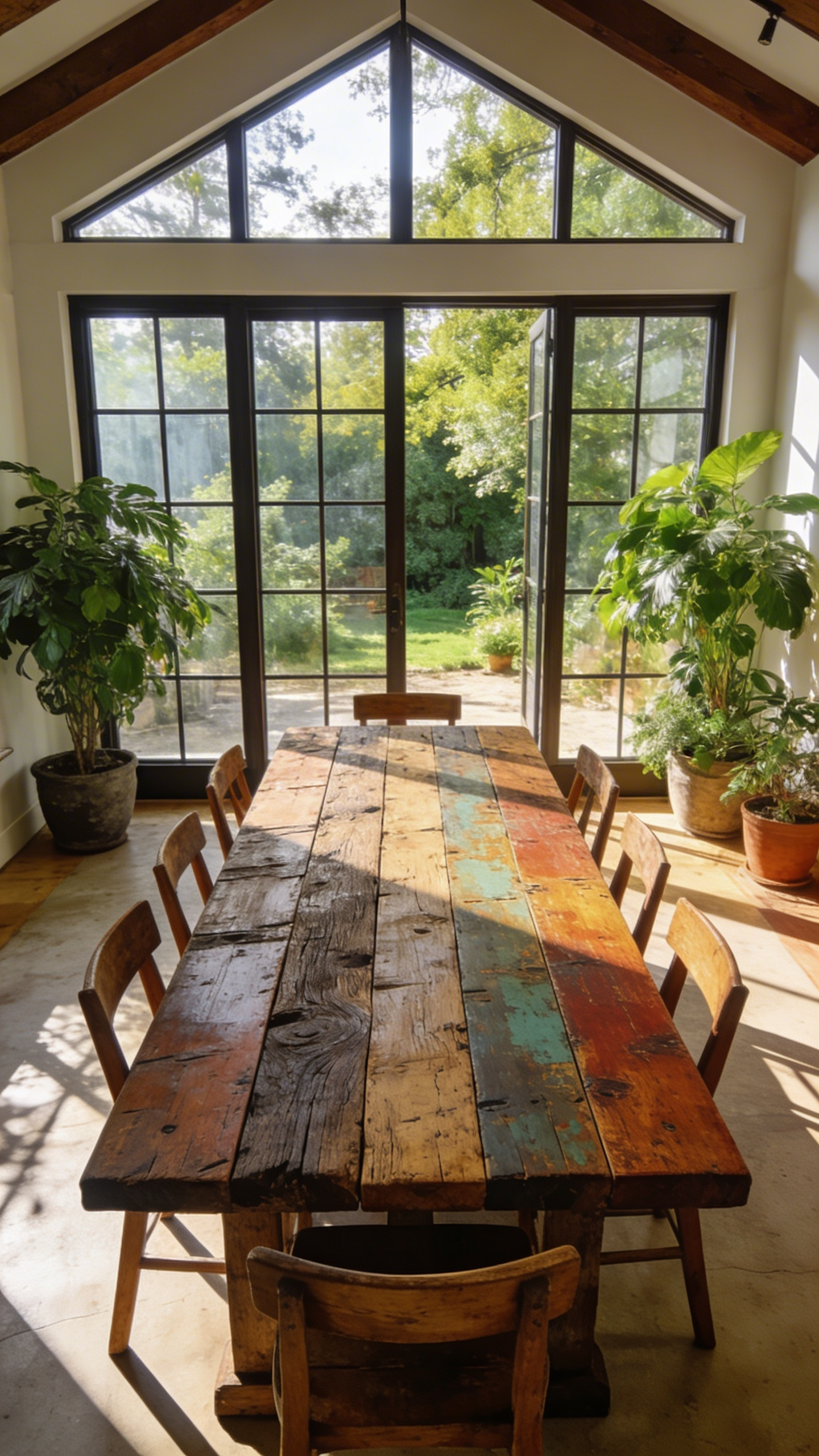
You must carefully decode the invisible chemistry holding these materials together. Authoritative makers now use biodegradable casein or starch-based adhesives for food-safe surfaces. Finishing a table with penetrating hardwax oils allows the wood fibers to breathe. These natural finishes release a pleasant scent of clove or citrus into your space. Mass-produced tables often rely on thick polyurethane that feels cold and plastic-like.
True eco-conscious design relies heavily on traditional mechanical strength for ultimate longevity. Ancient mortise and tenon joinery uses structural tension rather than toxic glues. The solid wood can naturally expand and contract with seasonal changes without cracking.
Buyers must remain vigilant against pervasive greenwashing in the modern furniture industry. Always demand strict FSC 100 percent certifications rather than vague natural labels. GREENGUARD Gold certification ensures your beautiful piece actively preserves optimal indoor air quality.
17. The Tactile Tabletop: Styling Natural Materials Between Meals
Designing a sensory-first tabletop requires moving beyond purely visual styling. We must treat the table as a living landscape. The core of tactile design relies on deliberate material contrast. A rough-hewn farmhouse table provides a textured, light-absorbing base. Pairing this distressed wood with a heavyweight linen runner softens the surface. Pure linen features irregular weaves that beautifully mimic organic wood knots.
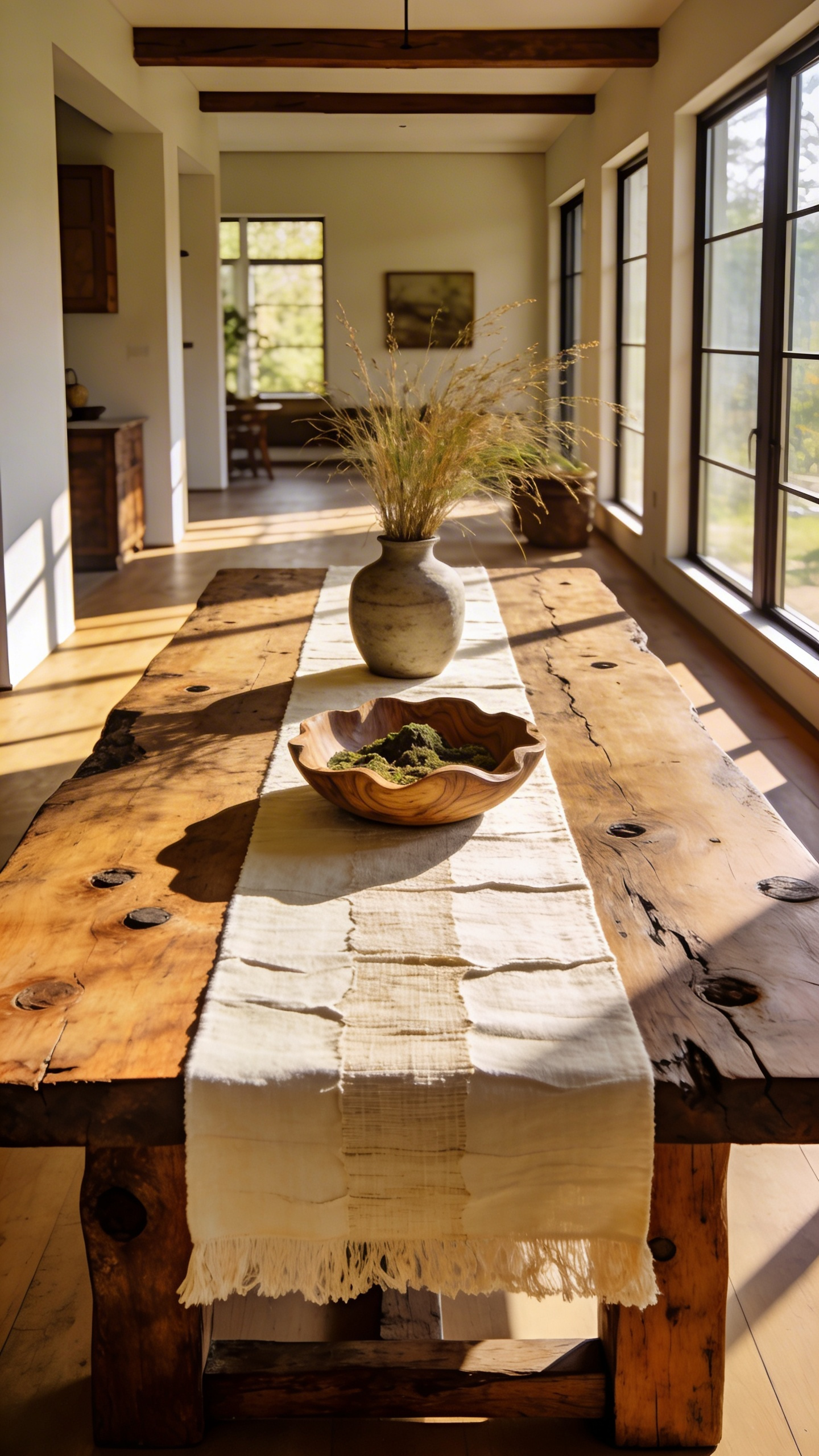
Experts rely on a “Stone-Wood-Fiber” triad for sensory balance. Resting a matte stoneware pitcher on wrinkled linen invites tactile exploration. Authoritative styling purposely avoids a stiff, museum-like appearance. Empty space acts as visual silence. Leaving mostly bare space allows the wood’s natural patina to breathe. This negative space highlights the history embedded in every scratch.
Practical objects add genuine character without feeling cluttered. A farmhouse table historically served as a busy, multi-tasking work surface. Choosing functional sculptures like a shallow dough bowl honors agrarian roots. A wrought-iron candle holder introduces a cold, weighty contrast. Interacting with these varied natural textures helps lower stress. Wood possesses low thermal conductivity for comforting warmth.
Seasonal changes offer fresh ways to layer sensory elements. Scent acts as an invisible texture in the room. Dried eucalyptus in a clay vase adds an earthy olfactory layer. During winter, heavy wool runners provide a coarse, protective barrier. Spring invites lightweight cotton gauzes that let the room breathe. This collected, tactile approach creates a deeply grounding sanctuary.
18. Long-Term Material Care: Scientific Maintenance Protocols for Waxed vs. Varnished Wood
Maintaining a farmhouse dining table requires balancing molecular science with sensory design. The choice between wax and varnish dictates the table’s structural lifecycle. Varnish operates as a continuous, film-forming polymer barrier. It acts as a smooth plastic raincoat atop the wood. This creates a highly hydrophobic surface preventing natural moisture exchange. Traditional waxes penetrate deeply into the hollow centers of wood cells. High-quality wax actually bonds with the wood’s cellular walls. It becomes an integrated part of the matrix rather than a separate layer.
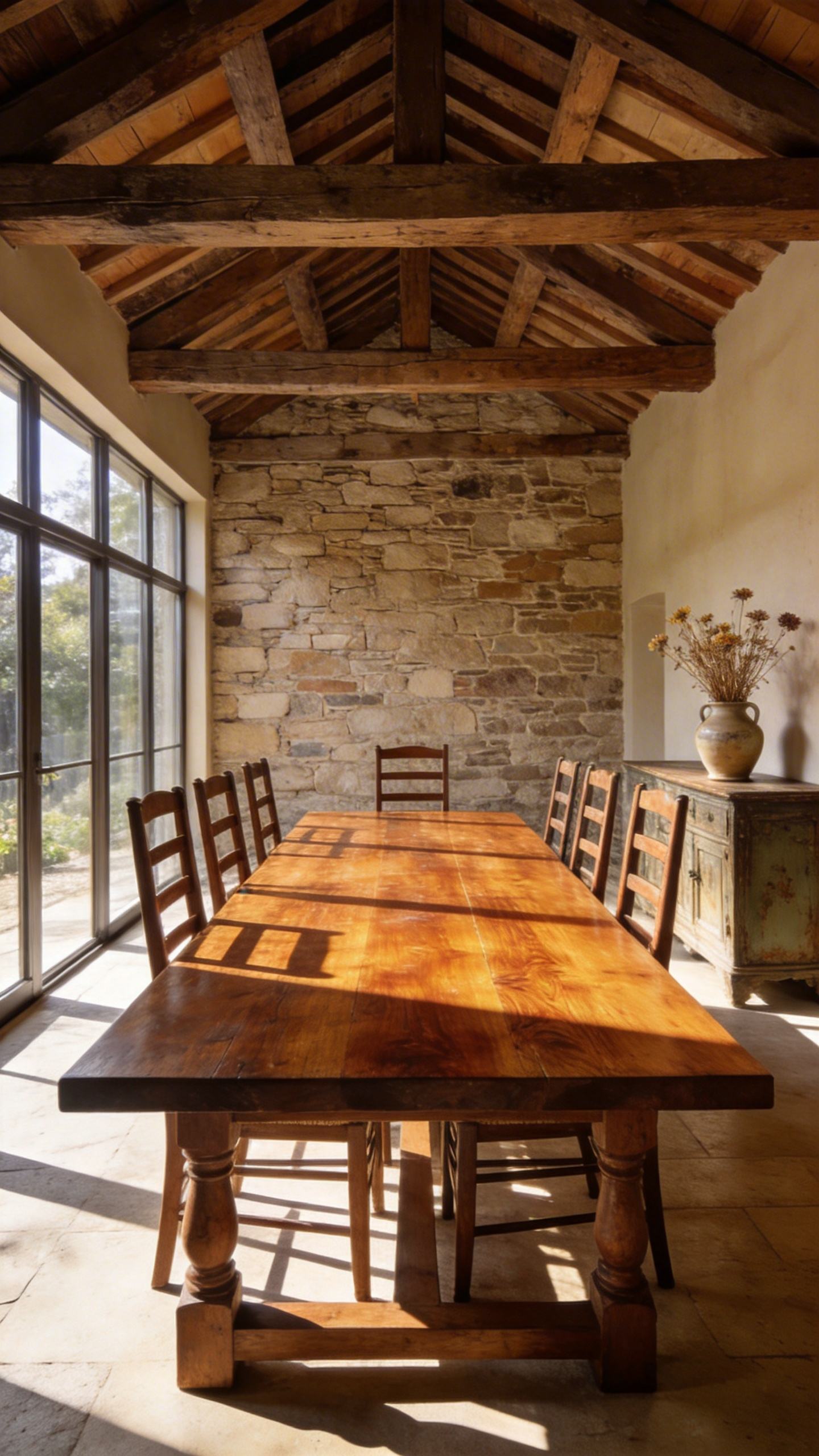
Waxed wood is a living finish requiring additive maintenance. Fresh wax refills the microscopic pores lost to daily friction. Varnished surfaces rely entirely on preservative maintenance protocols. Once this cured polymer film scratches deeply, moisture seeps underneath it. Repairing damaged varnish requires totally stripping it back to bare wood. Beyond structure, we must also consider everyday chemical vulnerabilities. Acidic vinegar easily strips protective natural wax shields. This exposes raw oak fibers to catastrophic blackening from tannin reactions. Varnish remains prone to trapping heat as cloudy white rings.
Tactile sensations dramatically shape the dining room’s atmosphere. Humans scientifically perceive the rich texture of waxed wood as emotionally warm. Varnish provides a notably colder, plastic haptic sensation. Craftsmen historically used friction heat to melt wax deep into the wood grain. This traditional method creates a beautifully layered, three-dimensional glow. Modern spray-varnishes simply cannot replicate this deeply authentic refraction of light. Proper care ensures your farmhouse dining table remains a masterpiece for generations.
Frequently Asked Questions
What is the best wood for a farmhouse dining table?
White oak and reclaimed timber are the gold standard for high-end farmhouse tables. These materials offer exceptional density and moisture resistance. Their natural grain develops a beautiful patina over time, ensuring the piece lasts for generations.
How do I choose the right size farmhouse table for my room?
A functional dining space requires a minimum 36-inch circulation buffer between the table’s edge and the nearest wall. Designers recommend the 60/40 rule. The table and chairs should occupy sixty percent of the floor space, leaving forty percent as open breathing room.
How do you maintain a solid wood farmhouse dining table?
Maintenance depends entirely on the finish. Waxed tables require periodic re-waxing to fill microscopic pores. Varnished tables need gentle cleaning with pH-neutral solutions to preserve the polymer barrier. Avoid harsh chemicals entirely, and always use coasters to prevent heat rings.