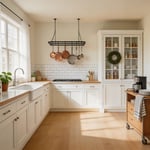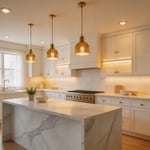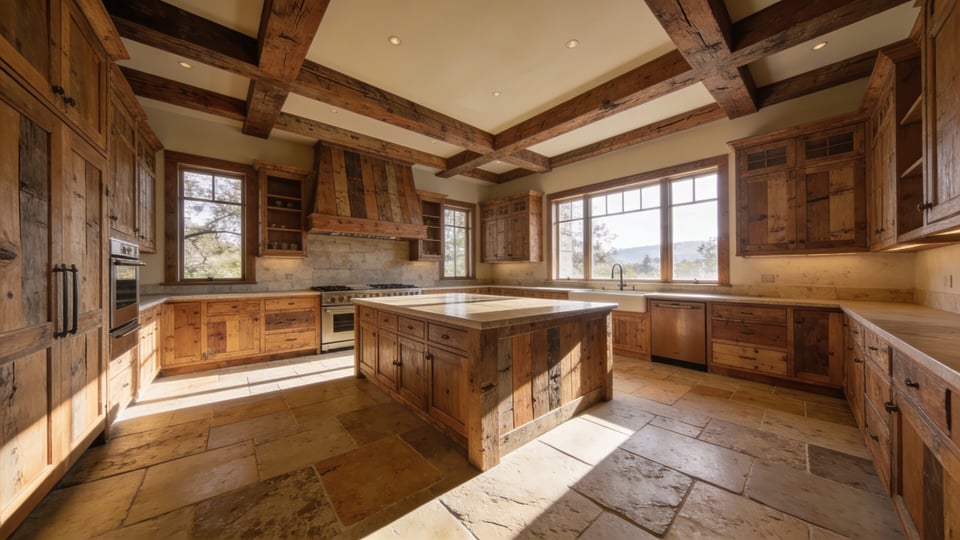
Choosing a kitchen floor is a massive decision. It is the literal foundation of your home’s busiest room. When exploring kitchen flooring ideas, you have to look past the showroom aesthetics. Instead, focus on how a material actually feels and sounds. Are you planning a gut renovation? Or maybe just seeking upgrades for your kitchen remodel ideas strategy? Either way, this surface dictates the acoustic and thermal rhythm of your space.
Theme I: The Timeless Foundation (Natural Stone & Heritage Wood)
Kitchen flooring has shifted from decoration to architectural anchoring. Specifically, natural stone and heritage wood offer real permanence. They turn a loud, chaotic kitchen into a multi-sensory refuge. For example, think about the room’s sonic profile. Polished marble bounces sound around, amplifying every clinking glass. Conversely, old-growth timber absorbs noise. Its dense structure dissipates energy for a quieter environment. Indeed, reclaimed heart pine even releases an earthy fragrance when warmed. These natural resins are scientifically linked to stress reduction.
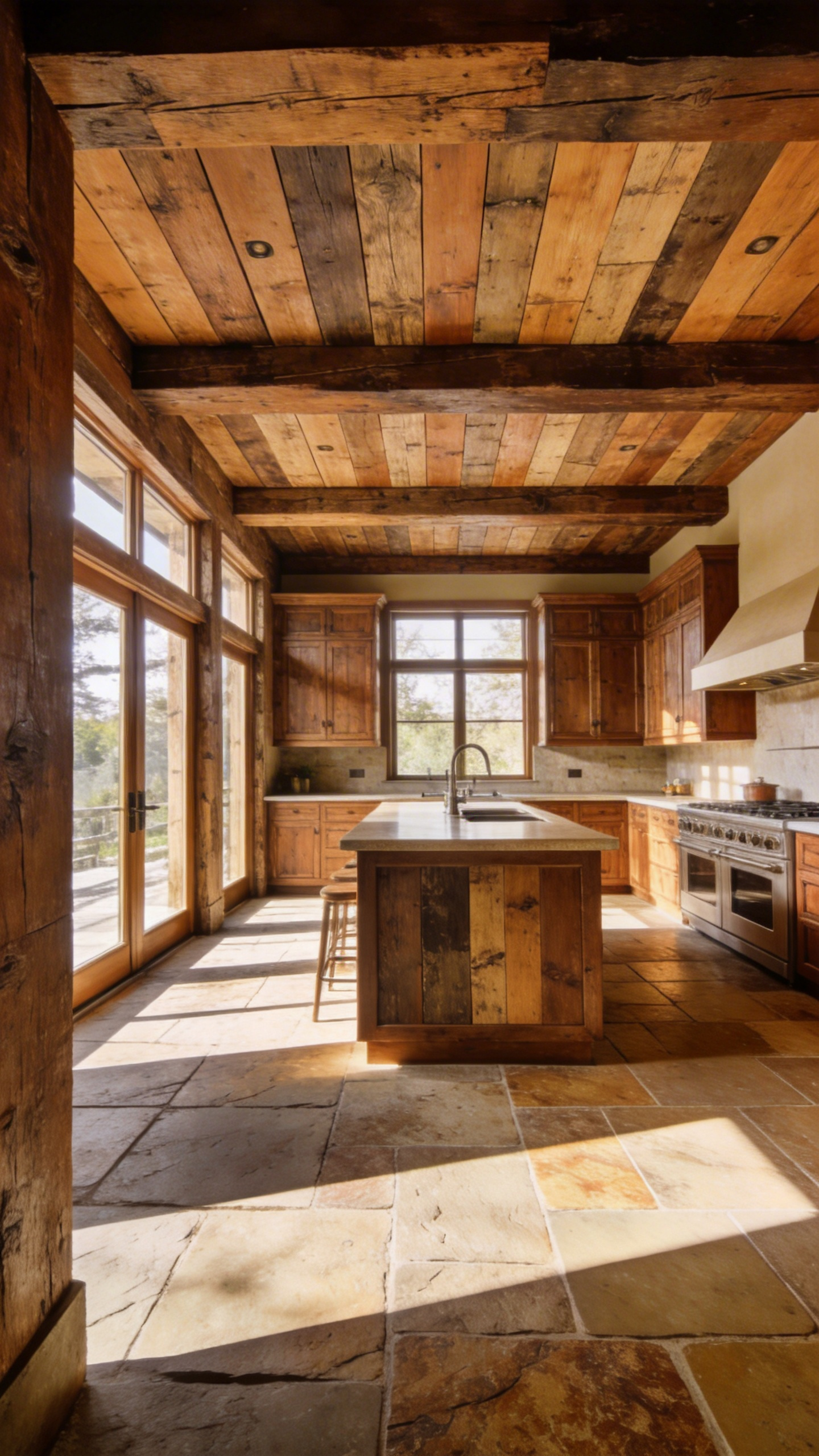
Therefore, pairing these materials requires basic thermal physics. Flagstone has high thermal inertia. This makes it feel cold at first. However, it is the ultimate battery for underfloor radiant heating. Next, consider heritage wood. It is a brilliant natural insulator. It never steals heat from your feet during long cooking sessions.
Ultimately, living with these floors requires a specific mindset. Etching on marble is not a defect. Dents in wood are completely normal. Instead, they form a patina that evolves over decades. Indeed, these imperfections add real character to the room. In fact, both choices are highly sustainable. Natural stone requires minimal energy to produce. Meanwhile, reclaimed wood keeps old timber out of landfills. Together, they build a space that ages beautifully.
1. Reclaimed French Oak: Cultivating Historical Patina in High-Traffic Zones
Reclaimed French Oak brings centuries of history into your kitchen. Specifically, these timbers come from historical structures in France. Therefore, the slow-growth wood has incredibly tight rings. It also features deep medullary rays. In fact, this dense structure changes how the floor feels. The wood is silky and naturally warm each morning. Next, it easily absorbs the sharp clatter of a busy room.
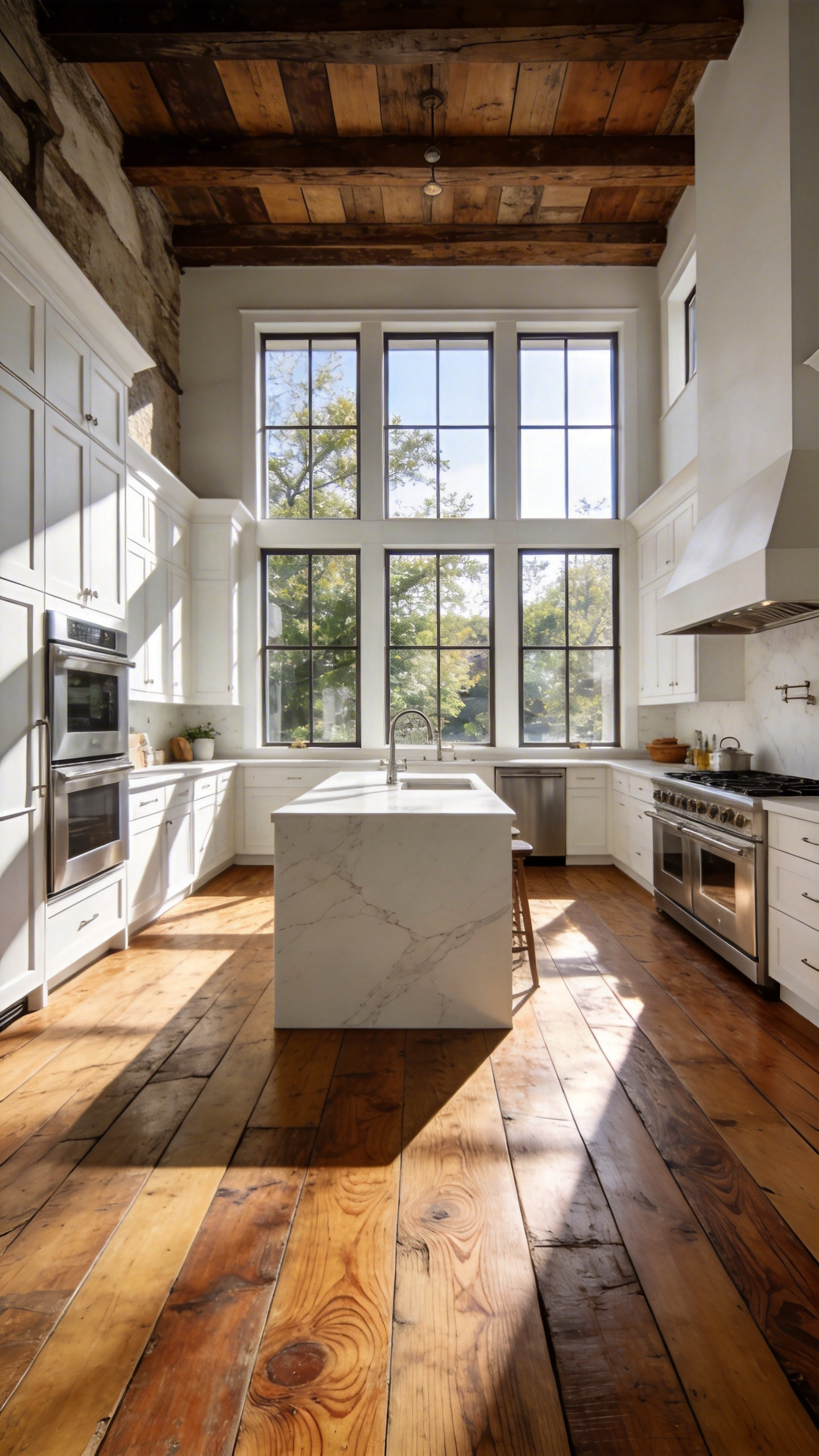
Still, this antique wood handles heavy foot traffic beautifully. In fact, centuries of seasoning push its Janka hardness rating above 1360. The material finished expanding and contracting two hundred years ago. Therefore, it resists cupping from modern kitchen humidity. Naturally, the patina of reclaimed oak is a living finish. Deep oxidation means scratches just reveal more dark wood beneath. Interestingly, acidic spills react with the tannins to deepen the color.
We highly recommend a breathable hardwax oil finish here. Specifically, hardwax bonds directly with the dense wood fibers. It does not form a cheap plastic film. Ultimately, this allows for easy spot repairs if you drop a pot. Finally, consider engineered reclaimed oak for radiant heating. It pairs an authentic antique surface with a stable birch core.
2. Honed Travertine Large-Format Slabs: The Tactile Appeal of Matte Natural Stone
Honed travertine slabs offer a sophisticated middle ground. Specifically, this matte stone diffuses harsh overhead lighting. Instead, the surface acts like a soft optical sponge. This lets high-gloss cabinetry stand out without visual competition. Next, the tactile feel depends entirely on the chosen filler. Travertine has natural voids that require sealing. Traditionally, cement creates a breathable, organic texture. However, a resin fill is the gold standard for kitchens. This clear epoxy creates a non-porous, velvety surface. Therefore, the stone feels surprisingly soft on bare feet.
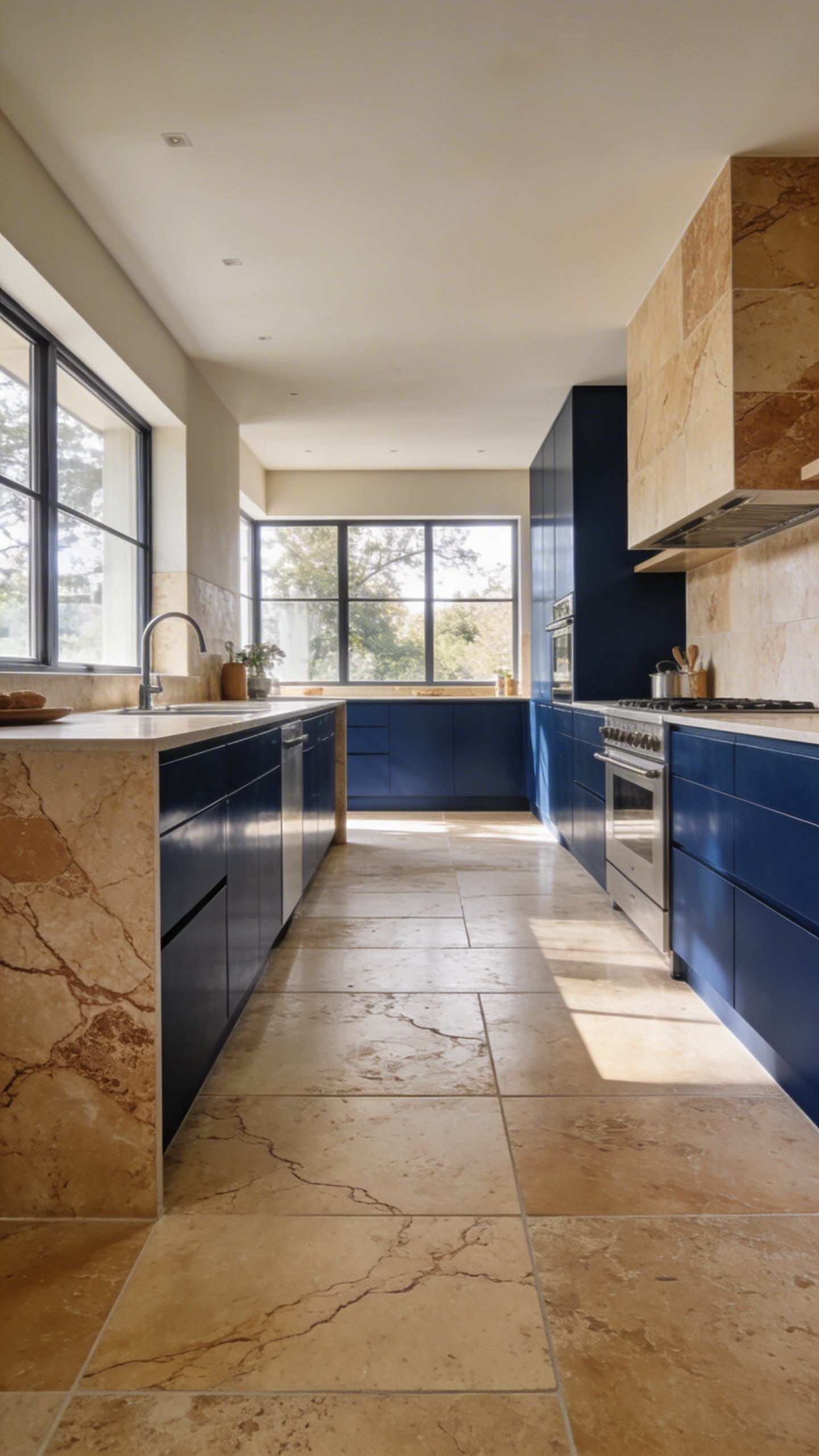
In fact, large-format slabs change a room’s spatial perception. Without busy tile grids, the floor becomes one continuous plane. Tight-joint installations create a seamless, grout-free illusion. Therefore, this monolithic effect makes small spaces feel much larger. Historically, travertine built iconic structures like the Colosseum. Today, it defines minimalist luxury in modern homes. Indeed, honed travertine ages incredibly well. Instead of looking worn, everyday scratches develop into a rich patina. Interestingly, this stone is remarkably warm to the touch. It has a lower thermal conductivity than standard porcelain. Finally, the honed finish gives you a safe, grippy texture. Ultimately, pairing it with radiant heating maximizes comfort.
3. Hand-Fired Terracotta: Mediterranean Warmth That Grounds Modern Cabinetry
Hand-fired terracotta brings real soul to contemporary kitchens. Specifically, this traditional material grounds sleek, modern cabinetry. Authentic Mediterranean clay is fired above 1000 degrees Celsius. Therefore, the extreme heat bakes a highly durable tile. Traditional wood-fired kilns create subtle, smoky color variations. Indeed, these natural iron oxides make cool-toned cabinets pop. Each handmade tile has a slight, microscopic cup or warpage. Therefore, these gentle waves break up clinical, perfectly flat surfaces. I love the visual contrast this brings to a sterile room.
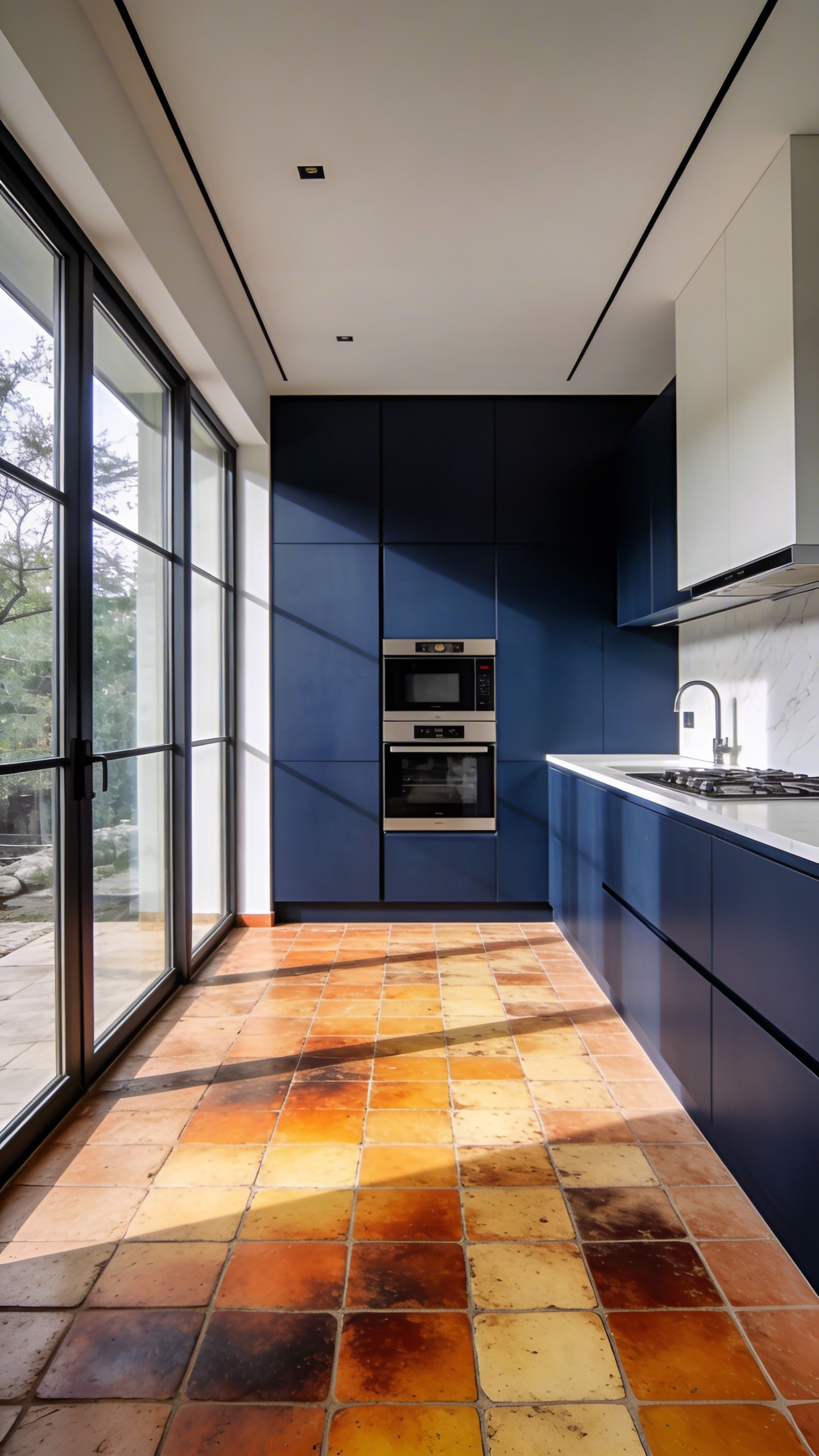
However, terracotta changes how a room actually sounds. For instance, the microporous clay is a natural sound diffuser. It absorbs high-frequency clatter rather than bouncing it around. Next, this high-density earth provides incredible thermal mass. It retains warmth beautifully for radiant heating setups. Ultimately, this living finish is a permanent investment. You absolutely must use an impregnating sealer to protect the porous tile. Indeed, this preserves its raw Mediterranean warmth for decades.
4. Classic Checkerboard Marble: A Masterclass in High-Contrast Geometry
The classic checkerboard marble floor is an architectural staple. Specifically, it bridges historical design with contemporary minimalism. Dutch masters used this pattern for perspective in the 17th century. It acts much like modern kitchen tiles design concepts that enhance depth. Today, we still use these receding lines to deepen kitchens. In fact, high-contrast geometry actively manipulates your perception of space. For instance, laying tiles at a 45-degree angle widens narrow rooms. This diagonal trick draws the eye outward toward the corners. Next, alternating dark and light squares creates a visual vibration. Therefore, flat kitchen layouts never feel static.
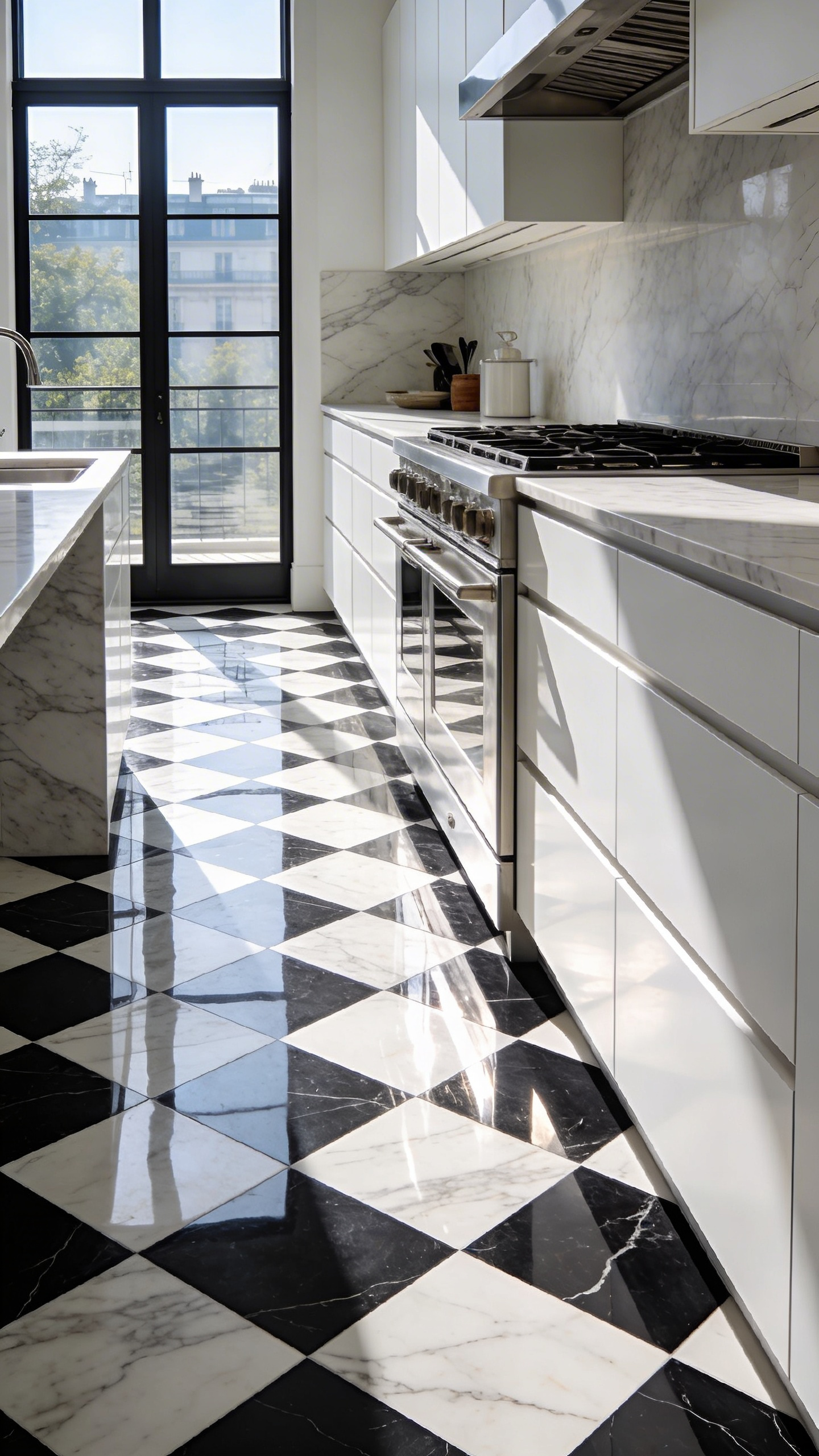
Nailing this look requires careful material selection. Naturally, Nero Marquina is the gold standard for black tiles. Thassos marble offers a pure, crystalline white contrast. However, Carrara introduces grey veining to soften the stark geometry. We highly recommend a honed finish here. Specifically, this velvety texture feels incredibly organic underfoot. Next, the matte surface safely hides etching from lemon juice or wine. Ultimately, natural marble is a living finish that ages gracefully. The resulting patina adds real character to the space. Finally, neutral grey grout stitches the stones together perfectly.
5. Cleft-Finish Slate Herringbone: Tactile Durability for Intensive Prep Zones
The herringbone pattern offers more than just good looks. Specifically, it descends from an ancient Roman masonry style. Engineers used this interlocking V-shape to distribute heavy weight. Therefore, it prevents shifting under immense structural pressure. In a busy kitchen, cooks constantly pivot between stations. Standard linear floors often experience subtle grout fatigue from this. However, herringbone provides structural stiffness to resist the twisting motion.
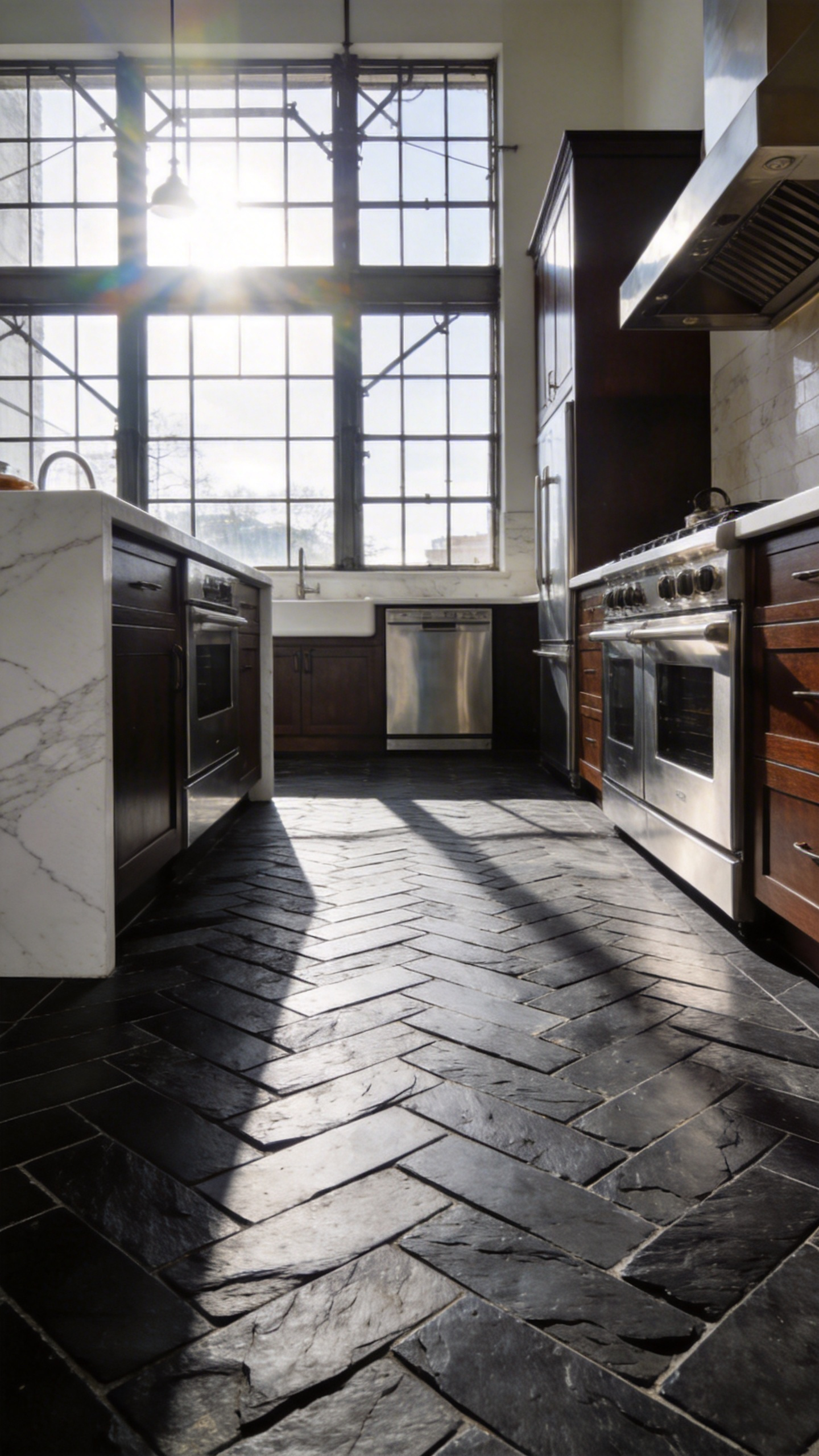
In fact, cleft-finish slate takes this durability even further. Unlike smooth stone, cleft slate splits along natural layers. This creates a slightly uneven surface of peaks and valleys. Interestingly, this interacts with your kitchen lighting to cast micro-shadows. These shadows beautifully hide stray flour dust and water spots. Next, this natural grit is a built-in anti-slip mechanism. Cleft slate has an incredibly high friction coefficient. Therefore, it keeps you safe if you spill olive oil.
Initially, you might notice small flakes lifting from the floor. Specifically, this “shaling” process happens during the first few months. However, this is just the floor naturally seasoning itself. Eventually, foot traffic softens the high points of the stone. The slate develops a broken-in, ergonomic texture. Indeed, natural slate also has incredibly high thermal mass. Therefore, it pairs perfectly with underfloor radiant heating. This radiating warmth keeps your leg muscles limber while cooking. Next, the dense stone acts as a stabilizing heat sink.
To preserve this tactile floor, maintenance is key. First, always use pH-neutral stone soaps for daily cleaning. Acidic cleaners like vinegar will slowly etch the stone. Next, apply a color-enhancing sealer. This deepens the rich charcoal tones of the slate. Consequently, the prominent grout lines recede for a seamless look.
Theme II: Engineered Innovation (Modern & High-Performance Materials)
Modern engineered floors represent a massive technological leap. Specifically, they act like waterproof shields while looking incredibly natural. The industry relies on two distinct core technologies right now. First, Stone Plastic Composite (SPC) uses a dense limestone backbone. Therefore, this core resists dents from heavy ranges and refrigerators. Alternatively, Wood Plastic Composite (WPC) uses a foamed, cellular structure. This trapped air provides a warmer, orthopedic feel underfoot.
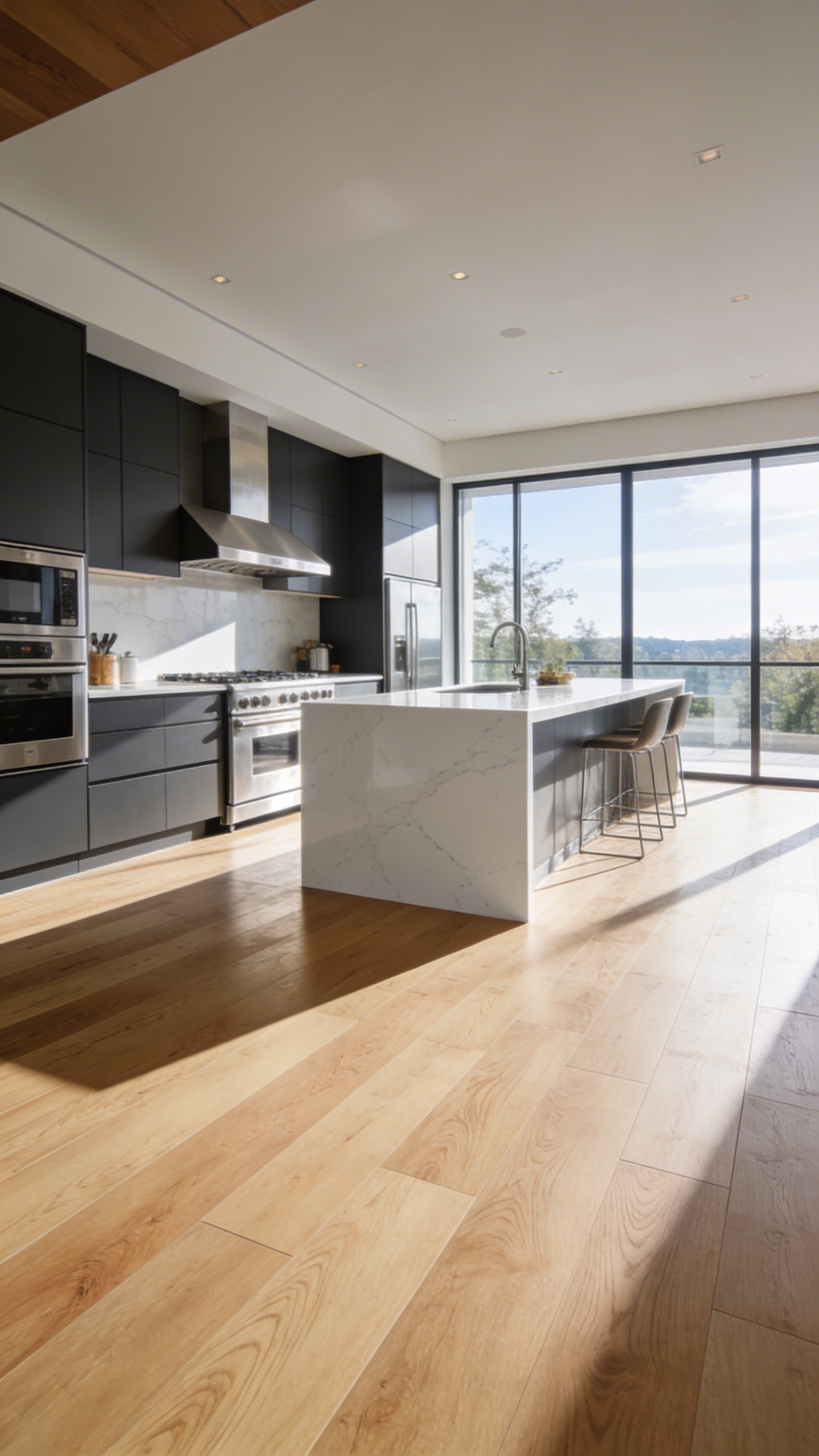
In fact, texture is where these floors really shine. Embossed-in-Register technology syncs physical textures with digital prints. Consequently, you feel a wood knot exactly where you see it. This micro-etched surface improves slip resistance without feeling like sandpaper.
Hygiene is another major focus for modern kitchens. Today, premium planks infuse titanium dioxide into their wear layers. This creates a microscopic liquid-glass effect that blocks bacteria.
Next, manufacturers finally figured out acoustic engineering. Pre-attached cork underlayments quietly absorb harsh footsteps. Ultimately, these innovations generate incredibly practical kitchen flooring ideas.
6. Ultra-Compact Sintered Stone: The Indestructible Evolution of Seamless Surfaces
Ultra-compact sintered stone is a true breakthrough in modern flooring. Specifically, it uses intense pressure to fuse natural minerals together. Manufacturers compress quartz, feldspar, and glass. Extreme heat creates a molecular bond without any plastic resins. Therefore, the surface is completely impervious to high heat and UV fading.
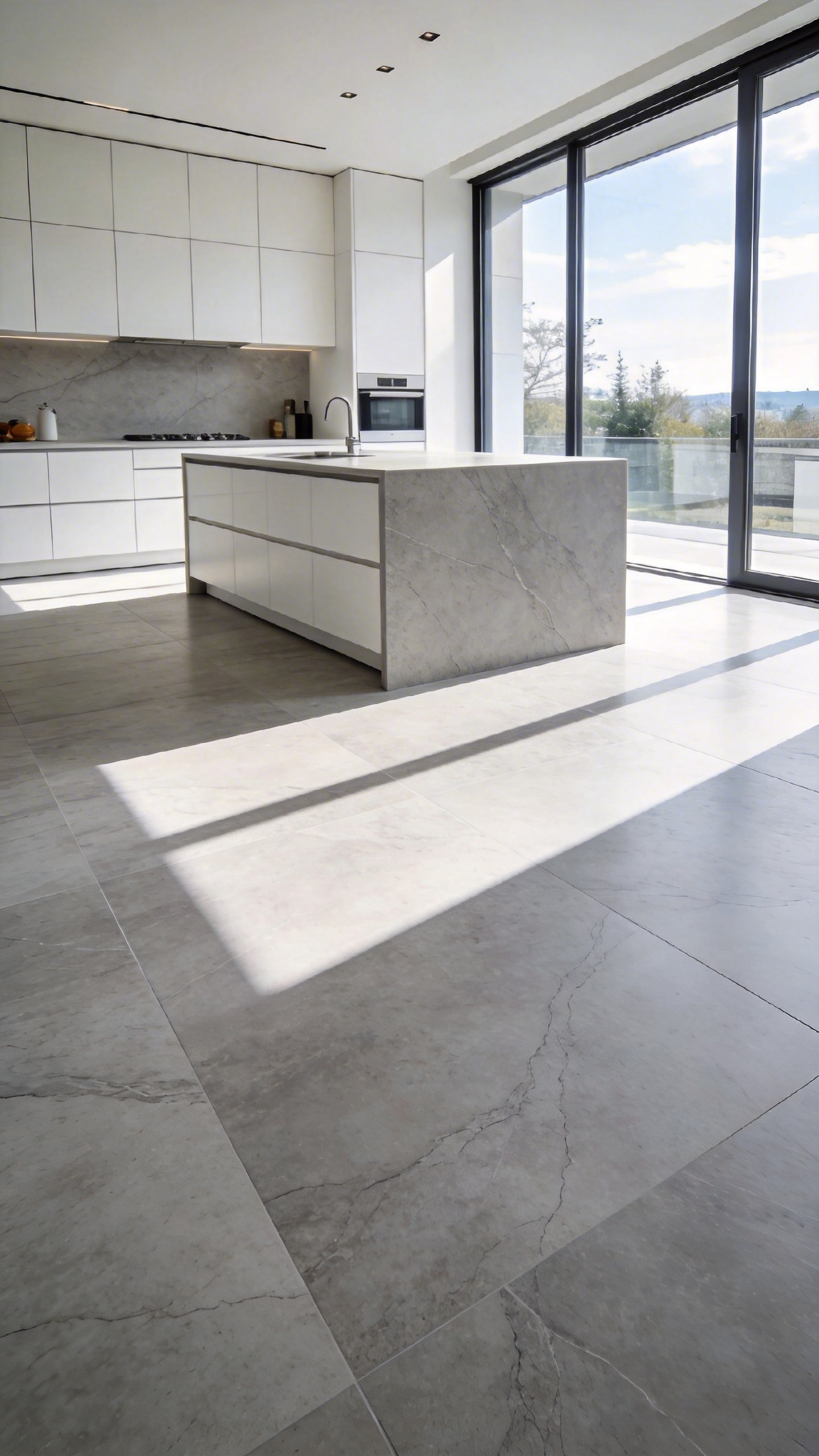
Visually, these massive slabs let designers create a monolithic aesthetic. In fact, a standard kitchen floor might have just two seams. Eliminating thick grout lines prevents bacteria buildup and stains. Tactilely, synchronized ridges align perfectly with visual veining. Therefore, the floor delivers an authentic, natural texture underfoot.
Next, its extreme density makes it an exceptional thermal conductor. The material absorbs warmth beautifully from radiant heating systems. A proper solid mortar installation yields a satisfying, heavy thud. This acoustic profile conveys a real sense of permanence.
However, there is a catch with this incredible hardness. The internal tension makes the slabs somewhat brittle during installation. Therefore, professionals must use specialized diamond tools to prevent shattering. Once installed, however, this stone is an indestructible foundation.
7. Luxury Vinyl Plank (LVP) Evolution: The Waterproof Revolution in Premium Textures
Luxury Vinyl Plank has transformed from a cheap alternative into high-performance gear. Specifically, this waterproof revolution started inside the plank’s core. Initially, WPC introduced a foamed core for a softer feel. However, the real evolution arrived with Stone Plastic Composite. By using a limestone core, manufacturers created an indestructible foundation. Therefore, this rigid structure resists dents from dropped cast-iron skillets. Next, tension-based locking mechanisms tightly seal the seams between planks. Standing water from a dishwasher leak simply cannot seep into your subfloor.
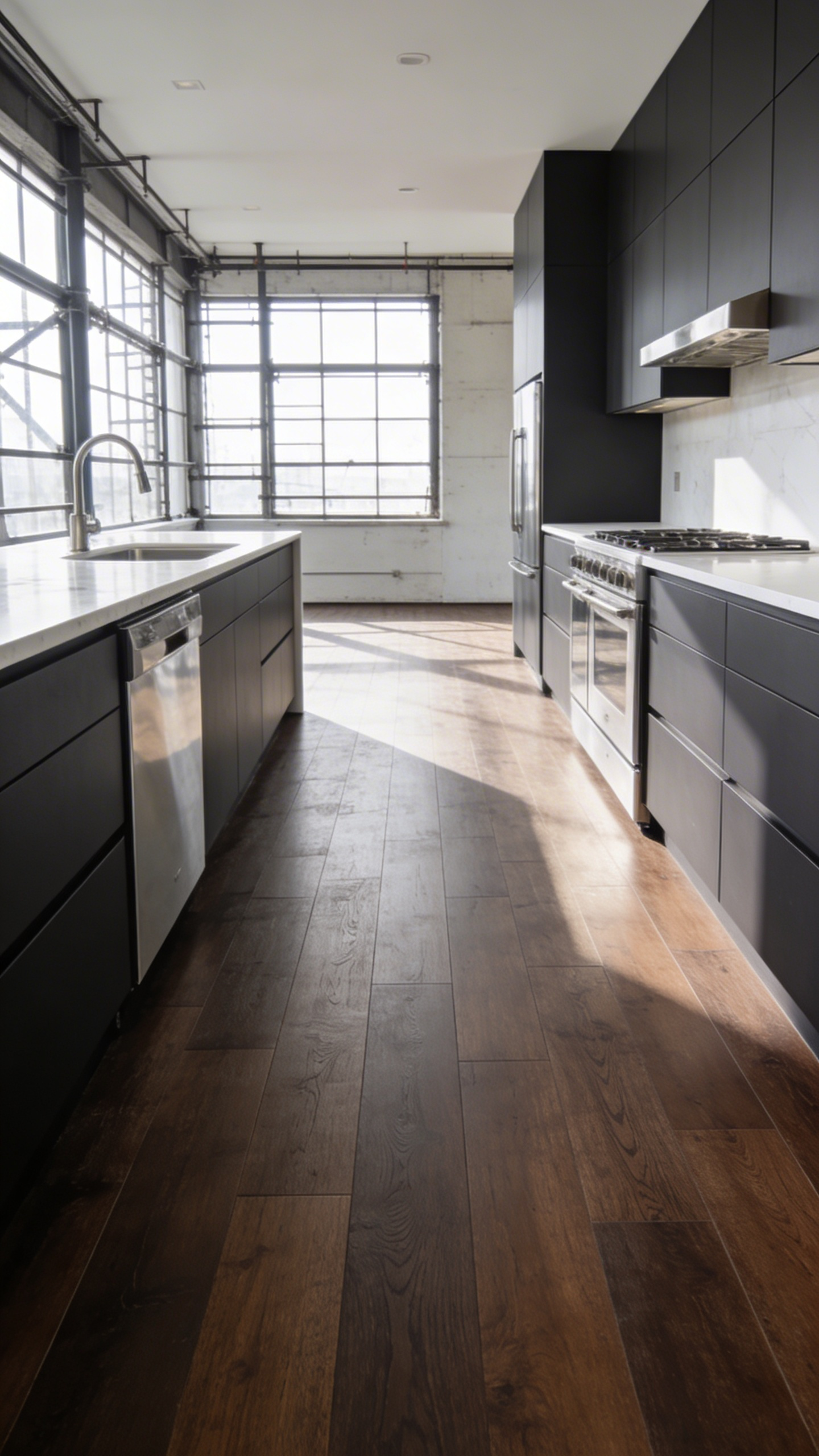
Beyond structural durability, modern LVP truly excels in texture. Historically, printed wood grains rarely matched the physical bumps of the floor. Today, manufacturers align 3D grooves directly with digital prints of wood knots. Visually, this creates a matte depth that eliminates that old plastic glare. Tactilely, the surface feels authentic and warm beneath bare feet. Ultimately, premium brands now fuse these limestone planks with cork underlayments. Indeed, modern kitchens get the acoustic comfort of wood with the grit of stone.
8. Polished Concrete Floors: Industrial Chic with Scientific Thermal Mass Benefits
Polished concrete brings incredible sensory depth to modern kitchens. Specifically, a liquid densifier reacts with the soft calcium in the slab. This forms a highly durable silicate network. The floor literally hardens from the inside out. Aesthetically, I prefer stopping at an 800-grit finish. This avoids the harsh, blinding glare of a car showroom. Instead, it yields a soft, satin-like texture. This monolithic look is the ultimate foundation for minimalist kitchen remodel ideas.
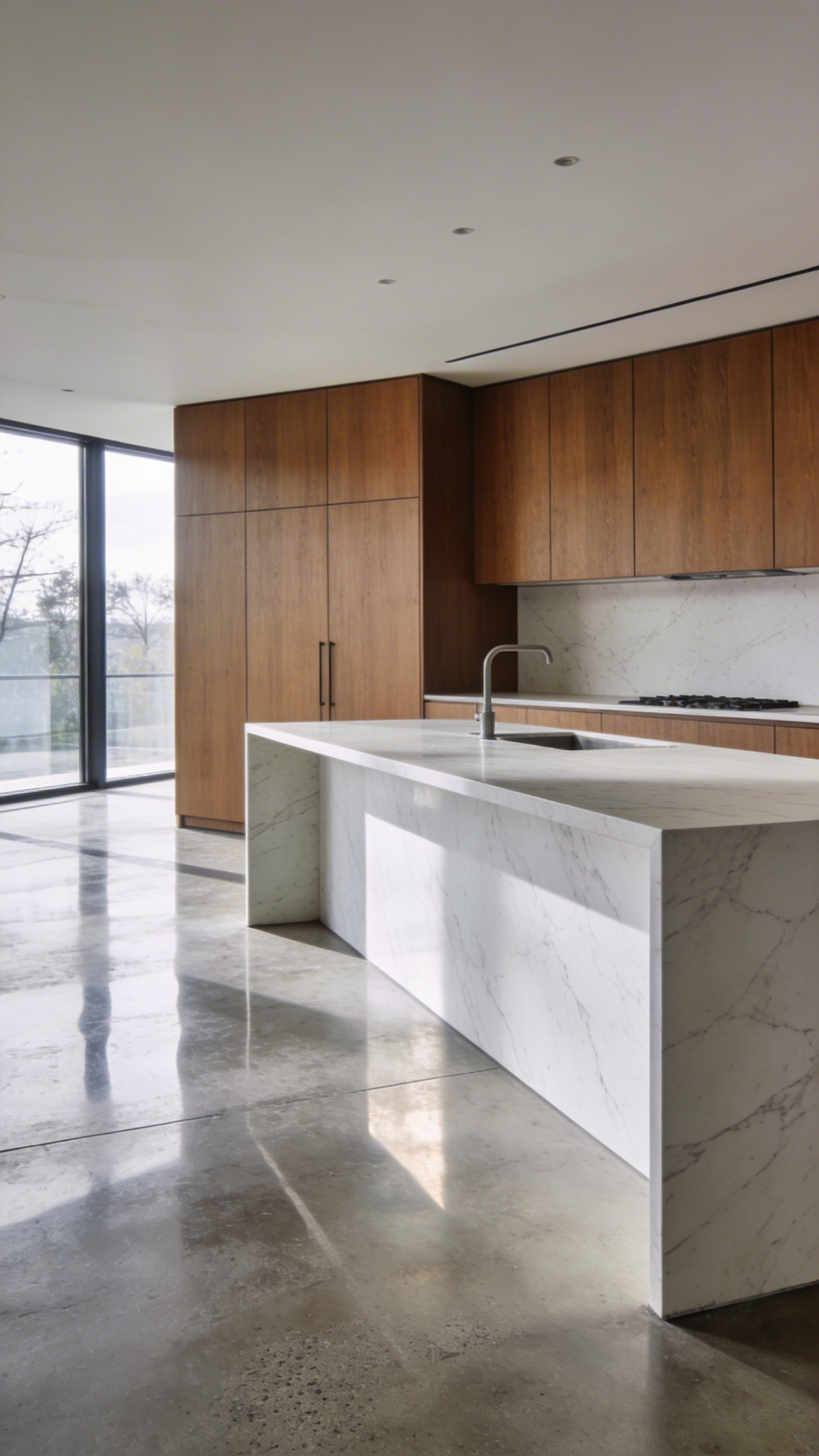
Meanwhile, the slab functions as a massive thermal battery. Dense concrete has a very high specific heat capacity. Therefore, it absorbs ambient daytime heat from your oven. Later, it slowly releases warmth as evening temperatures drop. Indeed, pairing these floors with hydronic radiant heating is a game-changer. It provides a welcoming warmth for bare feet on winter mornings.
However, you have to accept minor flaws with concrete. The surface is vulnerable to mild acidic etching. Specifically, spilled lemon juice will chemically alter the floor. Ultimately, this just creates a living patina over the years. Acoustically, dense concrete reflects sound aggressively across an open room. Therefore, we highly recommend pairing it with warm timber shelving. These softer wooden textures balance out the industrial hardness. Finally, anti-slip additives ensure safety during inevitable kitchen spills.
9. Poured-in-Place Terrazzo: Custom Aggregate Expressions for Artistic Interiors
Poured-in-place terrazzo transforms your floor into an unbroken canvas. Historically, Venetian artisans created this medium from discarded marble. Today, modern epoxy binders allow for a incredibly thin installation. Specifically, this fluid layer sets at just a quarter-inch thick. Next, epoxy systems withstand intense thermal shock from hot ovens. Therefore, this liquid stone resists the stress that cracks traditional tile.
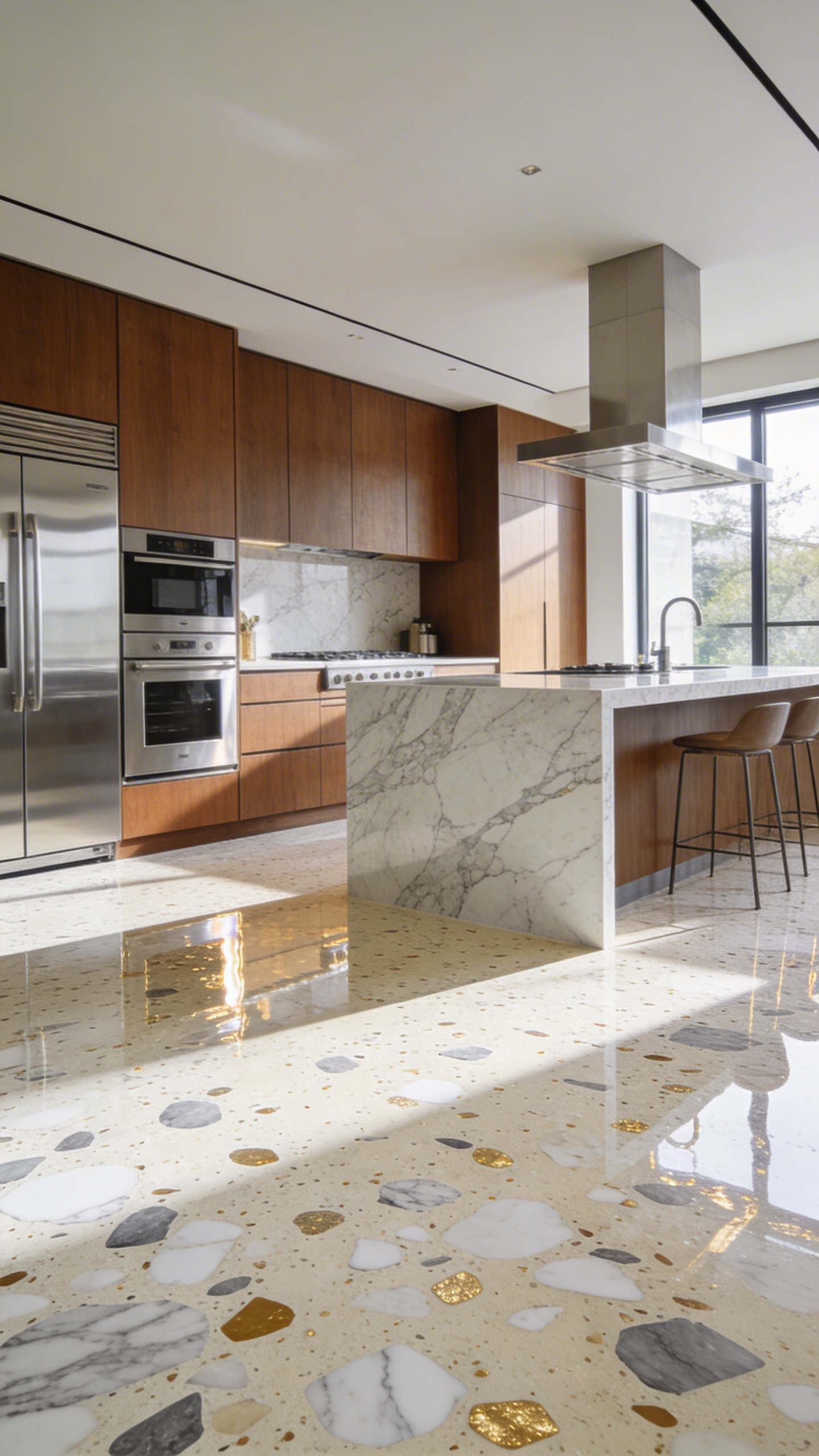
Visually, the real magic lies in the custom aggregates. For instance, designers often hand-toss mother-of-pearl into the wet surface. Naturally, the shells refract light to create shimmering depth. You can even embed semi-precious lapis lazuli for a bolder look. Occasionally, hand-bent brass strips help zone the space organically.
Structurally, pouring the floor creates a completely seamless environment. The lack of grout lines ensures a silent, cushioned feel. Next, this non-porous skin completely eliminates trapped dirt and mold. Sweeping the terrazzo up onto an island plinth visually expands the room.
Ultimately, this site-crafted surface is a forever floor. A well-maintained poured finish easily lasts a century. If the surface dulls, you just re-grind and polish it on-site. However, you must always clean it using pH-neutral soap. Harsh chemical sprays will slowly strip away its vibrant luster.
10. Engineered Walnut with Titanium Oxide Finish: Dimensional Stability Meets Rich Tones
Kitchens experience rapid micro-climate shifts from steam and heat. Therefore, solid walnut often warps aggressively in these spaces. However, engineered walnut solves this issue through cross-grain lamination. Specifically, each internal layer stops the others from expanding or contracting. This creates incredible dimensional stability in a demanding room.
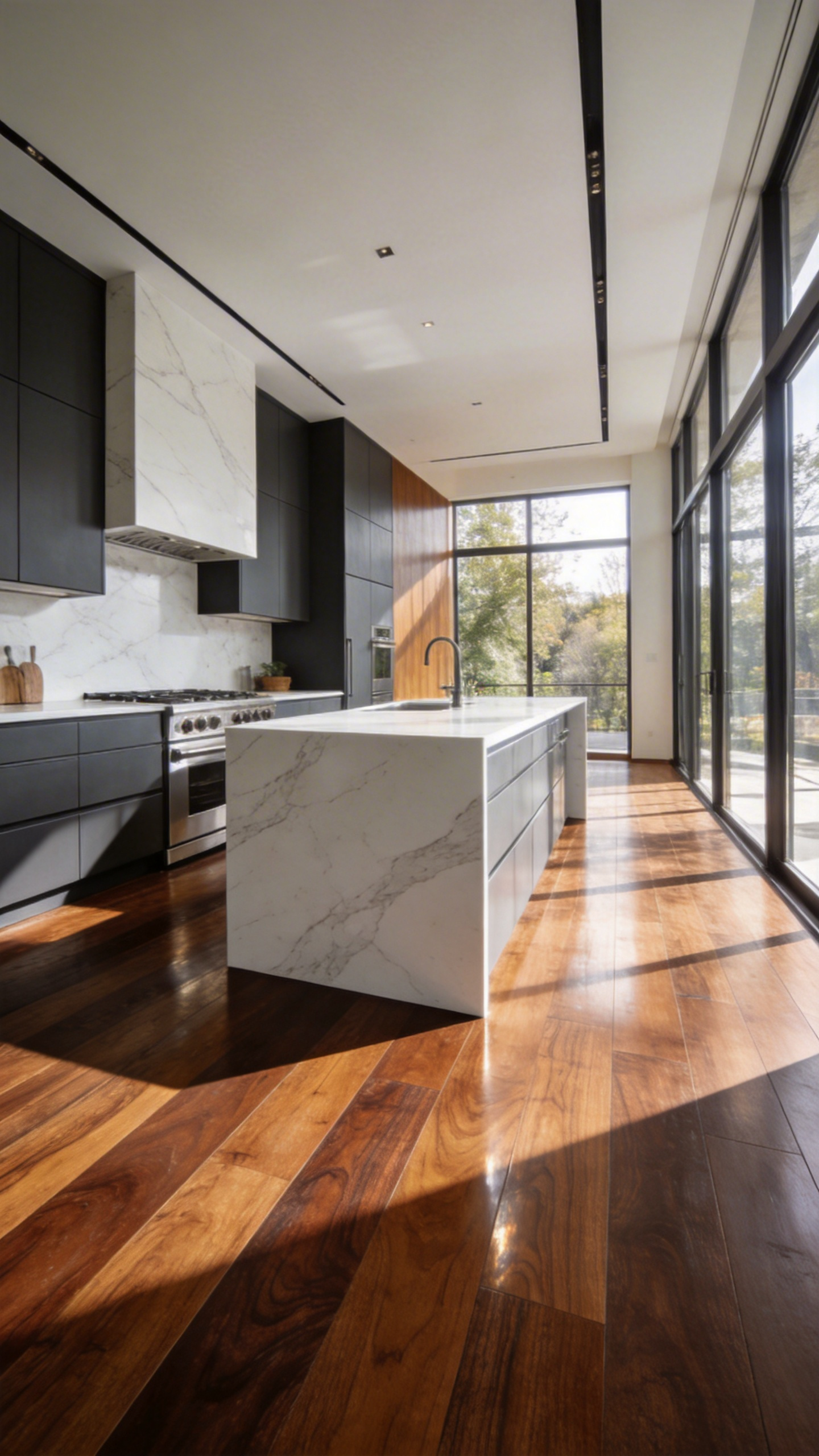
Beyond structure, the surface finish dictates the look. Traditionally, durable floors used aluminum oxide for scratch protection. Unfortunately, that chemical creates a cheap milky haze over the wood. Instead, modern titanium oxide features a much higher refractive index. Therefore, the finish remains virtually invisible to the eye. It perfectly preserves the deep chocolates and auburns of the walnut. Walking on this surface feels genuinely tactile. Indeed, it retains the dry, authentic look of natural oil. Yet, it delivers the diamond-hard protection of factory-cured urethane. This finish acts as a flexible armor against drops. For instance, a dropped skillet will not cause white cracking. Visually, dark walnut brilliantly grounds kitchens with stark white cabinetry. Ultimately, you get heritage luxury without sacrificing modern resilience.
Theme III: Spatial Transitions & Mixed Material Artistry
Floors are an incredible tool for architectural storytelling. Specifically, you can intentionally merge totally different materials together. This creates a beautiful bleeding edge between zones. For example, let organic hardwood bleed into rigid geometric tile. Visually, this dissolving boundary looks absolutely stunning. However, it also engages your sense of touch. Moving from warm oak to cold porcelain triggers a biological reset. Your brain instantly recognizes a shift between functional zones. Next, this material change acts as an invisible acoustic boundary. This is a brilliant trick in kitchen interior design. Hard tiles reflect the clatter of cooking. Conversely, the surrounding wood naturally absorbs ambient noise.
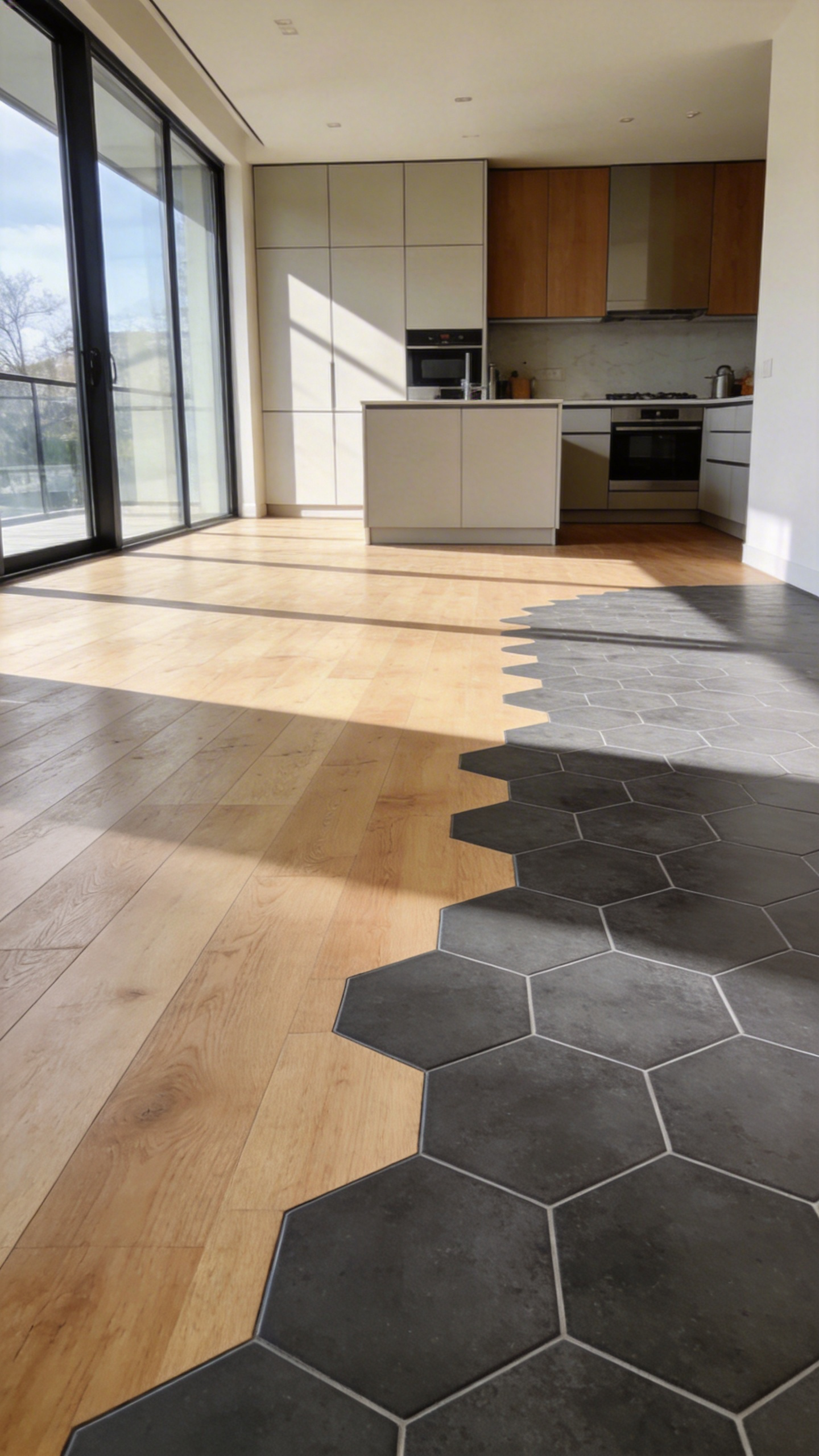
Pulling off this seamless threshold requires serious technical artistry. Historically, Victorian homes used functional tile rugs near fireplaces. Today, we use them to anchor dynamic kitchen islands. Installers often use precise CNC routing for a perfect fit. Alternatively, purists prefer the organic feel of hand-scribing the planks. Either way, the installation demands careful engineering. Wood is hygroscopic, meaning it constantly expands and contracts. Therefore, installers must use flexible polymers instead of rigid grout. This prevents nasty cracking during seasonal humidity shifts.
Keeping these contrasting surfaces completely flush is also vital. Hardwood planks are naturally thicker than ceramic tiles. Therefore, contractors must pour self-leveling underlayment beneath the tile zone. This achieves a flat transition without clumsy trip hazards. In today’s open-concept homes, we intuitively crave defined boundaries. Indeed, mixing materials turns cavernous spaces into curated, intentional zones.
11. Brass-Inlaid Hexagon-to-Wood Transitions: The Art of the Open-Concept Threshold
The brass-inlaid hexagon-to-wood transition is a striking architectural handshake. Specifically, it replaces rigid straight lines with a pixelated flow. This clever design blurs the hard boundary between utility and comfort. Therefore, small open-plan areas feel significantly more expansive. It creates an invisible threshold that gently guides the eye.
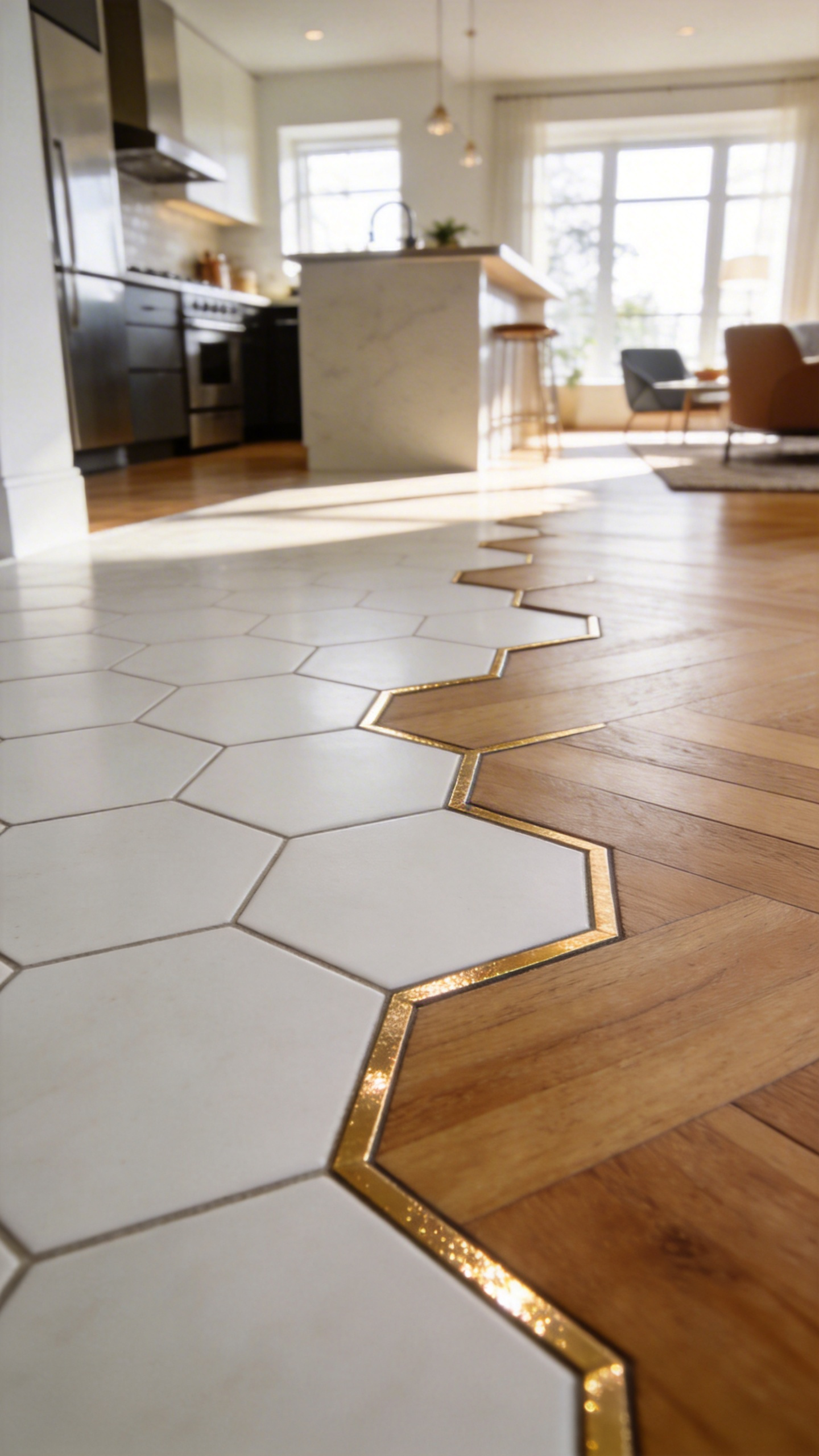
Nailing this look requires extreme precision from your contractor. For instance, tile and hardwood rarely share the exact same thickness. Therefore, professionals use custom backer boards to perfectly align both surfaces. Next, solid brass profiles anchor the jagged hexagonal edges. These metal inlays protect the brittle tile from shifting wood planks. You also need color-matched acrylic caulk instead of rigid grout here. Ultimately, this disguised expansion joint prevents buckling during humidity shifts.
Stepping from cool, matte porcelain onto warm oak is sensory magic. It provides a distinct tactile wake-up for your bare feet. Similarly, room acoustics shift dramatically across this boundary. Hard tile reflects sound, while organic timber instantly absorbs it. Today, this combination elevates humble thresholds into bespoke home jewelry. Indeed, the naturally patinating brass guarantees lasting architectural character.
12. Perimeter Border Framing: Using Contrasting Stone to Subtly Define Culinary Zones
In high-end design, the floor acts as a silent architect. Historically, Roman builders used large stones for bold borders. Today, we reimagine this ancient technique for modern luxury. Specifically, a tone-on-tone perimeter border beautifully frames the culinary zone. This manages the psychological territory effect in an open plan. It subtly signals to the brain that this area is a workspace. Therefore, guests naturally avoid standing in your busy prep path.
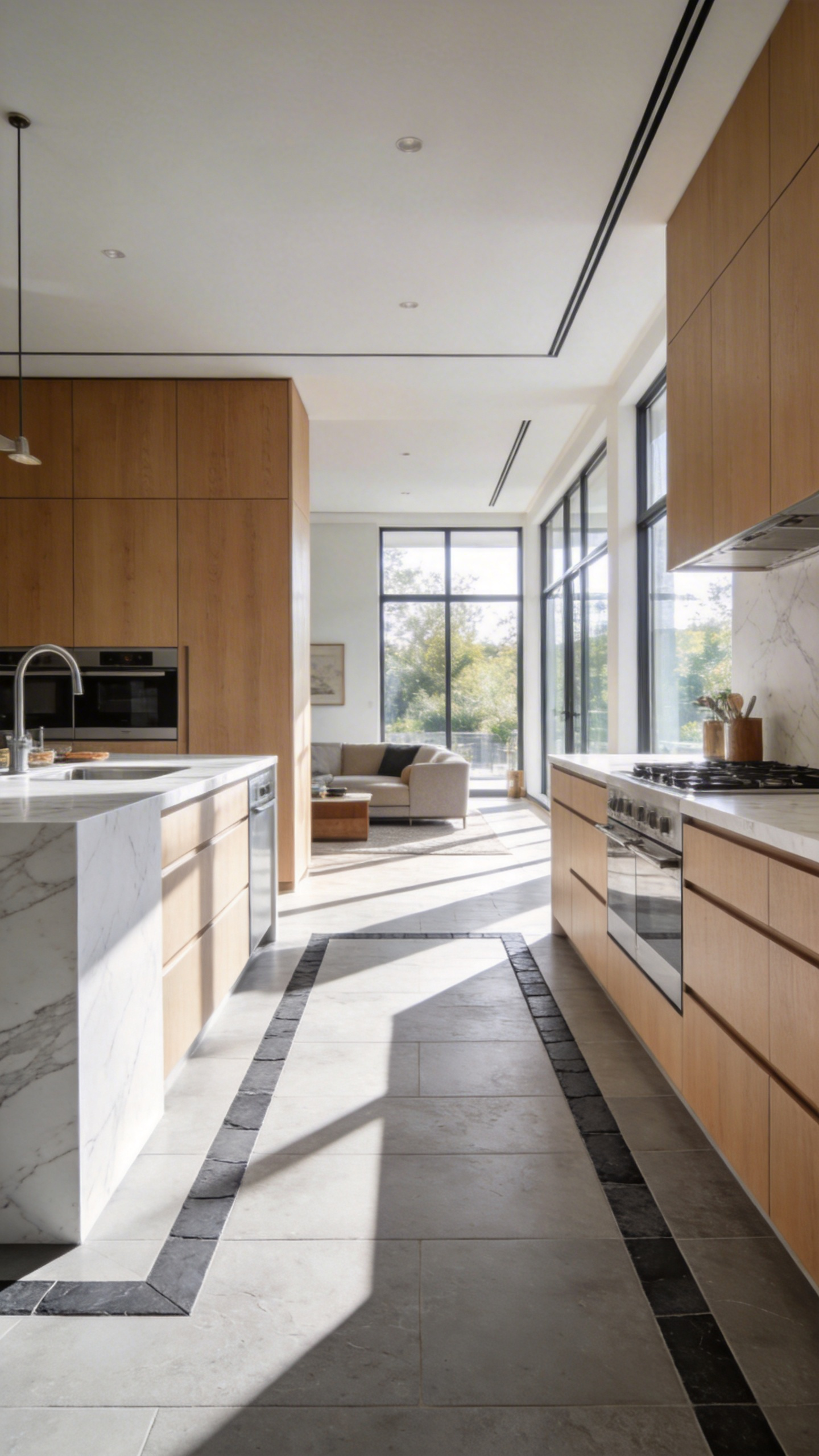
Achieving this subtle boundary requires visual restraint. We recommend a border-to-field ratio of about one to ten. Next, limit the contrast to just twenty or thirty points. This prevents a jarring outline while maintaining a distinct edge. Beyond color, you can map spaces using tactile transitions. For instance, step off a polished social area onto a leathered-finish work zone. This sudden change in foot-feel provides a clear physical cue.
Hard, polished stones reflect sound very sharply. Conversely, honed stones soften the acoustic profile of the kitchen. Ultimately, this design requires choosing stones with very similar porosity levels. Otherwise, differential wear will make the floor age terribly. Finally, apply a durable epoxy grout that matches the darker stone. Indeed, this blurs the seam for an organic, waterproof transition.
13. Directional Parquet Patterning: Flooring Architecture That Guides Visual Traffic Flow
Directional parquet acts as interior wayfinding for your kitchen. Specifically, think of the flooring as a visual liquid. You pour this surface to direct eyes toward a specific focal point. For example, the classic Chevron pattern creates a continuous arrow. Historically, this pattern guided French royalty through long palace galleries. Today, it points the way through your modern home. Therefore, it intuitively signals that the space is moving forward.
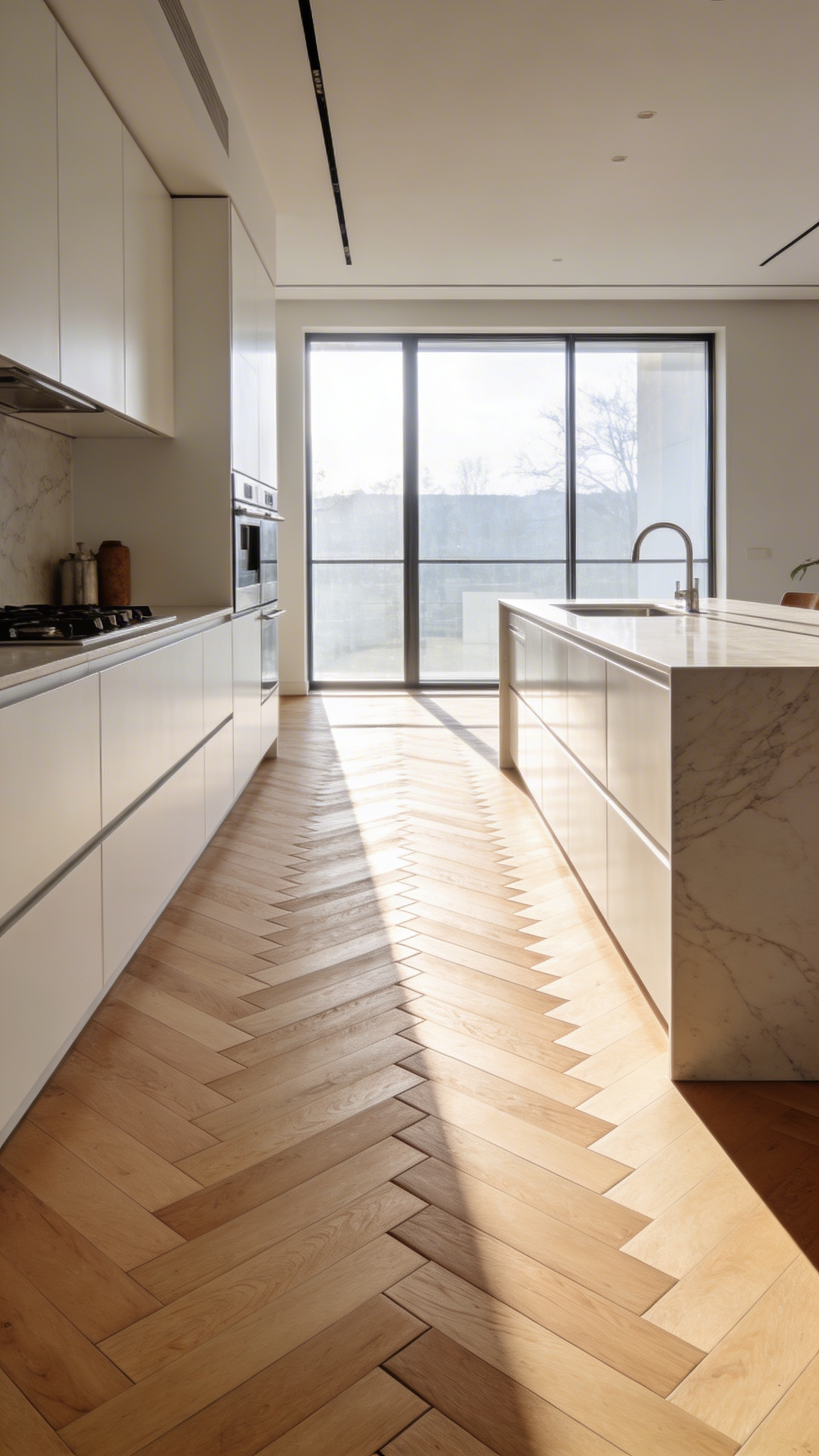
Naturally, the human eye deeply follows these geometric lines. Aligning the points away from the door creates visual expansion. Conversely, pointing the planks across the room acts as a visual brake. This makes a narrow kitchen feel much wider and firmly anchored. Next, the geometric vanishing point beautifully anchors large central objects. Directional points can converge directly at your custom kitchen island. Therefore, the island becomes a true architectural destination.
I often suggest a straight-grain wooden border around the cabinetry. This effectively stops the zigzag flow with a grounded border effect. Morning sun hits the mitered joints to create amazing rhythmic shadows. The warm wood floor seemingly ripples toward the natural light. Finally, the specific plank ratio dictates your room’s visual speed. Long, narrow planks make a cramped kitchen feel grand. Alternatively, wider wooden blocks create a slower, intimate rhythm. Indeed, these choices completely choreograph both movement and mood.
14. The ‘Rug-Effect’ Mosaic: Anchoring the Kitchen Island with Intricate Embedded Tile Work
Modern open-plan kitchens often leave big islands looking adrift. Therefore, we use the “rug-effect” mosaic as a visual anchor. This technique embeds an intricate tile pattern right into the surrounding floor. Historically, this architectural practice dates back to ancient Roman villas. Today, it replaces fragile cloth rugs with durable porcelain or marble. This heavier visual weight gives the island real architectural permanence. Implementing this kind of kitchen remodel designs ensures your centerpiece stays visually grounded.
Executing this flush fit requires absolute technical mastery. Installers must calculate the subfloor depth down to the millimeter. In practice, they use a crack isolation membrane to prevent uneven edges. Next, professionals strictly follow the 18-36 rule for sizing. The tile must extend 18 inches on the working sides. However, it should stretch 36 inches on the seating side. This ensures your heavy barstools remain fully on the patterned surface.
This tiled rug offers a fascinating tactile paradox. The cool stone feels refreshing underfoot during summer. Meanwhile, the intricate geometric patterns provide real psychological warmth. The exact material selection changes the room’s entire atmosphere. For example, matte encaustic cement offers a chalky, historical texture. Alternatively, waterjet-cut marble introduces swirling curves for precise modern luxury. Ultimately, using epoxy grout ensures this permanent “rug” remains completely stain-proof.
Theme IV: Lifestyle Integration (Sensory Design & Practical Maintenance)
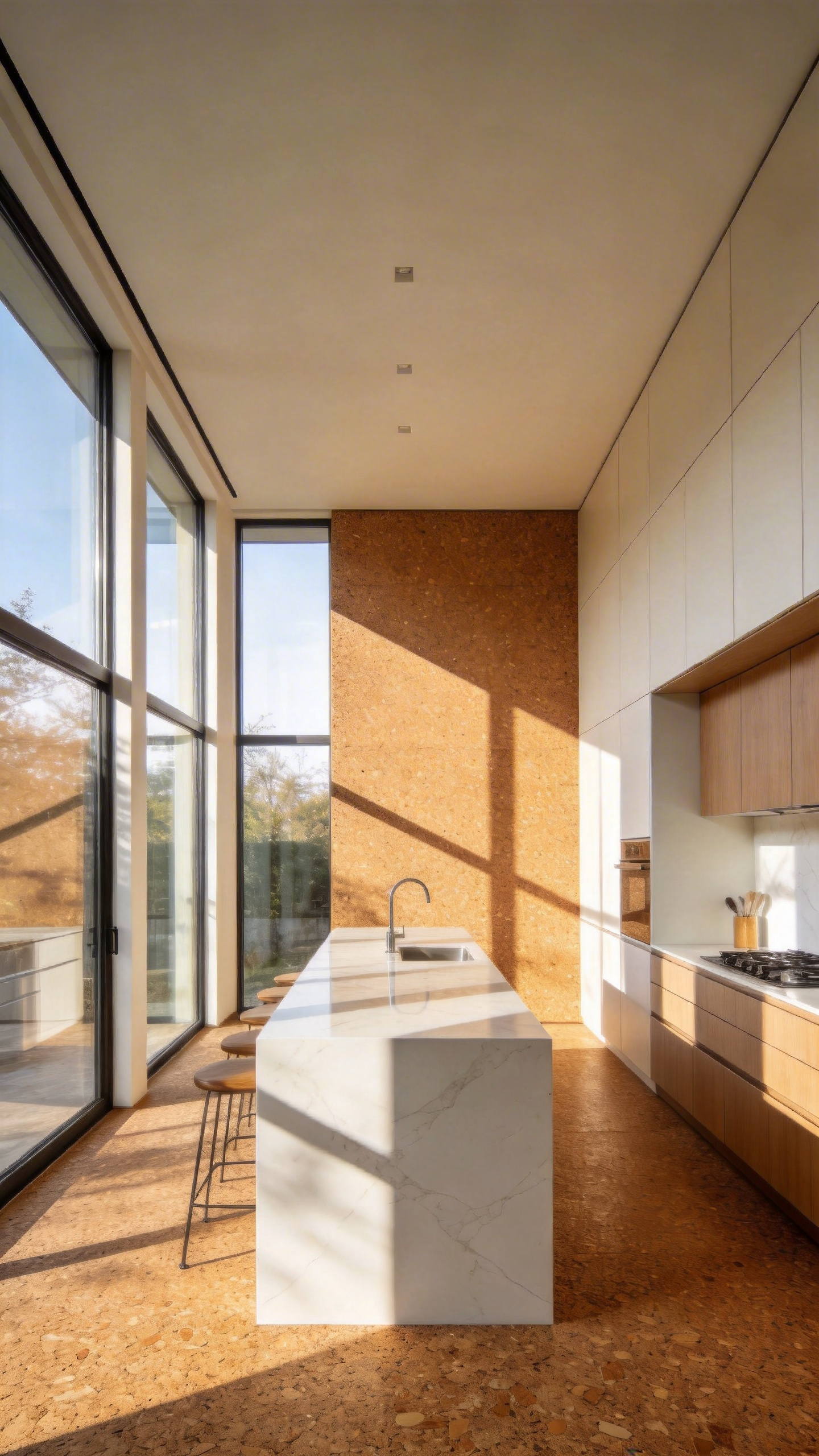
Modern kitchen flooring must respond to the human body. The kitchen is an incredibly high-fatigue work zone. Therefore, the physical yield of a floor impacts your joints. For example, yielding surfaces like cork encourage supportive micro-movements. These tiny foot adjustments stimulate circulation while you chop vegetables. They also reduce daily back strain remarkably well. Conversely, unyielding surfaces like polished concrete trigger muscle tension over time. Thermal haptics also play a critical sensory role here. Natural wood inherently maintains a warm, neutral temperature. Meanwhile, stone acts as an uncomfortable, cold heat sink.
Open-concept kitchens face significant acoustic challenges. In fact, they frequently become the loudest room in the house. Therefore, we now treat acoustic dampening as a true luxury finish. Premium floors often target an Impact Insulation rating above 70. This ensures the floor blocks heavy impact noise effectively. Sound-absorbing underlayments keep the room’s energy calm. Your mind stays relaxed without enduring the overwhelming clatter of dishes. Thus, the workspace transforms into a restorative living area.
Beyond acoustics, practical maintenance now operates at a molecular level. Today, modern floors feature built-in antimicrobial surface technologies. For instance, silver-ion treatments passively reduce household bacteria by 99.9%. Likewise, finish choices dictate your daily maintenance routine. UV-cured urethane acts like an impermeable raincoat against daily spills. Alternatively, traditional oiled wood behaves much more like living skin. Oiled floors certainly require active care and ongoing oiling. However, they allow for rapid, localized spot repairs. Ultimately, natural materials like reclaimed wood offer true sustainability. Their developing patina ages beautifully alongside your growing family.
15. High-Density Cork Flooring: Ergonomic Resilience and Acoustic Dampening for the Serious Chef
High-density cork flooring is often misunderstood as a fragile material. However, it represents the absolute peak of natural resilience. The material contains 40 million microscopic air cells per cubic centimeter. Therefore, it gently compresses underfoot like a tiny spring-loaded cushion. It compresses up to forty percent and recovers its shape instantly. This elastic memory drastically reduces physical fatigue on your joints. Next, a natural waxy substance called Suberin coats the cellular structure. This hydrophobic barrier keeps the floor highly resistant to kitchen spills. It also maintains a comforting, body-neutral surface temperature.
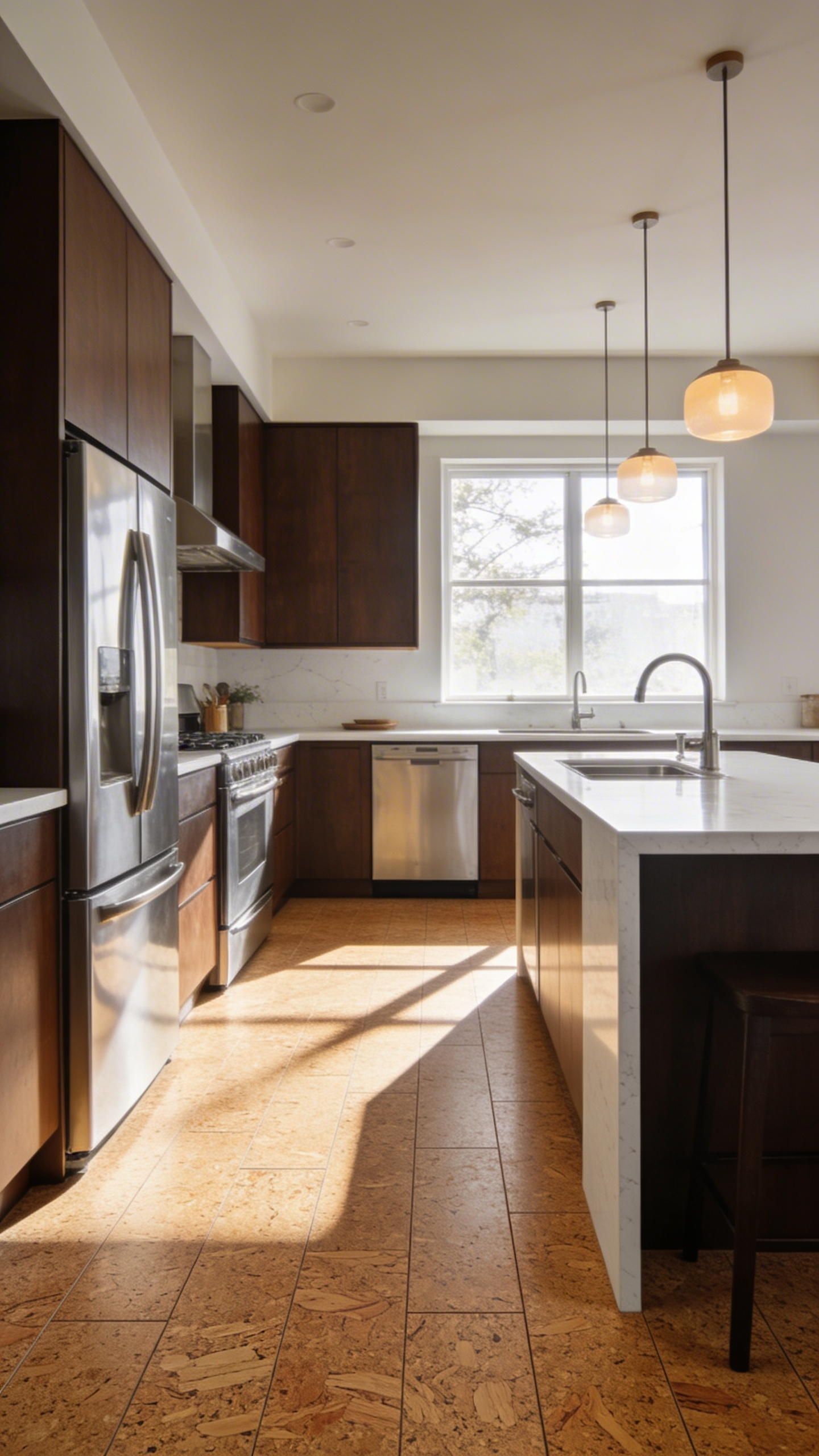
Kitchens are notoriously loud, clattering environments. Fortunately, high-density cork has an impressive Noise Reduction Coefficient of 0.70. The surface safely absorbs seventy percent of ambient sound waves. It also reduces heavy impact noise by up to twenty-two decibels. Naturally, busy cooks worry about dropping sharp culinary knives. Yet, the material is highly engineered and incredibly dense. The resilient cork cells slowly expand to close minor micro-punctures. Dropping that same heavy knife on traditional porcelain would shatter the tile. Today, high-pressure steaming transforms the material’s natural sugars. Ultimately, this creates sophisticated, chocolate-brown grains that ground your culinary space.
16. Radiant Underfloor Heating: Transforming Cold Stone into a Tactile Morning Luxury
Humans have been warming stone floors since 5000 BC. Specifically, this practice dates back to ancient Korean Ondol systems. Today, radiant underfloor heating transforms cold stone into tactile luxury. Naturally, your feet contain over 200,000 sensitive nerve endings. Therefore, stepping onto a freezing floor triggers a minor stress response. Conversely, heated stone promotes soothing morning muscle relaxation. Psychologists actually call this sensory pairing “soft fascination.” Beautiful marble combined with unexpected tactile warmth emotionally grounds you.
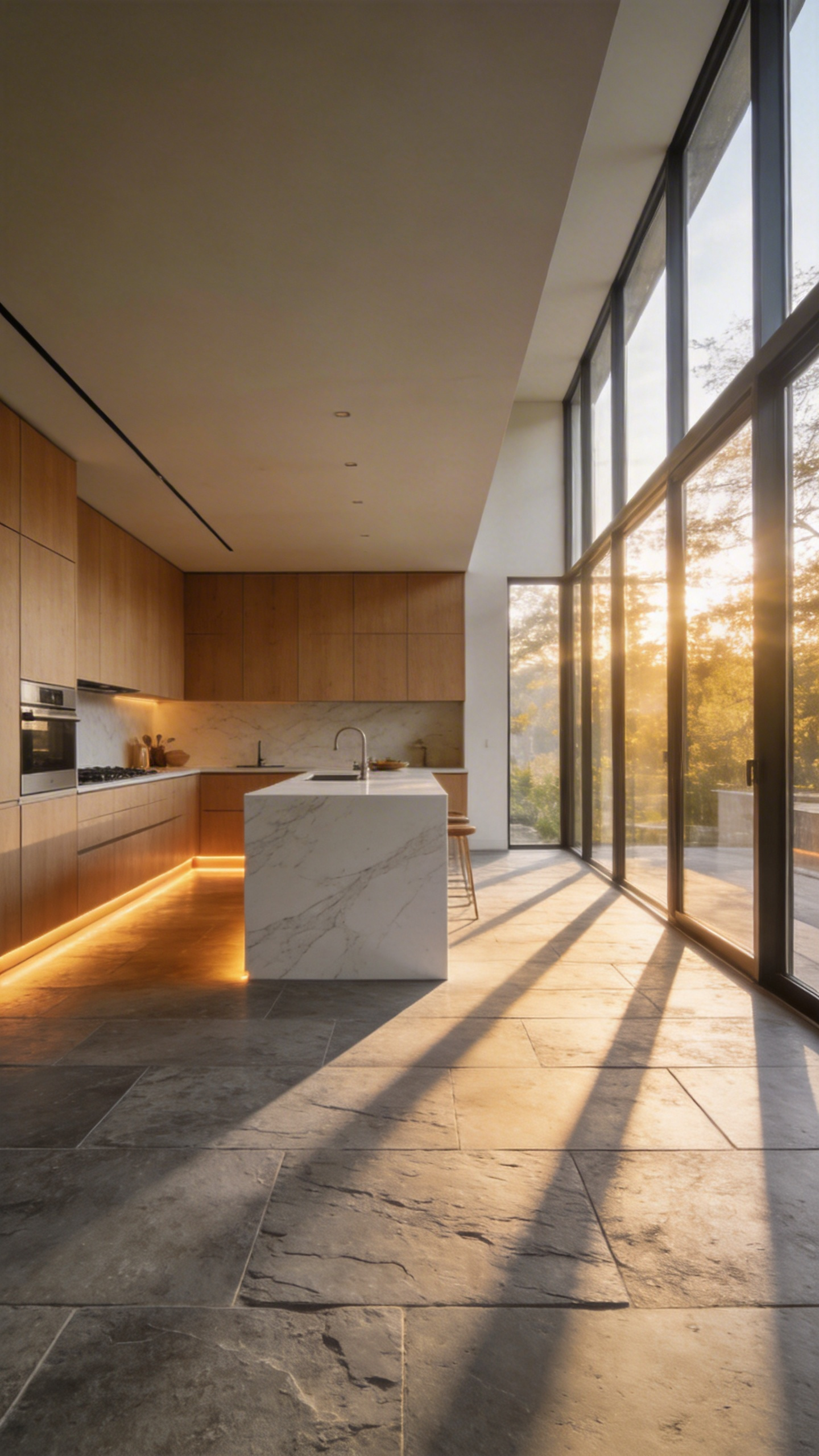
Functionally, natural stone acts as an excellent thermal battery. Dense granite transfers heat up to your feet with incredible speed. Meanwhile, porous travertine heats slowly but retains warmth for hours. However, this tactile luxury requires careful structural engineering. Continual heating and cooling cycles cause natural stone to expand. Installers must use specialized decoupling membranes under the surface. These flexible membranes absorb stress, preventing ugly hairline cracks. Next, radiant heat opens up the natural pores of the stone. Therefore, high-grade sealers are essential to prevent moisture issues. Finally, you have to choose between two distinct heating methods. Electric mats offer rapid heat in just thirty minutes. Alternatively, hydronic tubing provides constant, low-intensity warmth for new builds. Both systems turn a simple surface into an immersive morning experience.
17. Micro-Grip Slip-Resistant Glazes: The Material Science of Safe, Functional Wet Zones
Traditional slip-resistant tiles rely on harsh, sandpaper-like abrasion. However, modern micro-grip glazes completely change this experience. Manufacturers now grow invisible crystals directly inside the tile glaze. These silicates create a surface that feels perfectly smooth when dry. However, spilling water instantly triggers a latent grip. The microscopic topography uses capillary action to create a vacuum-like suction. Your foot displaces the water into tiny pores, preventing a slip. Therefore, these tiles easily exceed standard safety ratings. You get industrial kitchen safety paired with luxury residential aesthetics. High-definition inkjet printing allows these tiles to mimic honed marble beautifully. Next, the high silica content makes the matrix incredibly resilient. This surface easily survives a spilled glass of red wine.
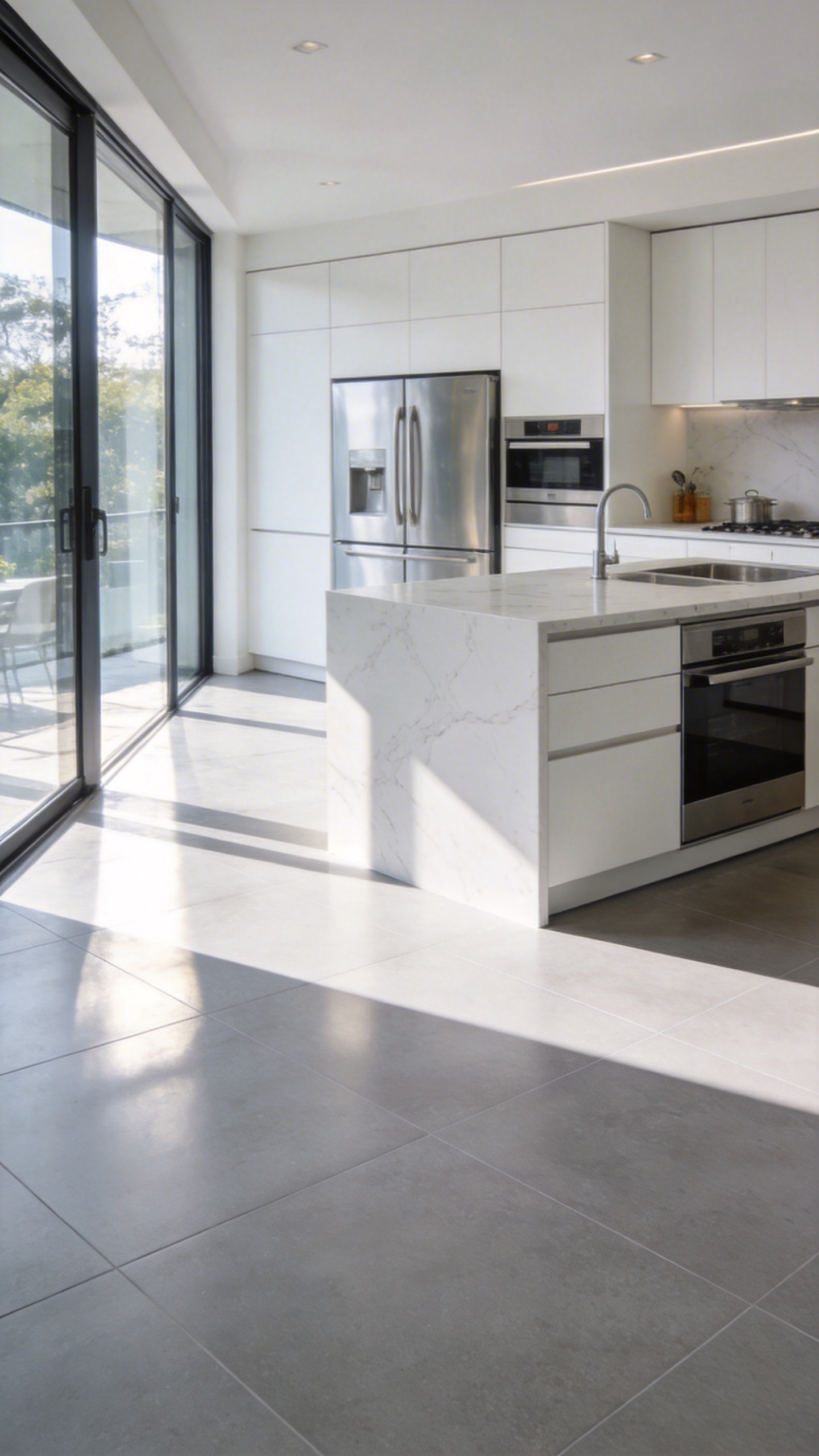
Nevertheless, maintaining these floors requires a specific approach. The same micro-pores that provide safety can trap cooking grease. Unfortunately, traditional cotton mops merely push this dirt across the surface. Instead, you must use a microfiber mop or high-pressure steam. The microscopic fibers easily reach into the indentations to lift trapped residue. Ultimately, this material science breakthrough allows for seamless visual flow. We can now safely extend elegant living room textures directly into messy kitchen wet zones.
18. Strand-Woven Bamboo: Rapidly Renewable Elegance with Superior Impact Resistance
Strand-woven bamboo has evolved into a heavyweight design contender. Specifically, this engineered marvel outperforms most traditional hardwoods. Manufacturers create it by shredding raw bamboo into long fibers. Next, they soak these thin strands in an eco-friendly resin. Finally, massive hydraulic pressure compresses them into dense blocks. This process eliminates internal air pockets for unparalleled density. In fact, strand-woven bamboo scores up to 5,000 on the Janka hardness scale. Therefore, dropping a cast-iron skillet rarely leaves a dent.
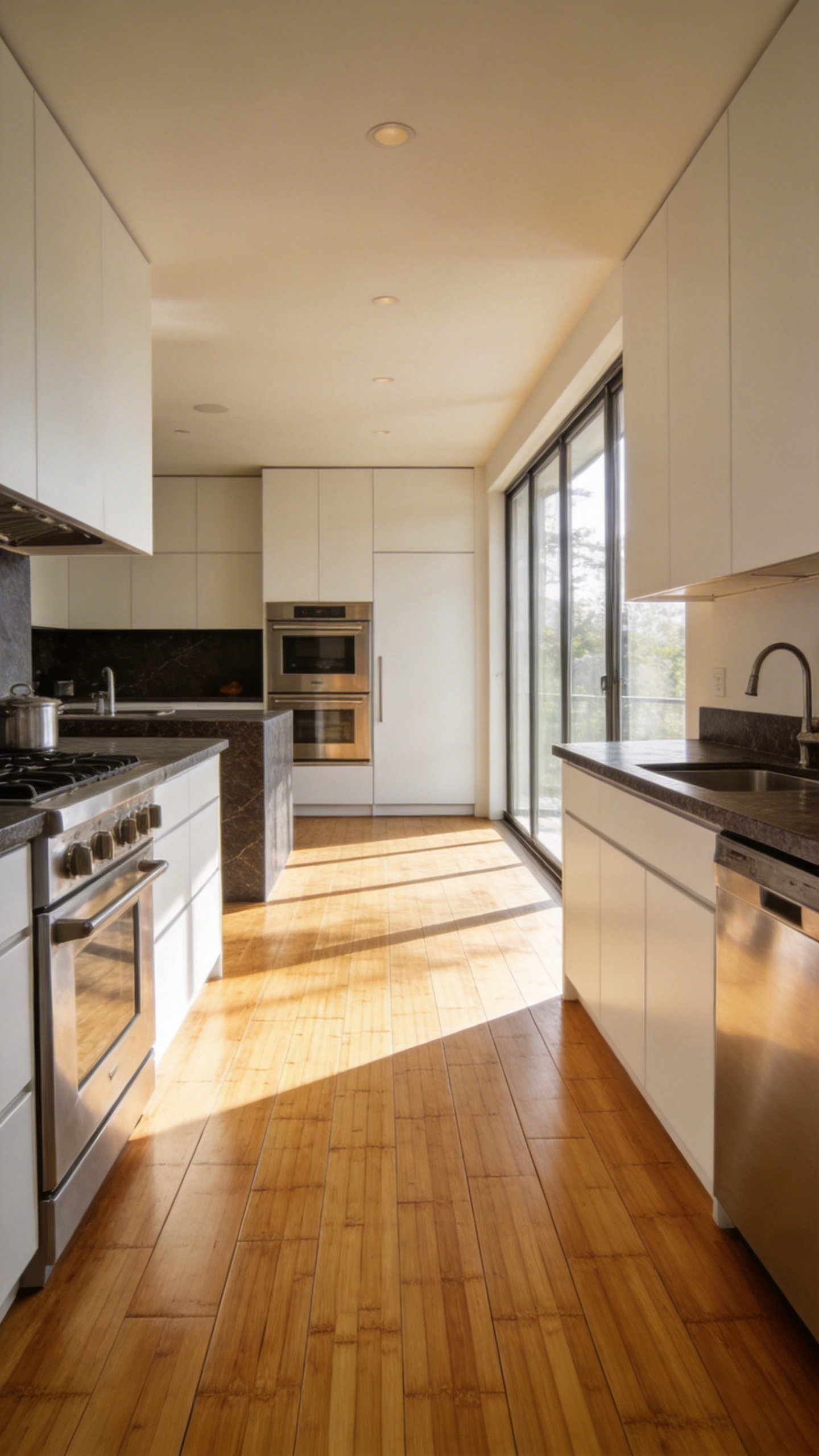
Beyond pure durability, this material offers a beautiful sensory experience. Unlike cold tile, bamboo acts as a natural thermal insulator. It provides a subtle underfoot give that reduces cooking fatigue. Visually, strand-woven planks feature a stunning, marble-like linear grain. Indeed, this texture effortlessly bridges sleek high-tech appliances and organic warmth.
However, you must carefully consider the popular carbonization process. Steam-treating the bamboo darkens it to a rich, coffee-like brown. Unfortunately, this beautiful caramelization softens the natural fibers slightly. Therefore, natural or mixed-tone finishes are better for maximizing impact resistance.
Ultimately, the best kitchen flooring ideas harmonize with your lifestyle. Bamboo provides a profound carbon-negative sustainability story. Moso bamboo matures in just five years, so it replenishes incredibly fast. Additionally, its root system stays alive after harvesting to sprout new shoots. Therefore, your kitchen floor actively captures carbon while delivering true elegance.
Frequently Asked Questions
What is the most durable kitchen flooring for high-traffic homes?
For maximum durability, ultra-compact sintered stone and premium Stone Plastic Composite (SPC) luxury vinyl are the top choices. Sintered stone is impervious to heat, scratches, and UV rays. Meanwhile, SPC offers incredible dent resistance and is completely waterproof. Both are ideal for active professional-grade kitchens.
Can I use real hardwood in a kitchen?
Yes, but material choice is absolutely critical here. Reclaimed heritage wood and engineered hardwood are the safest options. Engineered wood provides cross-grain lamination for dimensional stability against humidity. Conversely, reclaimed wood has already completed its structural movement cycle. This makes it far less prone to cupping than standard solid planks.
Is underfloor heating worth it for kitchen tiles?
Absolutely. Natural stone and porcelain have high thermal mass but low thermal conductivity. Therefore, they often feel ice-cold to the touch. Radiant underfloor heating transforms these surfaces into massive “thermal batteries.” This provides consistent, gentle warmth that drastically improves the comfort of your space.