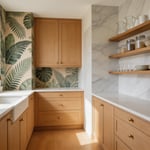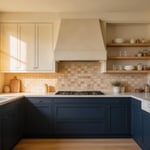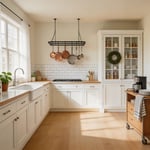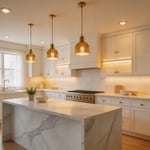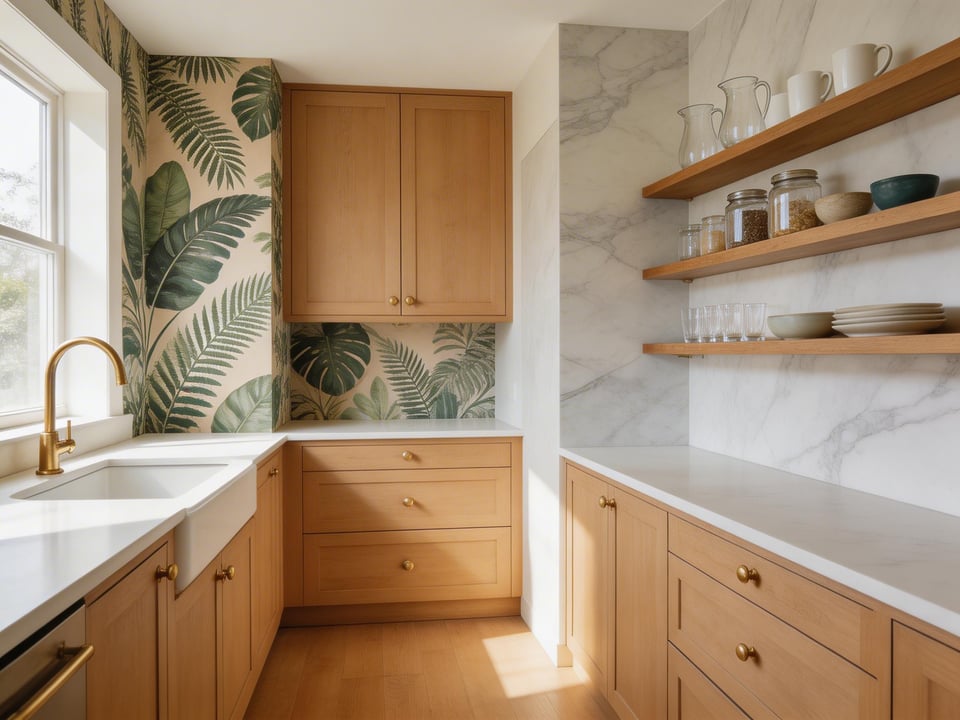
The kitchen is the one room where wallpaper gets consistently talked out of. Splashes, steam, grease — every reason not to commit gets rehearsed. But surface designers know what most homeowners don’t: the material options available today make kitchen wallpaper designs more durable, more washable, and more varied than they’ve ever been. In terms of visual impact per square metre, nothing else comes close.
The question was never whether wallpaper belongs in a kitchen. It was always about which type, in which zone, with which finish. Spend a few years watching how materials actually perform in real cooking environments, and you develop a different view — a pragmatic one that separates genuine risk (paper wallpaper behind a hob) from overcaution (ruling out wallpaper entirely because someone’s grandmother had a bad experience in 1987).
These fifteen kitchen wallpaper designs range from bold statement walls to understated texture plays, from historically rooted patterns to the kitchen wallpaper designs driving 2025’s most interesting renovation decisions. Each one was chosen for both its visual case and its real-world kitchen viability.
1. Large-Scale Botanical Prints That Bring the Garden Indoors
There is something specific that happens when an oversized leaf print occupies a kitchen wall. The eye doesn’t race — it settles. The scale of the botanical creates a focal point so clear and resolved that the rest of the room stops competing for attention. Large-pattern wallpaper, counterintuitively, reads as calmer than small-pattern wallpaper in the same space.
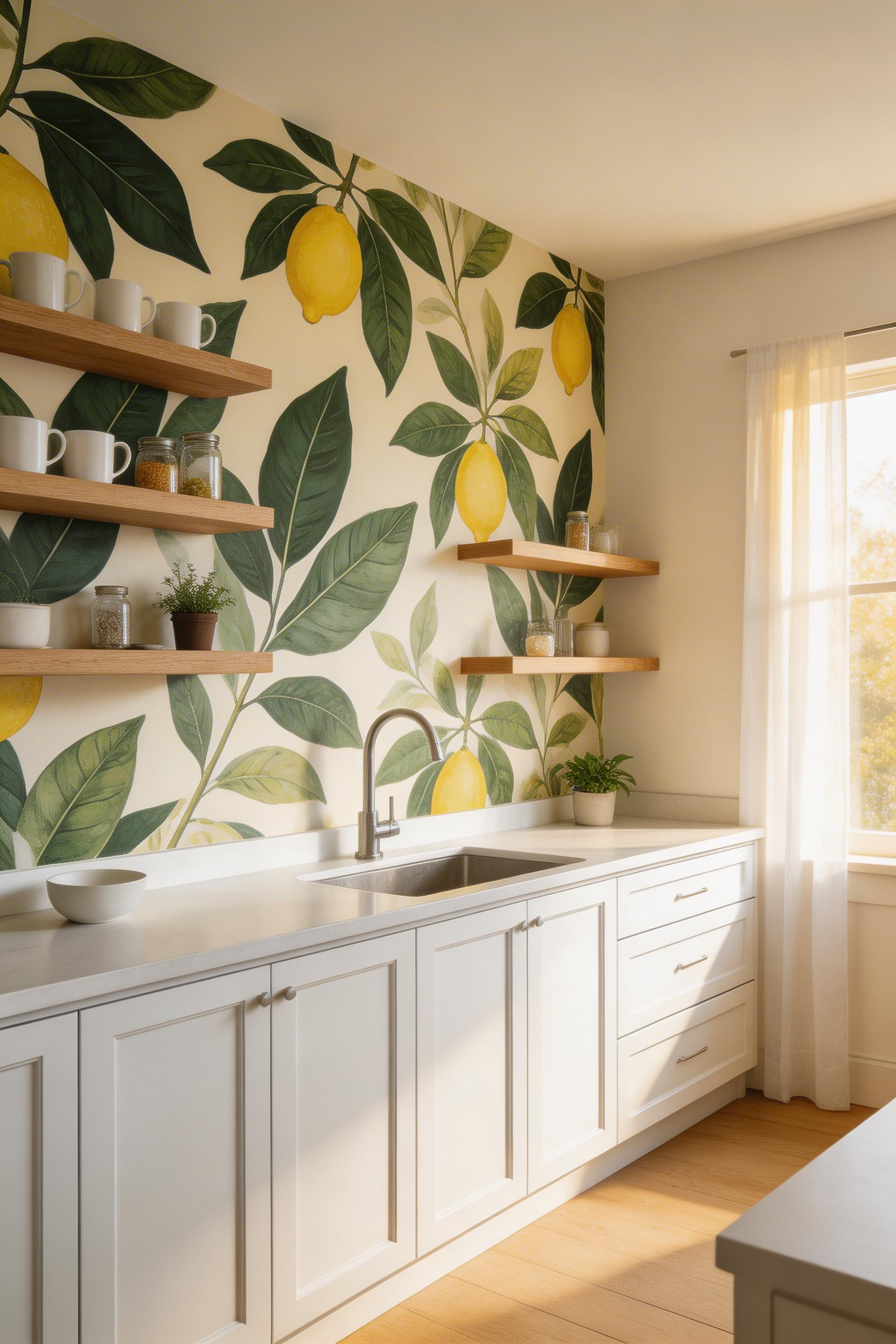
The format question matters as much as the pattern. Vinyl-coated finishes are the only sensible choice for kitchen use — paper-backed botanical wallpaper will peel at the seams and warp in steam from a kettle within a single year. Fully vinyl wallpaper doesn’t absorb moisture, can be wiped with a damp cloth, and carries no risk of humidity-related damage in zones away from direct splash. For botanical prints specifically, Grade I or Grade II washability is the right specification — Grade III scrubbable exists, but the embossed detail on some botanical textures softens over time with aggressive cleaning.
The specific motifs trending in 2025 skew culinary: lemon branch, olive tree, citrus grove. These aren’t coincidental choices for a kitchen — they connect the room’s function to its decoration in a way that feels intentional. So choose a botanical where the background colour anchors rather than overwhelms — a sage-green ground with dark printing reads as immersive; a white ground with green prints reads as cleaner and more easily reversed if your taste shifts. Three colour tones maximum across the design keeps the kitchen side of things coherent.
2. Geometric Kitchen Wallpaper That Does the Work of a Backsplash
The logic here is material, not decorative. Commercial-grade vinyl wallpaper — properly specified, properly hung — can substitute for a tile backsplash in the zone between counter and upper cabinets on general kitchen walls. Fresh grease splashes wipe off Grade III scrubbable vinyl without residue. Dried cooking splatter responds to mild detergent solution without leaving marks. This is not a compromise; it’s a material choice with a genuine performance case.
The critical limitation is worth stating plainly: wallpaper should not be used as the primary backsplash directly behind the hob. Heat and concentrated steam degrade even high-grade vinyl over time in that specific zone. The practical solution is the glass panel: apply scrubbable vinyl geometric kitchen wallpaper to the full backsplash area, then fit a single panel of low-iron clear glass directly behind the hob. You get the full pattern visible from the cooking position, with the glass protecting the section most at risk. If you’re looking for kitchen backsplash inspiration beyond the obvious, this hybrid approach opens up a much wider range of options.
For the pattern itself, Moroccan lattice (the interlocking star-and-cross geometry) is one of the most effective tile-impression designs because the strong line work reads as grout even in printed form. Encaustic tile-effect hexagonal patterns are the other strong performer. Key brands: Brewster’s York Wallcoverings Parkway and Galley lines both offer embossed geometric papers with genuine physical relief to the tile impression. Order 20% more than your calculated area — the backsplash zone’s specific proportions waste material at standard roll dimensions.
3. Textured Grasscloth for Warmth in a Modern Kitchen
Authentic grasscloth is made from natural fibres — seagrass, sisal, jute, or arrowroot — woven into fabric panels and bound to a paper backing. The woven construction gives genuine depth: no two panels are exactly alike because natural fibre variation is inherent to the material. Those visible seams between panels aren’t a flaw; experienced installers use them to create a deliberately panelled look that suits kitchens with cabinetry breaks and alcoves.
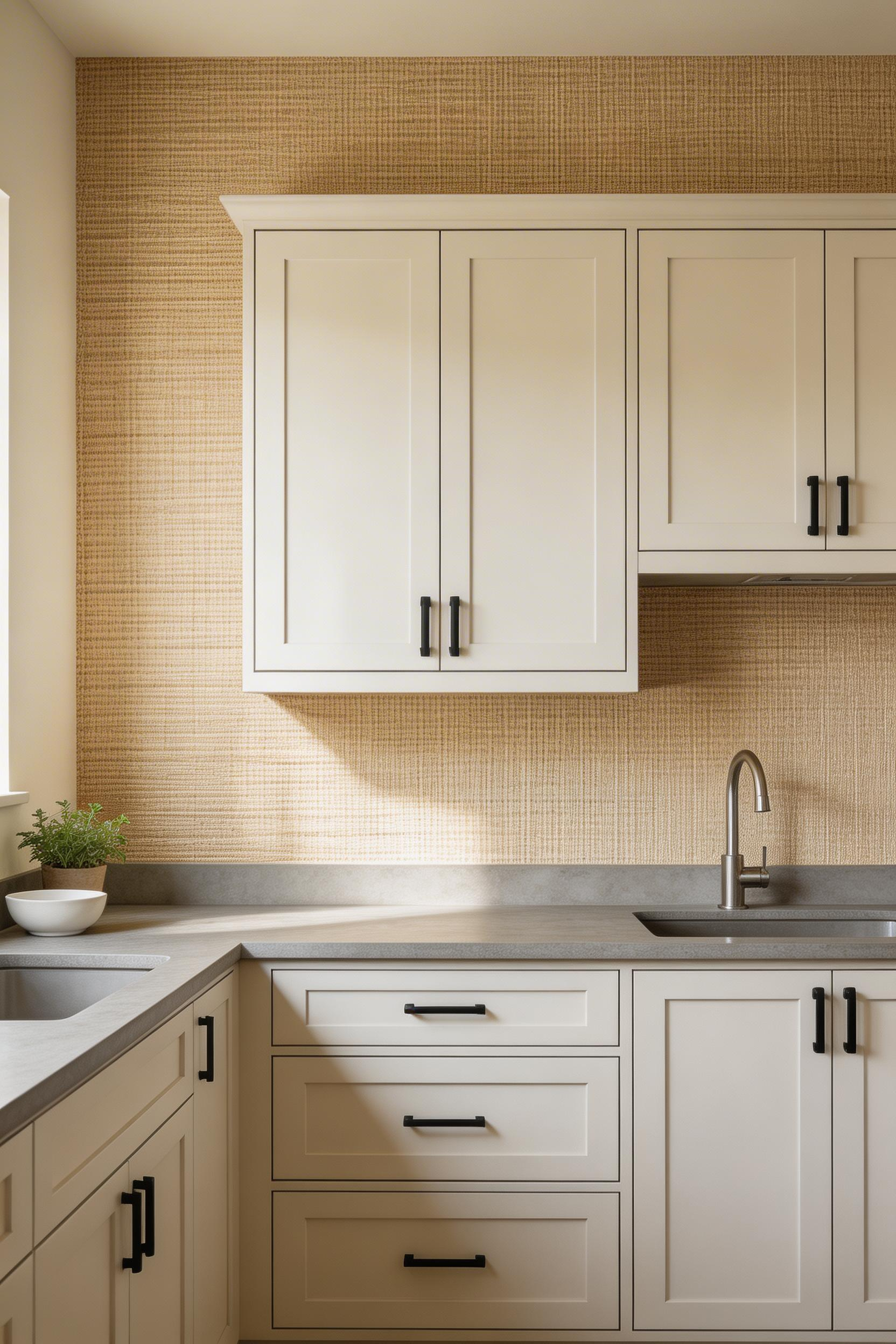
The honest material caveat: real grasscloth and kitchen humidity are fundamentally incompatible. Contact with moisture causes permanent watermarks, fibre shrinkage, and dimensional changes that cannot be reversed. Maintenance is limited to vacuuming with a soft brush — no liquid cleaners of any kind. This rules out real grasscloth for any wall within reach of the hob, sink, kettle, or dishwasher steam.
The faux grasscloth solution closes the gap effectively. Vinyl-backed faux grasscloth reproduces the woven visual texture with a scrubbable, moisture-resistant surface. Mitchell Black and York Wallcoverings both offer well-regarded faux grasscloth lines that capture the way light rakes across the woven surface — which is the whole point. The key visual difference is a slightly more uniform weave pattern and consistent seam width, but in a kitchen that reads as neat rather than imperfect. Pair warm natural tones (seagrass beige, warm linen) with matte shaker cabinetry in off-white or warm grey — this combination is quiet, considered, and ages well.
4. Toile de Jouy for a Classic French Country Kitchen
Toile de Jouy dates to 1760 and the factory of Christophe-Philippe Oberkampf in Jouy-en-Josas near Versailles — the name literally means ‘cloth of Jouy.’ The original designs featured pastoral scenes, classical mythology, and travel narratives printed in a single colour on cream cotton. That monochromatic quality is precisely what makes it read as sophisticated rather than fussy: it’s a detailed scene, not a cacophony of colour.
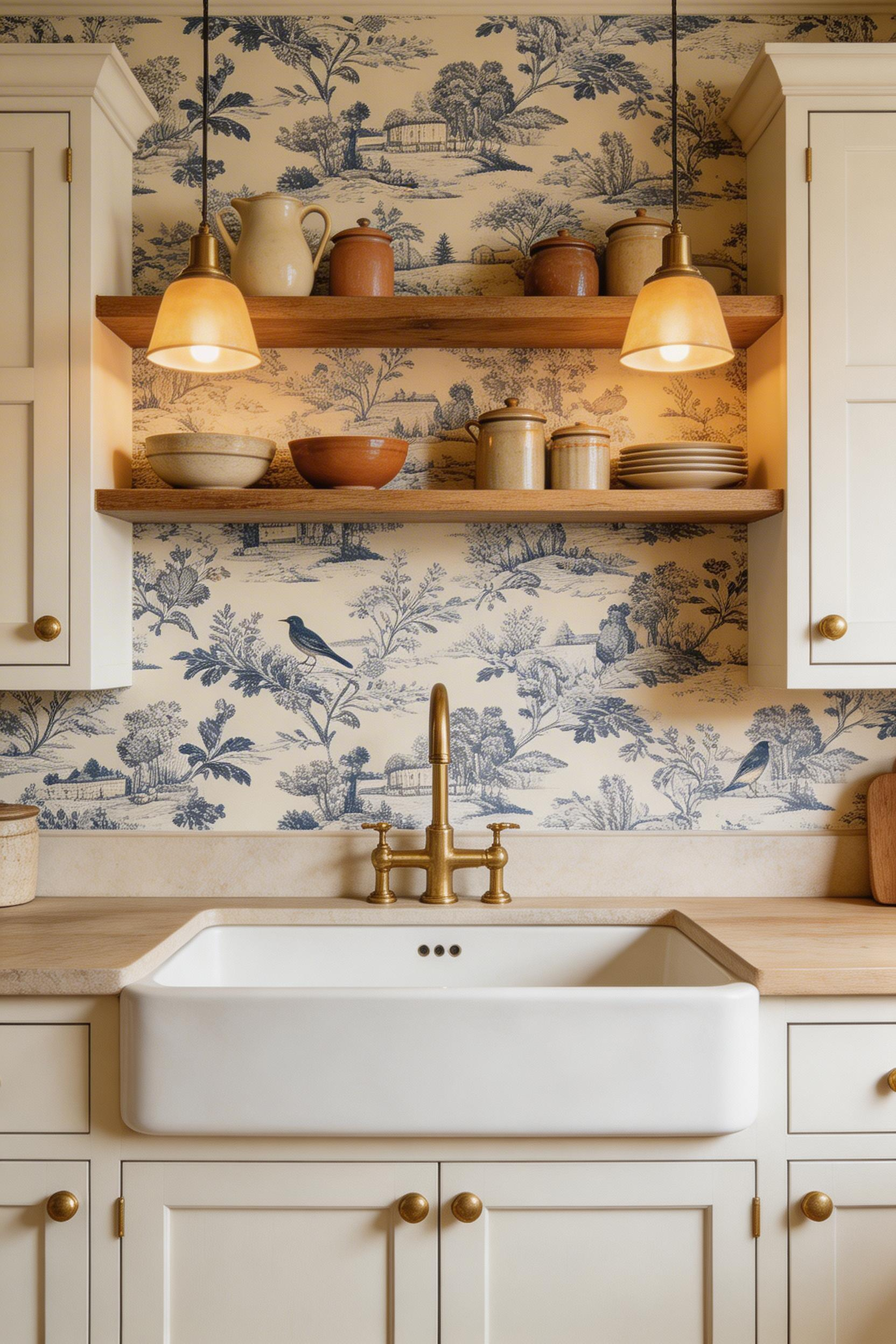
In kitchens, toile works because of a thematic connection that most wallpaper patterns can’t match. The content — farms, animals, food preparation, gardens — connects literally to the room’s purpose. It’s not decorating the kitchen so much as extending it, narratively, into the world of food and land. For colour, navy and cream reads the most contemporary — it pairs cleanly with grey Shaker cabinetry or unlacquered brass hardware. Red and white is the most traditional and the warmest, best with natural wood or white cabinets. The sage-and-linen version, increasingly popular, reads as botanical adjacent without committing to a full botanical print.
Scale is the variable most often misjudged. Large-scale toile repeats (18 inches and above) need high ceilings and long uninterrupted walls to read clearly. For standard 8-foot ceilings or compact kitchens, a 6-10 inch repeat gives the pastoral imagery enough room without getting cut off by cabinet soffits mid-scene. The end wall in a galley kitchen and the wall behind the table in an eat-in setting are the two strongest placements — zones you actually look at rather than work directly in front of.
5. Bold Floral Kitchen Wallpaper in Jewel Tones
Jewel-toned maximalist florals are not a trend you need to convince yourself into. Either the peacock blue ground with oversized roses speaks to you immediately, or it doesn’t. What material knowledge can tell you is how to make it work in a kitchen rather than against it.
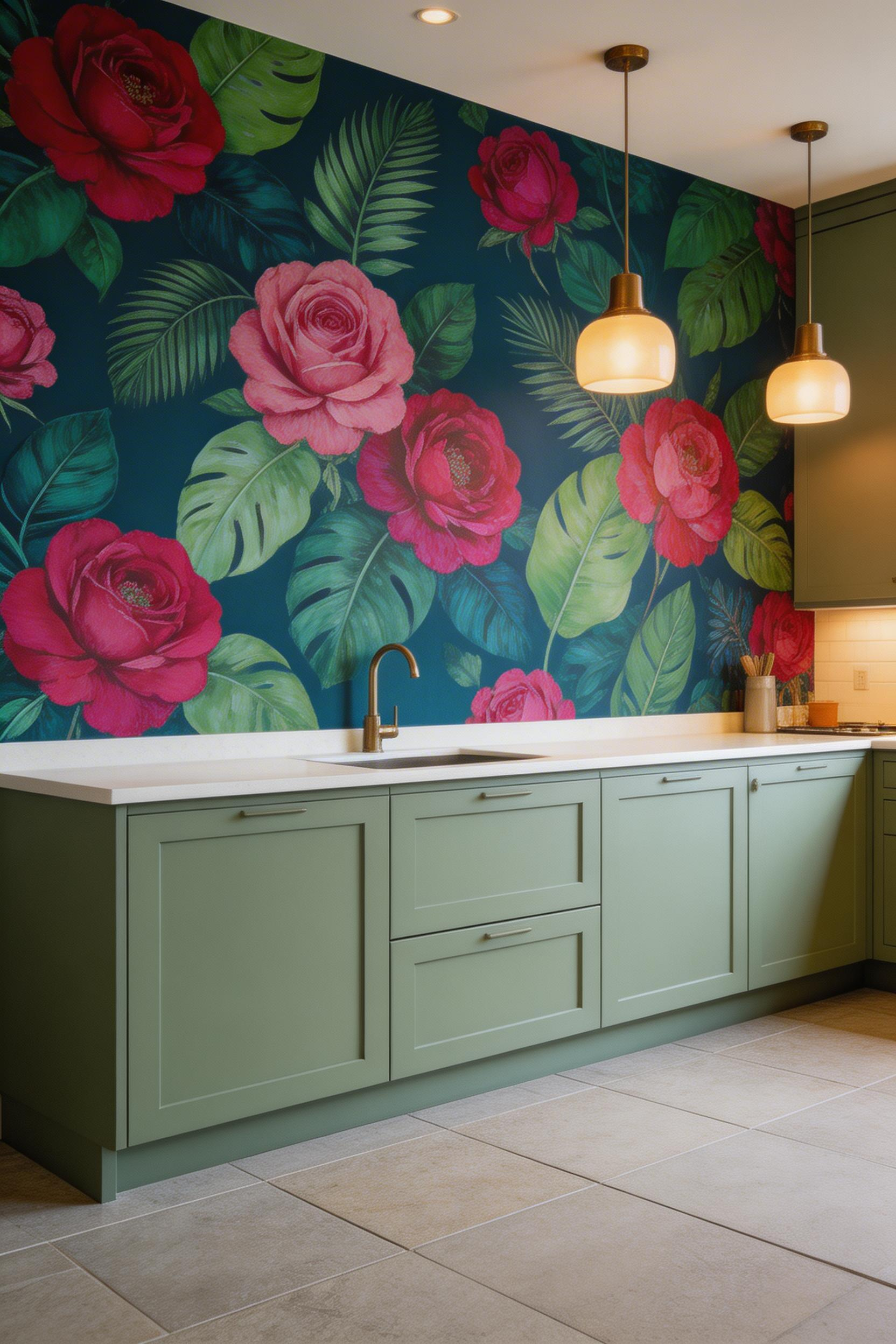
The lighting relationship matters. Warm LED lighting at 2700K-3000K colour temperature is the best match for saturated jewel tones — it enriches the ruby reds and emerald greens rather than flattening them. Kitchens with strong north light also work well; cool natural daylight accentuates saturated colour against white or pale cabinetry. However, moody dark-background florals need more artificial light than you might expect — they can visually disappear at night in an under-lit kitchen, so layer task and ambient lighting before committing to any midnight-ground design.
The material pairing that works: matte countertop surfaces let the bold floral kitchen wallpaper stand out; polished or shiny surfaces compete with it and create visual noise. Solid hardwood or large-format stone floors ground a maximalist kitchen without adding another pattern layer. Keeping the cabinetry in a single solid colour — deep sage, chalky navy, plain white — is the standard approach, and it’s standard for a reason. Finally: one wall. Apply the jewel-toned floral to a single focal wall, keep everything else quiet, and let the wallpaper do what it came to do.
6. Subway Tile-Pattern Wallpaper for a Low-Maintenance Classic
The argument against tile-effect wallpaper is usually aesthetic: it’s not the real thing. Set that aside and look at what the material actually does. Proper embossed subway tile wallpaper has genuine surface relief — physical texture that catches and distributes light in a way that flat paint simply cannot. Brewster’s Galley line, one of the reference products in this category, uses a slight luster finish that mimics the reflective quality of glazed ceramic. This is a material quality, not an imitation of one.
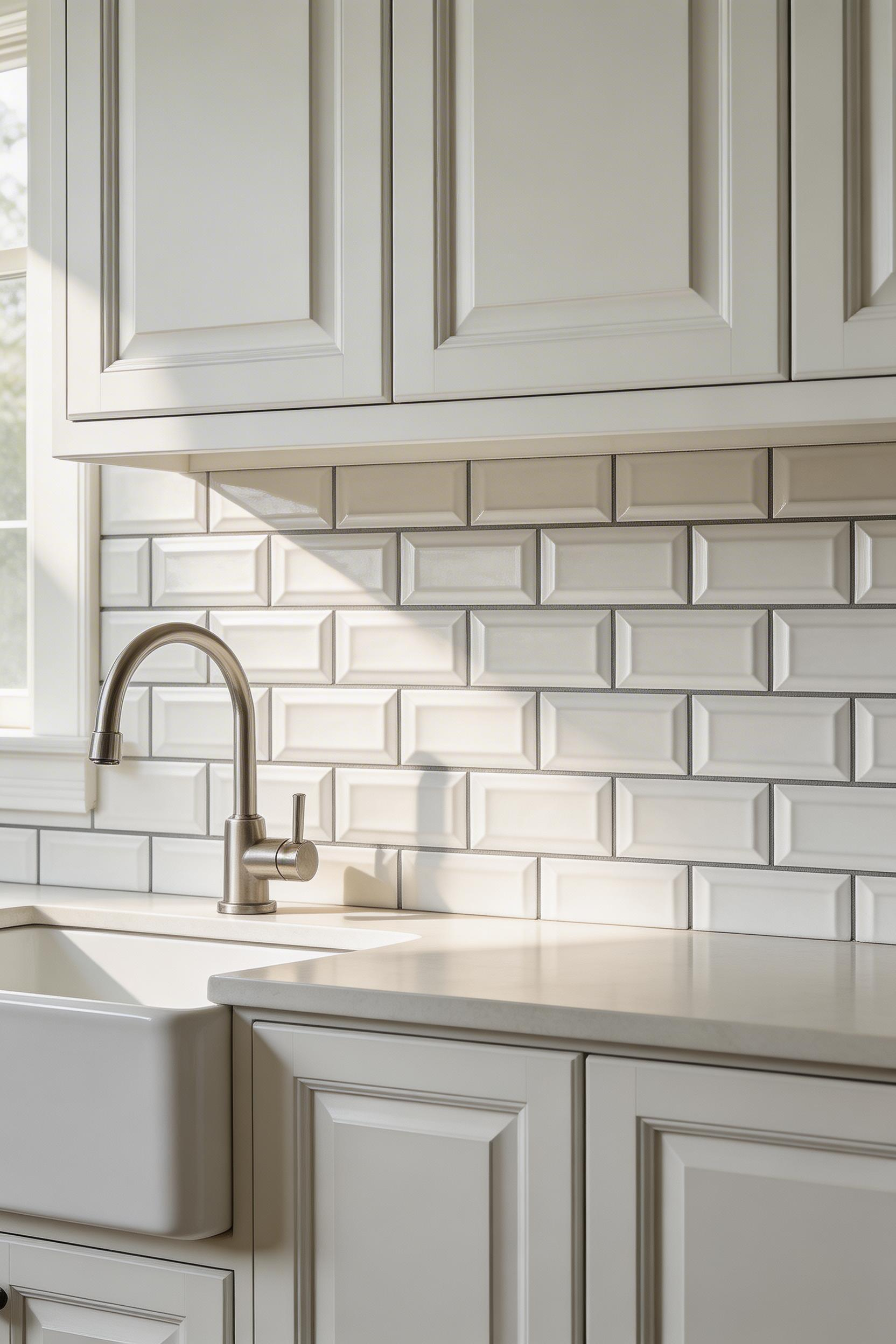
Embossed versus flat-printed is the critical distinction, and kitchen tiles design ideas make this comparison clear in a wider material context. Embossed papers have physical depth — the texture creates real shadow variation as light changes throughout the day. Flat-printed papers have fixed shadows that read as artificial under strong directional or raking light; they work better in ambient-lit kitchens. The seam requirement for embossed papers is strict: any misalignment is immediately obvious because the 3D texture amplifies it. Budget for a professional installer or a very experienced DIYer.
The grout colour simulation is worth thinking through before ordering. White tile on white grout is clean and seamless. White tile on mid-grey grout is the classic subway pattern. Dark grey tile on near-black grout is the current choice for contemporary kitchen wallpaper designs that want the industrial aesthetic without committing to full concrete effect. That combination, on an embossed Brewster or York Wallcoverings paper, is a stronger kitchen design move than many give it credit for.
7. Concrete-Effect Wallpaper for an Industrial Kitchen Look
A good concrete-effect wallpaper looks convincing for one specific reason: it doesn’t look uniform. Real concrete has aggregate variation, trowel marks, tonal shifts from corner to corner — no two poured surfaces are identical. Quality manufacturers like Rebel Walls and I Want Wallpaper build this variation into the print through layered production: multiple colour passes that shift the base tone across the roll.
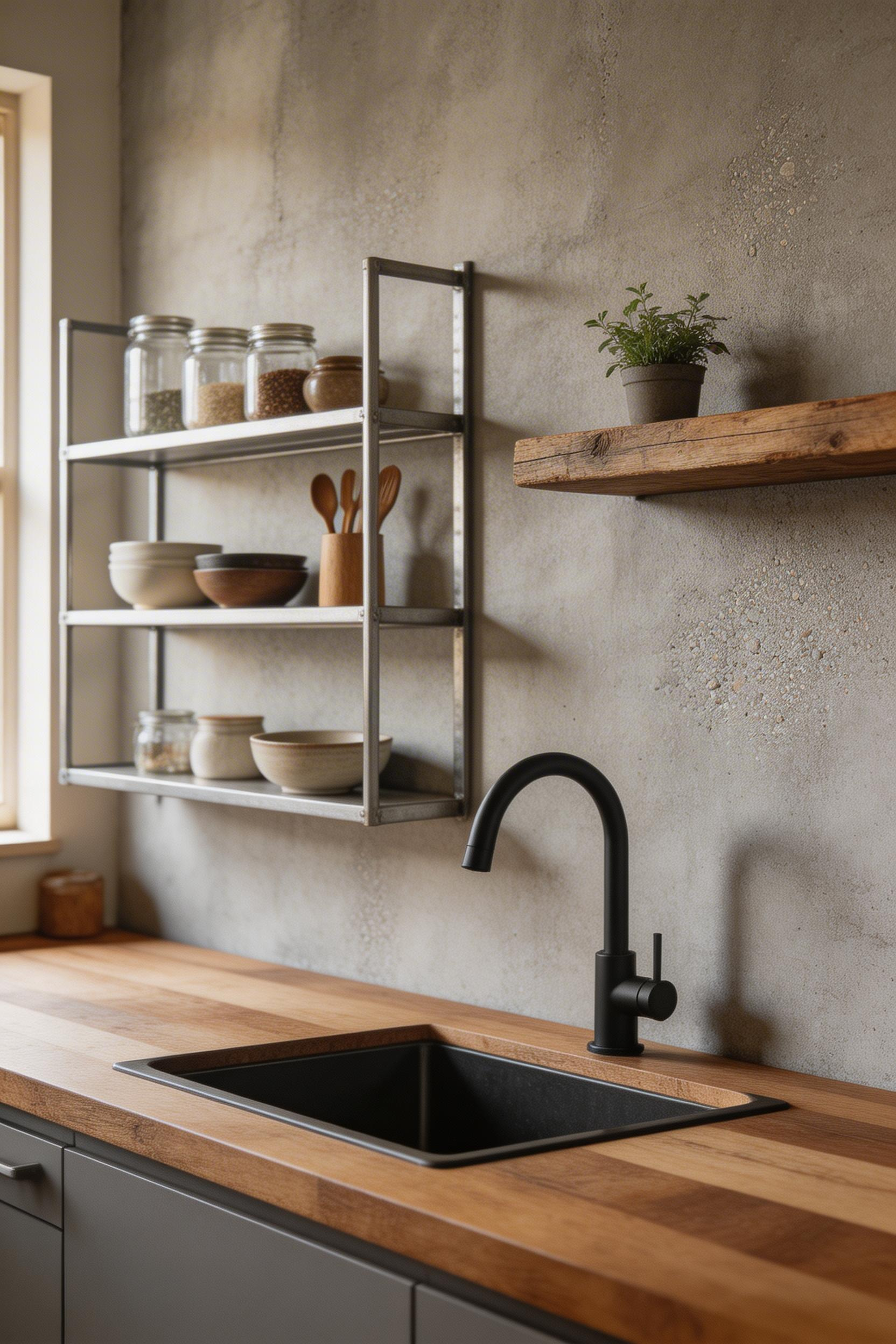
The difference between good and poor concrete wallpaper is immediately visible. Cheap versions are uniformly grey — they read as grey paint with a matte finish. Quality versions include natural voids, subtle aggregate clusters, and tonal variation that reads as genuine polished concrete in lower light. Vinyl-coated versions are essential for kitchens — standard paper concrete-effect wallpaper absorbs cooking residue and cannot be wiped clean.
What to put next to it: raw steel open shelving, a concrete effect wall, and a reclaimed timber floating shelf is the reference combination for the industrial kitchen aesthetic. Matte black tap fixtures and raw steel pendant lights complete the look. The warming note matters — without some timber, the kitchen risks reading as a car park. A butcher block counter section, wooden cabinet doors, or a timber floor resolves this without softening the industrial quality. One wall is almost always the right call. Full concrete coverage in a kitchen under 150 sq ft reads as oppressive; a single feature wall in an otherwise pale kitchen reads as intentional design.
8. Chinoiserie Wallpaper as a Kitchen Accent Wall Statement
Chinoiserie wallpaper tells a story — the birds rising through branches, the blossoms unfolding at every height, the distant mountain or pagoda in the background. This narrative quality makes a kitchen accent wall feel considered and layered in a way that repeating geometric or floral patterns cannot match. You’re not applying a surface treatment; you’re hanging a world.
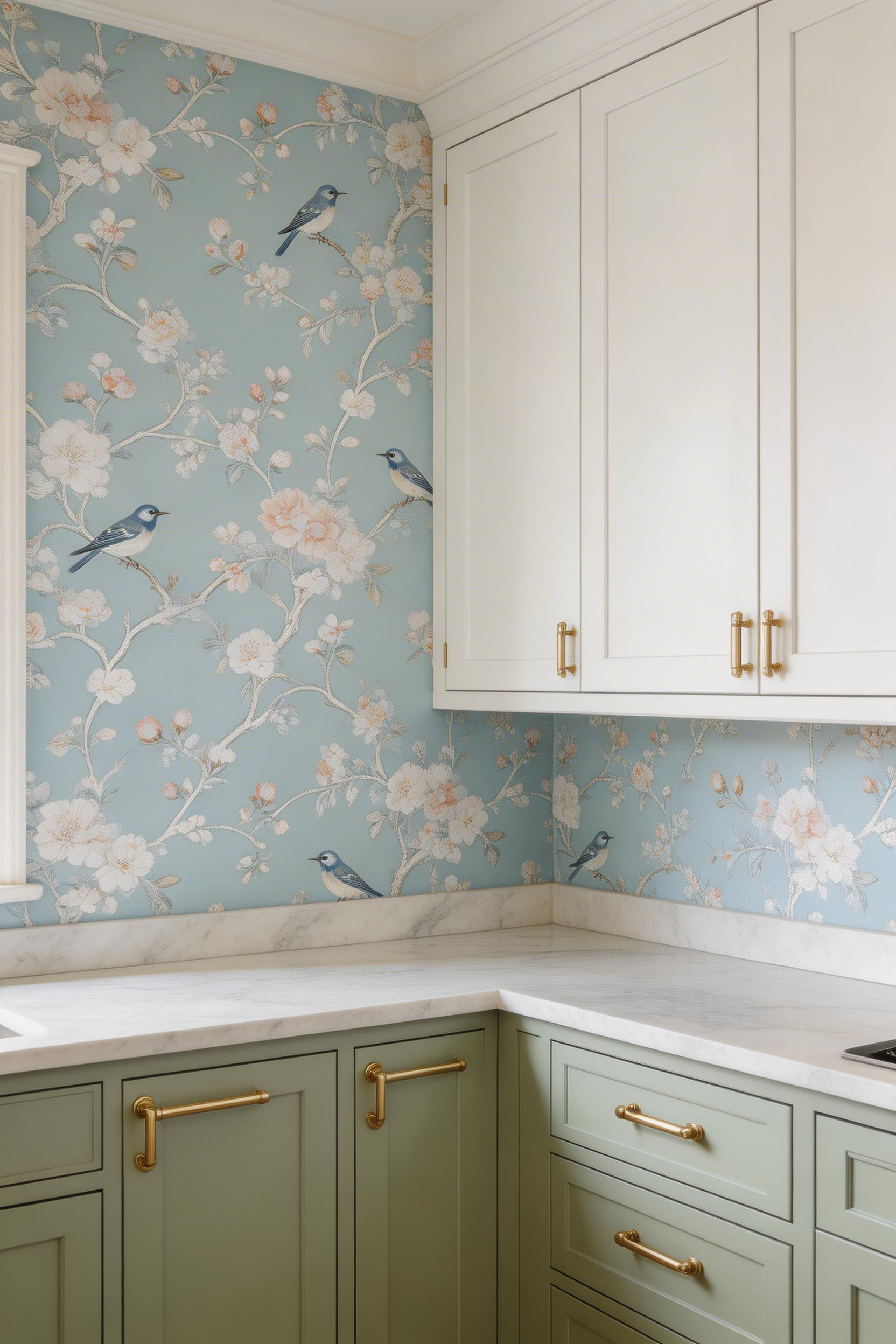
The vertical composition of most chinoiserie designs also happens to suit kitchen ceiling heights particularly well. Elements rising from a ground line to the ceiling draw the eye upward and add perceived height — useful in any kitchen, essential in older homes with 8-foot ceilings. Blue and white is the most classical choice and the most kitchen-safe in terms of longevity; green and cream reads as botanical and organic; multi-colour chinoiserie with warm pinks and yellows suits farmhouse and maximalist kitchens. Hand-painted panels from de Gournay or Gracie are the benchmark — brushstroke quality that printed versions can’t fully replicate — but at £500-£2000 per panel, the cost is prohibitive for most renovations. High-quality printed alternatives from Cole & Son, Brewster, and ONDECOR deliver the visual effect at 5-15% of the cost, and vinyl-backed versions handle kitchen humidity cleanly.
On cabinetry: sage green cabinets with blue/white chinoiserie is the pairing with the strongest design rationale — the green bridges the white ground and blue motifs without the cabinets competing. All-white or cream cabinetry is the universally safe choice. Dark grey or black cabinets with chinoiserie is the combination to avoid — the heavy tone fights with the detailed pattern and neither wins.
9. Bold Striped Kitchen Wallpaper to Add Height and Structure
Stripes are the oldest spatial manipulation in wallpaper history, and they work for one simple reason: the eye follows the line. Vertical stripes in a kitchen with 8-foot or lower ceilings add perceived height — the eye tracks the stripe upward and reads the room as taller than it is. Horizontal stripes widen narrow spaces; in a tight galley kitchen where width is the limiting dimension rather than height, horizontal bold striped kitchen wallpaper on the end wall makes the corridor feel wider.
There’s a constraint worth understanding: horizontal stripes can make low ceilings feel lower, so in a kitchen that suffers from both narrowness and low ceiling height, vertical is the safer choice. The stripe width also needs to scale to the room. Pinstripes (under 1cm) are refined and textural but disappear as a design element in rooms over 12 feet wide. The 5-10cm width is the kitchen classic — present enough to create structure, refined enough not to overwhelm. Bold stripes at 15cm or wider require large rooms and strong colour commitment; they read as coastal and period-influenced at their best.
Country and Mediterranean palette combinations — navy and white, terracotta and cream, deep forest green and cream — are the most enduring choices for striped kitchen wallpaper. Behind open kitchen shelving, vertical stripes create a structured backdrop that frames displayed objects well. The regularity of the stripe complements organised shelf displays — choose a stripe where the lighter tone approximately matches the shelf colour and the shelving appears to emerge from the wall rather than interrupt it.
10. Abstract Watercolour Designs for an Artistic Focal Point
Abstract wallpaper works better in kitchens than in living rooms. This feels counterintuitive until you understand why: kitchens have more solid, fixed surfaces than any other domestic room — cabinets, countertops, appliances — and this architectural groundedness creates a stable context for abstraction that living rooms full of patterned soft furnishings simply can’t provide. Abstract wallpaper in a kitchen reads as curated and intentional. The same paper surrounded by upholstered furniture and rugs reads as chaotic.
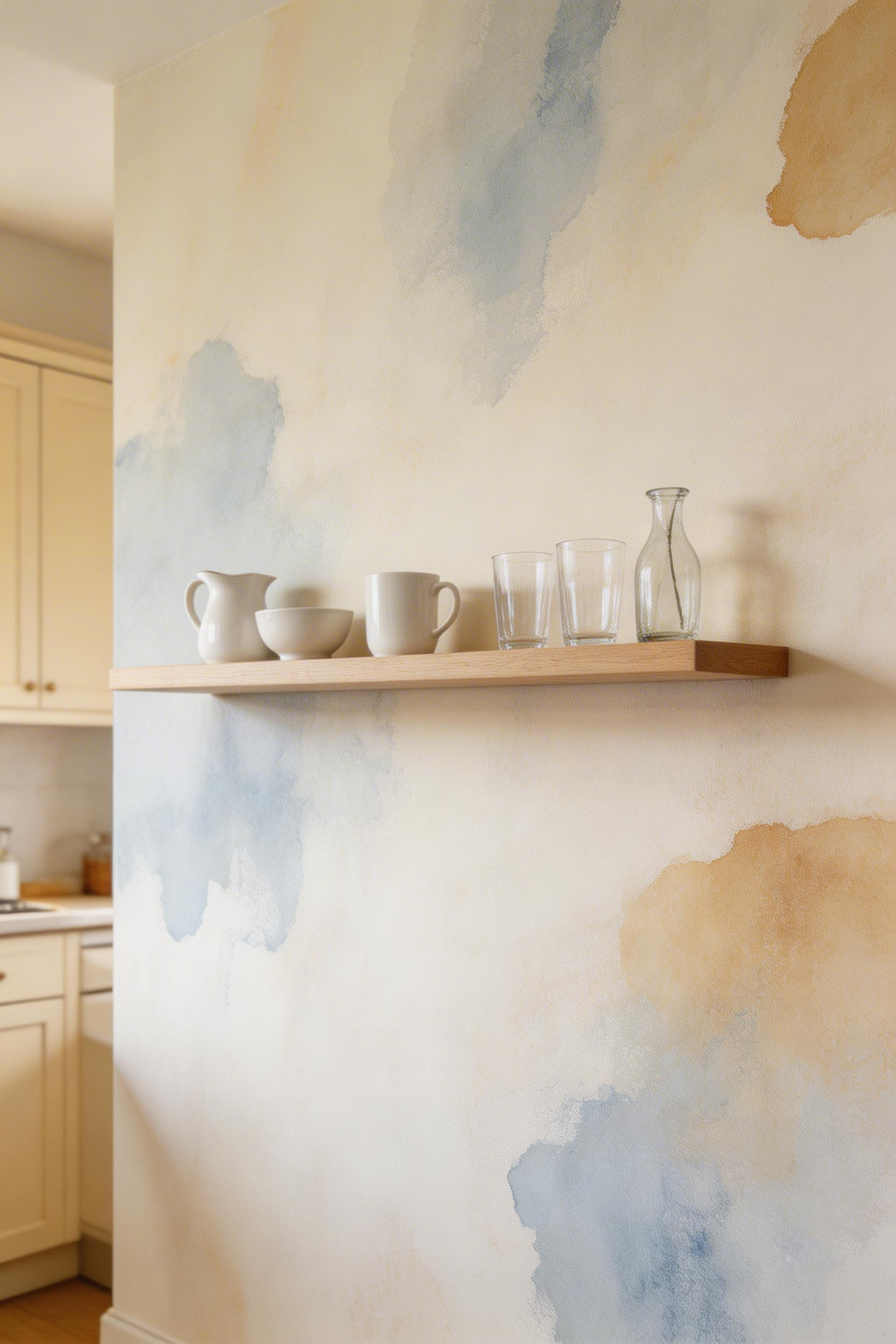
The quality of the print matters more with watercolour wallpaper than with most other types, because the whole point is soft colour transition — the bleed from one tone to the next. Bobbi Beck’s murals are hand-painted and then digitally remastered; their matte, PVC-free paper renders the watercolour gradients accurately without pixelation at seam joints. WallpaperMural.com uses VOC-free water-based inks and FSC-approved materials; their matte finish prevents the light glare that makes digitally printed murals look like photographs rather than paintings. Both are worth the additional cost. For context on how abstract wallpaper fits into a broader kitchen wall decor strategy, the answer is: as a standalone focal point, not as one element among many.
Anchoring the design is straightforward with a material-led approach. Choose solid-colour cabinetry that picks up one of the watercolour’s secondary tones. A watercolour with dusty blue washes and warm ochre accents works with dusty blue cabinets (immersive) or warm cream cabinets (complementary). Keep hardware simple — complex mixed-metal hardware competes with an abstract wallpaper and wins the wrong way. Natural timber floating shelves bridge the painterly quality of the wallpaper and the functional character of the kitchen better than any other shelf material.
11. Retro Kitchen Wallpaper With Diner-Inspired Nostalgia
The 1950s American diner aesthetic has a precise visual vocabulary — atomic starburst (radiating lines from a central point), boomerang and kidney curves (the signature mid-century abstract shape), checkerboard patterns that migrated from floors to walls, and polka dots on cream ground. The palette is equally specific: pastel turquoise, bubblegum pink, lemon yellow, and cherry red. These aren’t retro in a generic sense; they’re a coherent design language that reads immediately and ages well because it was always self-consciously stylised.
For authenticity, Bradbury & Bradbury in California produces museum-accurate reproduction 1950s wallpapers using period-correct colours and original archive patterns. This is the reference point for anyone restoring a mid-century kitchen. Contemporary alternatives take the same motifs — starburst, checkerboard, atomic shapes — but update the palette to more muted versions: dusty pink instead of hot pink, sage instead of turquoise. This contemporary retro approach reads as knowing and designed rather than nostalgic. You’re quoting the era rather than recreating it wholesale, which generally works better in kitchens that mix old and new elements.
Stainless steel appliances are actually a strong pairing for diner-era retro kitchen wallpaper designs — the commercial diner aesthetic of stainless reinforces the theme. What pushes things into costume territory is chrome everywhere: coloured cabinet knobs, period-style tap fixtures, and a checkerboard floor are individually good details; all four together starts reading as a theme restaurant. Let the wallpaper define the era and allow the appliances to stay modern.
12. Wood-Grain Wallpaper That Mimics Planked Accent Walls
Modern wood-grain wallpaper printing has closed the gap between representation and reality. Mitchell Black, Tempaper, and Mayflower Wallpaper all use multi-pass printing that creates genuine grain variation — the lighter sapwood and darker heartwood distinction that makes real timber recognisable at distance, plus convincing knot formations and surface variation. In normal viewing conditions at kitchen distances, the best versions are not immediately distinguishable from the real thing.
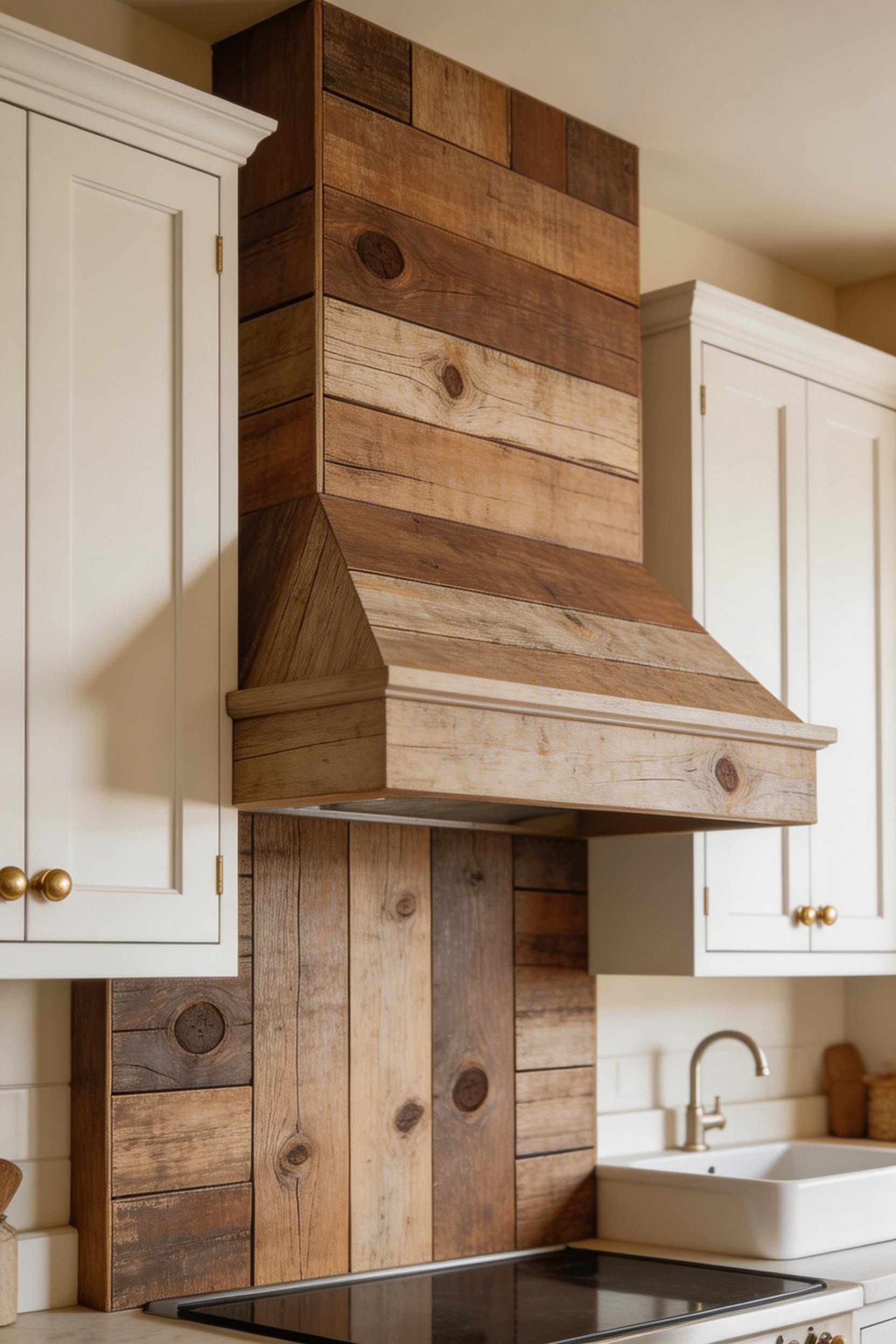
The kitchen applications that work best are small, defined zones rather than full-room coverage. The range hood surround — the chimney wall above the hob — is the highest-impact small canvas in the kitchen: everyone looks at it, it’s defined cleanly by the cabinetry on either side, and a wood-grain treatment creates a farmhouse or industrial focal point with a single roll. End panels of kitchen islands are another strong choice: plain island end panels transformed by wood-effect wallpaper become feature elements without structural complexity. Breakfast nook walls behind a built-in banquette are the most comfortable application — warm, domestic, intimate.
The maintenance comparison with real timber is where the practical case becomes clear. Real timber kitchen wall panelling needs annual oiling or lacquering, responds badly to sustained humidity, and stains from cooking grease in a way that requires specific cleaning agents. Wood-grain vinyl wallpaper wipes clean with a damp cloth, handles cooking residue well, and shows no warping in kitchen humidity. Over five or more years in a kitchen environment, a well-specified wood-grain wallpaper typically outperforms real timber panels on maintenance effort. That’s a practical argument that goes well beyond aesthetics.
13. Scandinavian Folk-Motif Wallpaper for a Calm, Story-Rich Kitchen
The distinction between Nordic folk pattern and generic Scandi design matters for kitchens more than for other rooms. True Nordic folk pattern — from the Kurbits tradition of Swedish painted furniture — uses stylised floral and tendril motifs in bold, confident strokes. It’s illustrative and hand-crafted in quality. Generic Scandi design, the more commercially dominant form, tends toward simplified geometric shapes: triangles, zigzags, clean repetitive motifs. Both are legitimate. But for a kitchen, the folk motif version is the stronger choice — its warmth and story quality suits domestic intimacy in a way the geometric version’s architectural cleanliness can’t match.
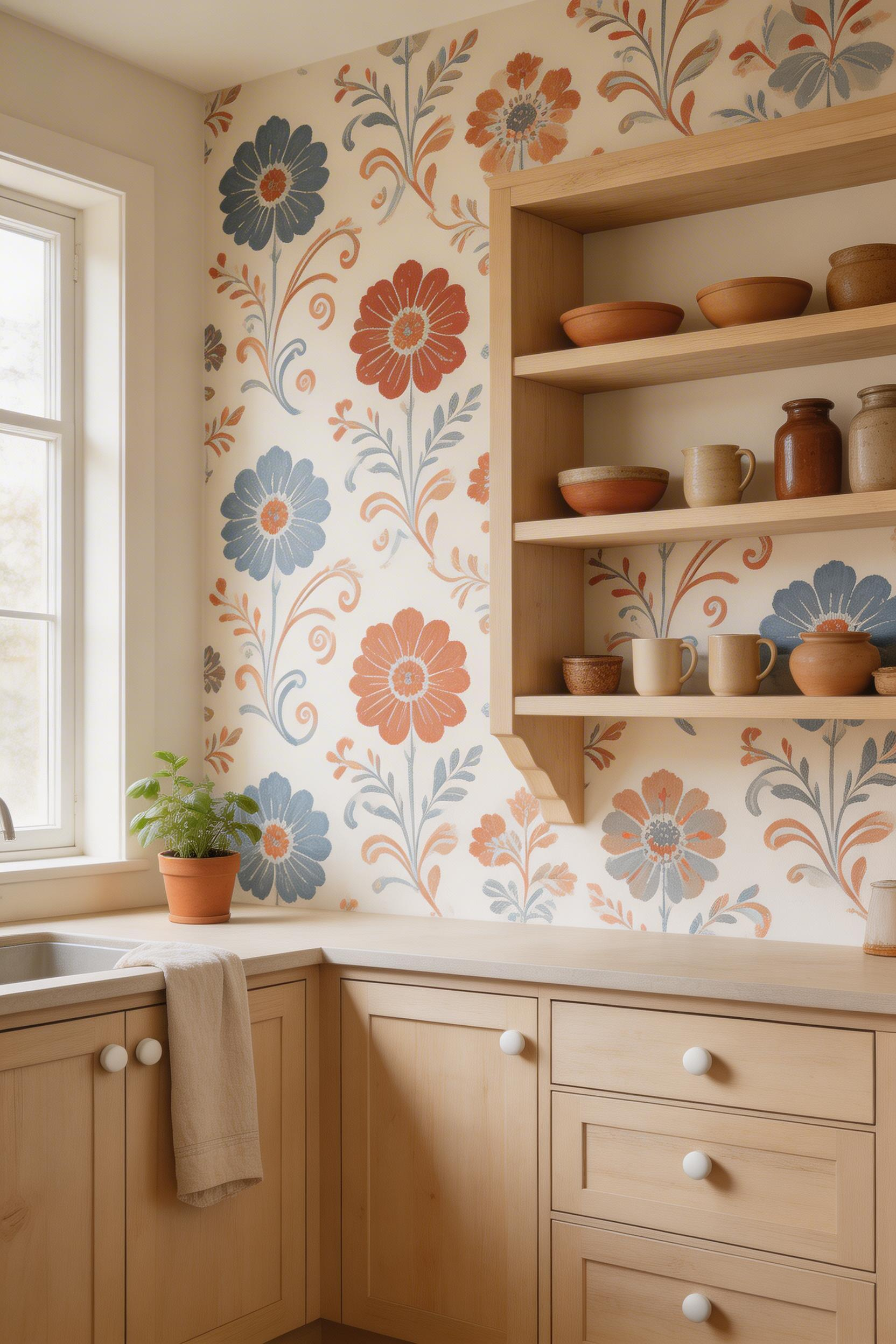
Palette is where most people get Scandinavian kitchen wallpaper wrong. The Scandi design tradition is built on muted, desaturated tones — colours that create calm rather than energy. The classic folk palette: dusty blue, barn red, and forest green on off-white or cream ground. The more current version: terracotta, sage green, and soft ivory ground — this has displaced the traditional red-blue-white combination in most modern renovations. Boråstapeter and Scandinavian Wallpaper Company are the specialist sources; they stock designs that read as authentically Nordic rather than generically decorative. For the material context of what makes this aesthetic work in a cooking space, the Scandinavian kitchen ideas that have proven most enduring share the same underlying principles.
Light birch or pine cabinetry is the ideal pairing for Scandinavian folk-motif kitchen wallpaper — the pale, clear grain of Nordic timber creates the right material relationship with the folk pattern. Avoid polished chrome hardware, high-gloss cabinet finishes, and contemporary appliances with aggressively modern styling. The folk motif is quiet and pastoral. It doesn’t need contrast — it needs confirmation.
14. Marble-Effect Wallpaper Behind Open Shelving and Display Areas
The design logic here is simple. Real marble wall cladding behind kitchen shelving requires substrate preparation, mechanical fixing, proper sealing, and structural support for the stone weight — a serious renovation job costing £3000-£8000 or more for a typical alcove. Marble-effect wallpaper achieves the same visual effect in a single working day for £40-£150 in materials. The luxury signal is equivalent. The complexity and cost are not.
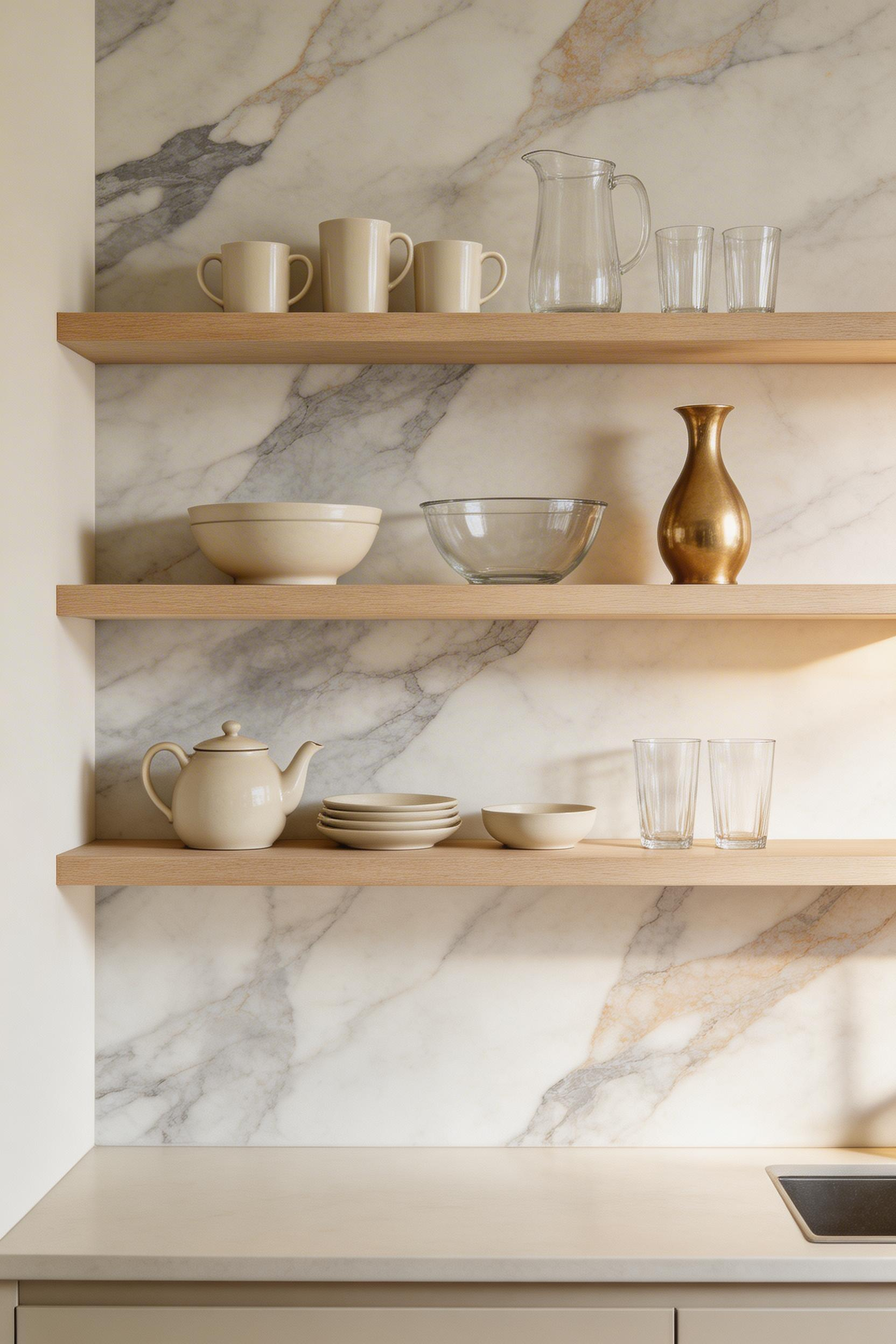
Behind open shelving specifically, the marble pattern is partially obscured by the displayed objects at any given time — which works in the wallpaper’s favour. Partial views of a marble pattern are harder to identify as print rather than stone, particularly in the ambient kitchen lighting conditions where shelving is typically viewed.
What to Look For in a Quality Marble Wallpaper
The tell of poor-quality marble wallpaper is uniform vein spacing and a flat grey ground. Real marble has random vein clusters — some tight, some loose — and significant tonal variation including tertiary tones (pale buff, subtle green) that give Carrara marble its characteristic warmth. Vein scale also matters: a single vein scale reads as pattern; quality marble wallpaper varies between fine hairline veins and broader branching veins within the same design. Sandberg Wallpaper and Milton & King are the reference brands.
For the shelving: keep displayed objects in neutral and warm tones — off-white ceramics, clear glass, natural timber, warm brass or copper objects. Avoid colourful eclectic displays that compete with the marble pattern. The shelves should curate the wallpaper rather than bury it. For more on what to display and how to arrange it, kitchen shelves decor ideas that treat the back wall as an active design element are worth studying.
15. Modern Kitchen Wallpaper in Earthy Tones and Organic Shapes
Biophilic design holds that environments referencing natural tones and organic forms measurably reduce stress responses. The kitchen is one of the highest-activity domestic zones — a location where the performance pressure of cooking, the spatial demands of family activity, and the practical intensity of morning routine converge. So the case for earthy, grounding kitchen wallpaper designs in this specific room is not just aesthetic; it’s environmental. Terracotta, clay, umber, and moss green are the colours of soil and stone and plant life, and their presence in a cooking environment works to settle rather than stimulate.
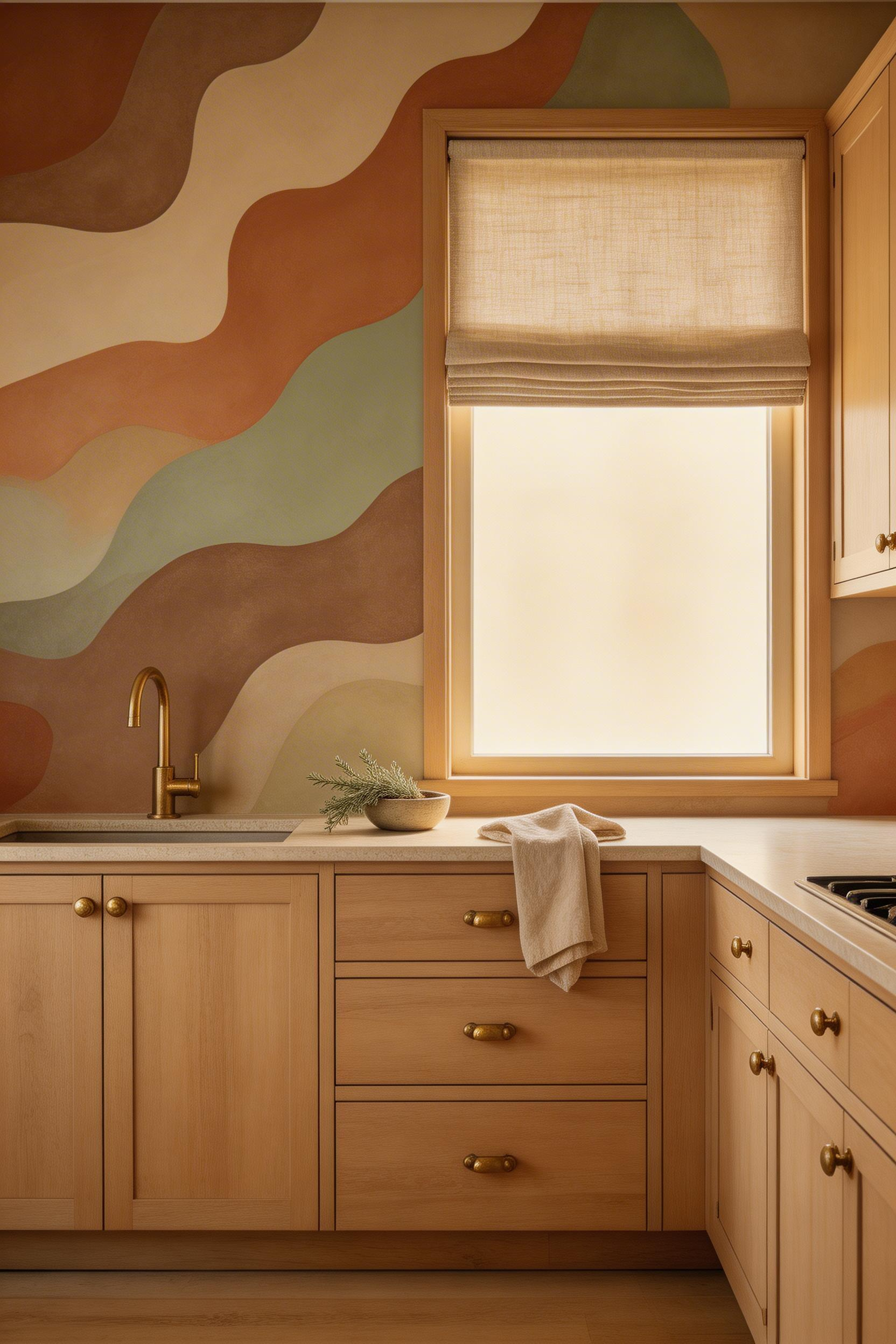
The 2025-2026 direction in kitchen wallpaper is clear. Both George Cabinetry’s design trend analysis and Empire Wallpaper’s 2026 forecast identify organic modern kitchen aesthetics as the leading direction — a direct reaction to the cool, all-white minimalist kitchen that dominated for most of the previous decade. Earthy toned modern kitchen wallpaper behaves particularly well across the day’s changing light conditions: warm morning light intensifies terracotta, neutral midday daylight reveals the full palette range, and evening light softens the tones gently. For a guide to finding the right modern kitchen wallpaper for your specific space, these practical tips on modern kitchen wallpaper cover material and installation questions in detail.
Pairing Earthy Kitchen Wallpaper With Materials
Unlacquered brass or warm bronze hardware is the single most effective material pairing for earthy wallpaper. The living metal finish — which oxidises and develops its own patina over time — shares the organic, imperfect quality of the earthy tones in a way polished chrome or brushed nickel simply cannot. Matte white or stone-look countertops anchor the palette without adding competition. Natural linen roller blinds or simple wooden shutters complete the material story. What to avoid: high-gloss white or grey cabinets — the contrast creates a visual tension between organic and synthetic that undermines the grounding effect you chose the modern kitchen wallpaper for.
Finding the Right Kitchen Wallpaper Design for Your Space
The decision comes down to three practical variables: pattern scale relative to room size, vinyl grade relative to zone, and pattern complexity relative to cabinetry.
On scale: match the pattern repeat to the room. A 6-inch repeat for kitchens under 100 square feet; a 12-inch repeat for medium kitchens; 18 inches and above only for large open-plan spaces where the pattern has room to complete a full motif. On grade: Grade I washable for walls away from cooking zones; Grade II highly washable for general kitchen walls; Grade III scrubbable for any surface within two metres of the hob or sink. On complexity: busy patterned kitchen wallpaper designs (florals, chinoiserie, toile) work best with plain cabinetry in solid colour; textural wallpaper (grasscloth, concrete, wood grain) works with any cabinet style because its purpose is surface quality rather than pattern display.
The one-accent-wall recommendation is the default for a reason. It manages risk, reduces cost, and often delivers more visual impact than full coverage — because a clear focal point beats a room-filling pattern that becomes visual noise. Full coverage works for textural wallpapers where you want the material quality to surround you. For everything else: pick the wall you look at most, hang the kitchen wallpaper design that makes you genuinely respond when you first see it, and live with a sample for a week in real kitchen lighting before ordering the full quantity. The wallpaper that feels right on the roll in a shop and the one that transforms your kitchen are not always the same paper, but the one worth choosing is always the one that stands up to those seven days of living with it.