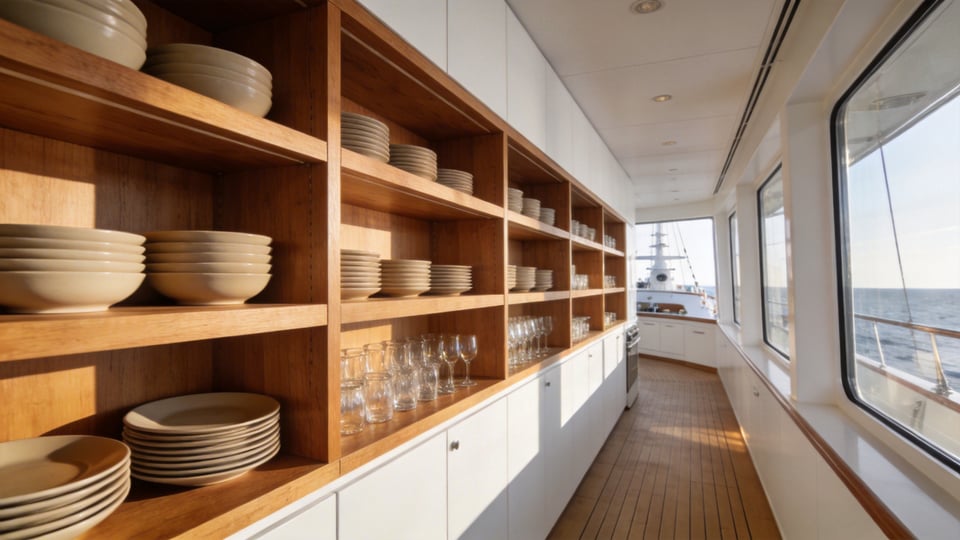
Modern kitchen storage shelves have evolved far beyond simple planks. For the discerning homeowner, these elements blend architectural integration with ergonomic geometry. Historically, efficient shelving traces back to the 1926 Frankfurt Kitchen. Back then, designers modeled fitted cabinets after ship galleys. The goal was simply to minimize wasted steps. Indeed, this reach-optimized approach remains the DNA of highly functional spaces today. We often rely on strategic kitchen storage ideas to systematically reclaim a room’s true potential.
Phase I: The Accessible Foundation (Core Mechanics of Kitchen Shelving)
Successful open shelving requires a hidden battle against twisting torque. The weight of your plates acts as a heavy lever pulling against the wall. Traditional two-prong rods fail often because of this force. They eventually cause gradual shelf sagging. However, modern bespoke cabinetry relies on continuous aluminum extrusions instead. These interlocking systems efficiently spread the heavy load across multiple wall studs. In fact, this specific engineering keeps the shelf perfectly level for years. Next, any external bracket must support at least two-thirds of the shelf depth. Otherwise, structural fatigue will compromise your carefully organized kitchen display.
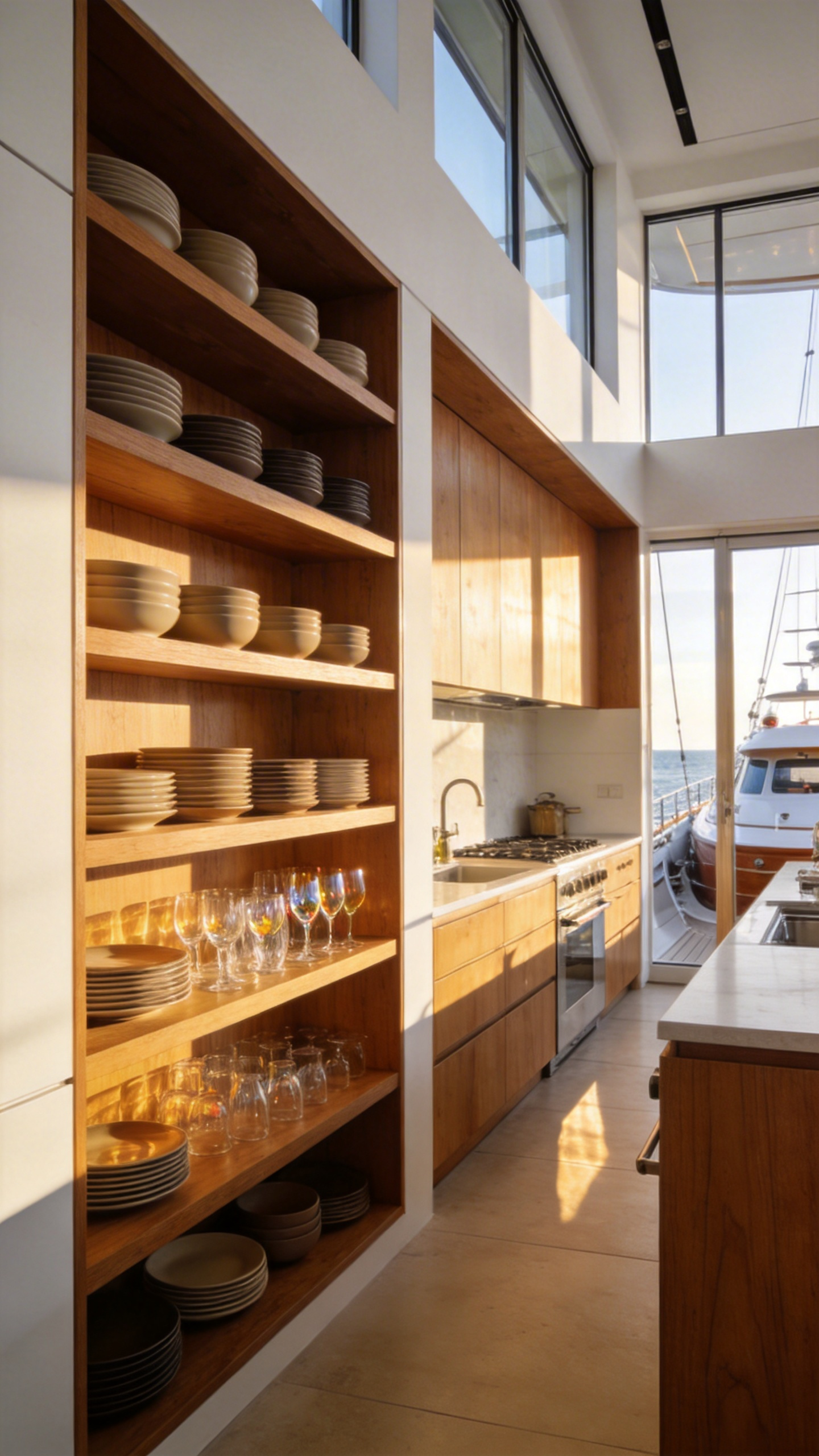
Universal accessibility also relies heavily on precise ergonomic geometry. Design rules state that half of your storage must sit comfortably within reach. Specifically, this optimal zone spans between 15 and 48 inches from the floor. High-rotation daily items remain an easy extension of the hand. However, dynamic gas-shock dampeners can even bring higher shelves smoothly down to you. Materials also shape the subtle sensory atmosphere of a room. For instance, dropping a ceramic plate onto glass creates a stressful, high-pitched clink. Natural wood, conversely, contains microscopic air pockets that gently absorb this sharp sound. Indeed, sanded hardwoods provide internal damping and warmer tactile comfort.
Completely open shelving creates a distinct maintenance trap despite these benefits. Aerosolized cooking grease quickly binds with household dust on exposed surfaces. Choosing between Open Shelving vs. Upper Cabinets means weighing hygiene against aesthetics. Professional organizers often recommend a strictly balanced storage split. Specifically, you should keep 70 percent of items safely behind closed doors. The remaining 30 percent holds heavily used, open display pieces. Therefore, you balance immediate visual access with long-term hygiene.
1. The ‘Active Zone’ Calculus: Positioning Kitchen Storage Shelves for Daily Flow
Professional kitchen designers utilize a precise methodology known as the “Active Zone” calculus. This system aligns physical storage with human kinetic movement to maximize daily efficiency. Unlike the static work triangle, this dynamic approach focuses strictly on horizontal and vertical reach. As a result, the optimal golden corridor exists between 20 and 50 inches from the floor. Items placed in this specific space require absolutely zero bending or over-extension. However, heavy cast-iron pans should never sit outside this highly accessible zone. Mechanically, perceived weight increases significantly when you lift items above your natural shoulder height. Therefore, everyday items must reside in a 15-inch band directly at elbow height.
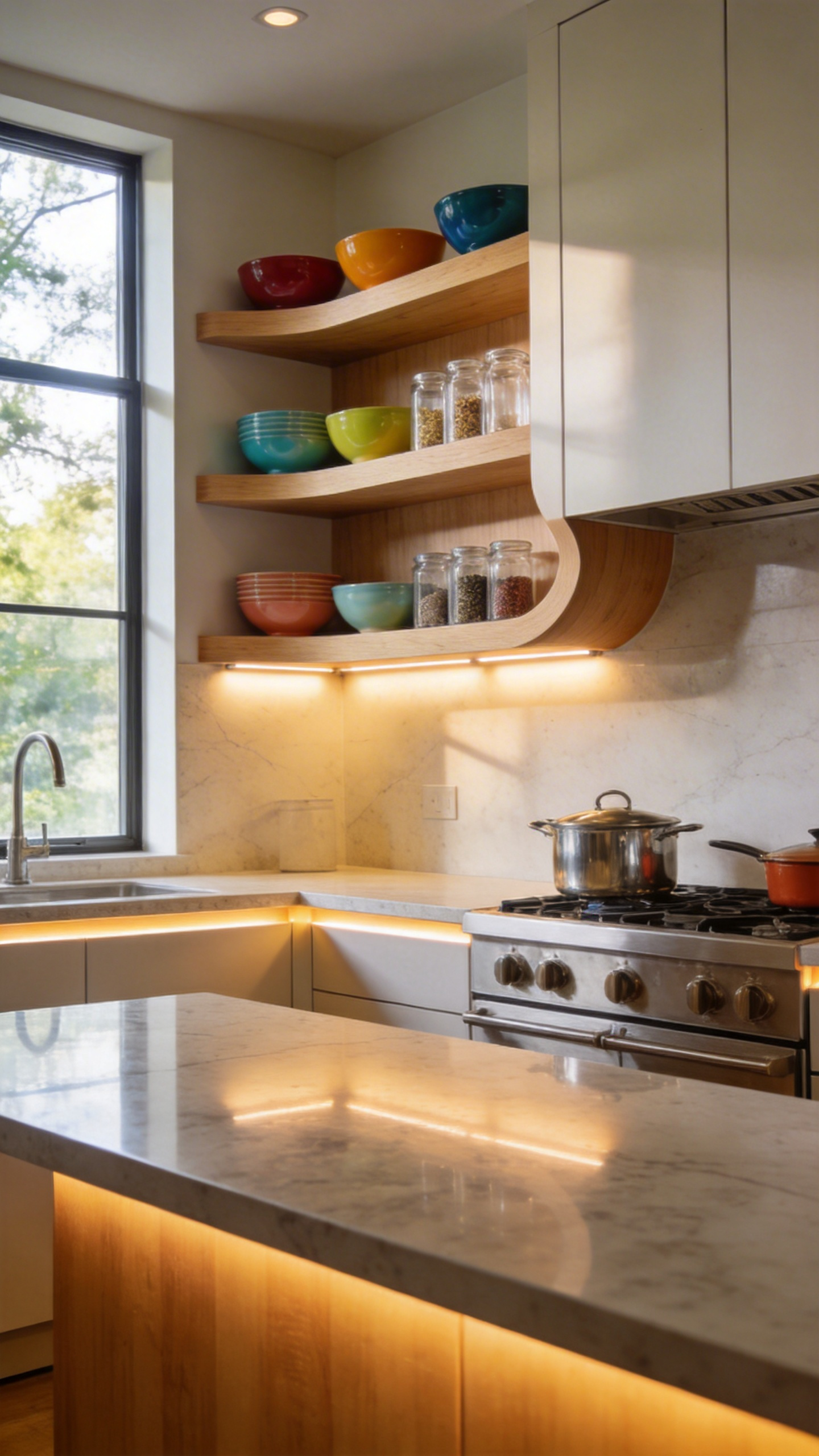
Historically, this spatial efficiency perfectly mirrors early twentieth-century Hoosier cabinets. Today, high-end workstation larders update this concept to reduce awkward pivot-and-step movements. Beyond physical ergonomics, deliberate shelf positioning directly impacts your underlying cognitive load. Cluttered shelves create constant visual noise that leads to quick decision fatigue. Accordingly, professional organizers recommend implementing a strictly calculated 70/30 visual split. In practice, display seventy percent of essential tools while concealing the remaining thirty percent behind doors.
Upgrading the subtle sensory elements elevates the entire bespoke cabinetry experience. For instance, lining shelves with cork or felt dramatically softens the jarring clatter of ceramics. Similarly, subtle tactile grooves on shelf edges help busy cooks build essential muscle memory. Preserving this prime real estate requires a strict one-in, one-out maintenance rule. Otherwise, new kitchen gadgets quickly push older essentials into forgotten storage areas. Ultimately, mastering this vertical arrangement creates a seamless workflow that feels entirely instinctual.
2. Depth-to-Item Ratios: Why Standard 12-Inch Floating Shelves Often Fail
In modern kitchen design, a twelve-inch floating shelf represents a risky intersection of aesthetics and physics. It lacks the vertical structural anchor of a standard upper cabinet. Consequently, the shelf acts as a dangerously long lever. Placing heavy objects far from the wall exerts extreme rotational force. Over time, this intense torque quietly rips out standard drywall anchors.
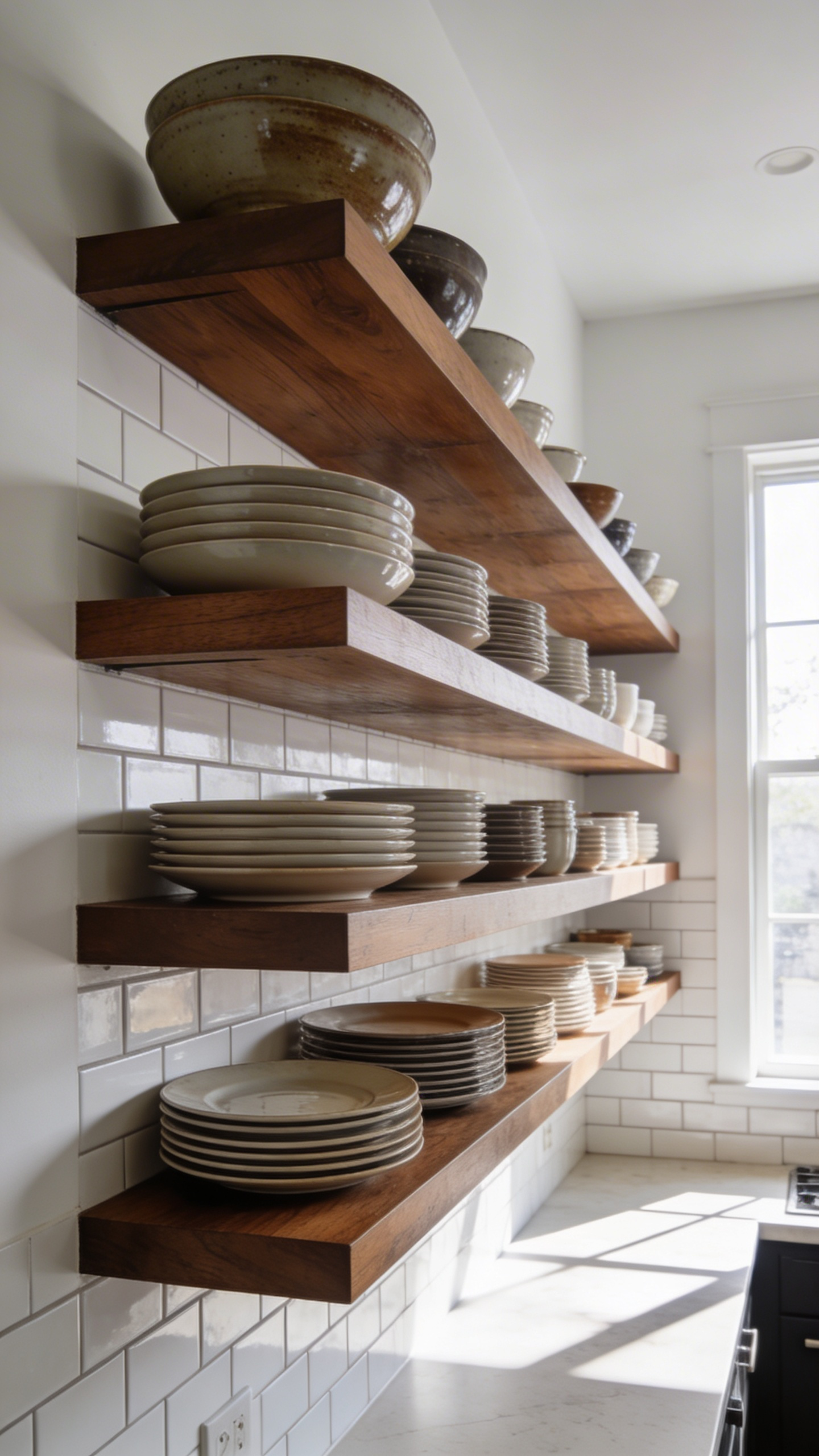
Historically, standard dinner plates measured a modest nine inches. However, modern stoneware plates have supersized to twelve inches. These larger, heavier plates often sit flush against the front edge. As a result, the center of gravity shifts drastically outward. Indeed, hidden bracket hardware routinely fails at this specific depth. Typically, steel support rods only extend five inches inside the wood. Because of this, the front half of the shelf remains entirely unsupported.
Eventually, stacking rough-bottomed ceramic bowls causes the internal wood fibers to compress. Next, the hidden metal support rods begin to bend downward. Even worse, dynamic kitchen environments accelerate this inevitable hardware failure. For example, constant vibrations from running dishwashers subtly shake the shelf structure. Additionally, aerosolized cooking oils create a slick, greasy surface film.
Heavy dishes slowly slide forward on a slightly sagging shelf. In fact, professional organizers call this terrifying phenomenon “shelf creep.” Structural experts enforce a strict ten-inch rule for floating installations to prevent this. Ultimately, limiting your shelf depth prevents catastrophic midnight hardware crashes. Alternatively, true twelve-inch depths require massive internal wall blocking during construction.
3. Weight-Bearing Truths: Selecting Heavy-Duty Anchors and Brackets That Last
When designing kitchen storage, a shelf acts as a mechanical lever. Specifically, the weight of ceramic plates creates exponential pull-out force. Therefore, tension failure at the top anchor is the real enemy. As shelf depth increases, this stress multiplies rapidly. A sagging shelf usually means the top anchor is incrementally withdrawing. To prevent this, bracket material selection is absolutely critical. For instance, cast iron looks beautiful but remains surprisingly brittle. Instead, 3/16-inch thick cold-rolled steel offers superior structural integrity. Additionally, brackets formed from a single piece eliminate weak weld points.
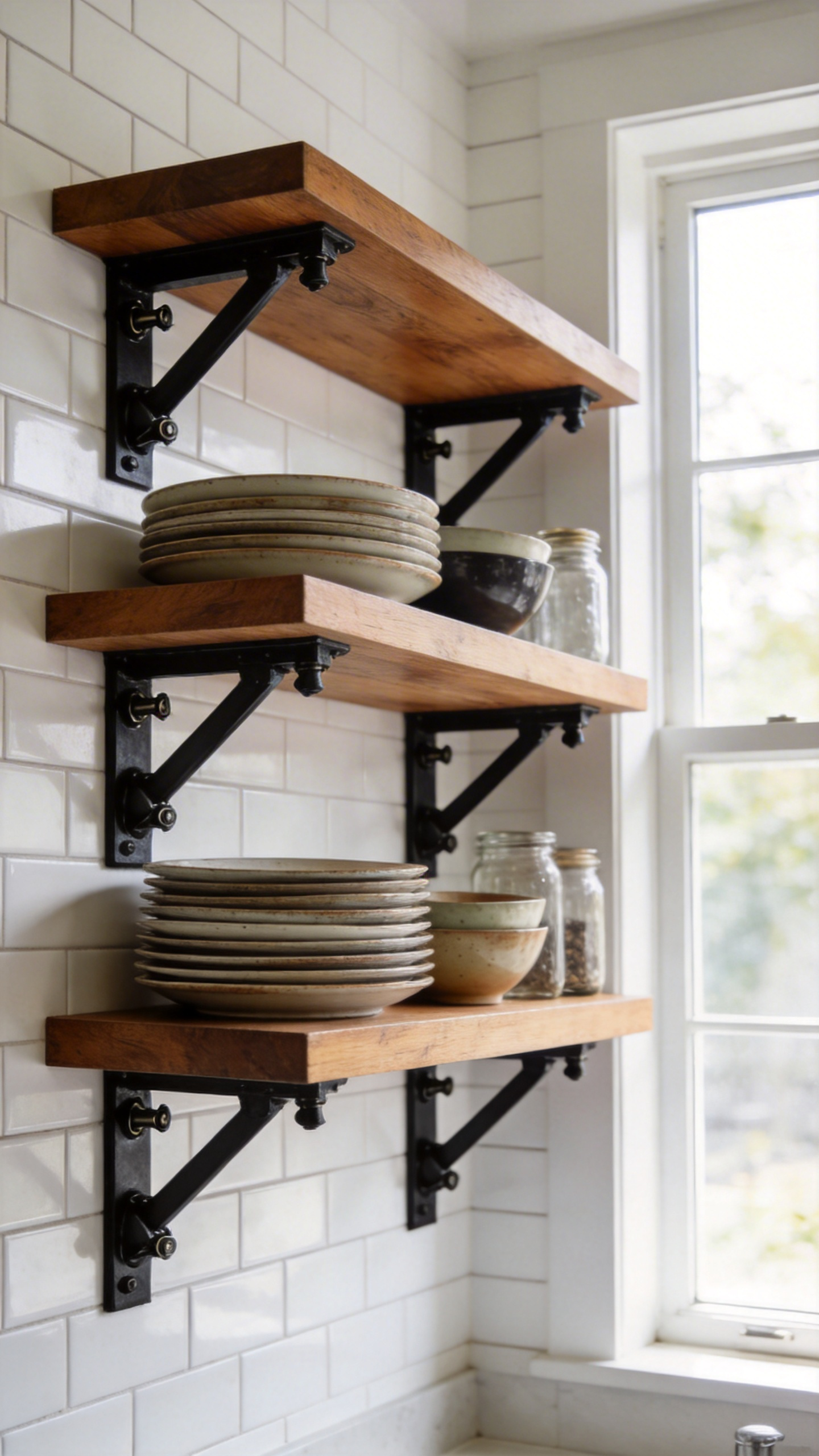
However, even the strongest bracket requires a reliable wall substrate. Standard drywall slowly crushes under heavy, constant loads. Because of this, expert installers demand zinc-plated steel toggle bolts. These heavy-duty toggles distribute weight widely across the inner wall. Ideally, you should anchor at least one bracket directly into a wood stud.
Kitchens are inherently high-vibration environments. Over time, slamming cabinets and heavy appliances cause micro-impacts. These daily vibrations slowly back out standard hardware. Thus, coarse-thread screws are essential to grip wood fibers tightly.
A properly secured shelf delivers a specific acoustic deadness. Specifically, setting down a heavy glass should produce a dull thud. This sound confirms the structural energy is safely transferred into the wall studs. Visually, industrial steel hardware supports massive weight while maintaining modern aesthetics.
4. The Visual Breathing Room Rule: Spacing Open Shelving Without Crowding
Open shelving often fails by becoming chaotic visual noise. Therefore, treating empty space as an active material is essential. To achieve this, designers apply the strict 60/40 mathematical rule. This guideline dictates that 60 percent of the shelf holds physical objects. Meanwhile, 40 percent must remain entirely as negative space. As a result, this intentional gap acts as a visual frame. Without it, your brain perceives shelves as heavy, solid blocks. Instead, purposeful gaps highlight your textured wall material.
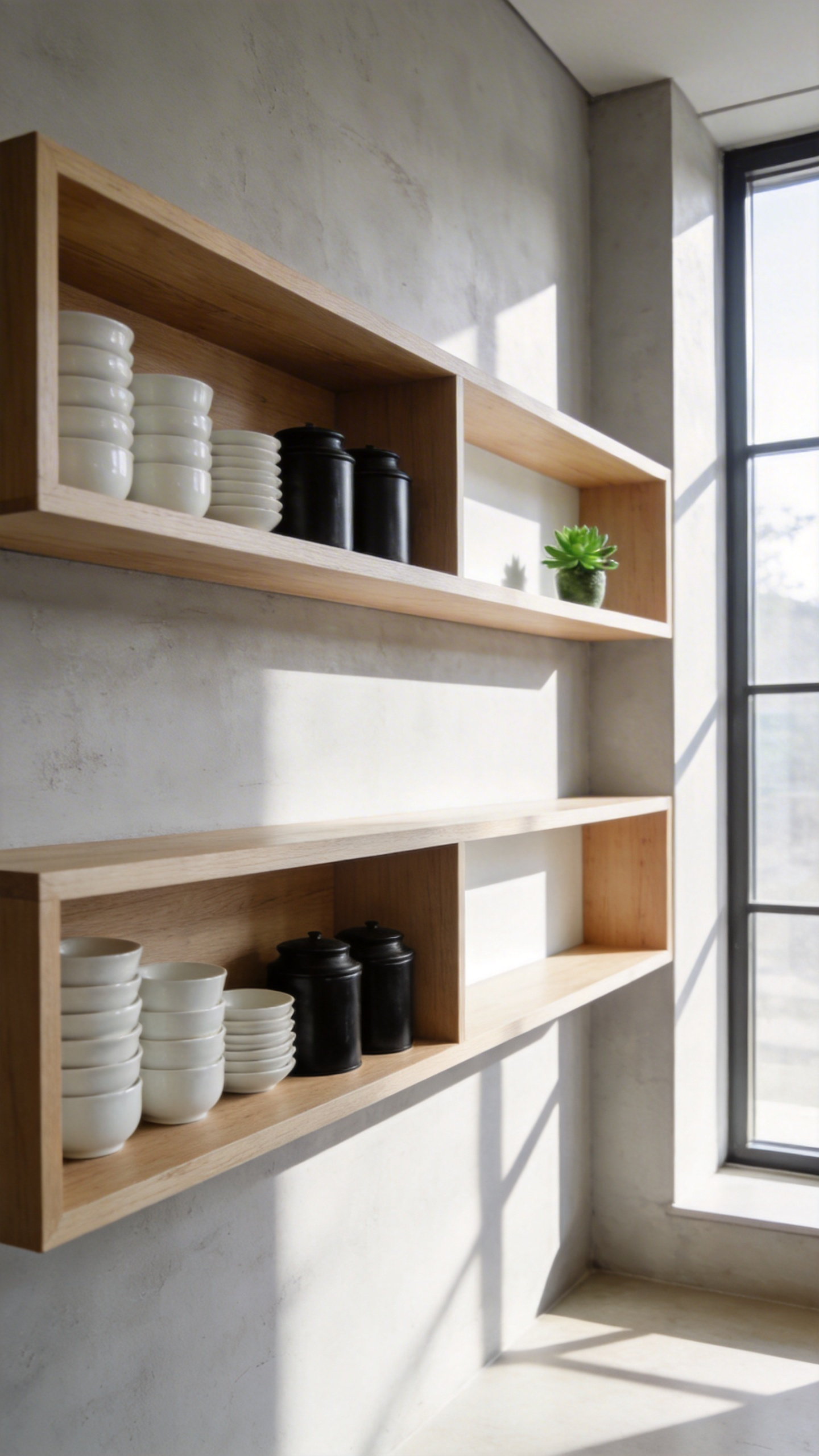
This breathing room also significantly reduces daily cognitive load. In a busy kitchen, sensory relief is absolutely vital. Thus, properly spaced shelves allow your tired eyes to rest. Similarly, vertical spacing dictates the interplay of light and shadow. Specifically, you need 12 to 18 inches of vertical clearance. Otherwise, tightly stacked shelves cast heavy, overlapping dark shadows. Adequate vertical space lets ambient light illuminate the back instead. Consequently, the air itself appears to glow and visually expand.
However, maintaining this delicate balance requires a dedicated lifestyle shift. Authoritative styling demands a ruthless, routine edit. For example, cluster your sculptural items in odd numbers. Next, leave a significant gap before the next aesthetic grouping. You must adopt a strict one-in, one-out inventory philosophy. When you add new bowls, everyday mugs must move into kitchen storage cabinets. This system keeps your space perfectly organized. In doing so, this systematic discipline preserves your carefully curated negative space. Indeed, smart spacing transforms cluttered storage into a masterful, airy display.
Phase II: Intermediate Development (Systematizing the Storage)
Systematizing storage stops being about pure volume. Instead, it becomes an exercise in movement. Specifically, we map the shelf as an active workspace. Professional organizers call this the Golden Zone. You should place daily items between your shoulders and hips. This simple ergonomic shift removes daily physical friction.
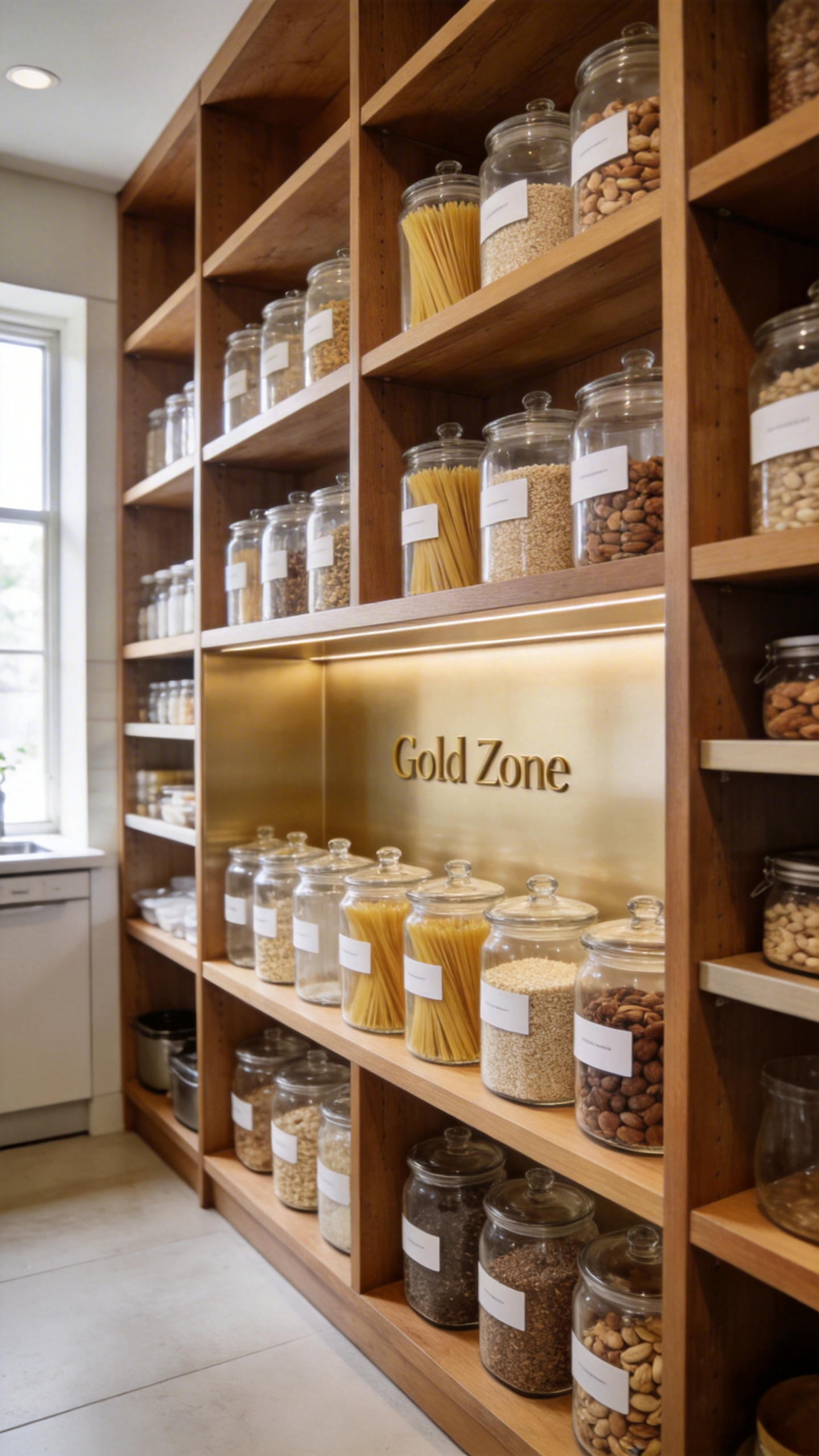
Visual clutter also actively slows your workflow down. Original supermarket packaging creates unnecessary visual noise. To fix this, transfer goods into uniform, transparent vessels. This decanting creates a highly glanceable organizational system. You instantly know flour levels from ten feet away. Additionally, glass against wood creates a focused acoustic environment.
Next, consider the strict physics of weight distribution. Vertical stratification dictates placing heavy cast iron low. Lightweight seasonal platters belong up high. As a result, you build a much safer storage setup. In fact, no item should ever hide behind another.
Your material choices should reflect this structural evolution. For example, industrial wire shelving offers crucial airflow dynamics. Wire prevents dust pockets and ventilates fresh produce. Alternatively, solid oak absorbs the vibration of heavy appliances. Thus, your shelving transforms into a high-efficiency cooking machine.
5. Zonal Grouping: Structuring Wall-Mounted Storage by Culinary Function
Zonal grouping transforms your kitchen into a high-performance workspace. By organizing wall shelves by culinary tasks, tools rest nearby. Specifically, they stay within a simple 45-degree pivot. This strategic placement minimizes cognitive load during complex meal preparation. For example, a dedicated heat zone requires thoughtful curation. Open shelves here hold thermal-reactive oils and heavy salt cellars. Conversely, a baking zone protects sensitive items like cocoa powder. Grouping items by function creates vital visual silence. Therefore, you effortlessly enter a seamless state of cooking flow.
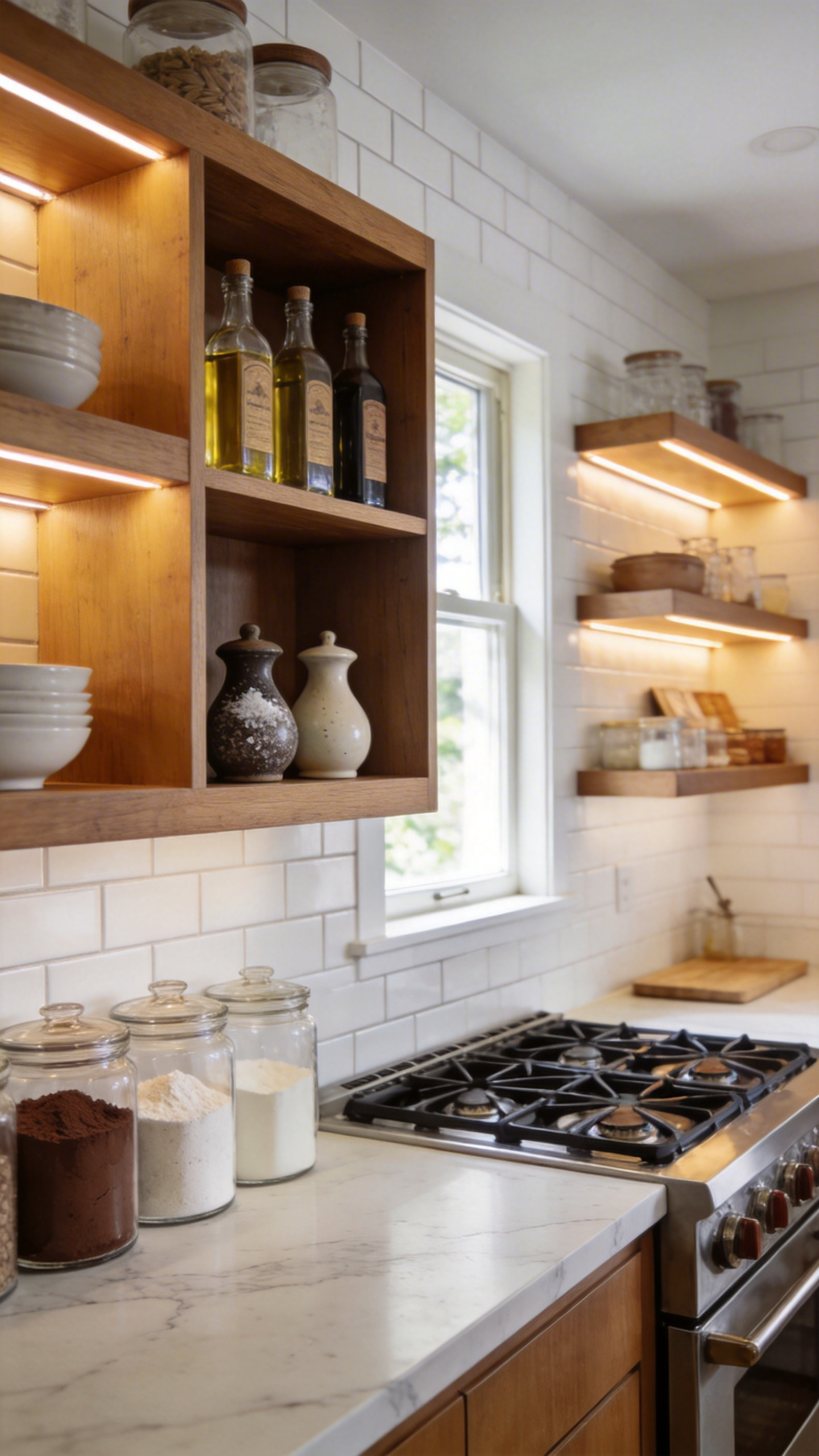
Notably, not all vertical space serves the same purpose. The golden zone sits perfectly between eye and waist level. Accordingly, this prime prep area handles immense kinetic weight. Shelves must support heavy wooden blocks and thick metal colanders. Meanwhile, the finishing zone holds delicate garnishing oils and plates. Keeping these areas entirely separate prevents frustrating clutter creep.
Shelf materials must also balance aesthetic appeal with functional success. Steam zones near ranges demand slatted French bistro racks. Proper air circulation prevents sticky kitchen grease buildup. Alternatively, dry baking zones require solid wood or stone surfaces. Thus, fine powders never sift down onto lower workspaces.
Finally, a dedicated prep wall completes the system. Integrated pegboards and shelves mimic professional line-cook stations. Ultimately, this setup transforms daily cooking from a chore into an art.
6. The Decanting Strategy: Unifying Visual Clutter on Exposed Pantry Shelves
Decanting transcends mere tidiness to bridge the gap between working kitchens and curated living spaces. Commercial packaging aggressively screams for attention. Placing these boxes on exposed shelves creates immense visual noise. Therefore, we utilize basic psychology to calm the environment. By transferring goods into identical vessels, the brain perceives unified textures rather than chaotic clutter. Implementing sophisticated pantry organization ideas ensures the space remains beautiful and functional.
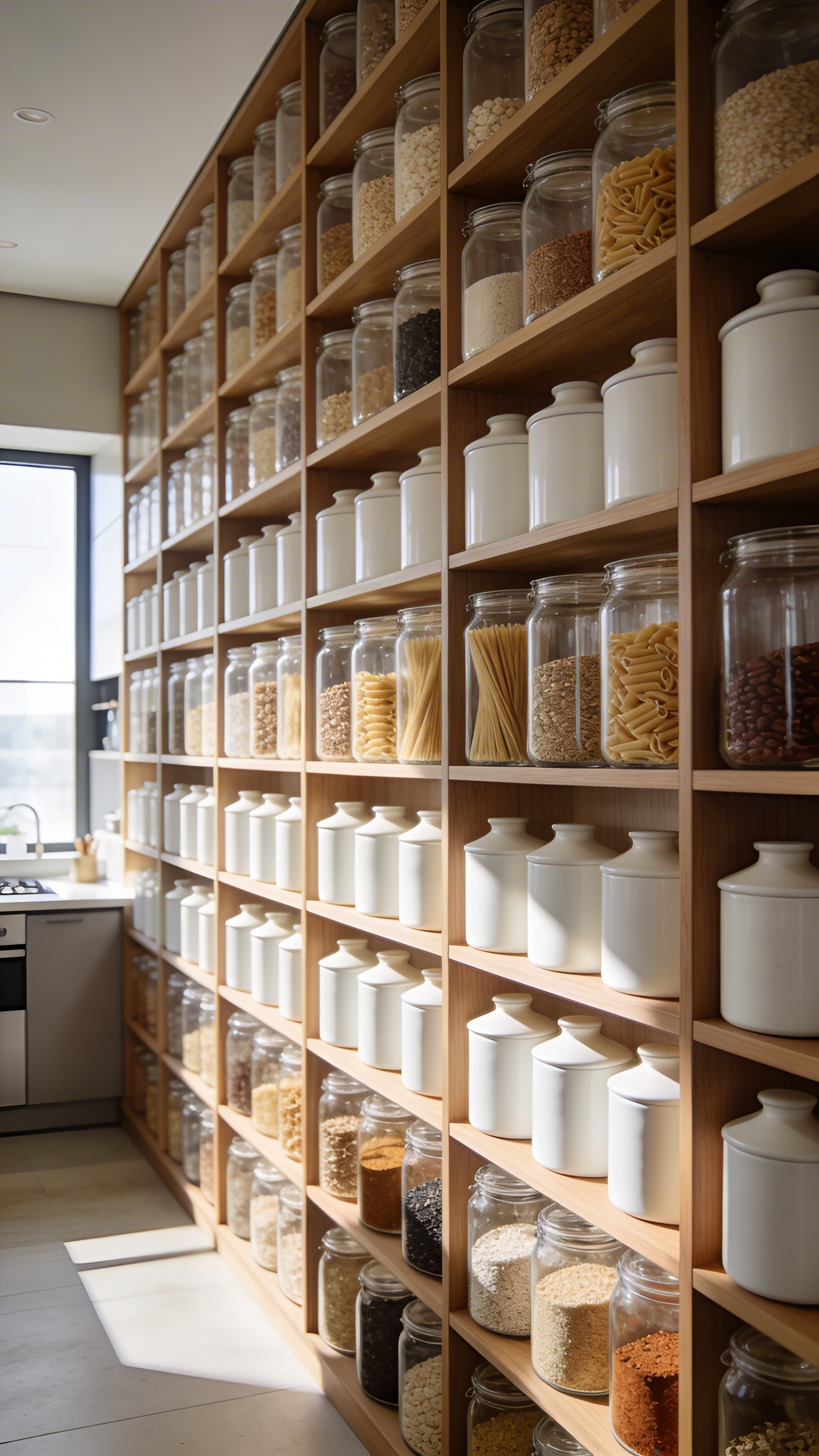
Historically, this practice traces back to the apothecary tradition. Indeed, early storehouses utilized uniform glass jars to protect valuable spices. Today, decanting replaces commercial branding with natural food textures. It turns the natural amber of honey into actual room decor.
However, exposed shelving presents distinct technical challenges like photo-oxidation. Ambient ultraviolet light quickly breaks down sensitive vitamins. Thus, professionals recommend using chemically inert borosilicate glass. Quality decanters must also feature robust hermetic seals. Otherwise, ambient kitchen steam will easily cause dry goods to clump.
Beyond preservation, the tactile experience greatly enhances the room. For instance, the satisfying whoosh of an airtight seal feels incredibly grounded. Admittedly, critics argue that decanting creates annoying backstock clutter. Fortunately, you can solve this by utilizing a hybrid decanting method. Simply cut out the cooking instructions and tape them underneath the glass jar. Ultimately, immediate inventory visibility heavily outweighs the minor maintenance load. Knowing your exact pantry inventory strictly prevents frustrating over-purchasing.
7. Hybrid Concealment: Mixing Woven Baskets with Exposed Display Areas
Hybrid concealment offers a systematic solution to the ongoing open shelving debate. Specifically, this method uses woven baskets to selectively filter out distracting visual noise. Your brain stops processing dozens of tiny, mismatched labels and brightly colored gadgets. Instead, it immediately registers a single, calm, and highly organic woven shape. Therefore, this clever approach allows your eyes to rest intentionally on curated items.
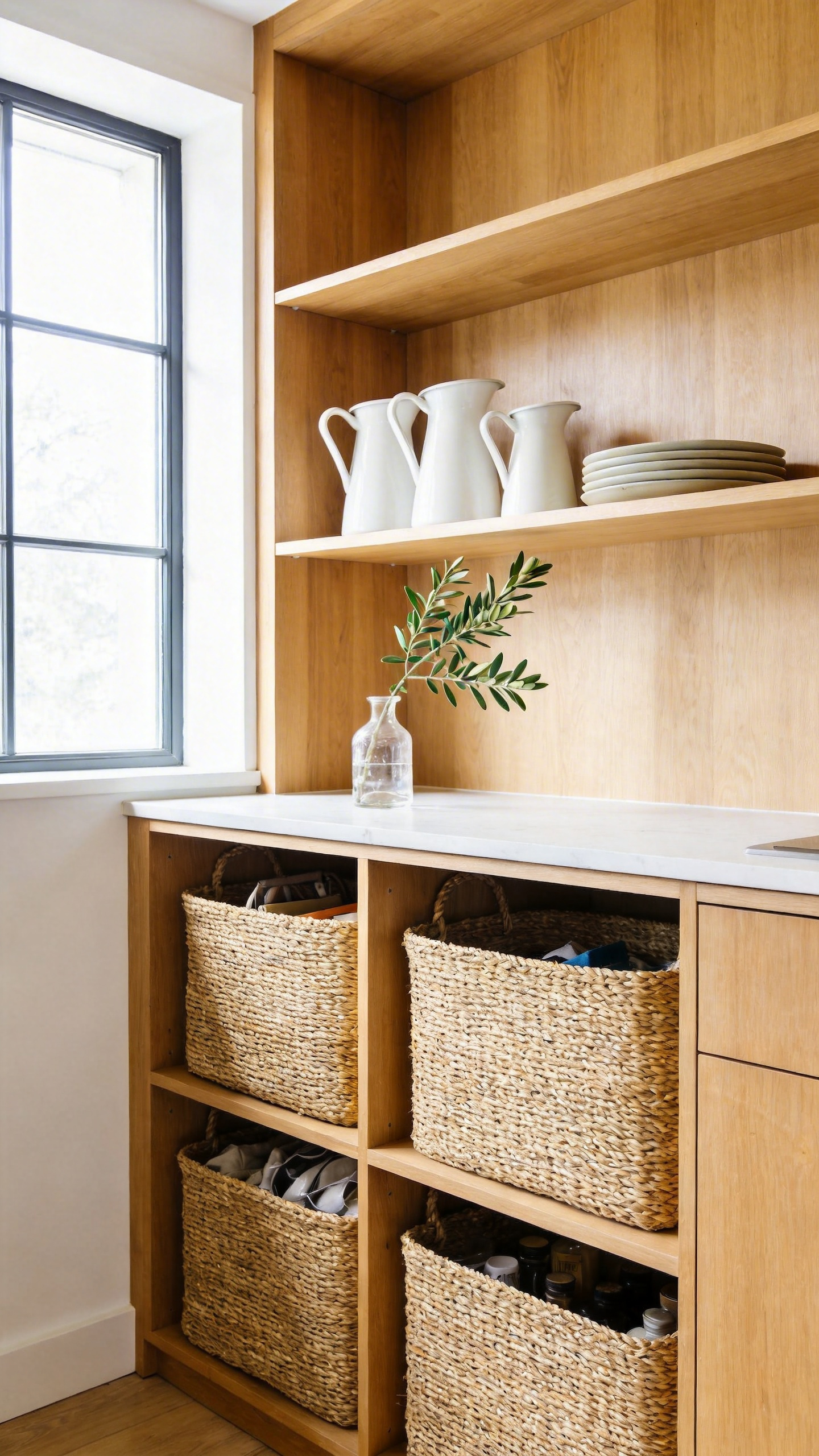
Professional stylists consistently rely on a strict visual ratio for perfect balance. Typically, seventy percent of the space remains functional display on your upper shelves. Meanwhile, thirty percent acts as concealed storage hidden directly on the lower shelves. Thus, everyday clutter like vitamin bottles perfectly disappears into accessible baskets.
These woven baskets provide a crucial technical advantage over airtight plastic bins. Highly porous natural fibers offer superior passive ventilation for your food storage. For example, a seagrass basket creates a constant micro-current of fresh circulating air. Naturally, this continuous airflow prevents rot and moisture buildup around root vegetables.
Natural seagrass serves as a highly durable workhorse material for heavy goods. It slides beautifully across wooden shelves with a satisfying, dry rasp. Conversely, thicker water hyacinth feels pillowy but easily attracts mold near stoves.
Eventually, all open kitchen shelves gather a layer of aerosolized grease. Therefore, proper routine maintenance requires dry-dusting deep into the textured weave every week. Alternatively, you can mist a diluted vinegar solution to gently blot away heavier grease. High-density synthetic weaves offer an entirely washable and practical modern design alternative. Ultimately, these faux-rattan options brilliantly merge traditional aesthetic warmth with effortless daily maintenance.
8. Vertical Tiering: Doubling Cabinet Capacity with Wire Risers and Shelf Inserts
Standard built-in cabinets often create fixed-height fatigue. Specifically, a standard 12-inch vertical gap wastes valuable space. Vertical tiering utilizes wire risers to reclaim this dead air instead. Historically, this concept evolved from industrial high-density storage. Today, shelf inserts physically enforce a crucial 2:1 density rule. Splitting a tall cabinet halves your maximum stack height. Otherwise, stacking heavy ceramics leads to stack failure.
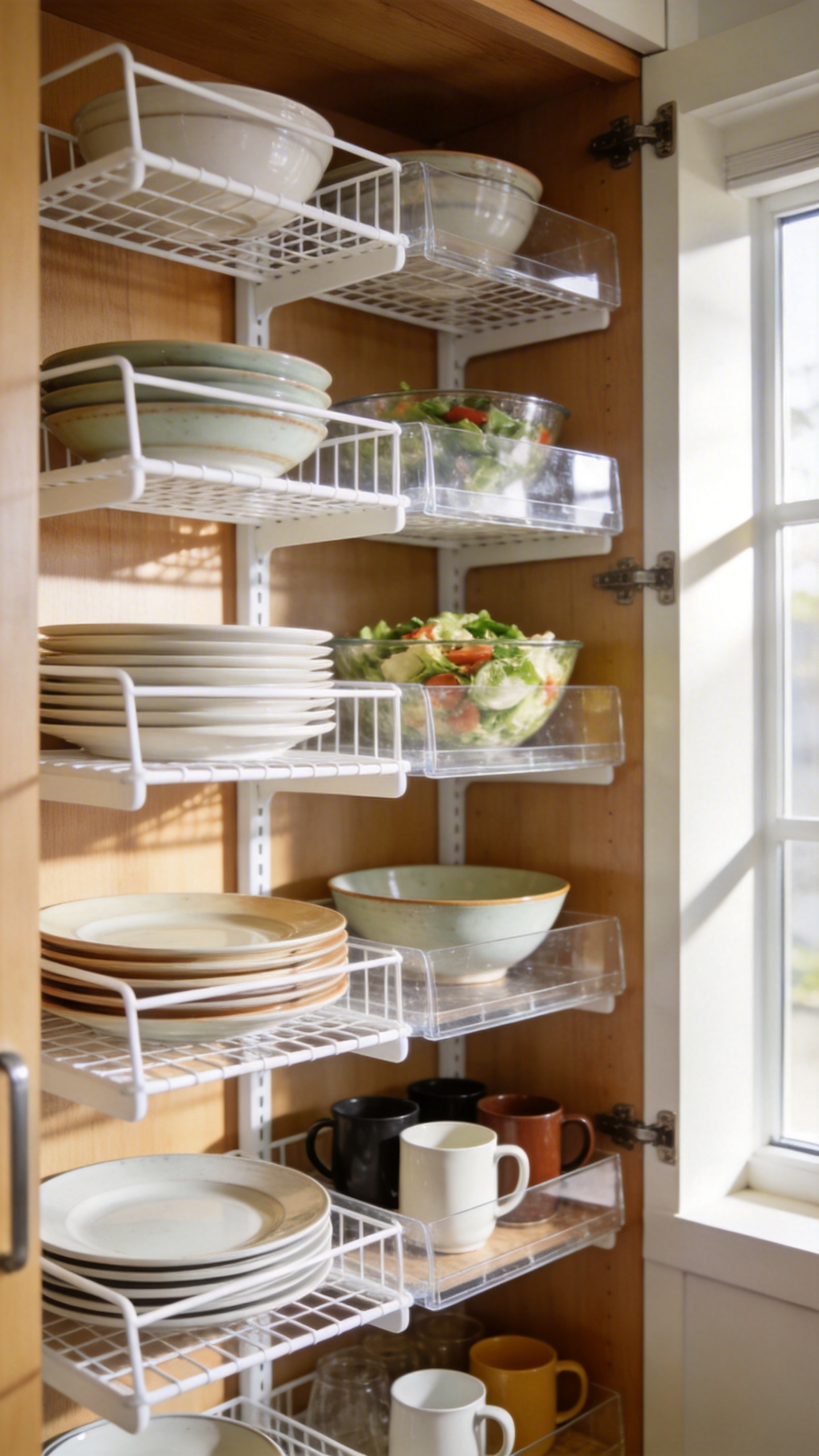
A leaning tower of plates quickly becomes highly unstable. Standard wire inserts use rigid 10-gauge steel wire to prevent this. This thick material prevents bowing under heavy twenty-pound loads.
Crucially, the external coating dictates the kitchen’s sensory experience. For instance, polyethylene coatings provide soft-touch acoustic dampening. Thus, the soft plastic prevents the harsh clink of ceramic plates. Conversely, flashy chrome plating frequently micro-cracks in humid environments. Eventually, compromised chrome exposes the internal steel core to rust.
Psychologically, horizontal tiering lines immediately reduce visual kitchen noise. Additionally, tiering guarantees single-touch access for daily dishware. You effortlessly grab exactly what you need. Ultimately, this specific weight distribution preserves fragile vintage china. Limiting stacks prevents stress fractures in delicate older porcelain.
9. The Under-Shelf Opportunity: Utilizing Magnetic Strips and Hanging Rack Systems
Traditional cabinet design often wastes the crucial space beneath your upper shelves. Experts now prioritize “first-layer access” for high-velocity kitchen items. Specifically, eighty percent of daily cooking requires only twenty percent of your tools. Therefore, utilizing the under-shelf area effectively eliminates the friction of opening doors. Historically, modular under-shelf tracks descended from 18th-century maritime French cleat systems. Today, this concept successfully transforms dead space into functional surfaces. For instance, hanging rails allow you to keep spatulas instantly accessible.
Professional kitchens rely on Type 304 stainless steel for these racks. This non-porous material easily resists corrosive steam rising from your stovetop. Crucially, always anchor hanging systems directly to the solid cabinet frame. Otherwise, hot steam quickly degrades chemical adhesives and causes sudden mounting failures.
Alternatively, magnetic strips offer a sleek, modern under-shelf storage solution. Hiding magnets behind a thin wood veneer maintains beautiful aesthetic appeal. However, this material thickness creates an “air gap” that reduces magnetic strength. Therefore, custom builders must use high-grade N52 Neodymium magnets to penetrate the wood.
Heavy knives snap firmly against the shelf with a satisfying auditory click. This tactile feedback genuinely reduces positioning time and improves your workflow. Finally, magnetic spice jars hanging by their lids solve annoying pantry depth problems. This clever orientation creates a highly visible map of your spices. Ultimately, treating your under-shelf space strategically balances organized utility with structural harmony.
Phase III: Advanced Application (Customization & Architectural Integration)
The transition into advanced design elevates kitchen storage into permanent architectural integration. Shelves evolve from mere furniture into seamless structural millwork. Custom builders install full-height walls directly from floor to ceiling. Consequently, the kitchen gracefully disappears into the surrounding home architecture.
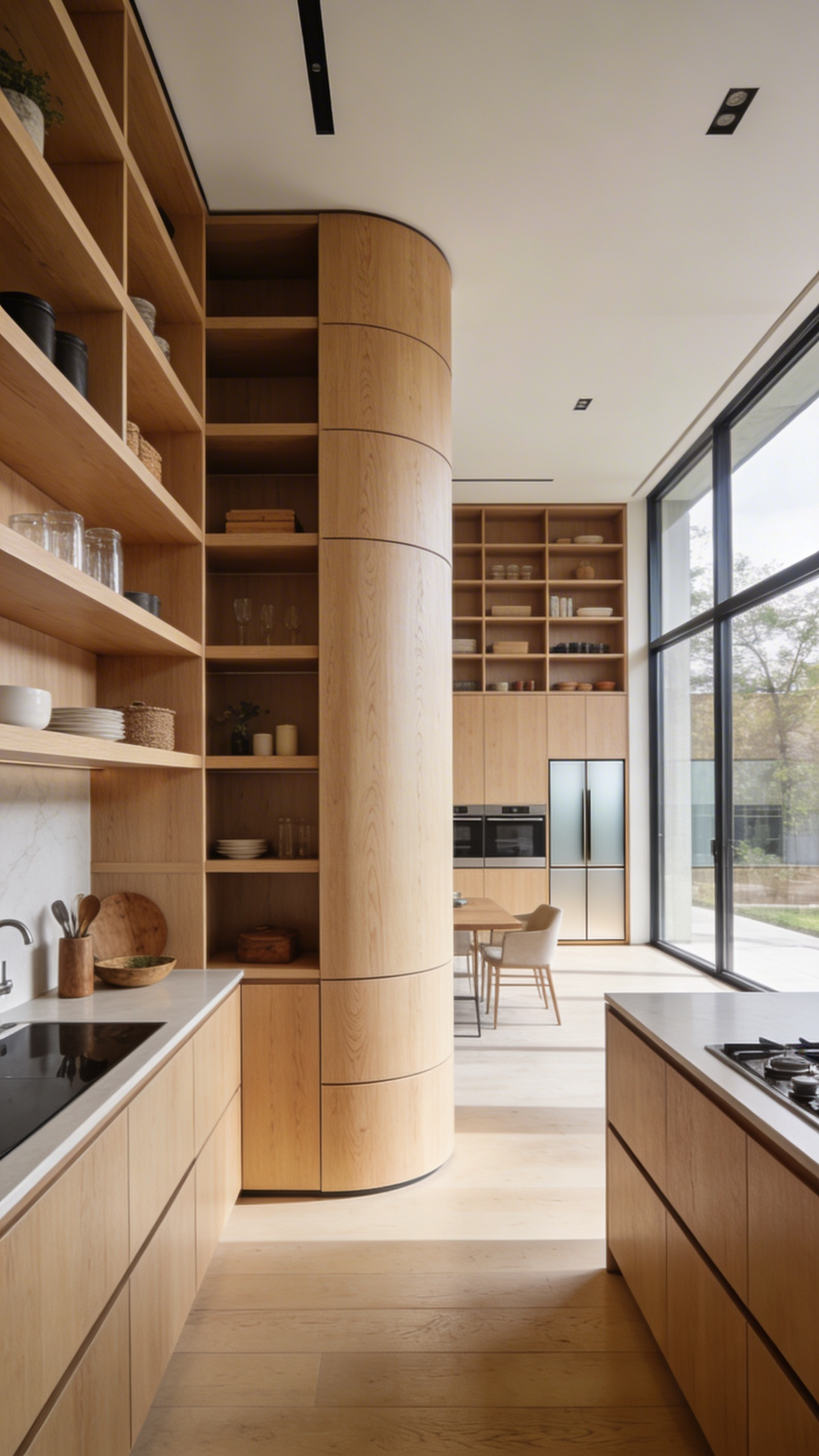
Wrapping shelving around load-bearing posts safely preserves valuable floor space. Meanwhile, hidden storage requires kinetic hardware for completely frictionless movement. For example, bi-fold flipper doors retract to reveal temporary workstation zones. Motorized lifts effortlessly conceal active espresso and baking stations. Indeed, motorized vertical tracks increase daily access efficiency significantly.
This bespoke integration relies entirely on strict material continuity. Craftsmen use a single wood sequence to flawlessly grain-match panels. Alternatively, heavy stone shelves use hidden steel rods for solid support. As a result, the cool stone organically grows from the warm walls. Likewise, wooden baffles hide LED strips to cast a soft, dimensional glow.
Ultimately, this level of custom design creates an uncluttered visual oasis. In fact, many designers note a strong preference for concealed storage. Disciplined organization behind closed panels drastically reduces daily cognitive load. These furniture-grade architectural upgrades also boast incredible long-term investment returns. Notably, competitive urban markets see excellent cost recuperation.
10. Corner Maximization: Custom L-Shaped Shelf Transitions for Dead Space
Historically, kitchen corners were deep, unreachable voids. Today, custom L-shaped transitions reject complex hardware for visual accessibility. Removing the cabinet box entirely eliminates heavy countertop shadows. Consequently, light flows around the corner to expand the room visually.
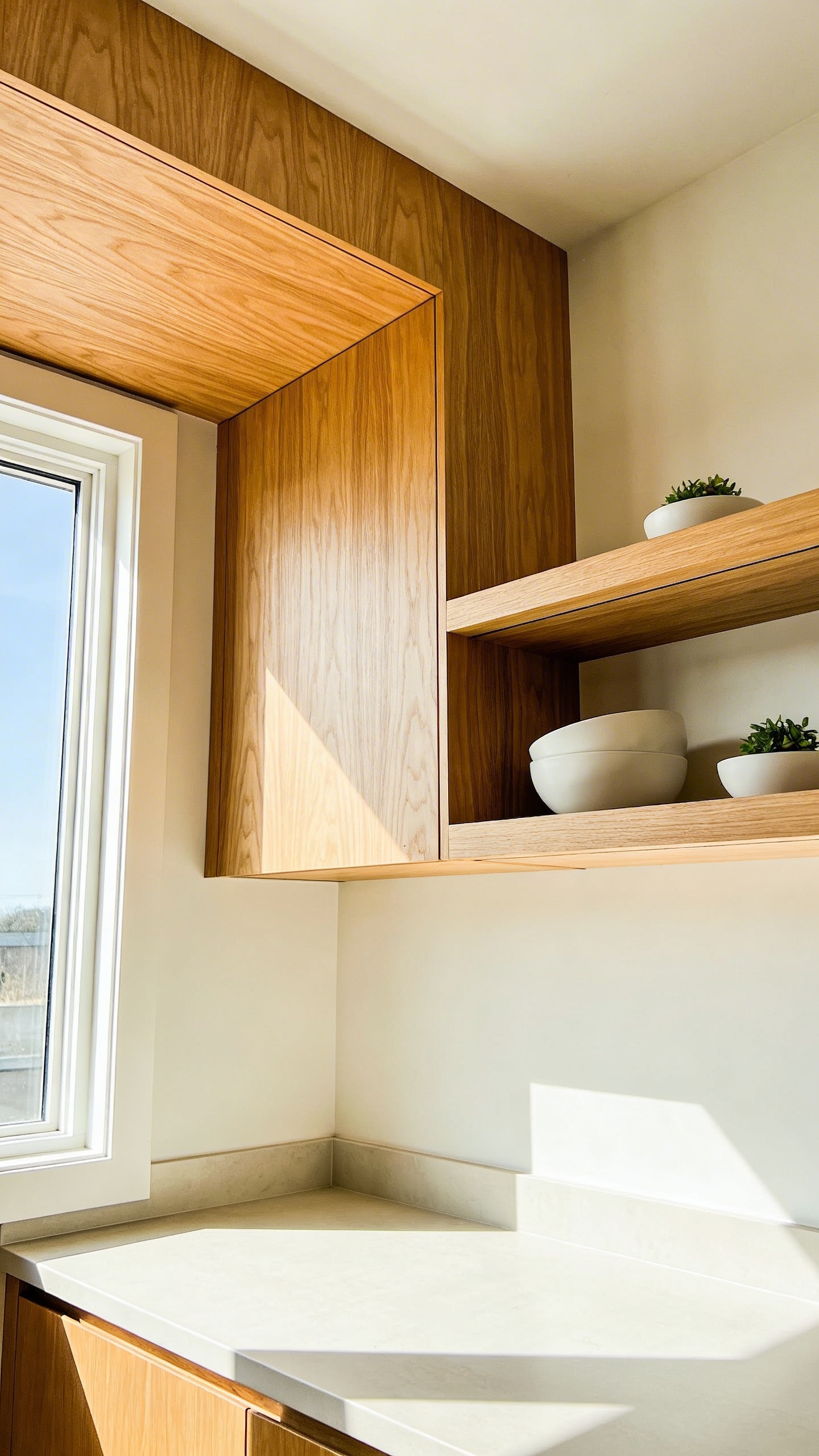
Achieving this monolithic look requires serious craftsmanship. For instance, expert woodworkers use a mitered fold technique. This allows the wood grain to flow uninterrupted across the joint. Meanwhile, hidden steel brackets bolt directly into the wall studs. Therefore, the shelf floats effortlessly without cluttering the dead space.
However, residential walls are never perfectly square. Because of this, installers must carefully scribe the shelf. This involves planing the back edge to match any drywall undulations. Additionally, biscuit joints inside the miter manage thermal expansion near hot ovens.
Ultimately, this open corner demands staged, active storage. Instead of hiding clutter, you create a curated display. For example, group daily-use ceramics or cooking oils in threes. Thus, you turn a stressful design flaw into a highly efficient focal piece.
11. Material Synergy: Matching Reclaimed Wood and Metal to Existing Cabinetry
Mixing reclaimed wood shelves with existing cabinetry requires careful material synergy. Designers use chromatic echoing to prevent tonal clashes. You must match the wood’s secondary undertones to your cabinets. For example, silver-weathered barn siding perfectly complements cool navy cabinets.
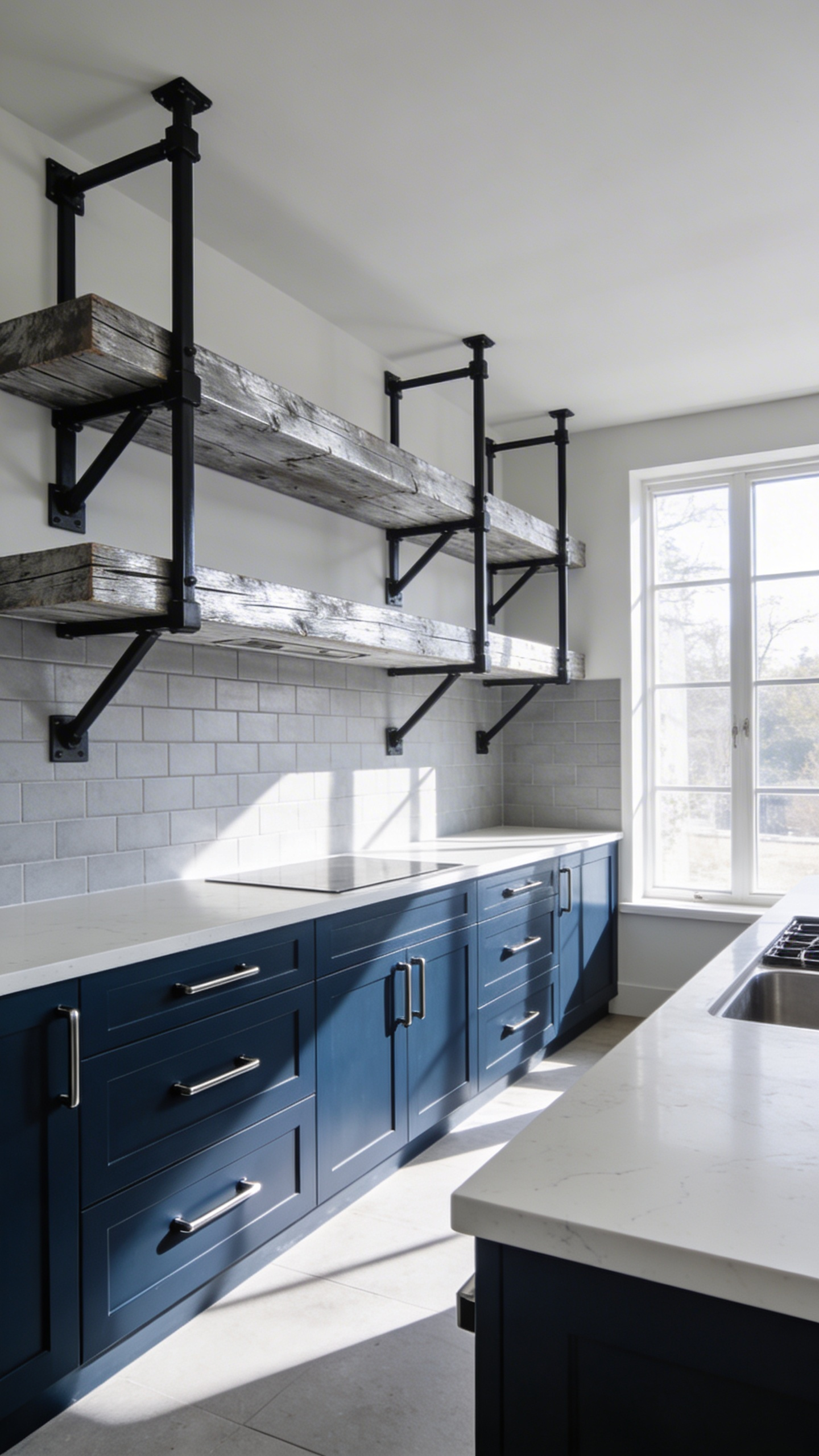
Metal brackets act as a structural handshake between materials. To bridge this gap, select hardware mirroring your existing cabinet pulls. Conversely, pairing rough wood with polished brass creates beautiful high-low luxury.
Achieving visual gravity is crucial for true spatial balance. Your shelf thickness should always match the cabinet door frames. Otherwise, thin planks placed next to heavy cabinetry create visual frailty. Installing thick-cut factory joists offers an intentional, structural heft.
Next, you must manage texture transitions through a careful patina gradient. Wire-brushing removes crumbly top layers while preserving deep historical cracks. Applying a dead flat varnish softens the tactile feel. This technique allows rough wood to complement smooth satin cabinets seamlessly. Finally, carefully consider how shelves physically meet the cabinet side. An integrated dado groove feels permanent and highly architectural. Alternatively, leaving a half-inch reveal creates an airy, floating effect.
12. Integrated Task Lighting: Routing Seamless LED Channels into Shelf Undersides
Historically, under-cabinet lighting was a bulky afterthought. Today, routing LED channels into wood creates a seamlessly glowing architectural feature. However, this invisible engineering requires precision to maintain structural integrity. A routed groove must never exceed one-third of the shelf thickness. Therefore, a shallow five-millimeter channel fits smoothly without compromising structural load. Professional organizers also heavily prefer flanged aluminum channels for custom storage. Because these extrusions possess a thin overlapping wing, they easily hide jagged wood splinters.
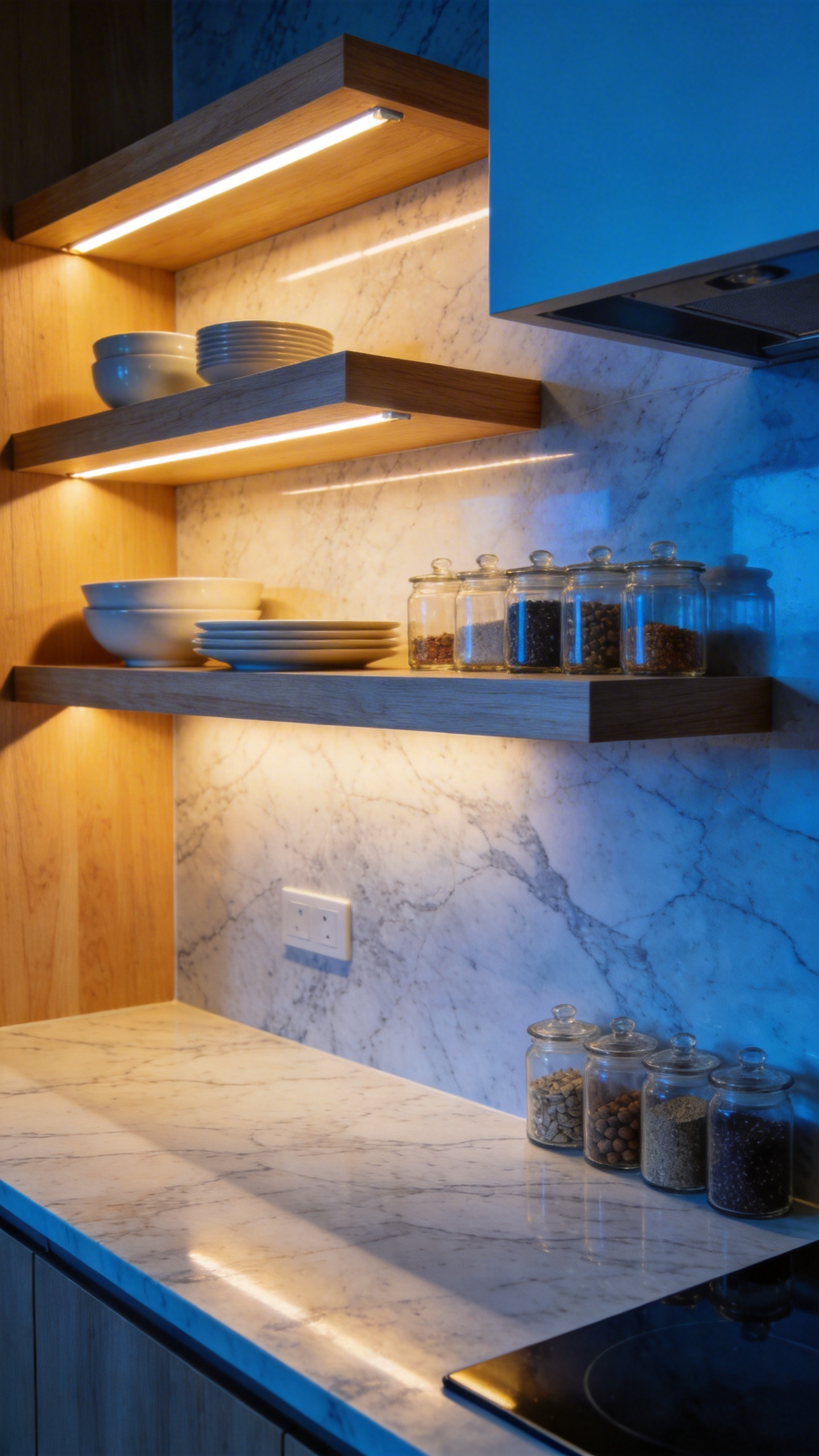
The cool metal channel acts as a vital heat sink. Dissipating this heat extends the lifespan of your warm LEDs significantly. Aesthetically, modern kitchens demand a flawless, neon-like glow without harsh reflections. Accordingly, experts specify continuous Chip-on-Board technology paired with smooth frosted diffusers. This beautifully eliminates the dotted light reflections once common on glossy quartz countertops.
Precise lighting placement is just as crucial as the technology itself. Installers typically position these friction-fit channels two inches from the shelf edge. As a result, crisp illumination entirely removes dark shadows from your cutting board. Pressing the track into place without permanent glue allows for easy future maintenance. You can simply pop out the hardware for quick electrical repairs. Finally, tunable white lighting systems effortlessly shift your kitchen from bright morning workspaces to warm evening retreats.
13. Architectural Niches: Transforming Awkward Wall Cavities into Built-In Storage
Architectural niches transform the awkward void between wall studs into highly efficient storage spaces. Historically, these recessed wall cavities trace back to the medieval “ambry.” These locked alcoves safely stored precious spices and sacred texts. Today, this concept prioritizes space efficiency by embedding utility directly into your kitchen’s skeleton.
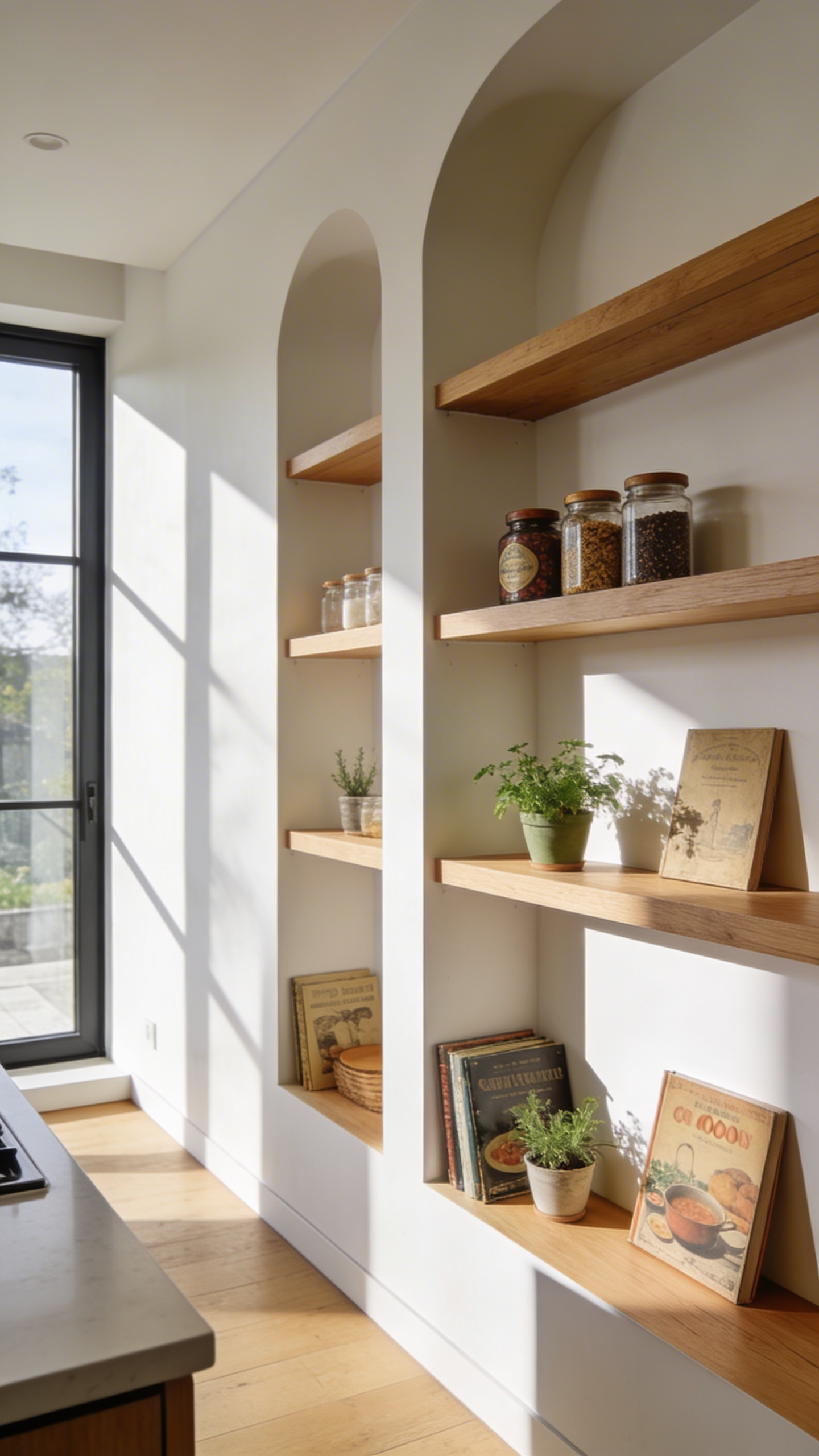
Most modern homes feature wall studs spaced exactly sixteen inches apart. Consequently, this creates a natural structural cavity for tall, narrow storage. Standard framing provides about three and a half inches of usable depth. This shallow alcove is perfectly sized for spice jars or coffee mugs.
Alternatively, designers can utilize thicker framing to achieve deeper niches. This allows for recessed small appliances like espresso makers or stand mixers. Aesthetically, integrating your countertop stone into the niche eliminates grime-collecting joints. Therefore, this creates a seamless, waterproof environment inside the storage zone.
Recessing the storage prevents the visual heaviness of traditional protruding shelves. Hidden LED tape lighting casts a gentle “wall wash” effect. This bounces soft light forward from the back of the alcove. Psychologically, drawing the eye into the illuminated wall makes the kitchen feel larger.
Recently, these awkward cavities have evolved into functional digital alcoves. Hidden outlets keep device charging cables away from wet prep zones. Additionally, stainless-steel backplates can create a sleek magnetic niche for holding knives. Ultimately, this structural commitment achieves the highly desirable minimalist aesthetic.
14. The Appliance Garage Alternative: Heavy-Duty Shelving for Mixers and Espresso Machines
The traditional appliance garage once hid visual clutter behind clunky wooden doors. However, modern kitchen design embraces curated utility. High-end espresso machines serve as beautiful tools of the trade. Consequently, homeowners are replacing cramped garages with heavy-duty open shelving. This systematic approach transforms hidden clutter into an ergonomic workstation.
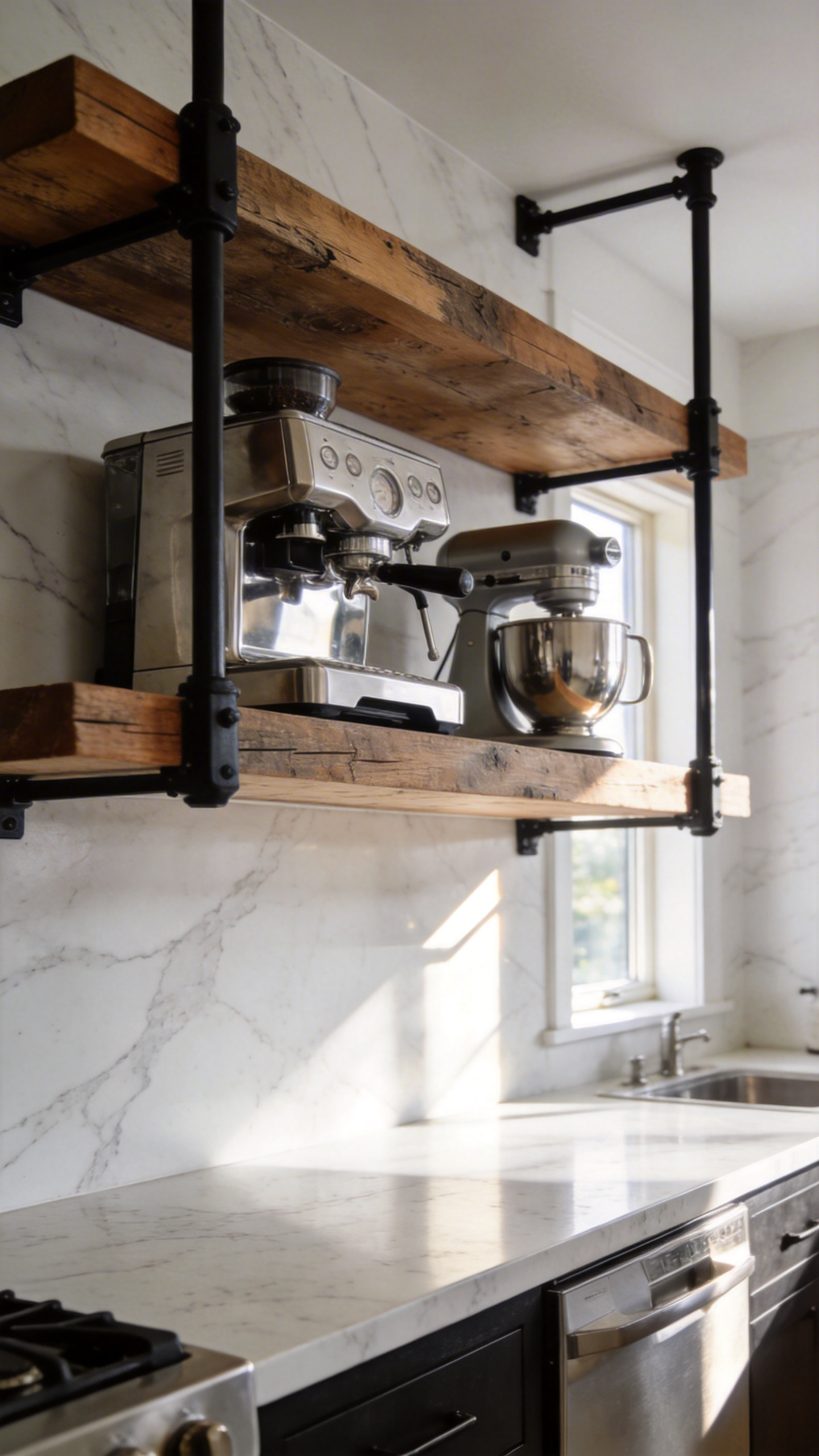
Displaying heavy equipment requires serious structural engineering. Standard adjustable cabinet shelves easily snap under a 30-pound mixer. Therefore, true exhibition shelving demands robust hidden support. Steel brackets must anchor deeply into wall studs. Using thick hardwood shelves also prevents dangerous perceptual sagging. Indeed, solid walnut shelving absorbs intense machine vibrations beautifully.
This open shelving follows a smart point-of-use philosophy. For instance, placing a heavy mixer at chest height eliminates awkward lifting. Minimizing this lifting arc greatly reduces daily physical strain. Alternatively, some homeowners prefer industrial pull-out shelves inside base cabinets. These full-extension glides offer weightless movement for 100-pound loads. Thus, soft-close dampers protect sensitive espresso components from slamming shut. Ultimately, modern design balances proud industrial display with quiet luxury. Upgrading to heavy-duty supports guarantees safe, beautiful appliance storage.
Phase IV: Mastery Integration (Sustaining the Organizational System)
Ultimately, a kitchen storage system must transition into a permanent, self-correcting ecosystem. This mastery requires moving beyond clear bins into advanced storage engineering. For instance, we utilize zero-footprint engineering by claiming the empty depth between wall studs. Recessed niches hold spice collections without sacrificing valuable square footage. Full-extension hardware also eliminates the problematic dark zones at the back of standard shelves. Mechanical design forces the system to remain organized by preventing hidden expired goods.
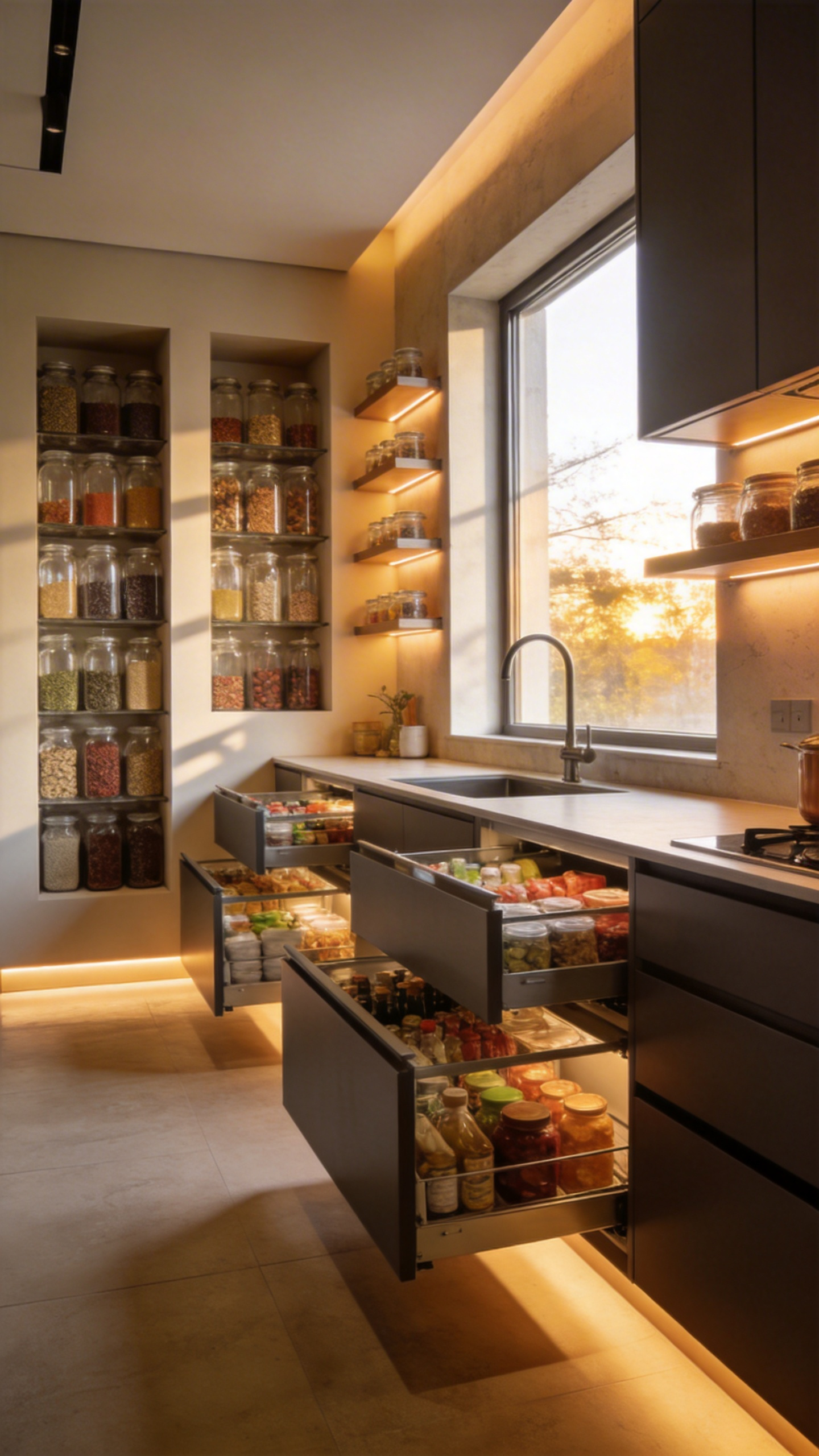
Disorganized spaces create stressful visual noise that quickly triggers decision fatigue. Decanting ingredients into uniform vessels directly removes chaotic, brightly colored marketing clutter. As a result, the eye processes visual information much faster during meal preparation.
Achieving a hidden versus open equilibrium remains essential for overall sensory balance. High-cadence items rest beautifully on warm, textured wood or marble shelves. Conversely, low-cadence tools remain perfectly concealed inside highly modular cabinetry units.
Sustaining this delicate harmony relies heavily on intuitive kinetic flow. We arrange essential tools by specific action zones instead of broad categories. Naturally, energy-intensive items sit comfortably at a convenient shoulder-to-waist height. You can easily maintain daily order through a strict one-in, one-out habit.
True mastery requires technical resilience to withstand harsh, humid kitchen environments. Medical-grade stainless finishes gracefully resist stubborn grease and constant dust build-up. Meanwhile, incremental one-inch shelving adjustments allow for effortless, ongoing lifestyle adaptation.
15. Adaptive Bracket Systems: Future-Proofing Adjustable Shelves for Changing Needs
Adaptive bracket systems represent a major shift in modern kitchen storage design. They move spaces away from static furniture toward highly dynamic infrastructure. Historically, standard adjustable shelving relied on basic pin-and-hole mechanisms. Unfortunately, these traditional setups offered very limited vertical increments. In contrast, modern continuous track designs utilize a notched-channel mechanism instead. Consequently, brackets can securely hook and lock at virtually any micro-increment.
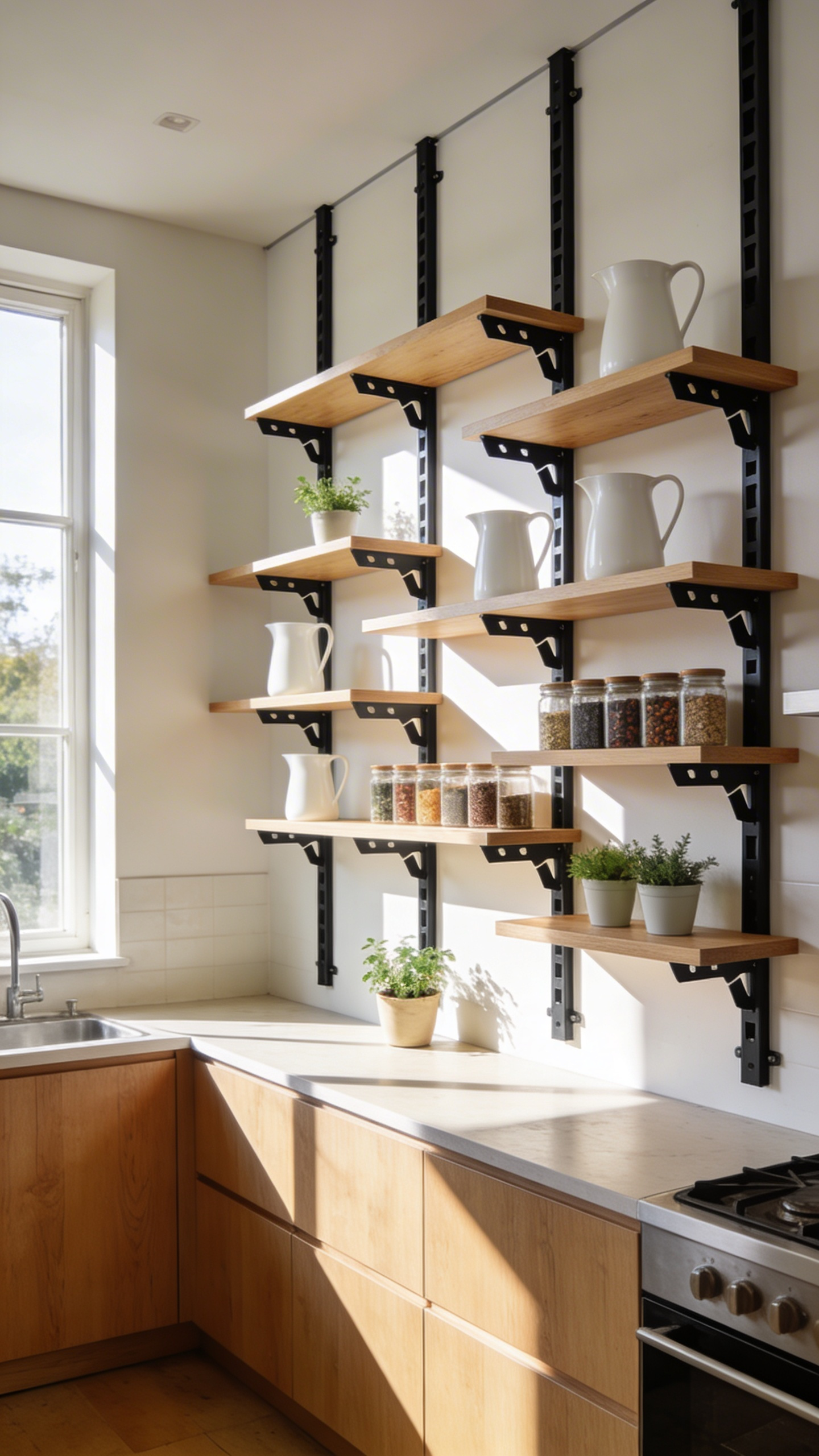
These systems also handle heavy loads exceptionally well. Advanced wedge-locking geometry actively tightens its grip as weight increases. Thus, heavy cast-iron cookware adds lateral stability rather than causing failure. High-end European systems even incorporate mechanical locks for pull-out shelves. As a result, a sliding shelf transforms instantly into a stable prep station.
Importantly, this adaptive approach champions true universal design. Gas-spring and motorized bracket mounts allow shelves to lower easily. Therefore, the kitchen remains fully functional as a user’s mobility needs change.
Interlocking aluminum extrusions can support upwards of 300 pounds per linear foot. Because of this, homeowners enjoy open aesthetics without fearing structural sag. Visually, a single track system eliminates the clutter of mismatched hardware. Expert-grade brackets offer satisfying tactile feedback during installation. You hear a distinct click when the hardware seats safely inside. Ultimately, this flexibility future-proofs the home while preserving a beautiful, calm aesthetic.
16. The Restocking Cadence: Creating a Self-Maintaining Inventory System
A well-designed pantry functions as a living dashboard. It shifts inventory management from active memory to passive recognition. You never have to remember what you need. Instead, the bespoke cabinetry physically tells you. To achieve this, we apply industrial efficiency to domestic shelving. For instance, the two-bin method uses a primary and secondary container depth. Pulling the back container forward serves as a tactile restocking signal.
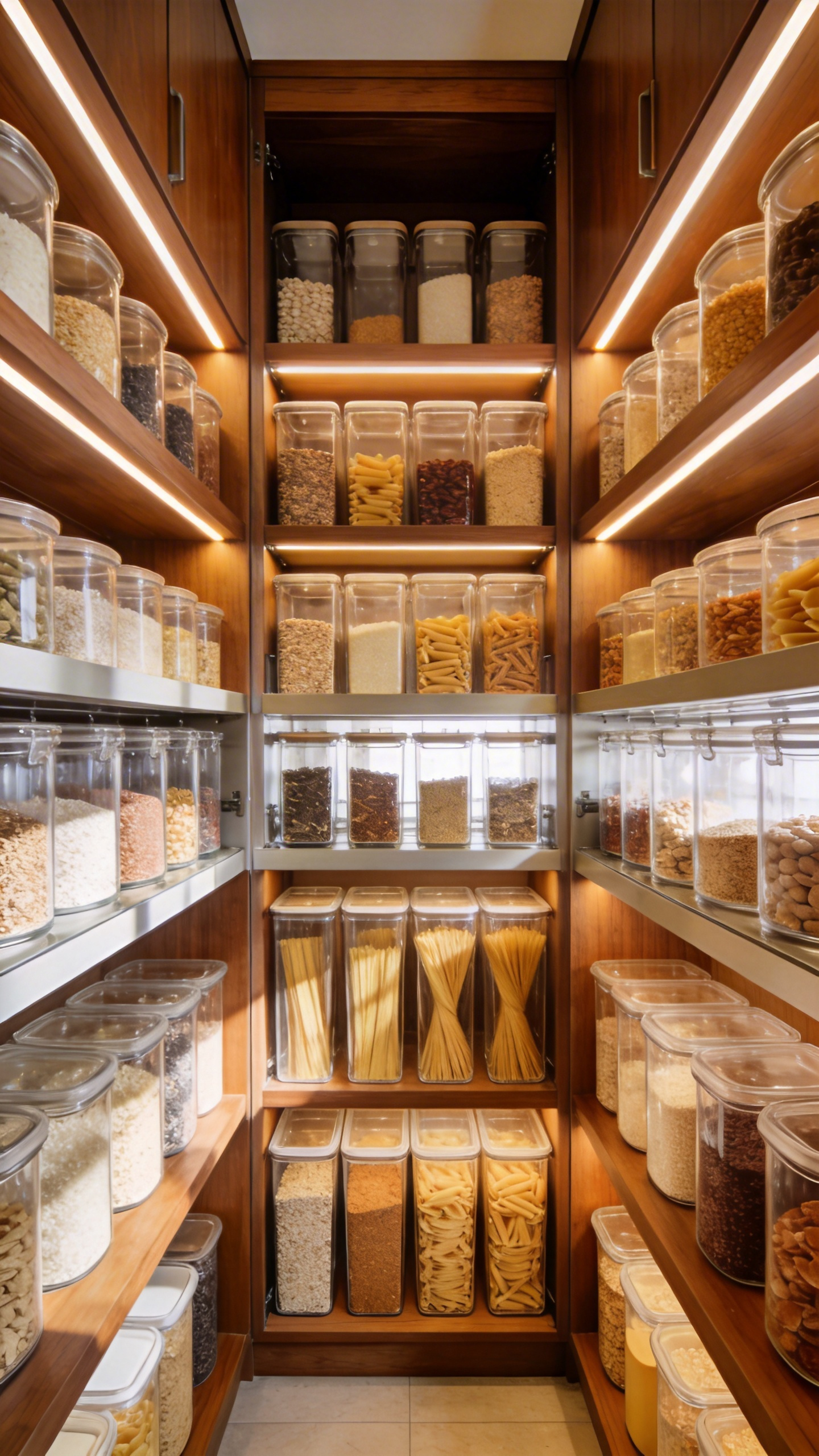
Decanting dry goods into clear acrylic jars acts like a gas gauge. Uniform glass transforms hidden cardboard boxes into transparent volume indicators. As a result, your eye can instantly sweep the shelf to spot supply bottlenecks.
However, a self-maintaining system also requires structural support to prevent expired shelf fossils. Gravity-fed angled inserts force older items to slide downward. This creates an automated first-in, first-out rotation. Moreover, the satisfying clack of a sliding can audibly confirms the system is reset.
Successful cabinetry maps out zones by metabolic rate. High-velocity items like coffee sit squarely at the waist-high strike zone. Conversely, low-turnover bulk grains belong on the highest archive shelves.
Finally, physical materials dictate how smoothly this rhythm flows. I recommend solid wood shelves fitted with low-friction liners. Indeed, a dark shelf beneath a white jar highlights empty negative space. Ultimately, this visual contrast prompts the brain to replenish missing stock automatically.
17. Negative Space Architecture: Knowing Exactly What Not to Display
In architectural design, negative space is a highly functional element rather than an empty void. It defines the positive visual space around it. Drawing from the Japanese concept of “Ma,” we must engineer visual silence. In fact, a shelf packed edge-to-edge triggers a constant visual scan. This endless searching leads to subtle cognitive fatigue during high-stress cooking moments.
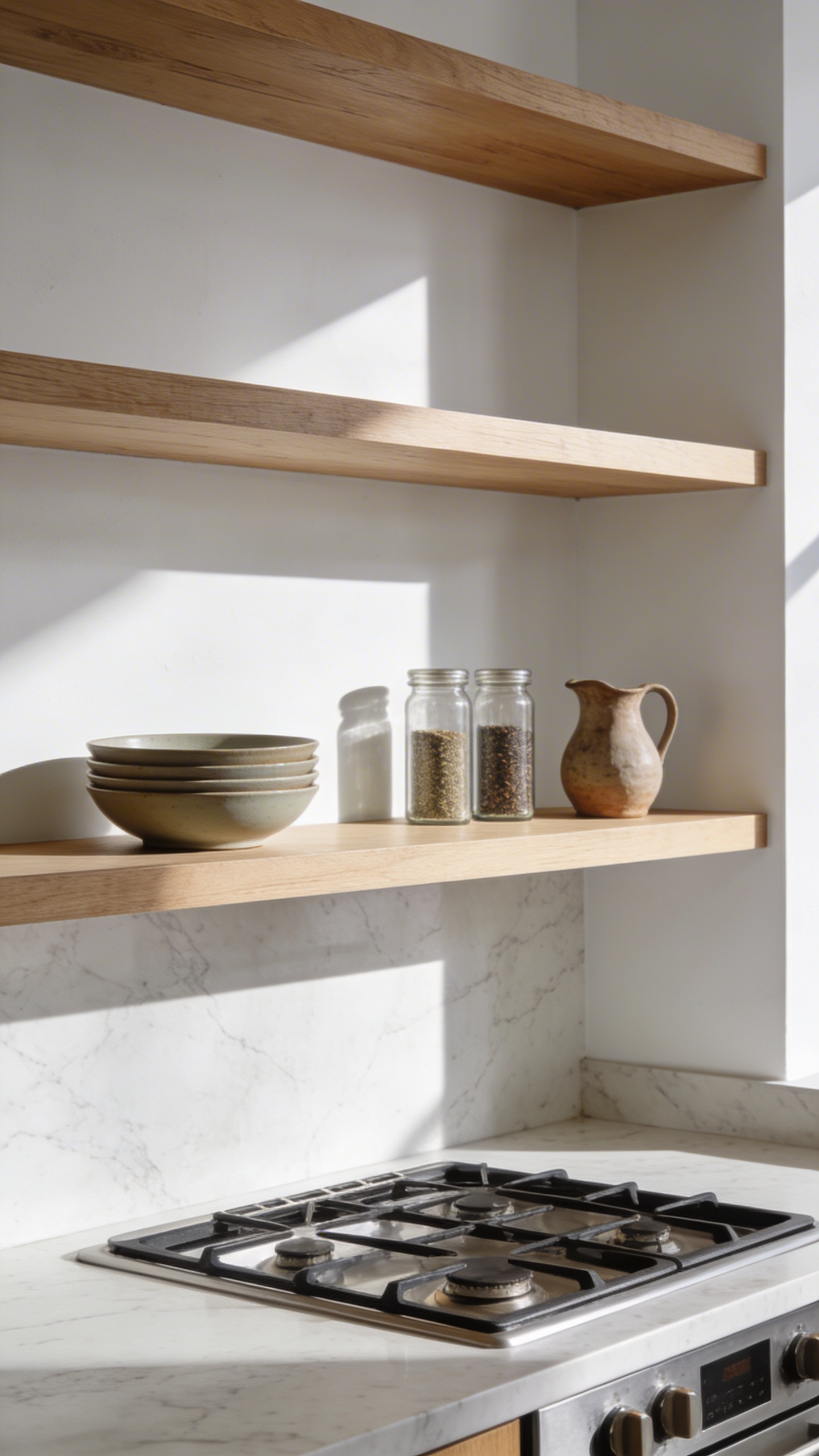
To prevent this, professional organizers utilize a specific mathematical proportion. The 1:2 ratio dictates our systematic approach to open shelving. For every visual cluster of three items, you should leave two units of empty space. This intentional void acts as a beautiful frame for your chosen artifacts.
However, knowing exactly what to hide is equally vital for efficiency. Utilitarian objects lacking a clean silhouette simply create distracting visual noise. Complex commercial logos, mismatched plastics, and irregular cereal boxes destroy architectural integrity. Instead, relegate these necessary items to hidden closed cabinetry.
Strategic negative space allows natural light to wash down the backsplash unhindered. Conversely, an overstuffed shelf creates a light dam that casts deep, muddy shadows. By keeping eye-level shelves sparsely populated, you actually increase the perceived room size. The eye travels directly to the wall behind the shelf. Ultimately, negative space provides the essential punctuation that gives your kitchen design true meaning.
18. Seasonal Rotational Shelving: The Ultimate Secret to Year-Round Kitchen Efficiency
Seasonal rotational shelving is the high-efficiency evolution of historical preservation rituals. Farmers once moved heavy root vegetables to cooler, lower shelves for winter. Today, we adapt this through prime-zone migration. You shift the most accessible kitchen storage according to the calendar.
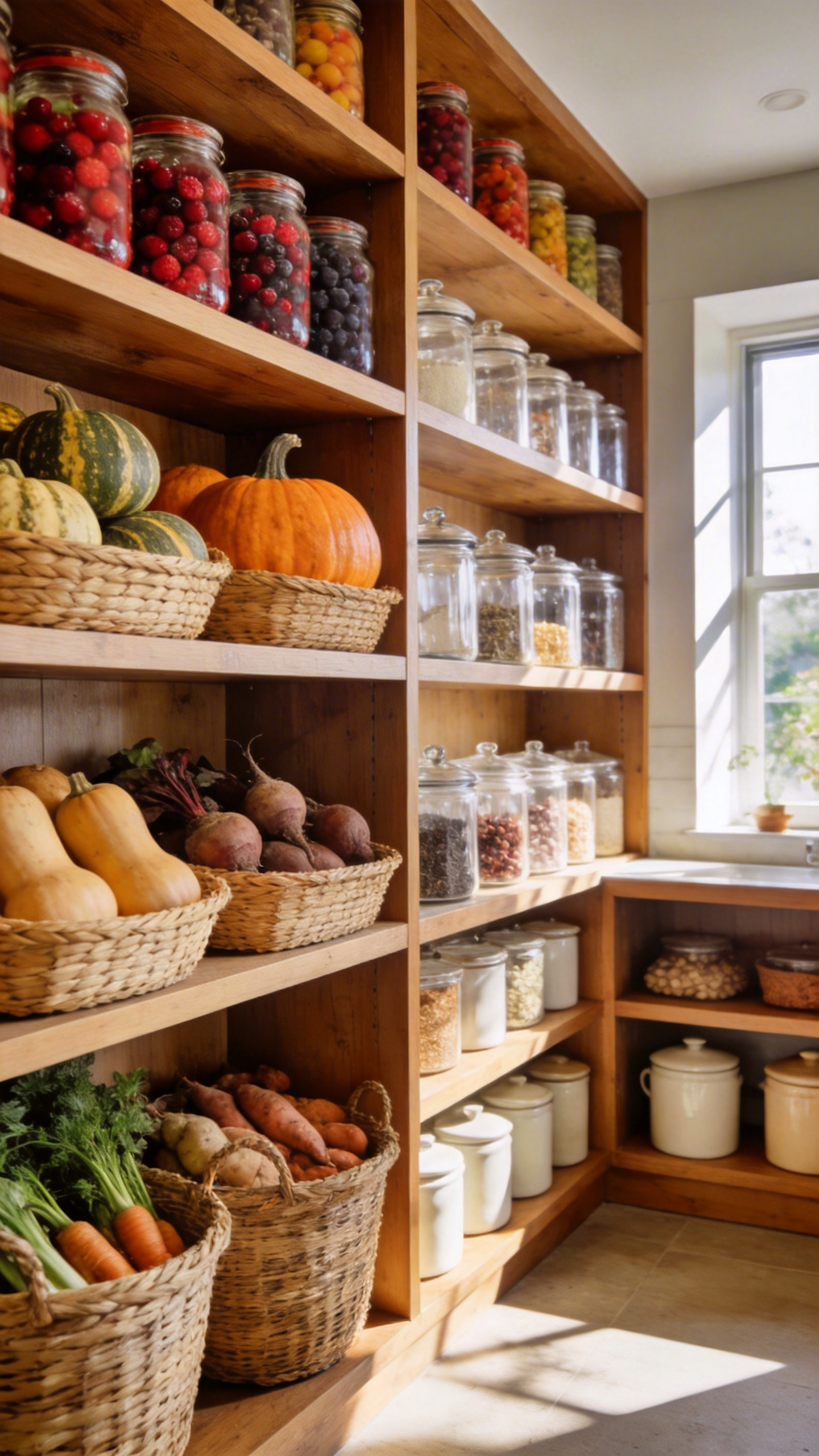
Standard organization often suggests grouping items strictly by category. However, workflow-based rotation treats your shelf space as liquid inventory. For instance, summer salad spinners are swapped for heavy winter Dutch ovens. These heavy items then sit at an ergonomic height to prevent strain. Additionally, clever hardware like toe-kick drawers can hide flat holiday platters beautifully.
This seasonal swap offers profound psychological benefits during darker winter months. Clearing out unused vibrant summer items greatly reduces visual noise. Professional organizers use this visual quiet technique to calm the mind. Instead of a chaotic display, shelves feature a soothing monochromatic winter palette. A seasonally efficient kitchen also feels and sounds fundamentally different. The light clink of summer glass naturally gives way to heavy stoneware.
We use twenty percent of our tools most of the time. Therefore, a complete system evacuation every six months keeps operational speed high. Clearing the seasonal clutter completely eliminates the frustrating daily excavation phase. Whether you are designing a full-scale renovation or refining a dedicated culinary zone, mastering the structural and visual dynamics of kitchen storage shelves ensures a kitchen that is as high-performing as it is beautiful.
Frequently Asked Questions
Are open kitchen storage shelves hard to keep clean?
While exposed surfaces attract aerosolized cooking grease and dust, strategic placement can mitigate this. Professional designers recommend placing open shelving away from the range. Maintaining a 70/30 split between closed and open storage minimizes cleaning maintenance.
How much weight can a standard floating kitchen shelf hold?
A properly installed floating shelf anchored into wood studs typically supports between 40 to 75 pounds per stud. However, capacity depends heavily on the bracket quality and shelf depth. Deeper shelves create more leverage and require heavy-duty internal steel supports.
What is the best material for premium kitchen shelving?
For the premium market, hardwoods like white oak, walnut, or maple are preferred for their durability and acoustic damping. Alternatively, stone or high-grade stainless steel offers a beautiful contemporary aesthetic. These materials are heat-resistant and non-porous, making them ideal for high-utility zones.