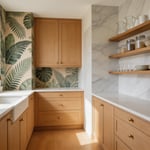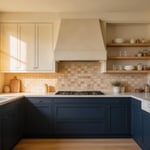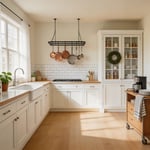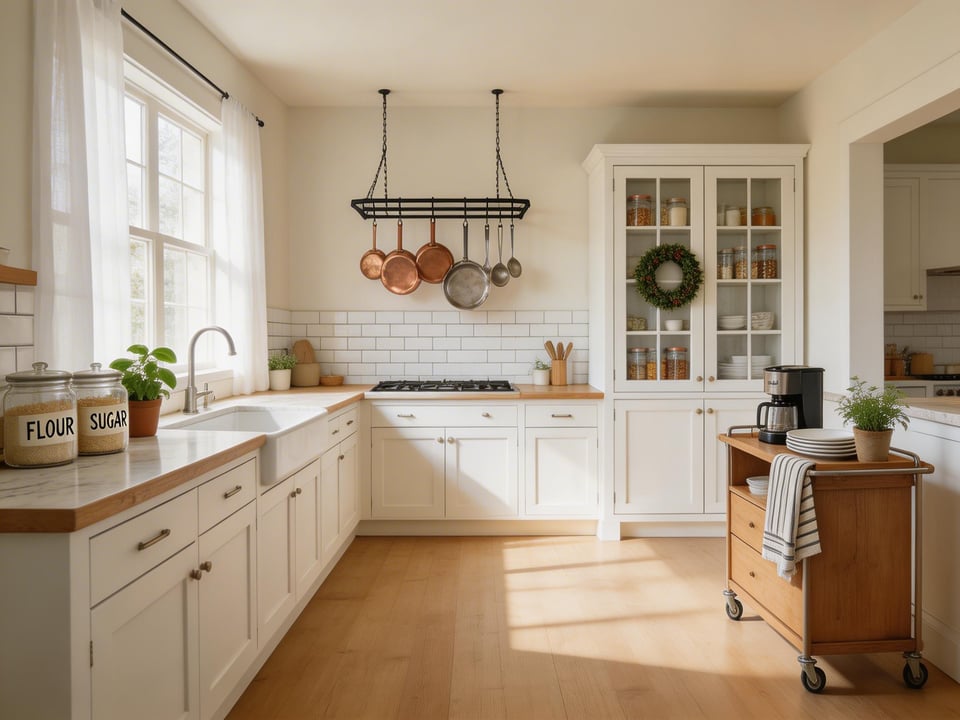
When I walked into a client’s kitchen last year, I noticed a tower of mixing bowls balanced on the fridge. Every cabinet was full. So the bowls lived on top of the fridge. The second thing I noticed: an empty wall next to the door. Four months later, that wall held a freestanding pantry cabinet and a wall-mounted pot rack. The mixing bowls had a proper home.
That’s what kitchen storage furniture does when you choose the right piece. It doesn’t just clear a surface — it builds a system. And systems stay organised in a way that goodwill toward tidiness simply doesn’t. Whether you’re in a small kitchen counting every inch, or a larger space where clutter has expanded to fill all available room, specific pieces of kitchen storage furniture solve specific problems. This article covers fifteen of them — what they do, what to look for, and where the budget versions fall short.
1. Freestanding Pantry Cabinet: Kitchen Storage Furniture for Bare Walls
The freestanding pantry cabinet is one of the most underused pieces of kitchen storage furniture. Most people assume they need built-in cabinetry to get proper pantry storage. In fact, a well-chosen freestanding unit along a bare wall can add more usable space than a run of upper cabinets — at a fraction of the cost.
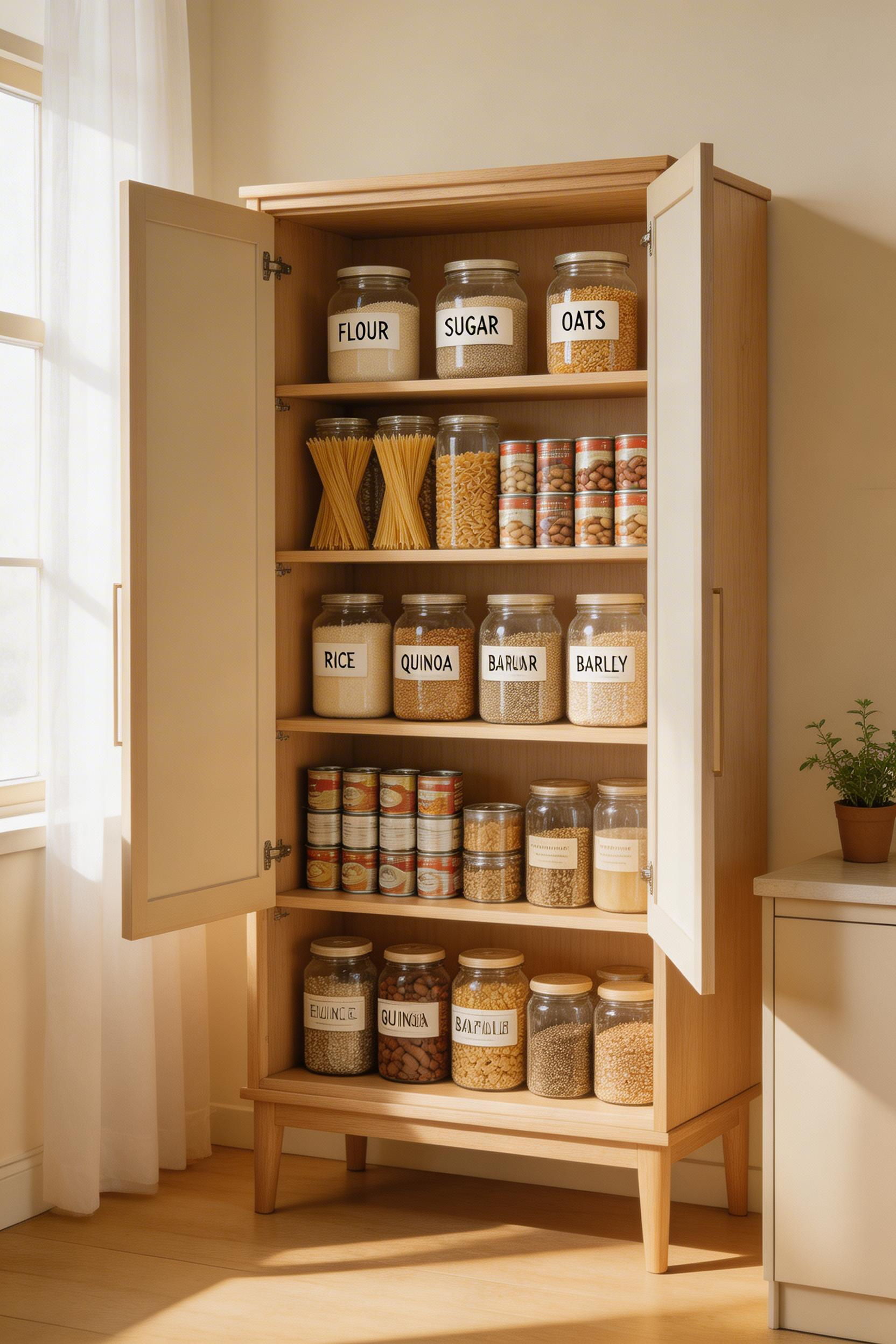
The most important specification to check is shelf adjustability. A unit with shelves at fixed heights sounds fine — until you try to fit a 15-inch stand mixer on a shelf with 13 inches of clearance. Look for 2-inch incremental adjustment. That range handles cereal boxes (13 inches), canned goods (4–5 inches), and kitchen appliances (12–16 inches) in the same cabinet. The IKEA IVAR pine system ($155–$310 for a double unit) does this well and accepts add-on drawers.
Construction Matters Near the Stove
MDF construction is adequate for dry goods away from heat. However, if your pantry cabinet sits near the oven, dishwasher, or any steam source, solid wood or plywood handles humidity fluctuations significantly better. Laminate finishes — like those on the Prepac Tall Pantry Cabinet ($220–$350) — offer reasonable moisture resistance and a more polished look than raw pine.
Pay attention to door clearance. A 24-inch wide pantry cabinet needs 24 inches of clear floor space in front to swing the doors fully. Wall depth matters too — units over 18 inches deep start eating into kitchen walkways. For most kitchens, 14–16 inches is the sweet spot. Also anchor anything over 70 inches tall to a wall stud. A tip-over with a full pantry cabinet is genuinely dangerous.
2. Kitchen Island with Built-In Drawers: A Workhorse That Earns Its Footprint
An island earns its footprint only when it provides more than counter space. The version worth buying has a base of deep drawers. Those drawers handle the heaviest, most awkward items: cast iron skillets, Dutch ovens, stand mixer bowls.
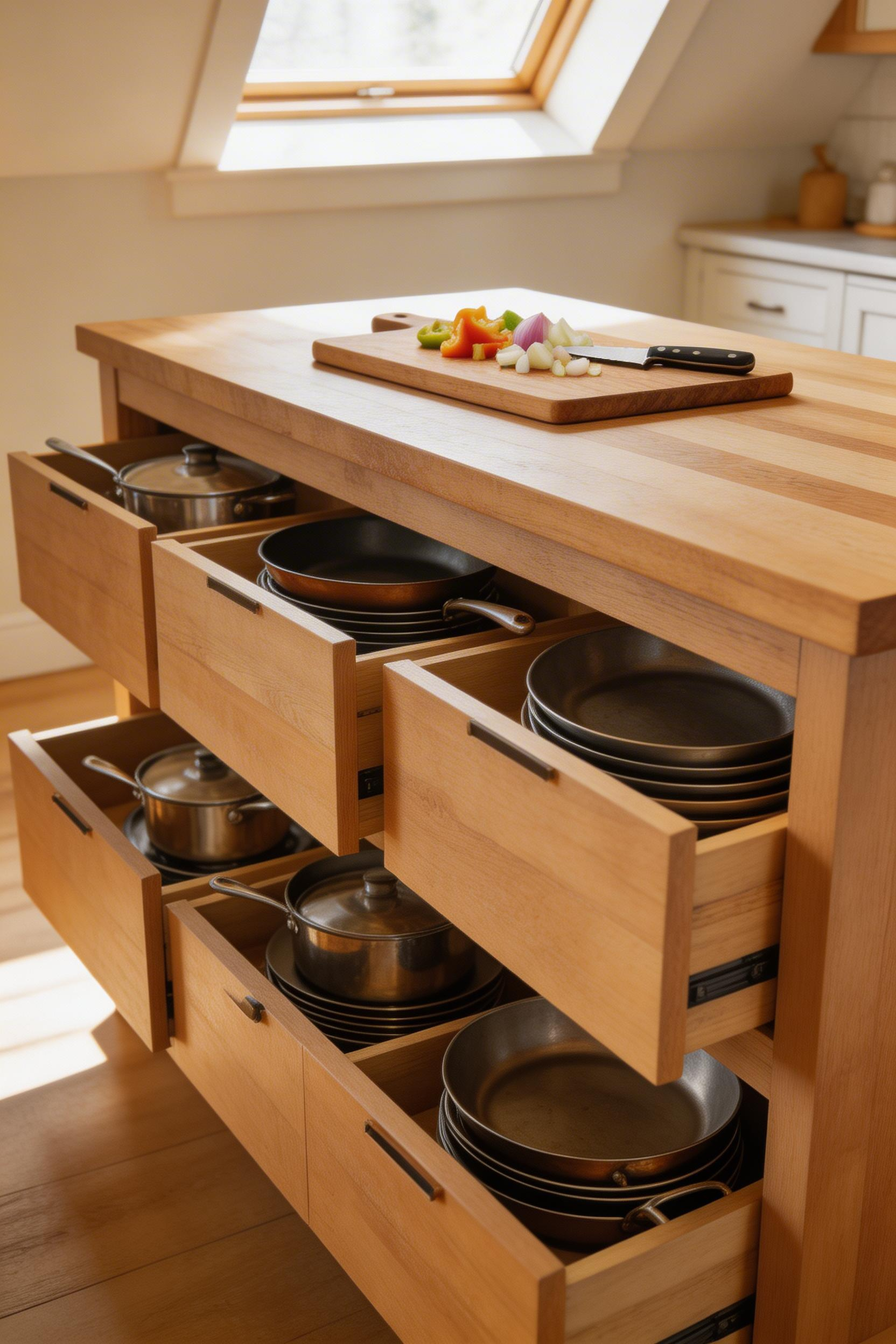
Drawer depth separates useful islands from decorative ones. A 12-inch cast iron skillet needs a drawer at least 21 inches deep to lie flat. Many budget islands come with 18-inch drawers. That forces you to store pans on their sides or stacked — exactly the situation the island was supposed to fix. The IKEA STENSTORP ($699) has 24-inch drawer depth, which handles most cookware without compromise. You can browse more approaches to this in our guide to kitchen island ideas.
Slide Quality Matters More Than You Think
Soft-close drawer hardware adds $15–$40 per pair. It also prevents slamming, which loosens drawer box joints over time. A kitchen island used by a family opens its drawers hundreds of times per week. Cheap slides show the stress within a year. Specify 100-lb rated full-extension slides if you’re storing cast iron or heavy mixing equipment.
Also confirm the island fits the room correctly. NKBA guidelines require 42 inches of clearance on working sides and 36 inches on non-working sides. An island that blocks the dishwasher from opening fully is more problem than solution.
3. Rolling Kitchen Cart: The Most Flexible Kitchen Storage Furniture
The rolling cart is the most flexible piece of kitchen storage furniture you can buy. It moves where you need it. It serves multiple functions at once. It’s the only storage option that’s equally useful as a prep station on Tuesday and a bar cart on Saturday. For smaller kitchens, that adaptability is worth more than a fixed cabinet of the same size.
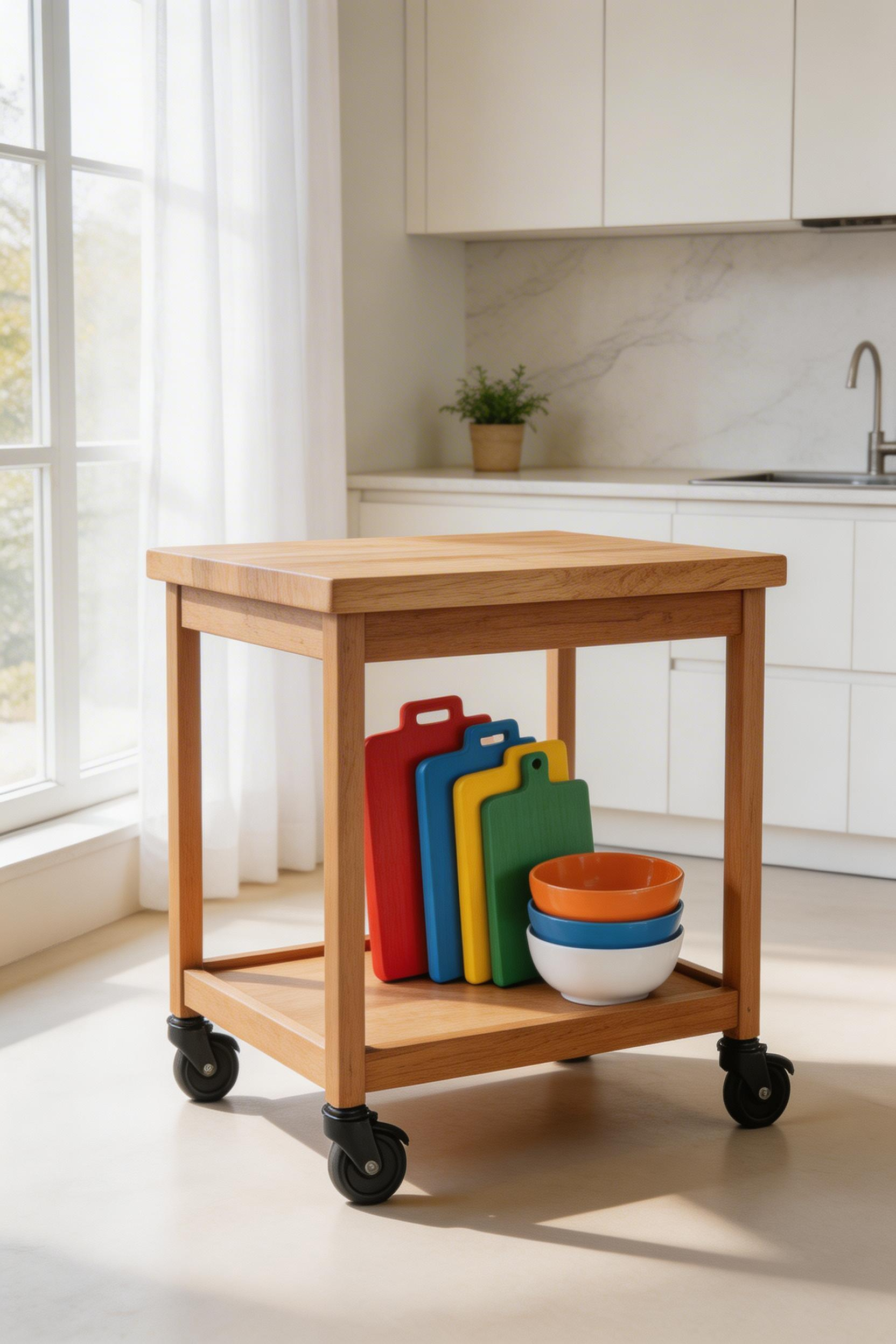
The countertop material is the first decision. Stainless steel handles heat up to 400°F and is the most hygienic option — it’s non-porous, so bacteria don’t harbour in the surface. Butcher block looks warmer and is more forgiving of dropped items. But it needs oiling every 3–6 months. It’s also not suited to placing hot pans directly on the surface. The John Boos Classic Butcher Block Cart ($850–$1,100) is the standard: solid maple or cherry, locking casters, lower shelves, and indefinite durability if maintained.
Caster Quality Is a Safety Issue
Lock all four casters when prepping — not just the two facing you. A cart that shifts under downward knife pressure is a genuine safety hazard. Most people lock the two visible front wheels and leave the back ones free. The whole unit then rotates slightly when you apply pressure. Four locks, all engaged, before you start work.
Budget carts from IKEA Förhöja ($130–$180) are a solid starting point for lighter loads. That covers daily prep, spice storage, and smaller appliances. For heavy pots or serious food prep, the frame quality difference between $130 and $400 is significant enough to spend more.
4. Wall-Mounted Pot Rack: Vertical Storage That Frees Cabinet Space
A wall-mounted pot rack recovers more cabinet space per dollar than almost anything else on this list. A full set of All-Clad pans weighs 40–60 lbs and occupies two entire base cabinet shelves. Hang them on a wall or ceiling rack and those shelves become available for everything else.
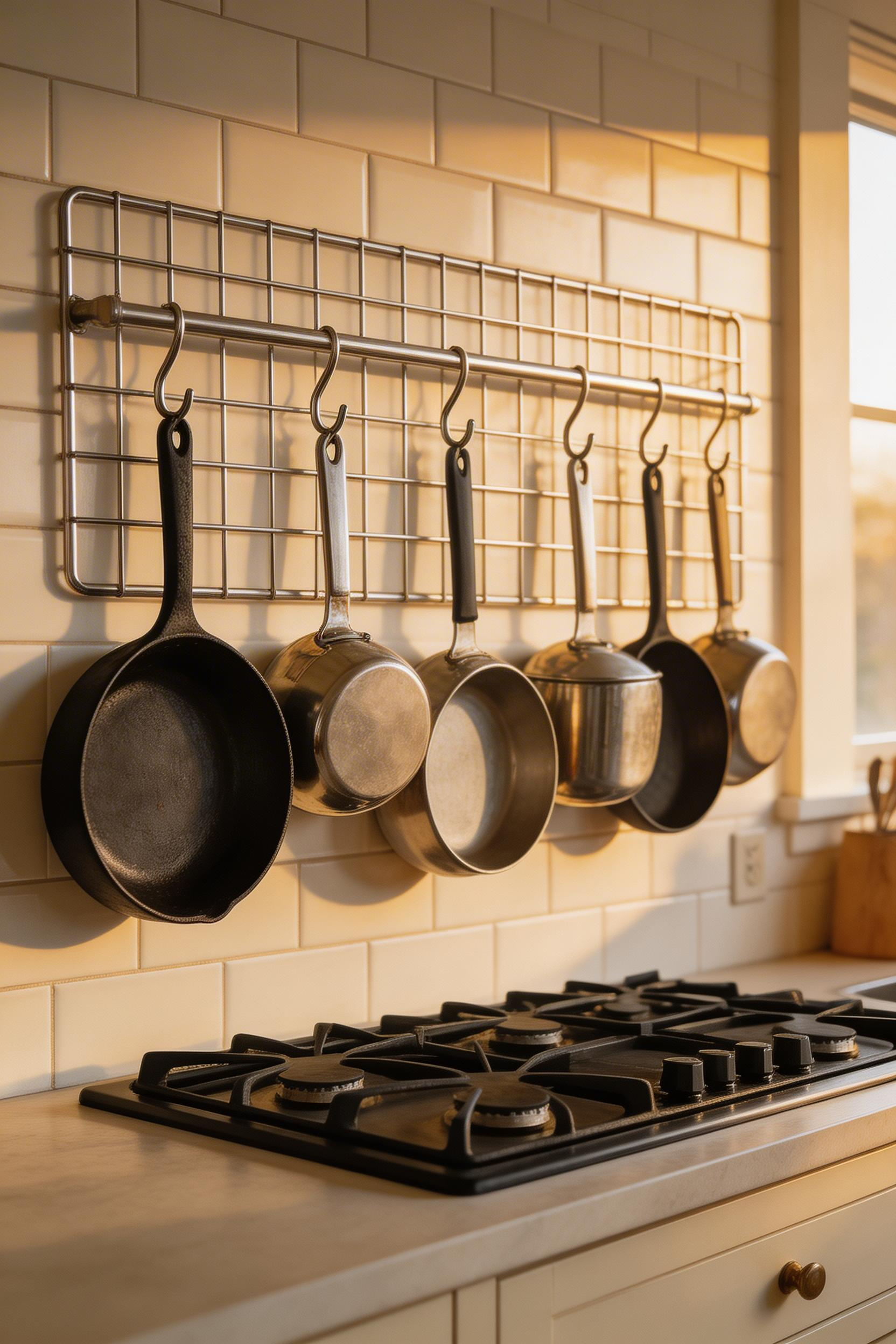
Clearance is the first thing to settle. Ceiling-mounted racks need 7 feet of clear height below them — measured from the rack, not from the ceiling. That ensures the tallest person in the household doesn’t catch a handle on the way past. For 8-foot ceilings, a ceiling rack positions pots at roughly 6 feet. That’s fine for most households. For anything lower, a wall-mounted grid is the safer choice.
Mounting Correctly Is Not Optional
Ceiling-mounted racks must anchor into ceiling joists or use toggle bolts rated for three times the combined load. A full set of cookware weighs 40–60 lbs, so the mounting hardware needs to comfortably exceed that. S-hooks rated at 10 lbs each are standard. The rack itself should list a total weight capacity of 50–100 lbs for a 4-foot rail. Stainless and wrought iron finishes are the most durable. Chrome peels in humid kitchen environments — not something you want to discover when it’s hanging above your stove.
The Enclume Premier Oval Ceiling Rack ($180–$280) is the entry-level benchmark for quality. The Old Dutch Wall-Mounted Grid ($90–$140) is the better-value option when wall mounting is more practical than ceiling work.
5. Under-Sink Pull-Out Cabinet: Kitchen Storage Furniture for a Wasted Zone
The cabinet under the kitchen sink is typically the most wasted space in the kitchen. The P-trap, supply lines, and garbage disposal eat up 30–60% of the interior. What remains is an awkward U-shaped void. Most people fill it with a jumble of cleaning products that fall over every time the door opens.
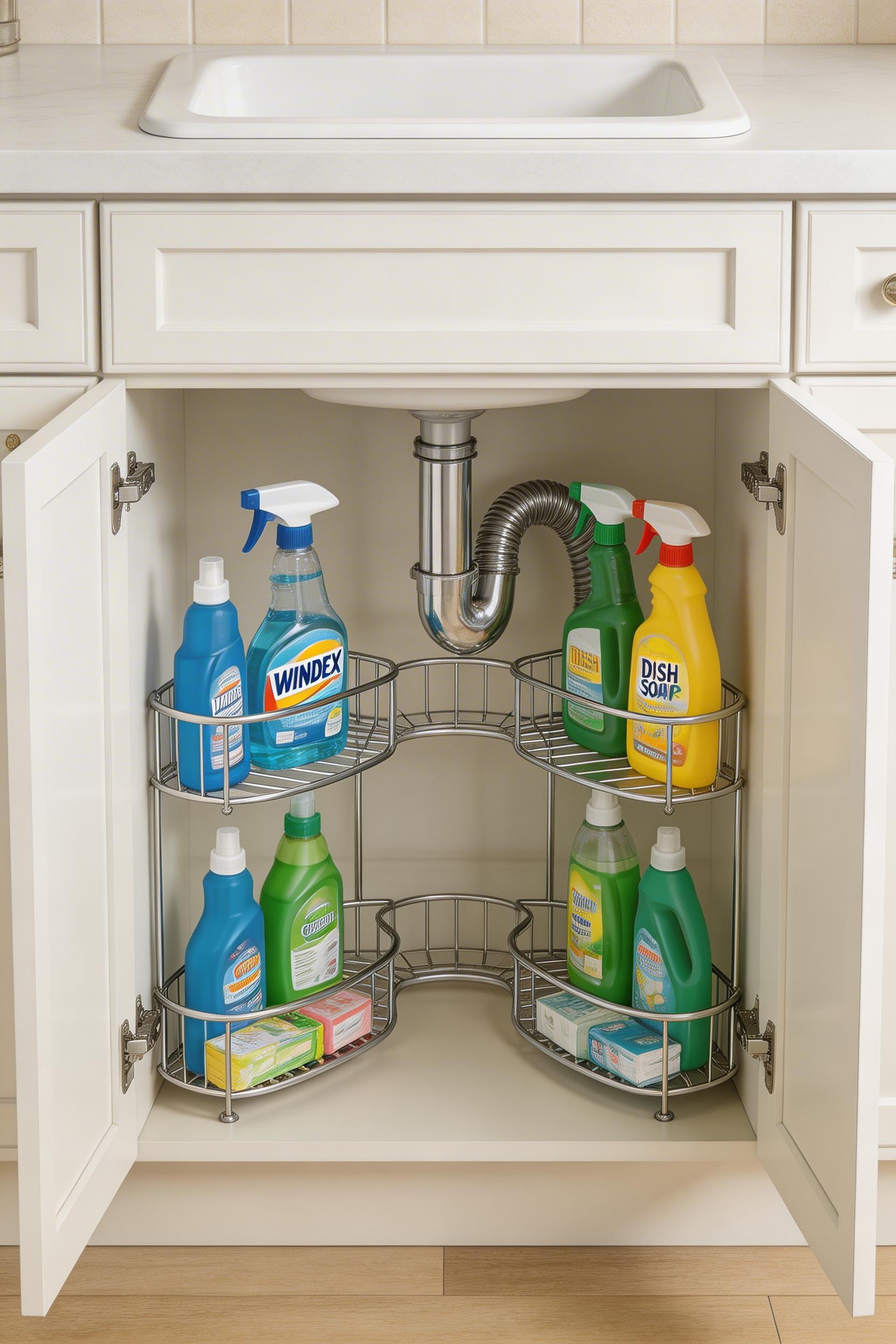
A purpose-built pull-out with a U-shaped cutout fits around the P-trap and restores usable space on both sides. The Rev-A-Shelf 447 series ($80–$120) is the contractor standard. It installs with a screwdriver in about 30 minutes, uses the correct cutout dimensions for standard P-trap configurations, and handles daily commercial kitchen use without issue. Two-tier sliding trays double the usable depth. They make the back 10 inches of the cabinet — usually completely inaccessible — fully reachable.
Kitchen Storage Material Matters in a Wet Zone
The under-sink area gets wet. Chipboard shelves delaminate within two years here. Cheap plastic trays grow mold in the corners. Wire or coated steel organisers resist moisture far better than wood-based materials. The simplehuman Under Sink Cabinet Organiser ($35–$60) is a no-installation option, good for renters who can’t drill. For permanent installation, the Rev-A-Shelf pull-out is worth the extra investment.
One measurement to take before ordering: P-trap height from the cabinet floor. Most U-cutout organisers assume the trap sits 6 inches from the floor. If yours is lower or angled differently, the organiser won’t clear it. Measure first, order second.
6. Corner Cabinet with Lazy Susan: The Fix for Dead Corner Space
A blind corner cabinet without any insert wastes 30–40% of its square footage. Items pushed to the back become functionally inaccessible. They become a rotation of guilt-inducing appliances you paid for but never use. The right insert turns a corner cabinet from dead storage into one of the most useful zones in the kitchen.
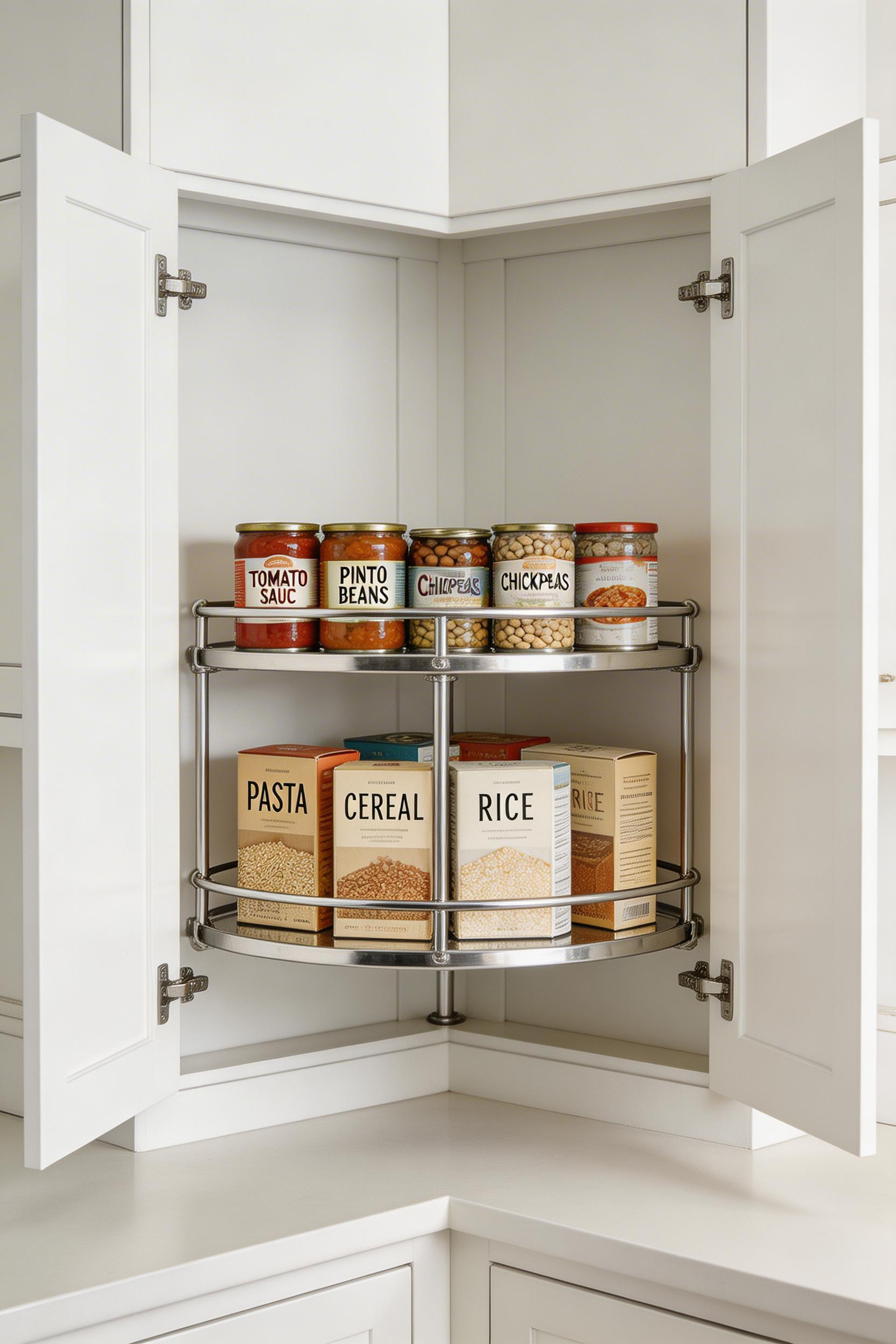
The cabinet opening determines which insert fits. Full-circle lazy susans need a 33-inch diagonal opening — that’s standard for most base corner cabinets. D-shaped (kidney-shaped) units work in tighter 24-inch openings. If neither type fits the specific geometry of your cabinet, a pull-out corner organiser like the Hafele Magic Corner ($280–$420) is the alternative. It pulls the back section of the cabinet forward, so you can see and reach everything without rotating anything.
Bearing Quality Is the Difference
The bearing at the centre of a lazy susan determines whether it lasts or fails. Injection-moulded plastic bearings develop wobble within 2–3 years. Steel ball-bearing units last a decade or more. The wobble isn’t just irritating — the tray starts scraping the cabinet interior, and eventually the mounting fails. The Rev-A-Shelf 5LS-2432 ($90–$130) uses a steel ball-bearing centre post. It’s the standard for retrofit installations in existing cabinets.
For more kitchen cabinet storage solutions beyond the corner, our breakdown of kitchen cabinet organizers covers a wider range of retrofit options.
7. Open Wall Shelving: Kitchen Storage Furniture That Shows What You Have
Open shelving as kitchen storage furniture gets debated endlessly. The criticism — that open shelves collect dust and look messy — is accurate if you fill them with random items and never edit. The counterpoint is also accurate: well-curated open shelving makes a kitchen feel more spacious than upper cabinets and gives instant visual access to everyday items.
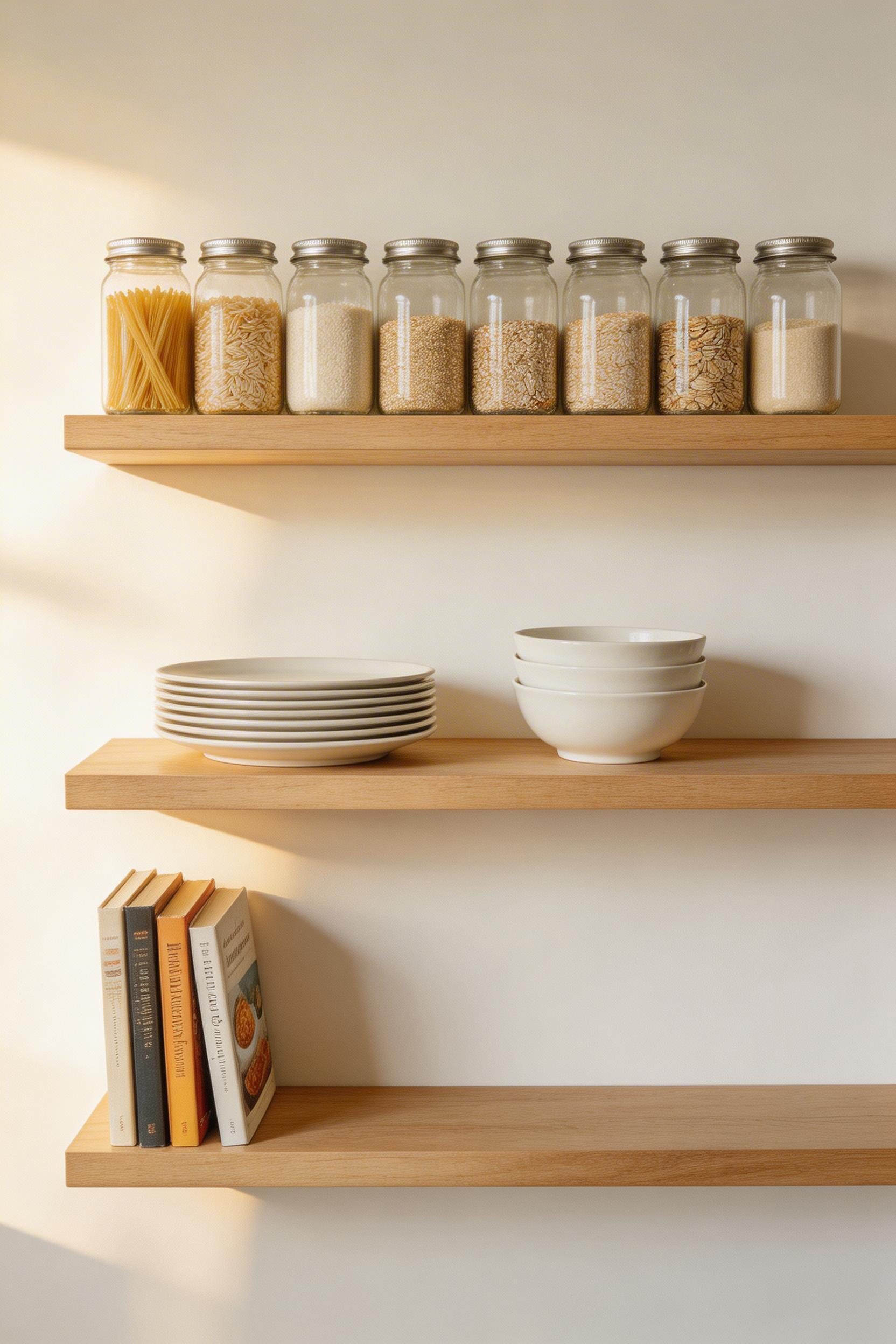
The structural spec is simple: brackets must anchor into wall studs for loads over 30 lbs. A shelf span of more than 36 inches without a centre support will bow under the weight of full jars and stacked dishes. For plaster walls where studs are difficult to find, toggle bolts rated at 50 lbs each are a workable alternative. But check the pull-out rating, not just the shear rating, before trusting them with heavy loads. For an organised approach to what to keep on open shelves, the wider principles in our kitchen storage ideas guide apply directly.
The Rule That Actually Makes Open Shelves Work
Store what you use daily on open shelves. Store everything else behind a door. This is less about aesthetics and more about function. Items used every day get put back in roughly the right place. Items used once a month tend to get set down wherever is convenient — and a shelf of occasionally used items is always mid-collapse into disorganisation.
Put the most-used items at lowest-reach height and the least-accessed at the top. It sounds obvious. But very few people actually organise this way — they arrange by size and end up bending down for the rice jar every morning.
8. Drawer Organiser Insert: The Highest-Return Upgrade in the Kitchen
The drawer organiser is the smallest piece of kitchen storage furniture on this list. It’s also, probably, the highest-return investment. A junk drawer full of loose cutlery and utensils costs fifteen seconds per retrieval. With a proper modular insert, the same drawer takes three seconds and stays that way.
The key word is modular. Fixed plastic trays lose their usefulness within six months as utensil collections change. A new set of salad servers here, a melon baller nobody asked for there — and suddenly the tray is overflowing. Expandable bamboo systems (OXO, Joseph Joseph, or generic bamboo sets) adapt to changing inventories. They also survive humidity in kitchens where cheap ABS plastic warps within two years.
Measure the Drawer Before Ordering
Interior drawer dimensions are 2–3 inches narrower than the exterior. The exterior is the measurement most people have in their heads. A 24-inch wide drawer typically has a 21-inch interior. Buy an organiser based on interior measurements and leave a 1-inch gap on each side for easy removal. Full-length utensils — wooden spoons, pasta forks, large spatulas — need at least 15 inches of depth. Most standard kitchen drawers are 21 inches deep, so that’s workable.
Knife storage should stay separate from the general organiser. Integrated knife slots in plastic trays dull blades faster than almost any other storage method. The blade sits in contact with plastic at an inconsistent angle every time it’s placed. A separate knife block or magnetic strip is the better long-term solution.
9. Over-the-Door Pantry Organiser: Kitchen Storage Furniture With Zero Installation
The over-the-door pantry organiser is the quickest win in kitchen storage furniture. No wall anchors. No tools. No permanent changes. Roughly 20–30 items of additional storage capacity in under five minutes. For renters, this is often the most accessible option available.
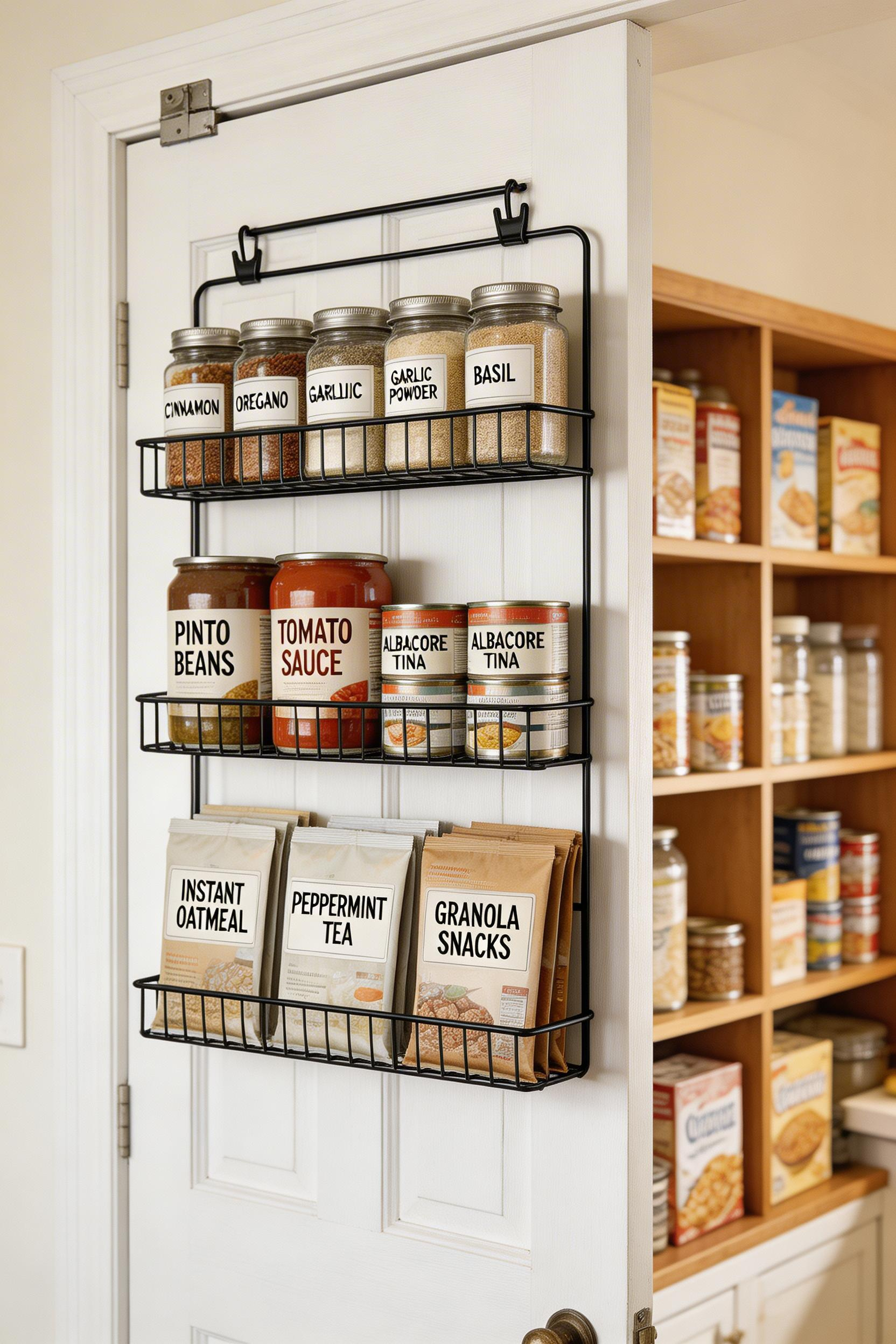
A 6-tier wire unit holds up to 60 lbs total — roughly 30–40 standard canned goods or 40+ spice jars. That’s the equivalent of 3–4 square feet of shelf space that didn’t exist before. The mDesign 8-tier rack ($35–$55) is the best-reviewed budget option. The Spectrum Diversified ($50–$80) is the contractor-grade version with heavier-gauge wire and more secure hook construction.
Check the Door Clearance First
The main failure mode with these units is a pantry door that won’t close properly after installation. Most over-door racks add 3–4 inches to the door’s swing depth. If the gap between the door and the adjacent cabinet or wall is less than that when the door is open, the rack will catch and the door won’t clear. Measure the gap before ordering — it takes thirty seconds and saves a return trip.
Door thickness is the other variable. Most racks fit doors up to 1.75 inches thick. Standard hollow-core interior doors are 1.375 inches, which fits comfortably. Older solid-core doors with thicker frames may not. Check the product spec sheet, not just the product title.
10. Pull-Out Drawer Retrofit: The Upgrade That Fixes What You Already Have
The pull-out drawer retrofit upgrades what you already have rather than adding something new. Converting fixed shelves in base cabinets to pull-out drawers increases rear cabinet accessibility by 40–50%. Items at the back of a shelf become fully reachable — instead of requiring you to remove everything in front of them first.
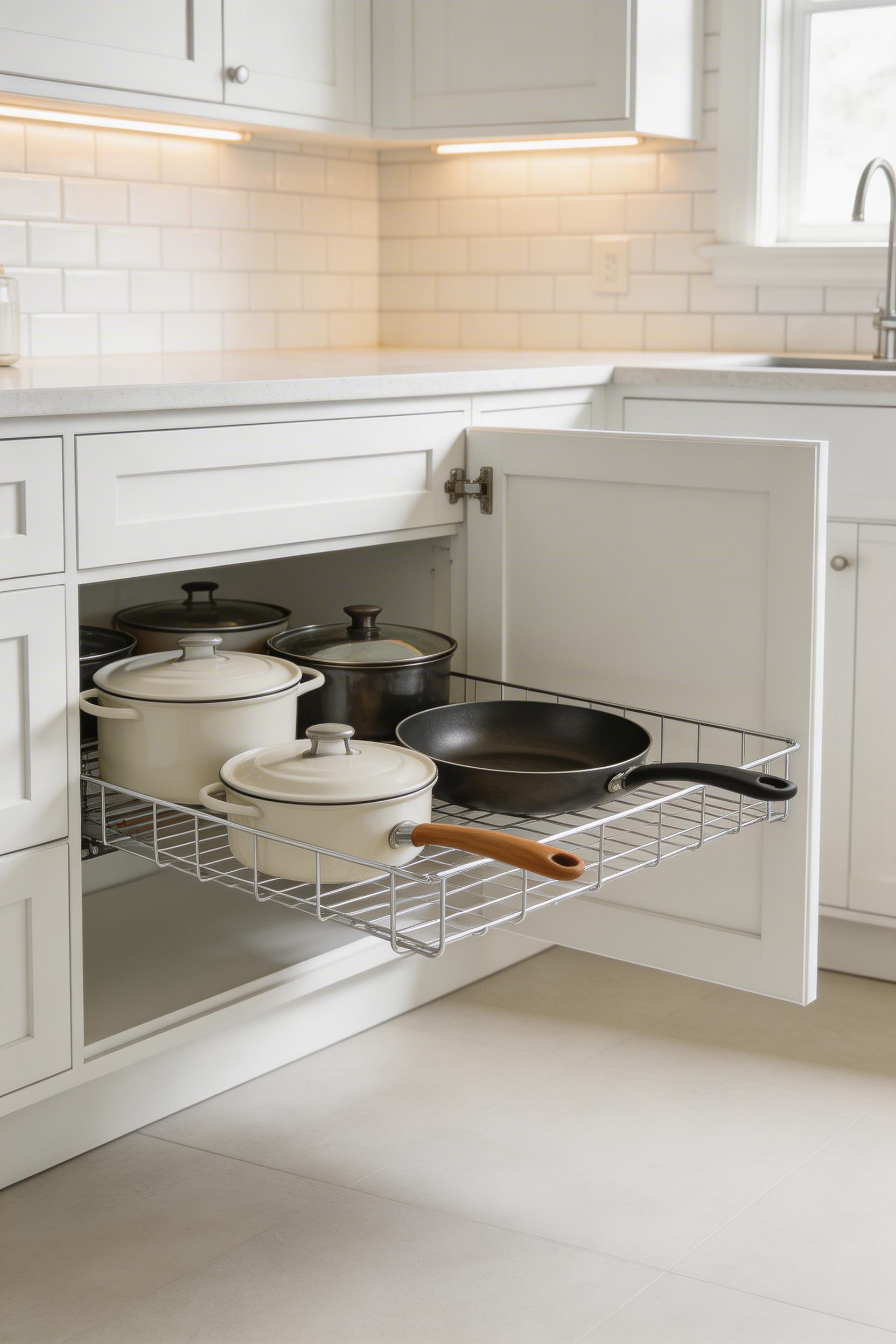
The Rev-A-Shelf 4WB series ($85–$140) is the go-to retrofit kit. It includes the wire basket, full-extension slides, and mounting hardware in one package. It installs in an existing cabinet in 2–4 hours. The wire basket sits on slides and pulls out to give full access to whatever’s stored at the back — no more kneeling on the floor and fishing around behind a colander. For general kitchen cabinet organisation beyond retrofits, kitchen storage and organizers covers the wider range of options.
Three Measurements Before You Order
Face frame opening width determines your drawer box width — not the interior cabinet width, which is wider. The drawer box must be 1 inch narrower than the face frame opening to clear the frame as it slides in and out. Cabinet depth determines slide length: slides must be 1 inch shorter than the interior depth.
Interior cabinet height is the third measurement people miss. If there’s a fixed shelf inside the cabinet, the drawer box can only be as tall as the space between that shelf and the cabinet floor. Take all three measurements, write them down, and check them against the product spec sheet before ordering.
11. Stackable Modular Shelving: Kitchen Storage Furniture That Grows With You
Stackable modular shelving is kitchen storage furniture for people who want to start small and build as the kitchen’s needs change. Unlike fixed cabinetry, modular units can be expanded, reconfigured, and, if necessary, moved to a different part of the house when the layout changes.
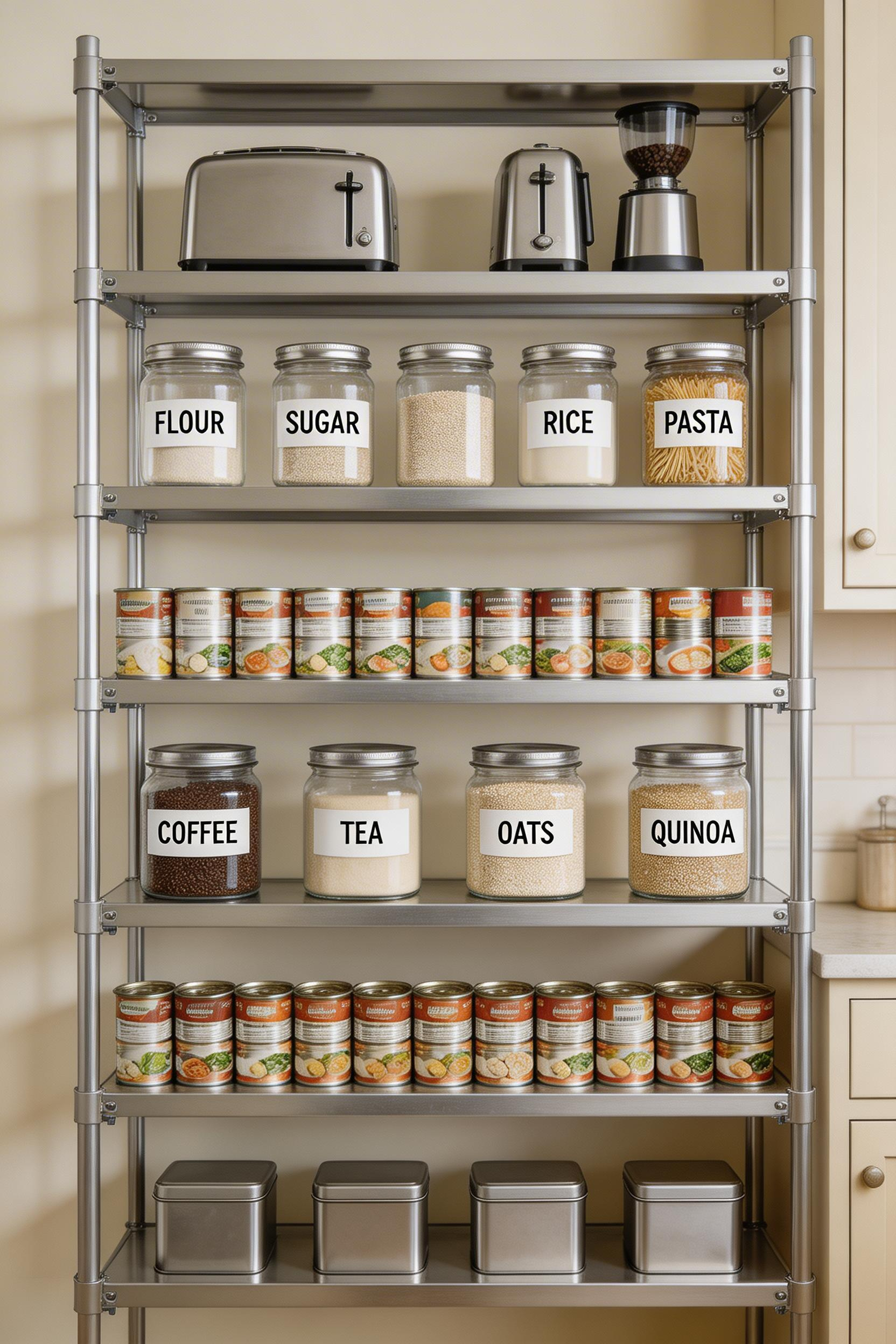
The IKEA OMAR shelving unit ($40–$100) is the standard choice: galvanised steel, 18-inch shelf depth, 77 inches tall, and easy to assemble without tools. The 18-inch depth is the minimum for kitchen pantry use — anything shallower and dinner plates hang off the front edge. The Seville Classics UltraDurable shelving ($60–$120) offers a sturdier steel frame with solid MDF shelves, rated at 1,500 lbs total capacity. That’s more than adequate for canned goods and appliances. For kitchen renovation context around where these fit, our kitchen renovation ideas article covers the broader picture.
Go Vertical to Maximise Kitchen Storage Space
The most common mistake with modular shelving is buying wide units when what the kitchen needs is height. Most kitchens have 18–24 inches of unused vertical space between the top of upper cabinets and the ceiling. That’s roughly 8 linear feet of additional storage if used correctly. A system with extension columns reaching 84 or 96 inches puts that dead space to work. The top section is ideal for seasonal items, holiday serving ware, and anything accessed fewer than six times per year.
Also buy the system with extension columns in the initial purchase rather than as afterthoughts. Mixing shelving lines from different manufacturers rarely works as cleanly as it looks in planning. Column heights rarely match.
12. Wall-Mounted Spice Rack: Dedicated Storage for Cooking Staples
A proper wall-mounted spice rack solves one of the most frustrating small-scale kitchen storage problems: finding the right spice in under five seconds. The average household has 40–50 spice jars. A single-tier rail holds 12–15. That arithmetic tells you most spice storage systems are inadequate from the start.
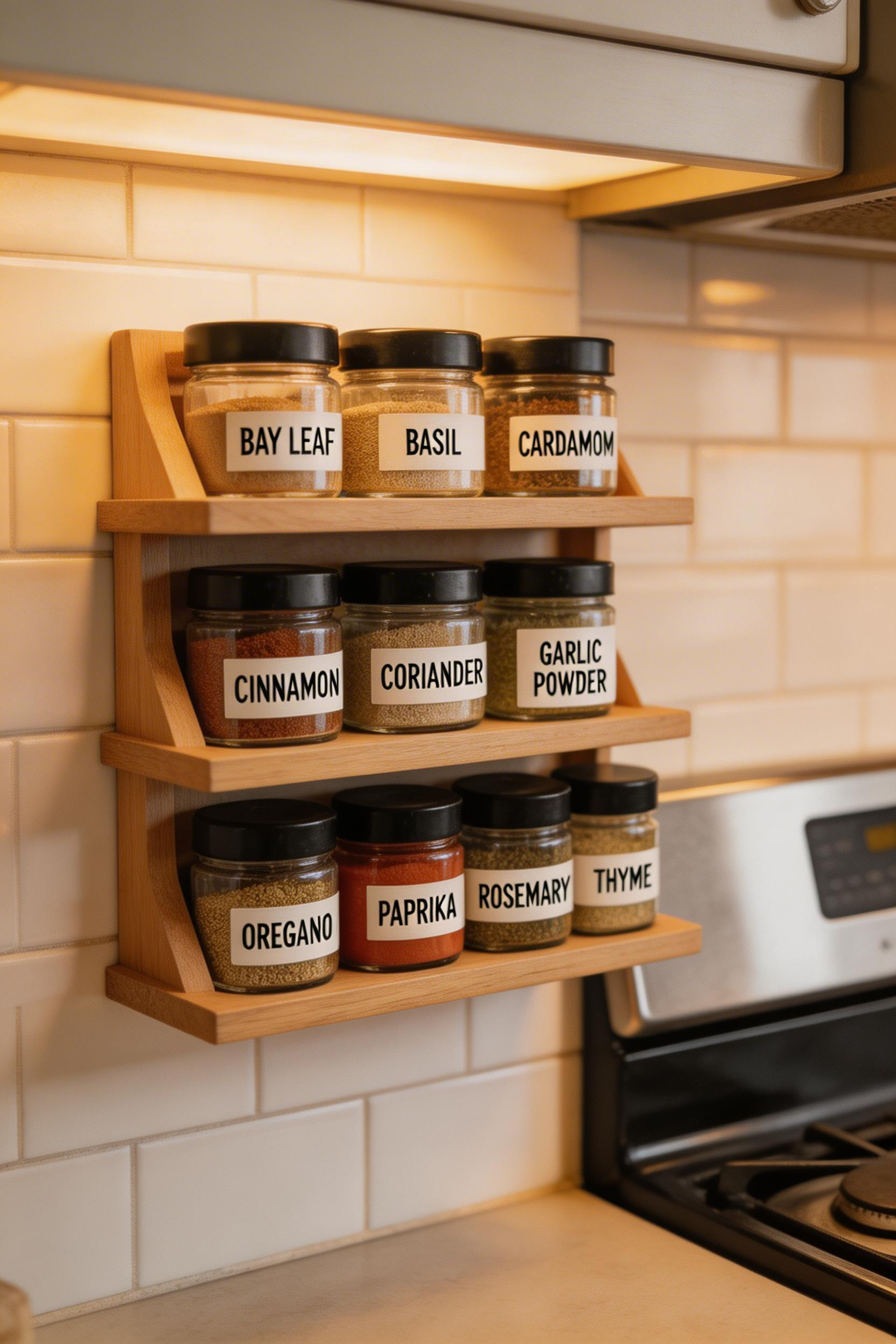
Magnetic spice systems look clean but limit jar capacity to 2 oz — too small for bulk spices or any full commercial jar. Rail-and-jar systems (IKEA GRUNDTAL, $25–$40) hold 4 oz jars and allow custom arrangement. They do require screwing into a wall stud or using an adhesive mount rated for the load. Tiered angled shelves are the most practical solution for standard spice jars. The 15–20 degree angle faces the label upward, so you can read the jar name without picking it up.
Distance from the Stove Matters
Don’t install spice storage directly above the stove. Steam and heat from cooking degrade spice potency faster than anything else. Even 12 inches to the side of the hob is significantly better than directly above it. Install at eye level for the primary cook — 48–54 inches from the floor — and within arm’s reach of the prep area. The Bambüsi 3-tier spice shelf ($35–$55) is a good option for this placement: angled shelves, bamboo construction, holds 30 jars.
13. Storage Bench: Hidden Kitchen Storage Furniture for Nooks and Banquettes
A storage bench turns wasted under-seat space into genuine kitchen storage furniture. In a kitchen with a breakfast nook or window seat, the bench is going to be built anyway. So specifying a lift-top version costs almost nothing extra relative to a solid bench.
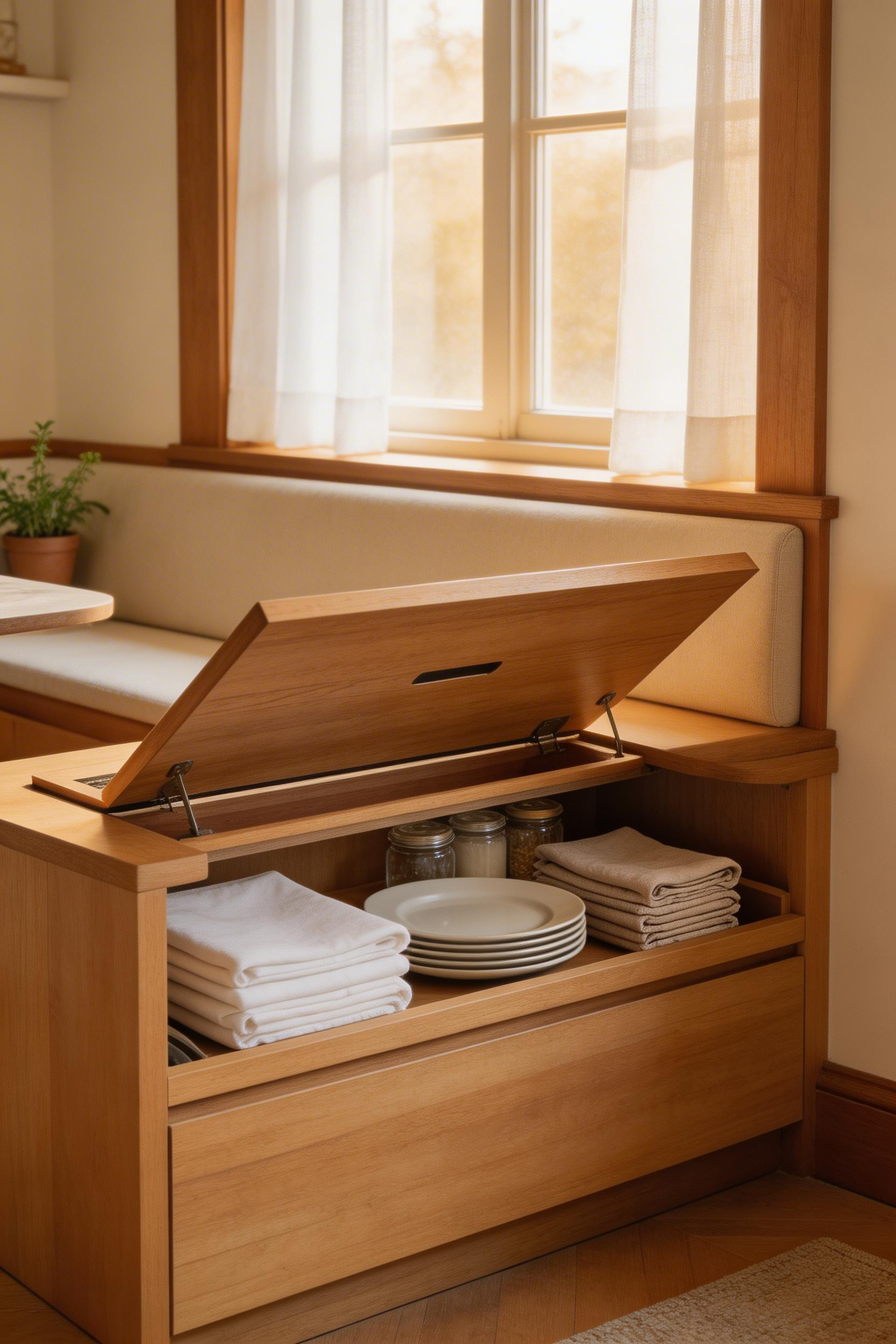
The interior cavity of a standard 42-inch bench is roughly 18×40 inches — 2.5 cubic feet, equivalent to a full base cabinet drawer set. Lift-top storage is ideal for items accessed once or twice a month: stand mixer attachments, holiday table linens, wine bottles, serving bowls. The IKEA HEMNES Storage Bench ($200–$280) is the standard for this application: solid pine, 44-inch width, lift-top lid, and a separately sold cushion.
Use Hydraulic Hinges
Standard piano hinges require you to hold the lid open with one hand while reaching in with the other. That’s awkward — and means you can only retrieve one item at a time. Hydraulic lift hinges ($20–$40 per pair) hold the lid open independently. You lift once. Both hands are then free. It’s a small detail, but it makes a real functional difference, particularly when retrieving heavy stand mixer bowls.
This piece of kitchen storage furniture works best as occasional storage, not daily-access storage. If you’re reaching in more than twice a week, the lift-top mechanism becomes a genuine annoyance. Daily-use items belong in drawers or pull-out cabinets.
14. Hutch or Buffet Cabinet: Freestanding Storage for Open-Plan Homes
The hutch bridges kitchen storage furniture and dining room furniture. In open-plan homes, that’s exactly what makes it useful: kitchen storage has to extend into the living space. A well-chosen hutch handles serving ware, small appliances, table linens, and everyday ceramics in a single piece of freestanding furniture.
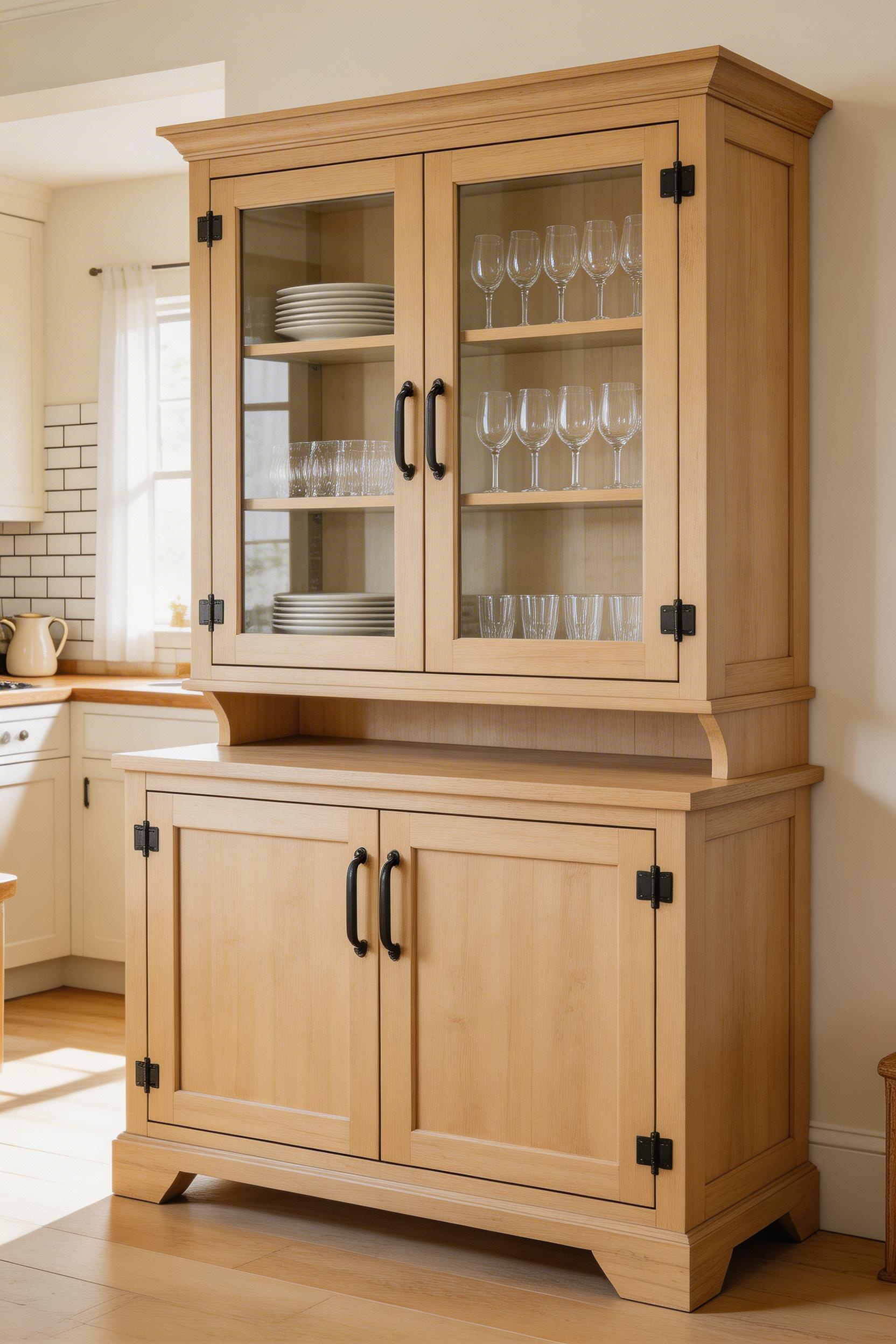
A standard hutch is 72–84 inches tall and 40–60 inches wide. It provides storage equivalent to 12–18 linear inches of kitchen cabinetry. The base unit — the buffet — functions as a serving surface at 33–36 inches, which is counter height. That matters if you’re planning to use the surface for a coffee station, a toaster, or any appliance that needs to be set down at standing height. For ideas on how the hutch fits into a complete kitchen furniture design, there are structural approaches worth reviewing before committing to a style.
Test the Shelves Before You Commit
Budget hutches are where MDF shelves most commonly fail. Two full place settings of ceramic plates, a stack of bowls, and a cast iron Dutch oven can bow a 3/4-inch MDF shelf visibly within six months. Solid wood or plywood shelves are the only materials worth putting heavy kitchen items on. Before purchasing, load the display model if possible. At minimum, check whether the shelf substrate is MDF, particleboard, or solid wood in the product description.
Glass door hinges are the second failure point on cheaper hutches. Wire hinges on budget units fail in 2–3 years. Concealed cup hinges are far more durable and allow door alignment adjustment when they inevitably drift.
15. Under-Counter Drink Station: Specialised Storage for Entertainers
A dedicated drink station built into the kitchen footprint serves a specific purpose well — or not at all. It depends entirely on how much you actually entertain. The under-counter wine fridge earns its place when you’re rotating through 20+ bottles regularly and entertaining at least twice a month. Otherwise, the $300 and the 24 inches of base cabinet space serve the kitchen better as standard kitchen storage furniture.
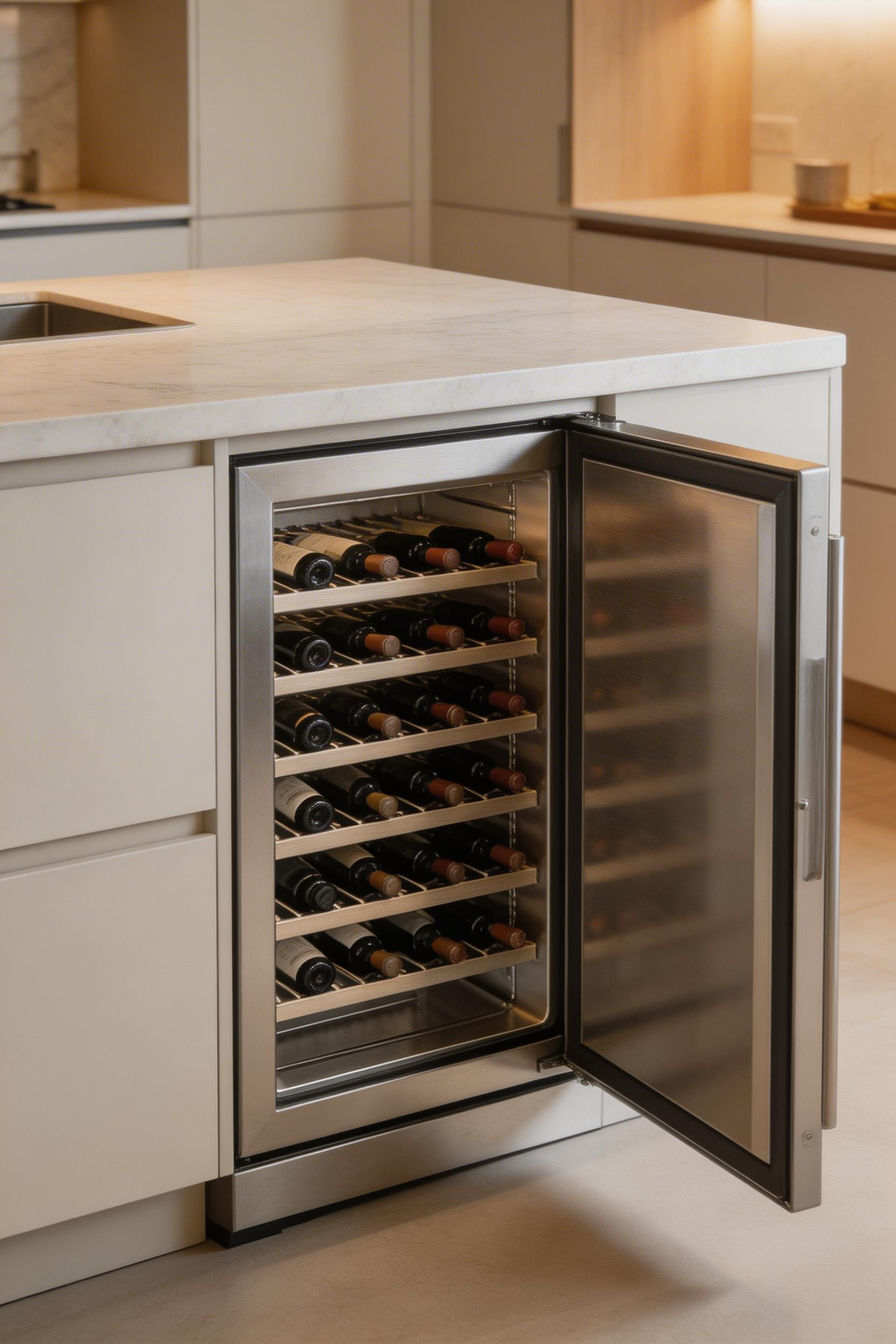
When it does make sense, a front-venting built-in unit is the right choice over a freestanding model. Front-venting fridges require zero side clearance. They fit into a standard 24-inch wide base cabinet cutout without modification. The Edgestar 26-Bottle Built-In ($250–$350) is the entry-level option: dual-zone, quiet compressor, stainless door. The Kalamera 30-Bottle ($220–$300) offers similar performance at a slightly lower price point. Both maintain 45°F for whites and 55°F for reds.
The Non-Refrigerated Alternative
If temperature control isn’t necessary — ambient storage for a small rotating selection, or a spirits and mixers station — an IKEA KALLAX unit ($80–$150) used under the counter is a quieter, lower-maintenance option. The 7-inch square cubes are sized for wine bottles. The unit can be configured horizontally to fit a base cabinet height. This works well for a kitchen drink station where organisation matters more than refrigeration.
Finding the Right Kitchen Storage Furniture for Your Kitchen
The fifteen pieces in this list cover the full range — from a $15 drawer insert to a $1,000 island. But the right starting point isn’t budget. It’s the specific problem your kitchen actually has.
If counters are overloaded, a freestanding pantry cabinet or a wall-mounted pot rack addresses that directly. If cabinets are stuffed and inaccessible, pull-out retrofits and corner inserts recover significant space without replacing anything. If the kitchen simply lacks room for everything, modular shelving, over-door racks, and rolling carts add capacity without permanent changes.
The mistake most people make with kitchen storage furniture is buying the most attractive piece rather than the most useful one. A beautiful hutch doesn’t help if the real problem is that the pots have nowhere to go. Work backwards from the friction point — the place where the kitchen breaks down every morning — and choose the piece that solves that specific problem. Then move to the next one.
For most kitchens, I’d prioritise in this order: pull-out retrofits or under-sink organisers for the cabinets you already have, then a freestanding pantry or modular shelving for expanded capacity, then a pot rack or spice storage to clear the surfaces. Fix what’s broken before adding something new.