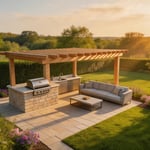
When exploring high-end patio decorating ideas, many homeowners assume that creating a beautiful space is strictly visual. They prioritize color palettes and stylish silhouettes above all else. But a truly exceptional outdoor space must also engage the sense of touch. In fact, psychologists note that “tactile diversity” helps induce mindfulness. Therefore, successful design requires a deep understanding of materials to achieve true architectural harmony.
Consider the physics of physical comfort. Terracotta flooring, for example, functions as a natural “thermal battery.” It absorbs solar heat to provide radiant warmth long after the sun sets. Linen upholstery, however, uses a unique hollow-fiber structure called the *lumen*. This microscopic architecture allows the fabric to dissipate body heat rapidly. Pairing these materials creates a balanced micro-climate for the body.
The texture of your furniture also tells a story of time. We will examine how UV rays break down teak’s lignin to reveal a silvery grain. Next, we contrast this organic roughness with the sleekness of powder-coated aluminum. This intentional friction between the industrial and the artisanal prevents a space from feeling sterile. Indeed, this guide reveals how to layer these elements effectively. By weaving these textures together, you build a narrative that engages the hand as much as the eye.
The Philosophy of Materiality: Why ‘Outdoor Living’ Demands Texture Over Color
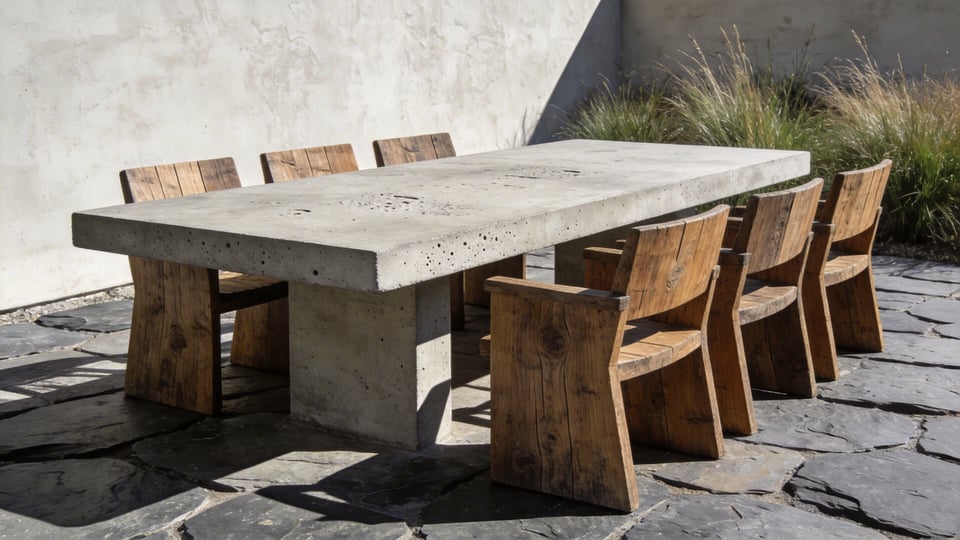
True outdoor design moves beyond merely matching color swatches. Instead, it acts as a choreography of experience. This philosophy rejects superficial “eye-candy” in favor of visceral texture. We call this concept “Material Honesty.” A raw concrete table, for instance, celebrates the actual labor of its build. The visible grain creates a sense of stability that synthetic paints simply lack.
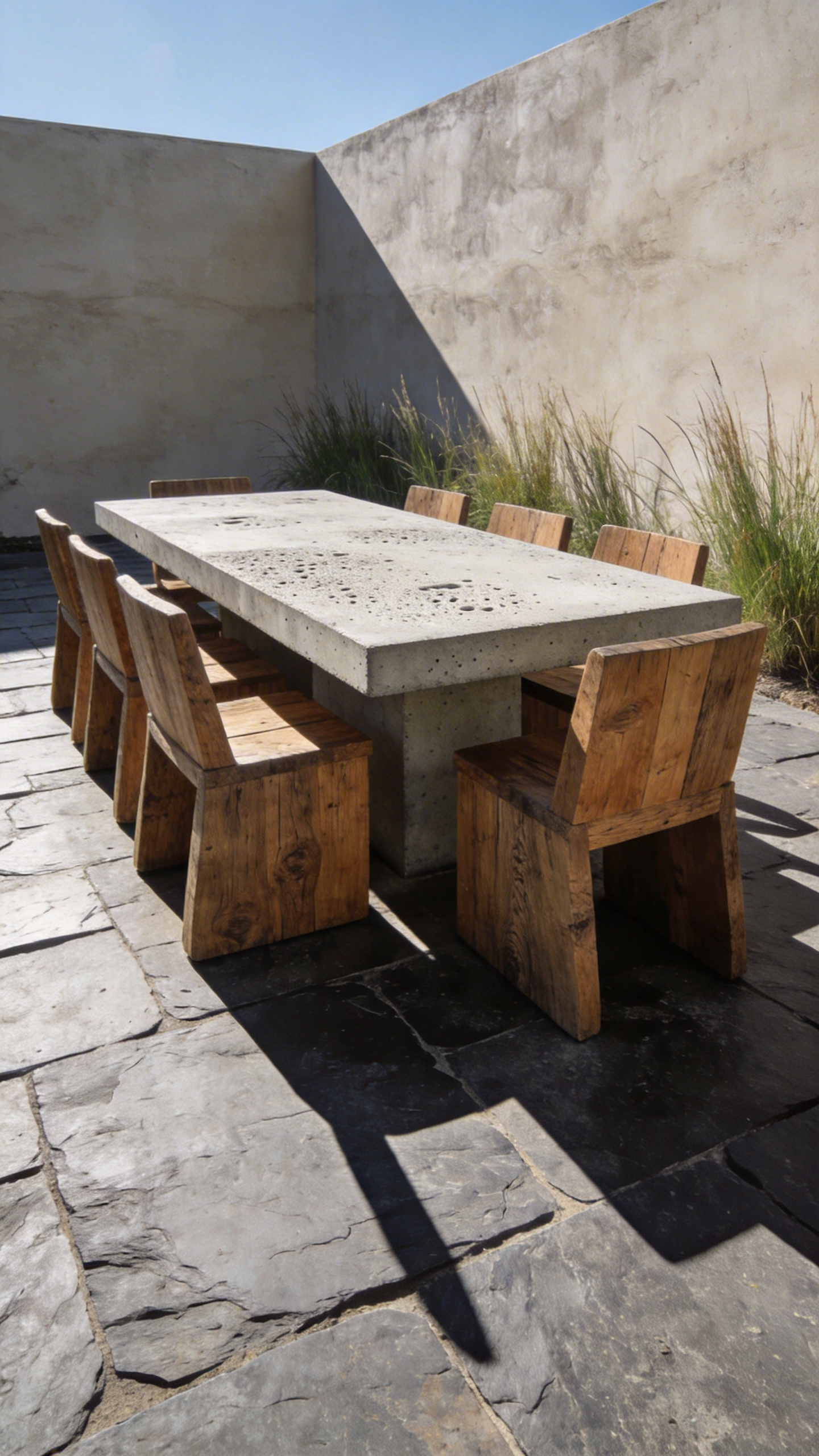
The harsh nature of outdoor light necessitates this approach. High-noon sun often washes out vibrant pigments, making them look flat. Direct light, however, is the best friend to texture. It casts deep shadows into the crevices of a stacked-stone wall. A textural patio functions almost like a sundial, changing its visual pattern every hour.
Additionally, we must consider the passage of time. While color remains static and prone to fading, texture improves with age. In design, we refer to this as patina. A cedar deck silvers beautifully over the years. Thus, the decoration becomes the passage of time itself rather than a fleeting pigment.
This approach engages what theorists call the “eyes of the skin.” Humans instinctively trust the physical weight of stone over the look of plastic. These tactile layers transform a patio from a display area into a genuine sanctuary.
1. The Ground Plane Narrative: Pairing Cool Travertine Pavers with Warm Composite Decking for Zonal Definition
The “ground plane narrative” transforms flooring into a functional map. Pairing cool travertine pavers with warm composite decking creates intuitive zones without walls. Travertine serves as a heavy visual anchor. Its pitted texture implies geological permanence. Therefore, it acts as a solid foundation for open-air gathering plazas. Composite decking, on the other hand, introduces a linear grain. This pattern guides the eye, creating a “bridge” similar to those found in 20 Brilliant Deck Design Ideas to Transform Your Outdoors.
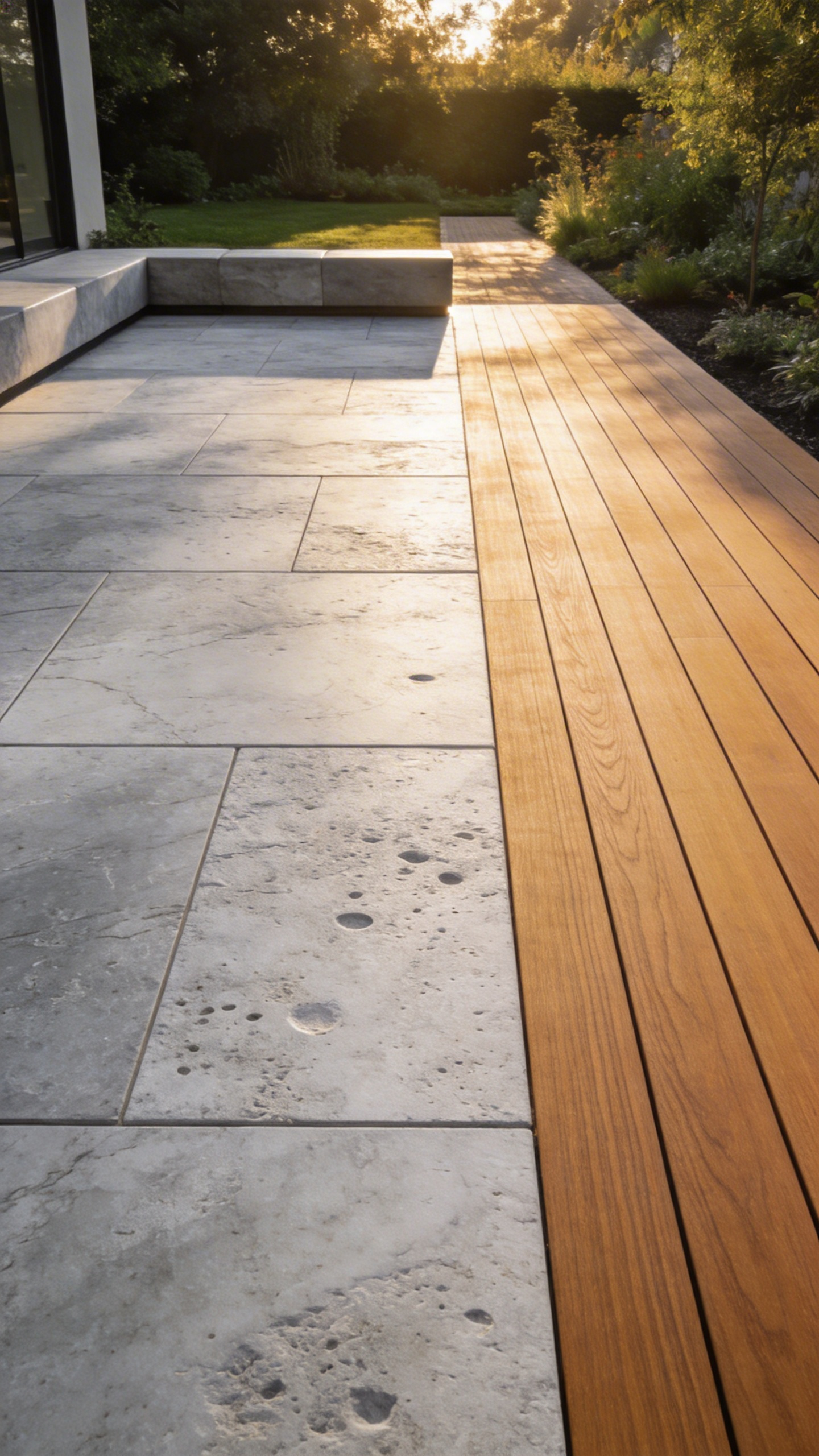
Beyond aesthetics, this combination manages thermal comfort. Travertine is often called the “barefoot stone.” Its unique internal architecture allows for evaporative cooling. As a result, the surface remains cooler than concrete. It is ideal for sun-drenched wet zones. In contrast, composite decking retains warmth naturally. This makes it better suited for shaded retreats or covered pergolas.
The transition also creates a sensory shift. Walking on stone produces a sharp click. Stepping onto decking, however, shifts the sound to a softer thud. This acoustic change signals a move from a public space to a domestic one. Historically, this mirrors the “zero-threshold” transition of Mid-Century Modernism. Installers often use a “picture frame” border to achieve this. Ultimately, these materials stitch the home’s architecture directly into the landscape.
2. Raw Meets Refined: Juxtaposing Rough-Cut Fieldstone Walls with Sleek Architectural Glazing
The juxtaposition of rough-cut fieldstone and sleek glazing creates a sophisticated dialogue. This pairing balances permanence with transparency. It relies on the psychological principle of “prospect and refuge.” Fieldstone offers a visual “thud,” providing a sense of grounding. Glass, conversely, acts as an ethereal membrane. It offers an unobstructed view of the horizon.
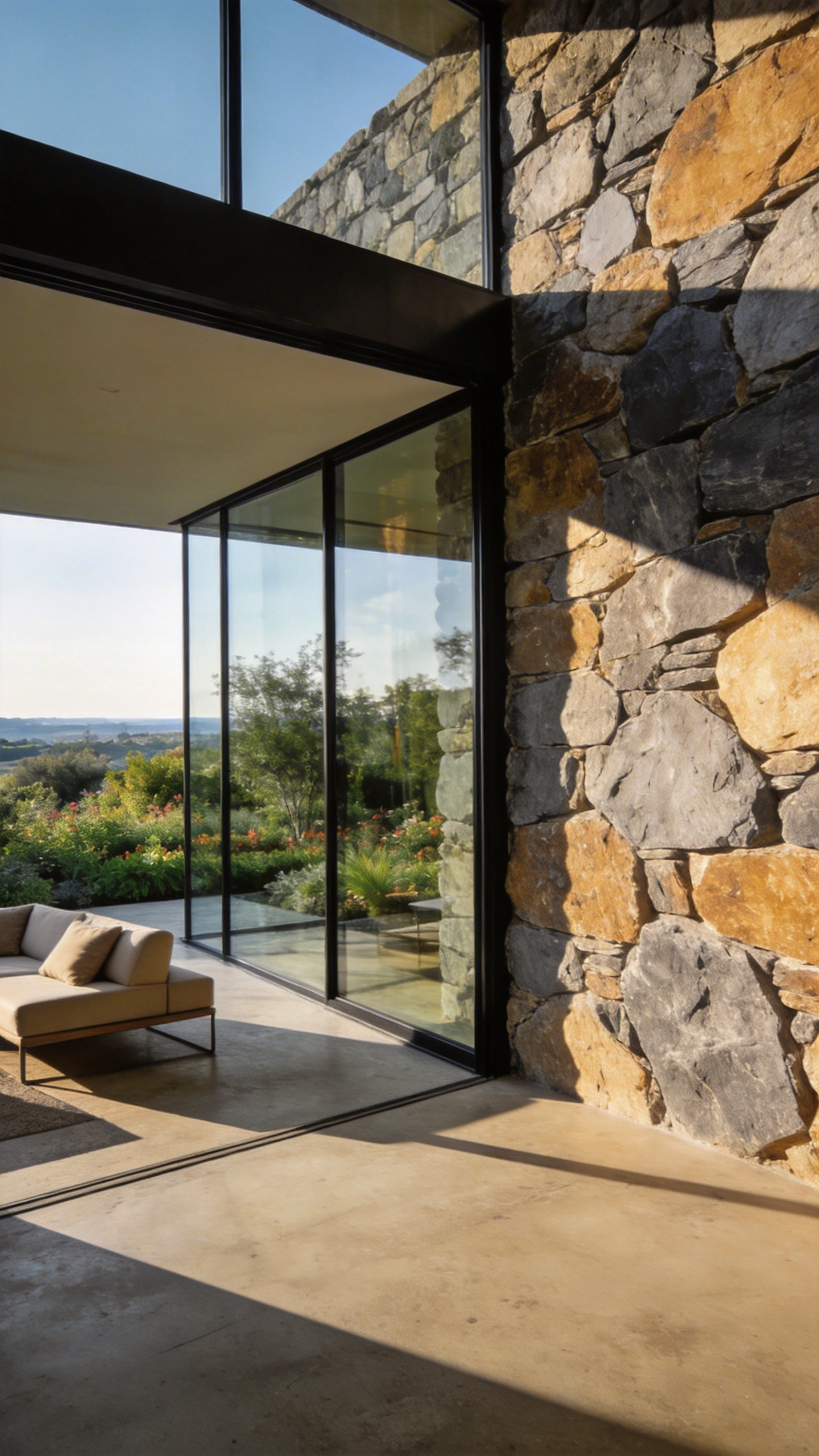
The artistry lies in the “impossible interface” where these materials meet. Stone is irregular, yet glass is rigid. Builders must use a process called scribing to join them. Consequently, the glass appears to grow directly out of the stone crevices. Sometimes, designers introduce blackened steel as a mediator to soften this transition.
Interaction with light transforms the patio throughout the day. The rough stone catches sunlight, creating dramatic shadows. Simultaneously, the sleek glazing reflects the garden, pulling greenery into the living space. This approach signals a shift toward “Wilder Modernism.” It satisfies the human need for nature while maintaining refined comfort.
3. The Patina Principle: Investing in Living Materials (Copper, Corten Steel, and Teak) That Evolve Over Time
The “Patina Principle” offers a sophisticated alternative to the perpetual newness of plastics. This philosophy champions materials that use weathering as a defense. Unlike standard rust, the oxidation on copper and Corten steel creates “living armor.” Copper reacts with moisture to form a stable verdigris shield. Similarly, Corten steel generates a dense skin containing chromium and nickel. This oxidized layer matures into a texture akin to heavy velvet.
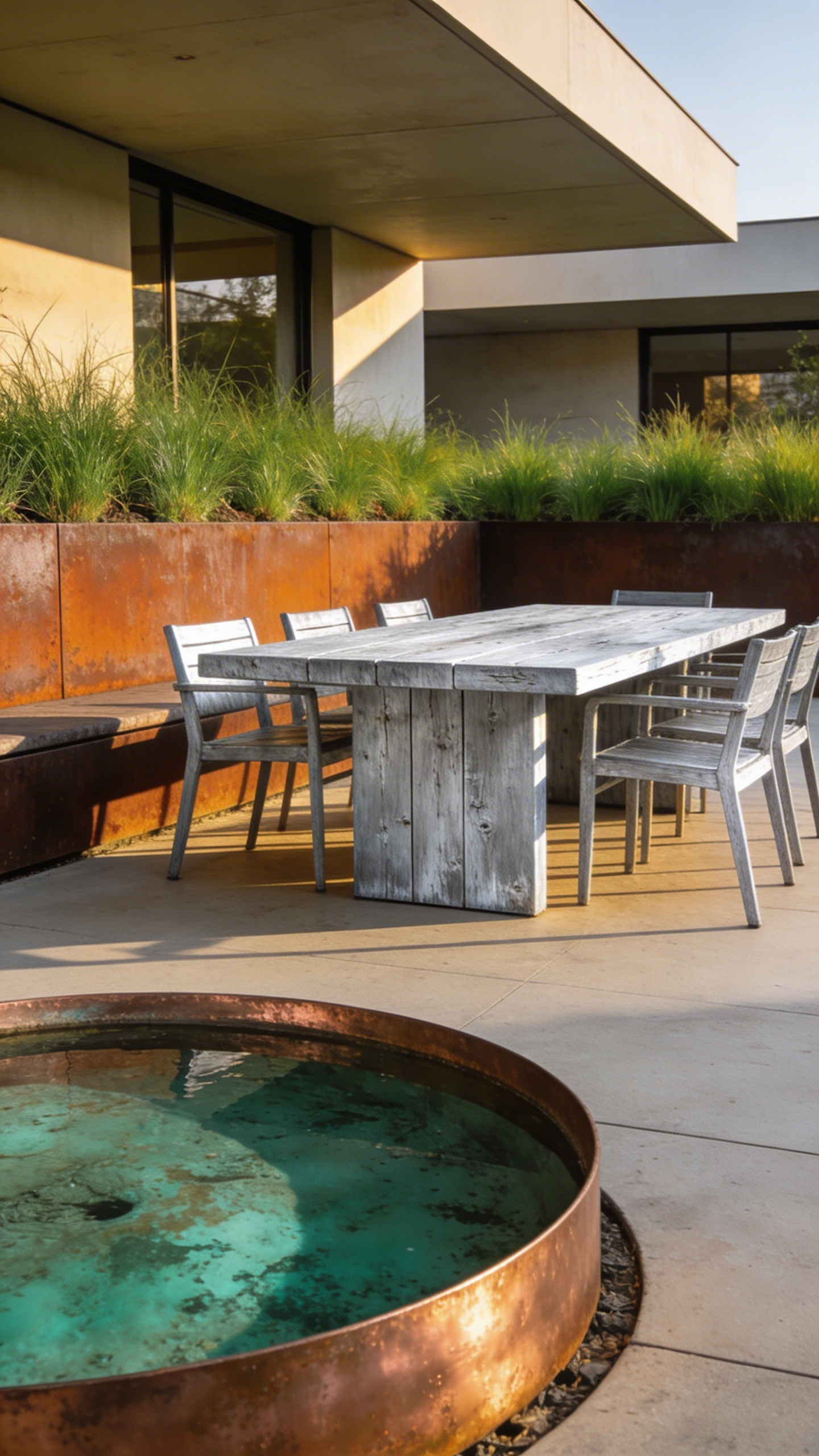
These living materials engage the senses through unique physical properties. Patinated surfaces interact dynamically with light, creating a depth that flat paint cannot replicate. Organic materials like teak also offer superior thermal comfort. While synthetic chairs scorch in the sun, teak maintains a neutral temperature. Visually, the wood transitions from honey-gold to a silvery hue. Selecting these materials is an investment in a narrative. You are effectively choosing “honest materials” that reveal their true nature over time.
4. Vertical Rhythm: Installing Slatted Timber Privacy Screens to Filter Light and Create Enclosure
Installing slatted timber screens is an exercise in architectural syncopation. These vertical lines manipulate the eye to expand the space. Specifically, the upward rhythm forces the gaze skyward. This mimics a forest’s natural verticality. Confined urban patios immediately feel taller and less claustrophobic. Moreover, the repetitive spacing reduces visual fatigue. It replaces solid walls with a calming cadence.
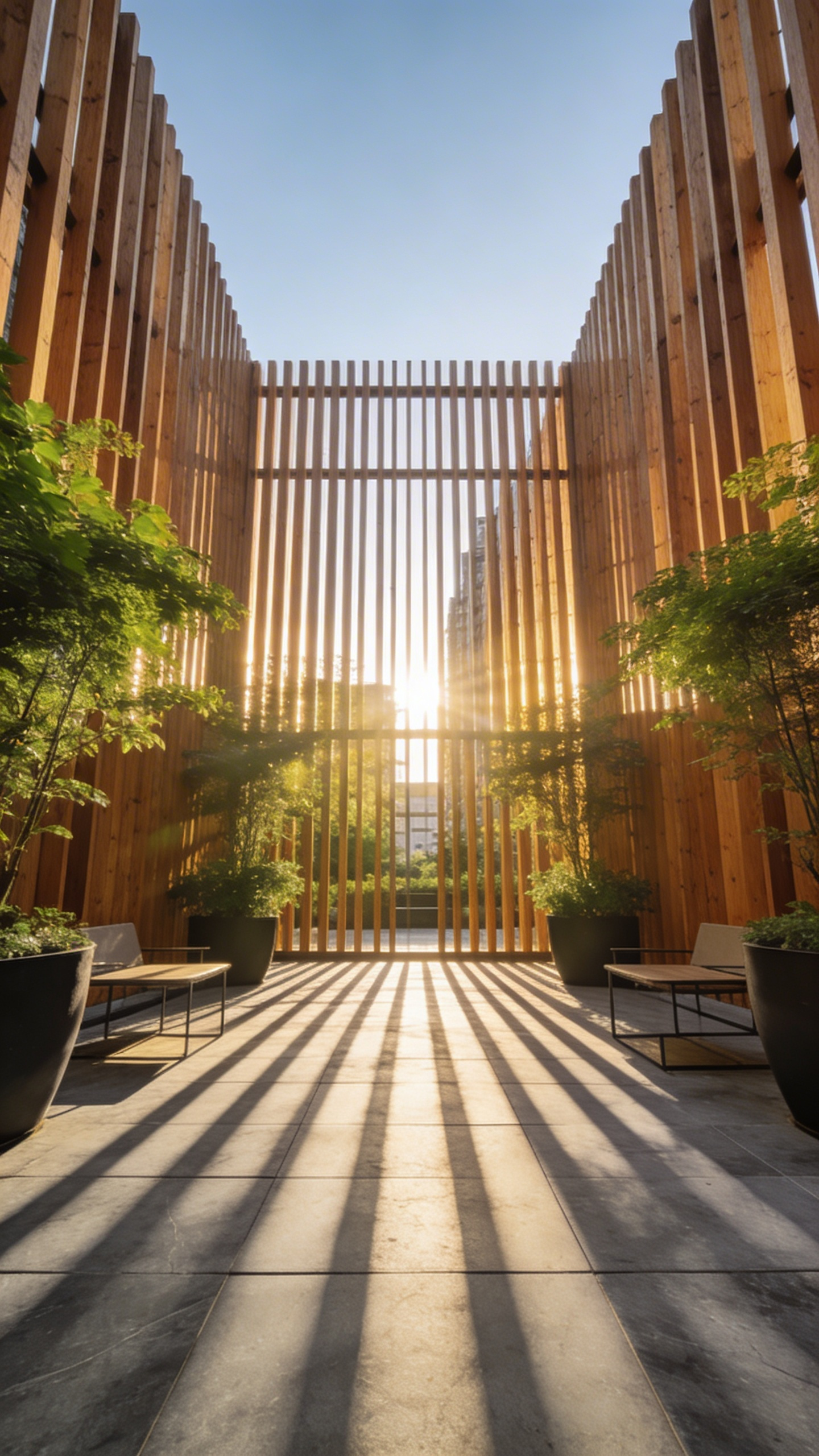
These screens masterfully filter light. Environmental psychologists call the effect “dappled light.” The sun filters through the slats, activating a state of “soft fascination.” Simultaneously, the timber absorbs heat while allowing air to escape. As a result, the patio remains cooler through passive airflow. Shifting shadows paint the floor with a moving tapestry, turning the surface into living decor.
The technical spacing determines the level of intimacy. Ideally, a “balanced tempo” uses 20mm to 30mm gaps between slats. Thus, you achieve visual enclosure while maintaining airflow. This balance satisfies our evolutionary need for “refuge.” You feel secure, yet connected to the breeze. The screen functions as a sophisticated filter rather than a barrier.
5. The ‘Invisible Threshold’: Matching Indoor Flooring Tones to Outdoor Hardscaping for Seamless Flow
The “Invisible Threshold” is a sophisticated evolution, not a fleeting trend. It seeks to eliminate the cognitive friction between interiors and the landscape. Achieving this flow requires engineering. Specifically, the goal is a “Zero-G” sightline. Modern design replaces raised barriers with flush drainage systems that sit level with the floor.
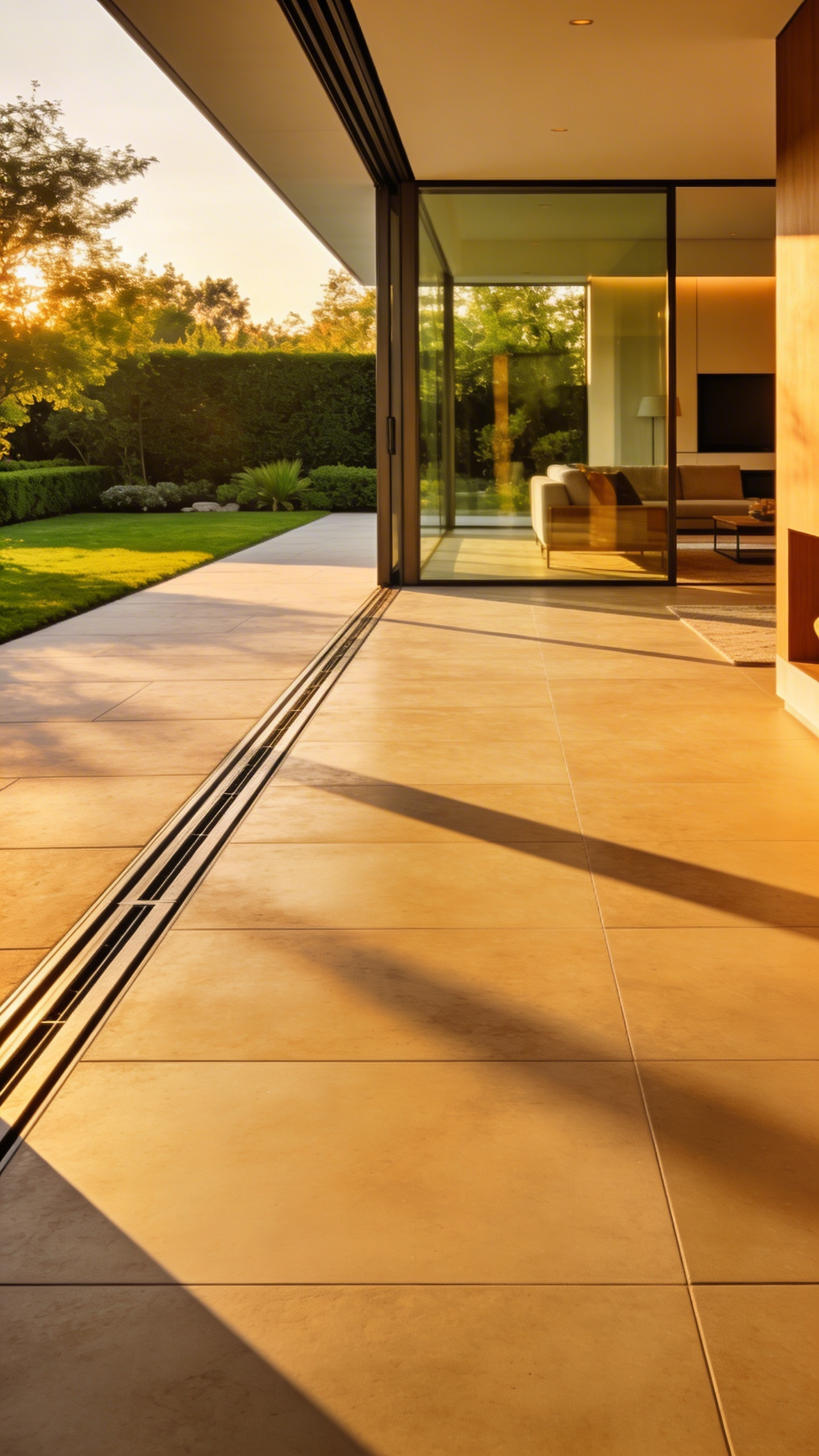
Visual continuity requires optical alchemy. You typically cannot use the exact same tile indoors and out. Outdoor surfaces demand higher slip resistance, usually rated R11. Indoor surfaces utilize smoother R9 finishes. To bridge this gap, manufacturers offer “matching-veined” porcelain. Consequently, the visual pattern remains identical despite the textural difference. Designers must also consider Light Reflectance Value (LRV). Direct UV exposure alters perception, so materials must maintain consistent visual weight.
Psychologically, this mirrors the Japanese *Engawa*, or “liminal space.” By extending the floor plane, the brain perceives greater expansiveness. In fact, this continuity lowers cortisol levels. To execute this properly, precision is paramount. Grout lines must align perfectly through the glass. Unlike limestone, porcelain resists weathering, ensuring the transition remains seamless. Ultimately, the floor becomes a neutral void, allowing nature to take center stage.
6. Mixed-Media Furniture Silhouettes: Anchoring Cast Concrete Tables with Airy Woven Cord Seating
This design trend creates visual tension through “Soft Brutalism.” Cast concrete tables act as the architectural “root” of a patio. Their mass provides a psychological sense of stability. Woven cord chairs, however, introduce necessary transparency. The negative space between the cords allows the eye to travel freely. This prevents the space from feeling overcrowded.
Material science plays a pivotal role here. When selecting seating, consider these 18 Inviting Porch Furniture Pieces to Transform Your Outdoors that prioritize durability. Manufacturers now utilize Glass Fiber Reinforced Concrete (GFRC) rather than heavy cement. Tables feature thinner, sculptural silhouettes that resist cracking. To complement this, modern seating uses solution-dyed Polyolefins. These fibers mimic the warm feel of paper cord but withstand moisture.
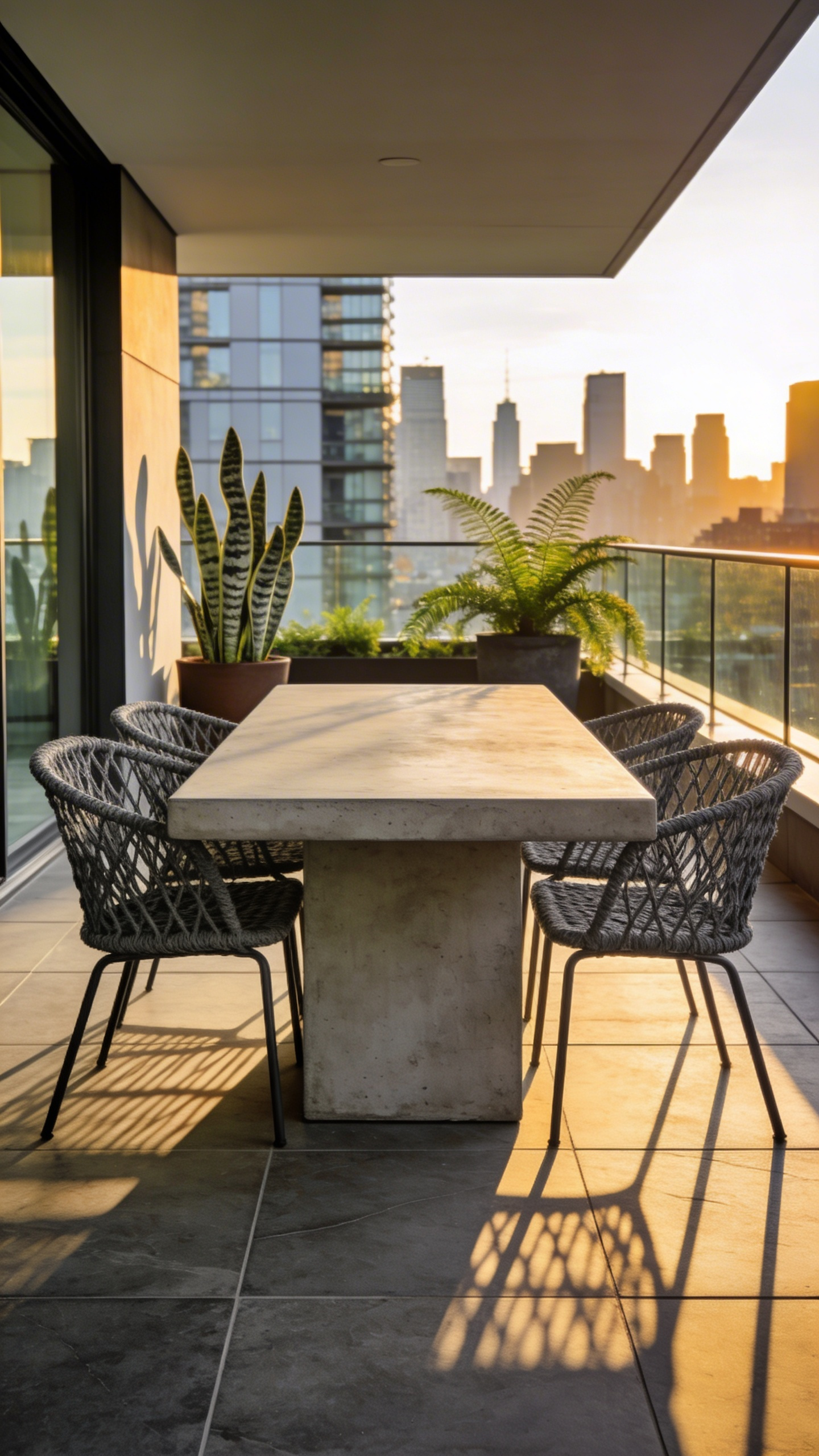
This pairing creates a dynamic sensory environment. The cool, smooth surface of sealed concrete contrasts against the warm, flexible seat. The open weave allows for passive airflow, keeping diners cool. Visually, sunlight filters through the chair patterns to cast moving shadows onto the concrete. To execute this look, pay attention to undertones. Concrete often carries blue or beige hues; select cord colors that match these warmth levels. This mix balances industrial strength with biophilic comfort.
7. The Metallic Accent: Introducing Living Brass Fixtures to Warm Up Cool Grey Scales
Modern patios often rely on cool “grey scale” palettes. Materials like concrete, slate, and charcoal gravel offer sophistication. Yet, these surfaces can feel cold. Introducing “living brass” provides essential thermal contrast. Unlike lacquered finishes, living brass is a reactive material. It is an unsealed alloy that breathes. As humidity interacts with the surface, a unique patina forms. Bright gold matures into a deep, protective oxidized umber.
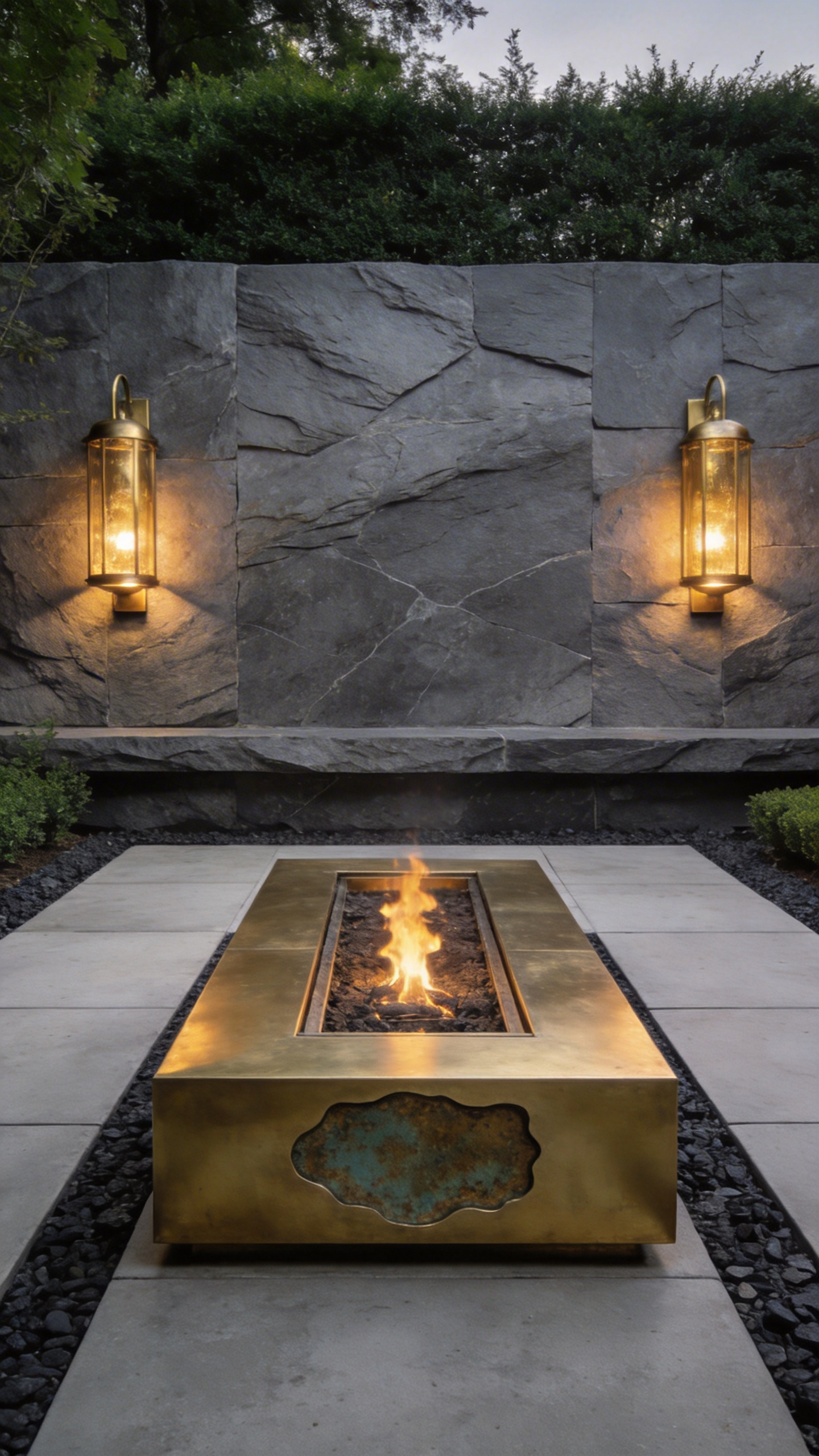
This material choice offers technical advantages. The developing oxidation layer actually shields the metal from failure. Thus, living brass outperforms stainless steel in coastal environments. Visually, the metal’s yellow undertones raise the temperature of grey stone. Brass also possesses a high spectral reflectance. It catches even weak natural light, preventing grey areas from appearing muddy.
Consider the impact on nighttime ambiance. Historically, brass was preferred for its interaction with firelight. Warm LEDs reflect off the metal to create a honeyed glow. This effect mimics the atmosphere of early gaslight. Placing an aged brass fixture against rough stone creates high-value visual tension. It turns a sterile surface into an inviting tapestry.
8. High-Performance Tactility: Elevating Upholstery with Outdoor Bouclés and Solution-Dyed Velvets
Modern patio design is undergoing a “tactile revolution.” Designers are shifting toward a trend known as “Raw Soul.” This movement prioritizes haptic feedback, replacing glossy finishes with the rich textures of outdoor bouclé and velvet. This high-performance tactility is engineered directly into the fiber. Unlike traditional fabrics, these use solution-dyeing technology. Pigments are injected before extrusion, creating a color that runs through the fiber like a carrot, rather than just on the surface like a radish.
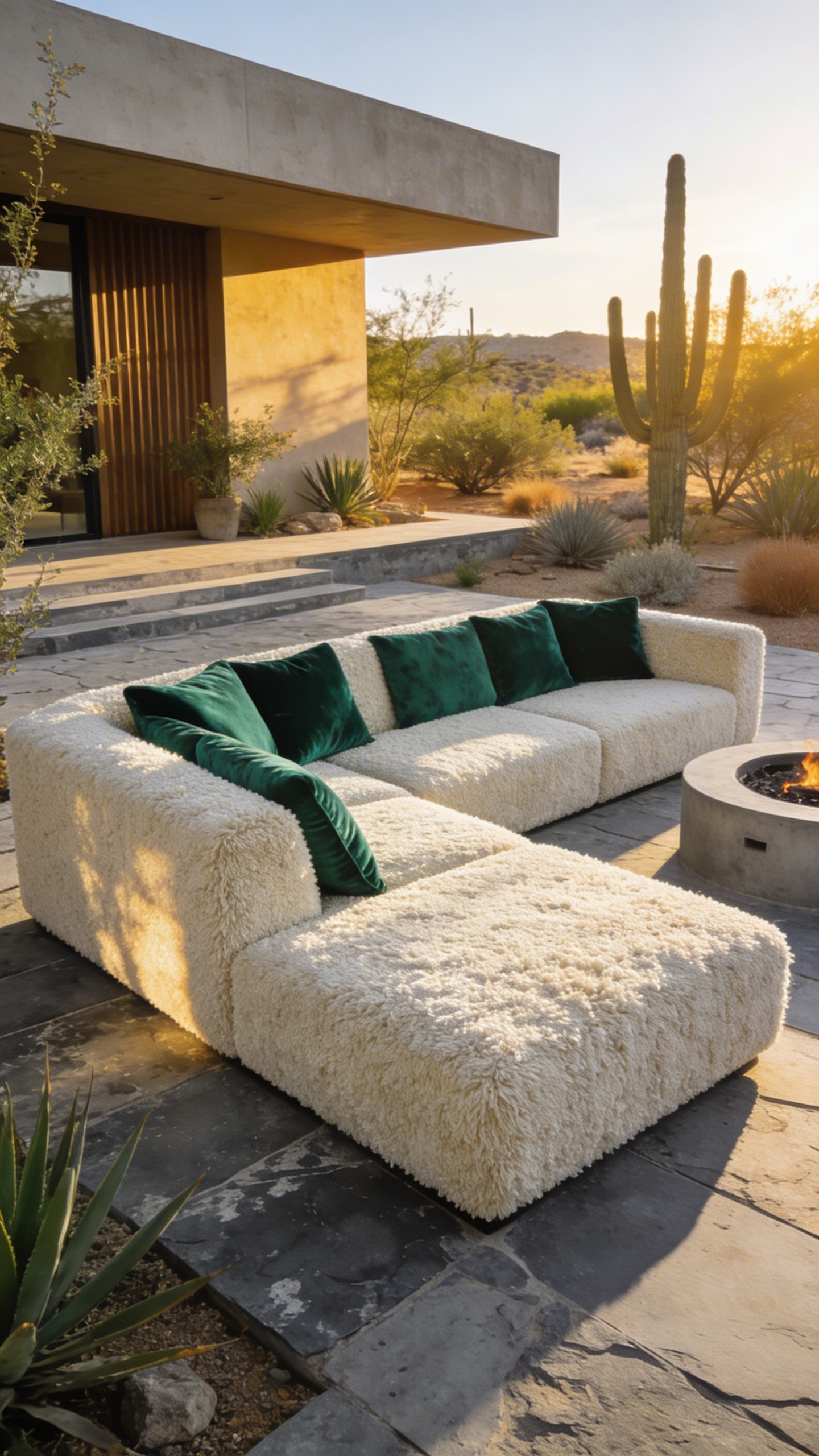
For bouclé, manufacturers use a complex yarn structure. The fabric retains its signature loops without the fragility of wool. Beyond aesthetics, these textiles offer sensory advantages. The irregular surface of bouclé reduces direct skin contact. As a result, the fabric feels cooler than flat canvas. The dense pile of velvet also acts as an acoustic dampener. This transforms a breezy terrace into a hushed sanctuary.
Maintaining this luxury requires specific care. Crushed velvet pile is easily restored with minimal steaming. Similarly, vacuuming bouclé with a brush attachment prevents dust from settling. These materials bridge the gap between indoor comfort and outdoor resilience.
9. The Rug Layering Technique: Grounding Conversation Areas with Flatweave Geometrics Over Stone
Mastering the art of layering flatweave geometrics over stone creates visual tension. Natural stone, whether flagstone or slate, possesses organic chaos. A geometric rug, however, introduces a mathematical anchor. This contrast signals to the brain that this zone is a defined, sophisticated texture for conversation.
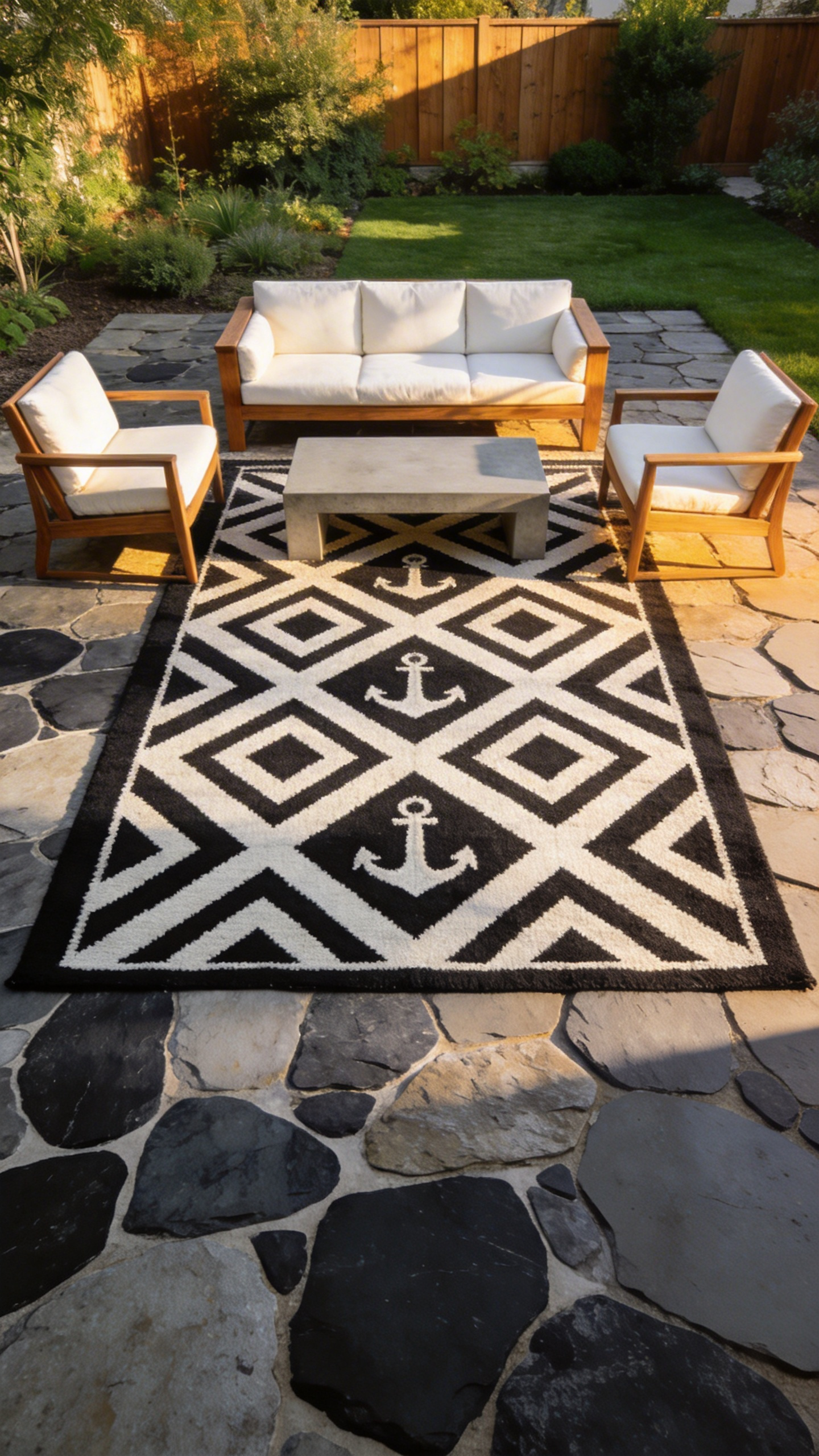
There is also a functional science at play. Stone acts as a high thermal mass battery. During the day, it absorbs solar radiation, becoming too hot for comfort. A flatweave rug serves as a crucial thermal break. Unlike high-pile options, thin weaves allow heat dissipation while protecting bare feet.
One must respect the material properties of the stone. Natural stone needs to breathe. Moisture constantly moves from the ground to the surface. Placing a rubber backing traps this dampness, causing efflorescence. To prevent this, experts recommend using breathable pads. This approach creates a functional bridge between the wild earth and civilized comfort.
10. Sculptural Biophilia: Using Oversized Glazed Ceramic Planters as Art Objects
Traditionally, patio design relies on a dense “jungle” effect. But a sophisticated shift known as Sculptural Biophilia is emerging. The focus moves from quantity to architectural form. Instead of clutter, a single oversized vessel acts as a “hero” object. Specifically, planters reaching 60 inches create a phenomenon called “shock scale.” For more inspiration on greening your terrace, explore these 21 Brilliant Patio Garden Ideas for Any Space.
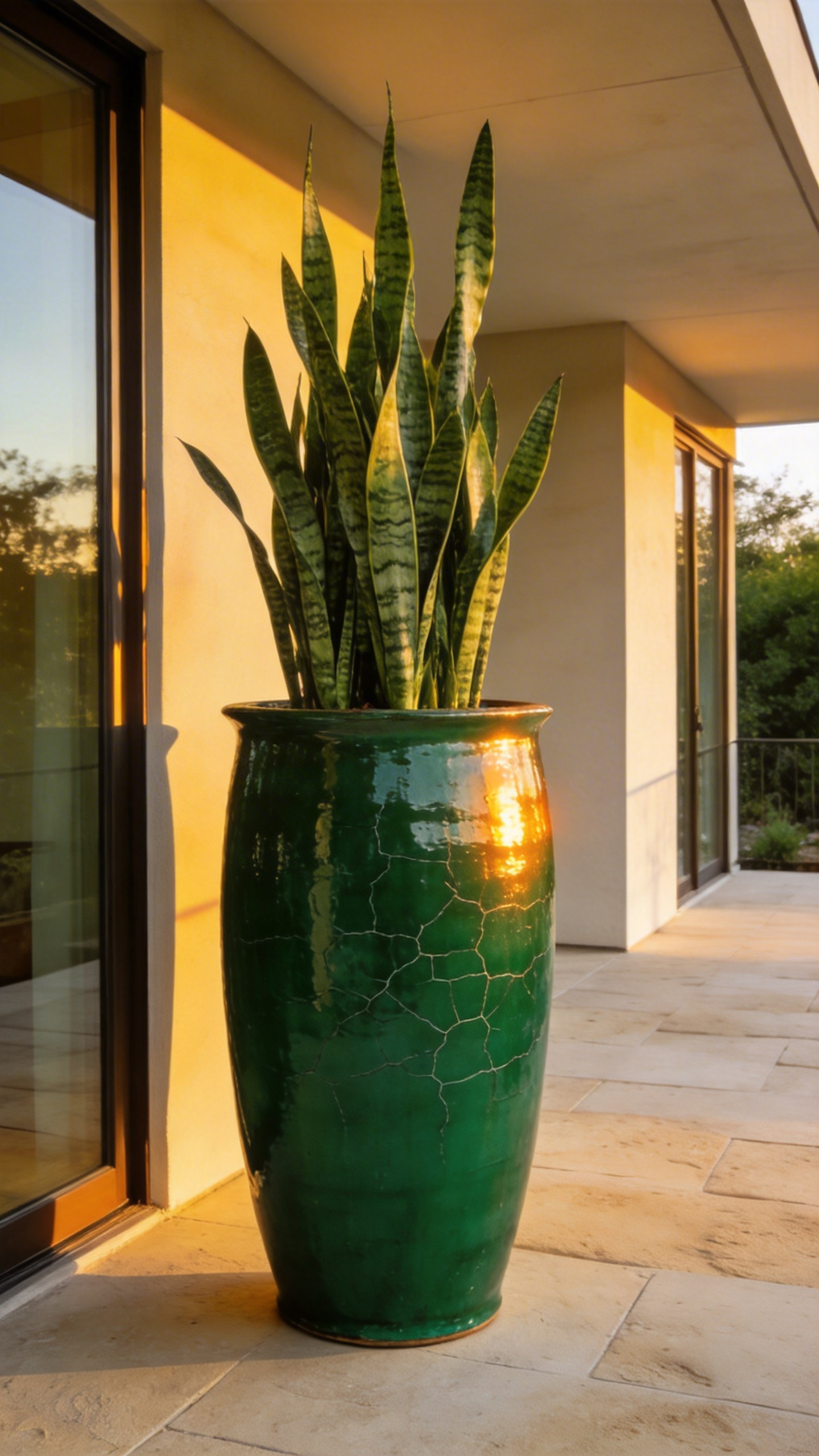
The surface texture defines the art. Unlike paint, reactive glazes utilize metal oxides like copper. During firing, these minerals melt into a glass-like finish. Thus, the planter becomes a dynamic light installation. A deep-blue glaze might resemble obsidian in the morning, yet reflect the sky by noon.
Ideally, treat these vessels as “generational objects.” Artisanal makers use specialized clays fired at extreme temperatures. The resulting density offers a permanence that plastics cannot replicate. You may even leave the vessel entirely empty. This “sculptural void” highlights the interior curve. The object itself satisfies our need for natural connection.
11. The Element of Fire: Integrating a Corten Steel Fire Bowl for Rough Texture and Warmth
Integrating a Corten steel fire bowl introduces a “living” material. Originally developed for industrial wagons, this weathering steel bridges the gap between grit and beauty. Architects like Eero Saarinen favored it for its rugged appearance. In fact, the metal’s deep brown hue mirrors plowed soil, grounding modern spaces with agrarian warmth.
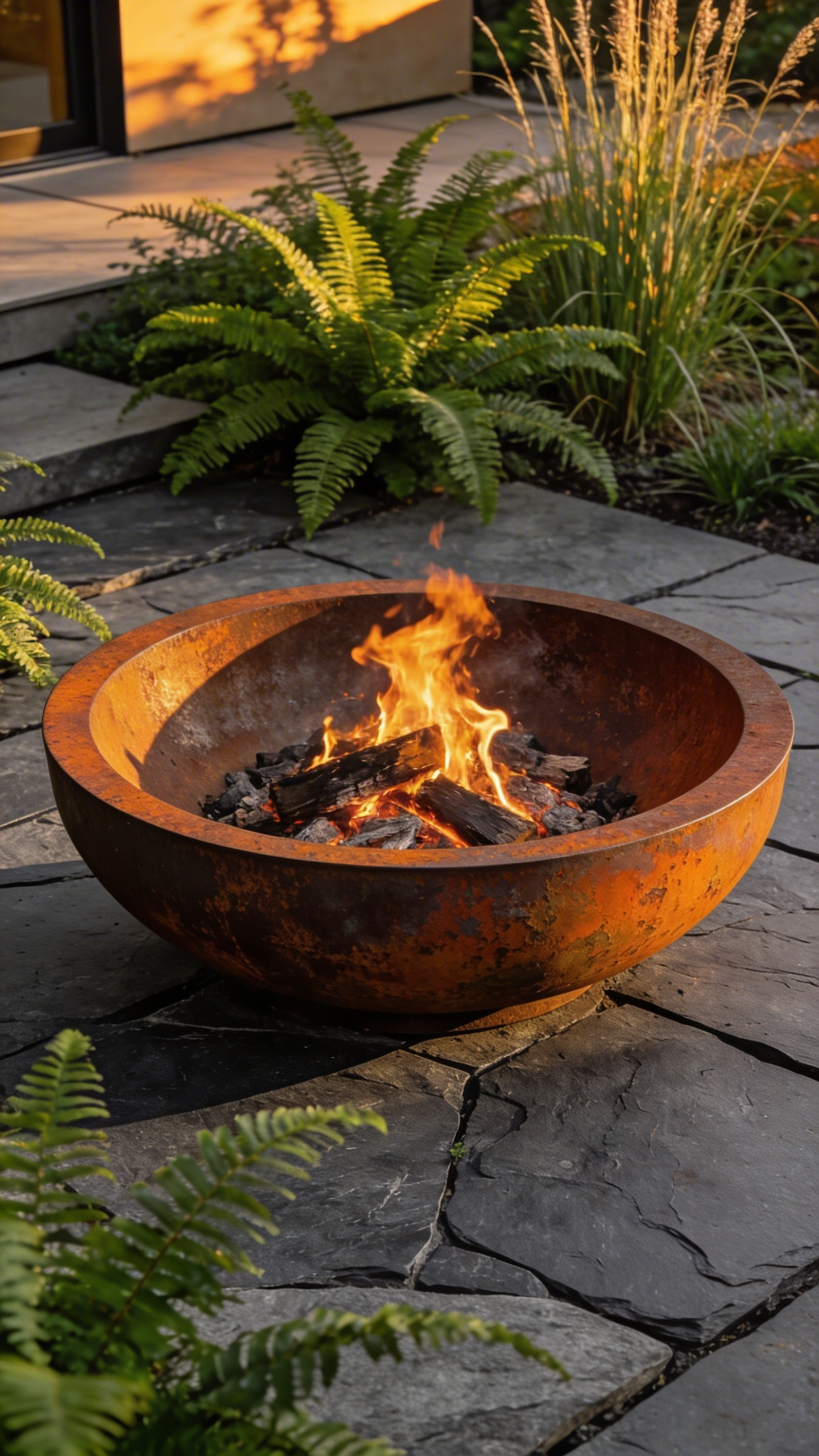
The bowl’s distinctive texture is the result of a specific reaction. Alloys like copper and chromium react with moisture to form a patina. Over time, this surface matures from gritty to velvety. Remarkably, this layer is self-healing; scratches simply re-oxidize and blend back in.
Designers use this material to create sensory tension. Pairing rough steel against smooth limestone highlights a pleasing “soft/hard” contrast. Corten steel also radiates heat effectively. The bowl warms guests while mimicking the intimacy of a campfire.
You must navigate the material’s “weeping” phase. During the first two years, rainwater can carry rust particles onto the ground. This runoff can stain light pavers. Therefore, place new bowls on gravel or dark slate until the patina stabilizes.
12. Water as Texture: Smooth Stone Basins vs. Rippled Water Surfaces for Auditory Calm
Water functions as a “auditory texture” in patio design. The physics of how water strikes stone defines the emotional resonance of your space. You should select your feature based on the acoustic atmosphere you wish to curate.
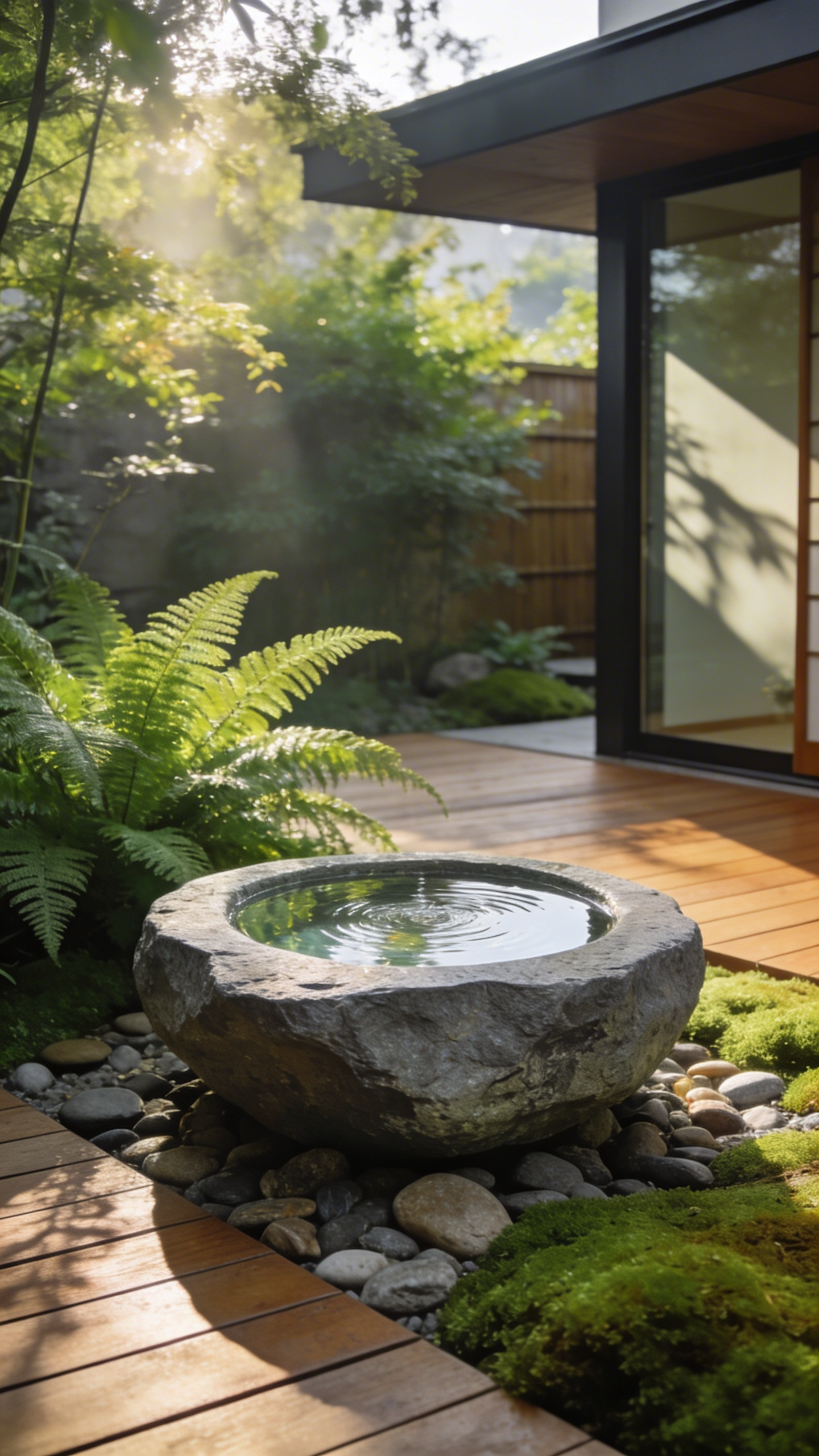
Smooth stone basins typically produce a low-frequency, resonant sound. Rooted in Japanese traditions, these vessels encourage grounding. The auditory profile is sparse. A polished granite basin reflects sound, resulting in a “crisp” tone. Porous stone like limestone absorbs sound, producing a muted trickle. Smooth basins are best suited for intimate seating areas.
In contrast, rippled water surfaces offer high-frequency energy. The breaking of surface tension creates “white noise.” This stochastic movement prevents auditory fatigue. Rippled features act as effective acoustic masks against traffic. Designers often layer “splash stones” to create micro-cascades. This transforms a blunt splash into a “sparkle.” Choose smooth basins for sanctuary and rippled surfaces for privacy.
13. Shadow Play Architecture: Utilizing Perforated Metal Lanterns to Cast Patterned Light
Shadow Play Architecture is a deliberate manipulation of the *chiaroscuro* effect. This technique redefines spatial boundaries through light. It mirrors the Arabic *Mashrabiya*, where latticework provided privacy. Today, we utilize perforated lanterns to achieve “shattered light,” drawing from Backyard Lighting: 10 Ideas to Illuminate Your Outdoor Space.
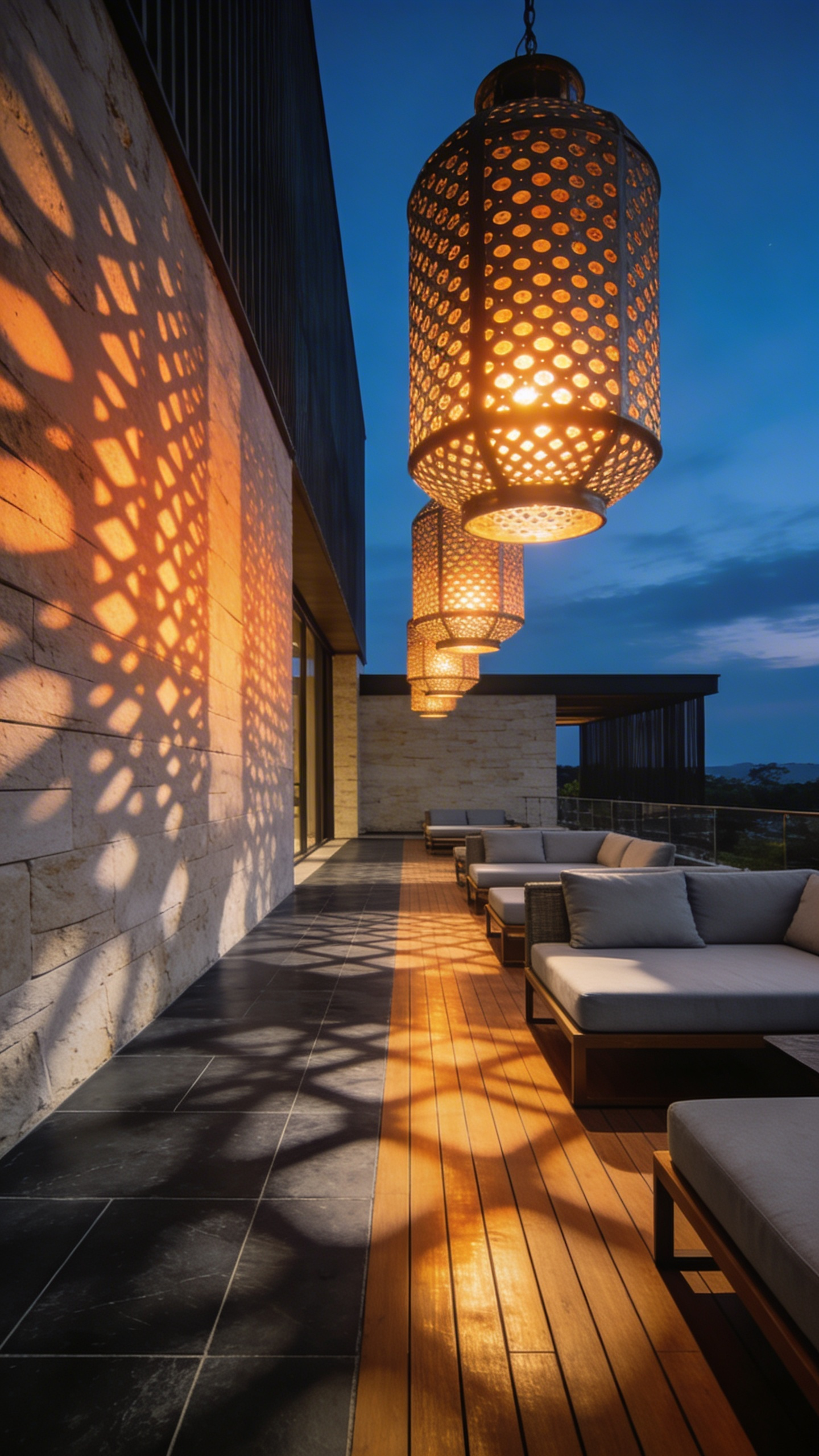
The choice of material dictates the atmosphere. Unsealed brass grounds itself within the garden’s colors. Powder-coated aluminum offers modern precision. The metal’s “open area” ratio controls shadow definition. A lower percentage, generally around 15–30%, creates sharp art. Higher percentages merely diffuse the glow. Pair these lanterns with a single point-source LED to maintain crisp edges.
These patterns act as “soft partitions.” By casting lace-like shadows, you define boundaries without walls. This “visual noise” mimics sunlight filtering through leaves. To implement this, apply the “Rule of Three.” Group odd numbers of lanterns at varying heights. Position them near vertical surfaces for dramatic “wall grazing.”
14. Reflective Expansion: Positioning Weather-Resistant Mirrors to Double Greenery and Light
Reflective expansion transforms a static patio into an infinite landscape. This aligns with the ancient principle of *Shakkei*, or borrowed scenery. A weather-resistant mirror acts as a framed portal. It folds the garden back into the living space. Material choice is paramount. Tempered glass offers high optical fidelity. Mirror-polished stainless steel provides a softer, water-like shimmer. Steel is also virtually indestructible.
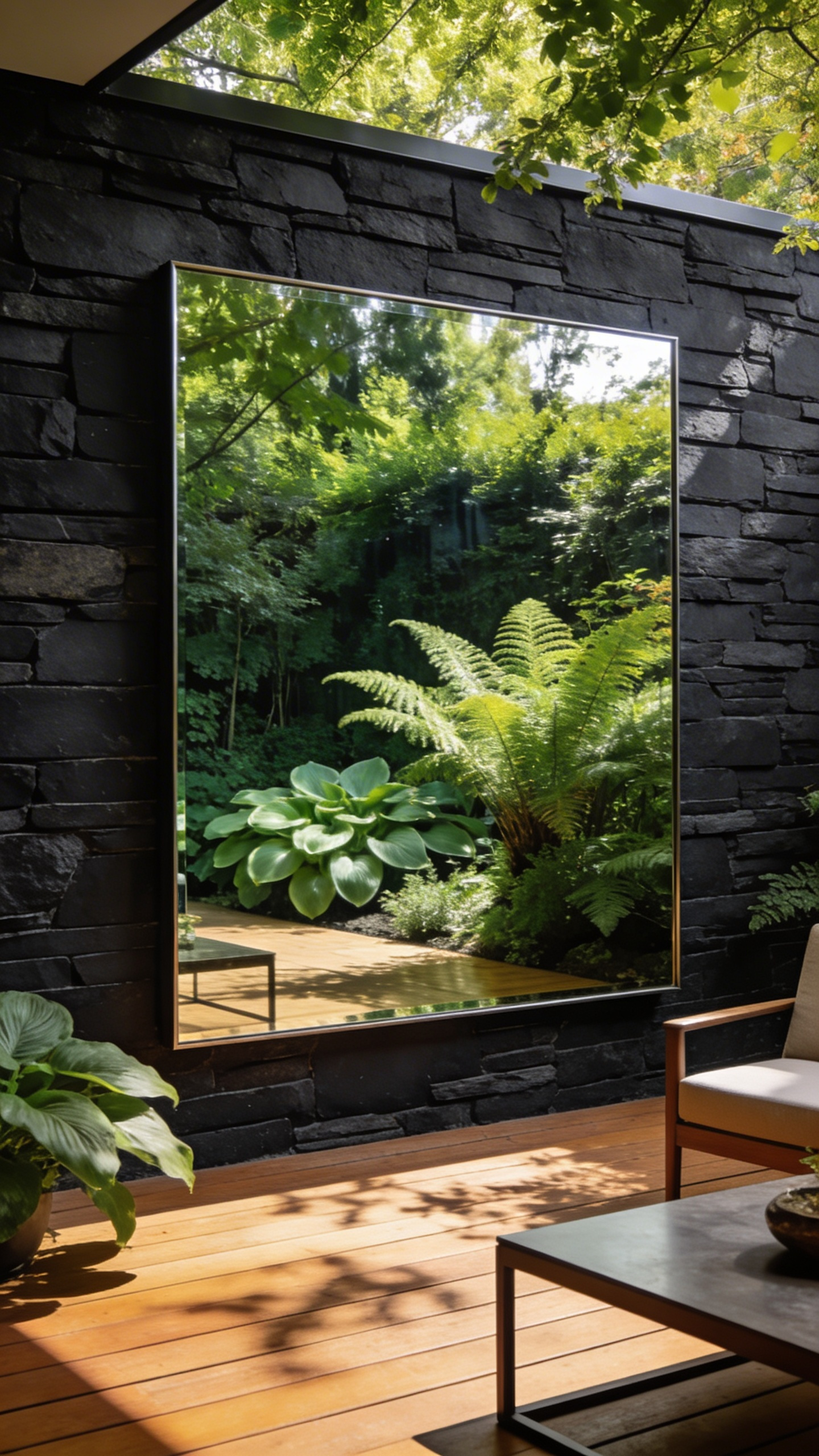
Placement requires a layered approach. Aim for a “Greenery Sandwich.” Position the mirror behind a potted maple but framing a climbing hydrangea. This creates a visual corridor that tricks the brain. Mirrors also serve a biological role. They act as a “second sun” for shaded corners. By angling the surface, you bounce light to sun-loving plants. Thus, a dark corner can suddenly sustain citrus trees.
You must design with safety in mind. Clear mirrors can endanger birds. Consider placing a trellis overlay to break up the reflection. Avoid concave shapes, which can focus heat like a magnifying glass. Ultimately, a well-positioned mirror doubles your greenery while amplifying light.
15. The Soft Canopy: Layering Canvas Shade Sails with Sheer Curtains for Movement
This design strategy creates a dynamic environment known as “Soft Architecture.” It relies on a play of opposites. Structural shade sails provide rigid, high-tension lines. Layering sheer curtains adds a fluid element to these sharp edges. Consequently, the space feels enclosed yet remains permeable.
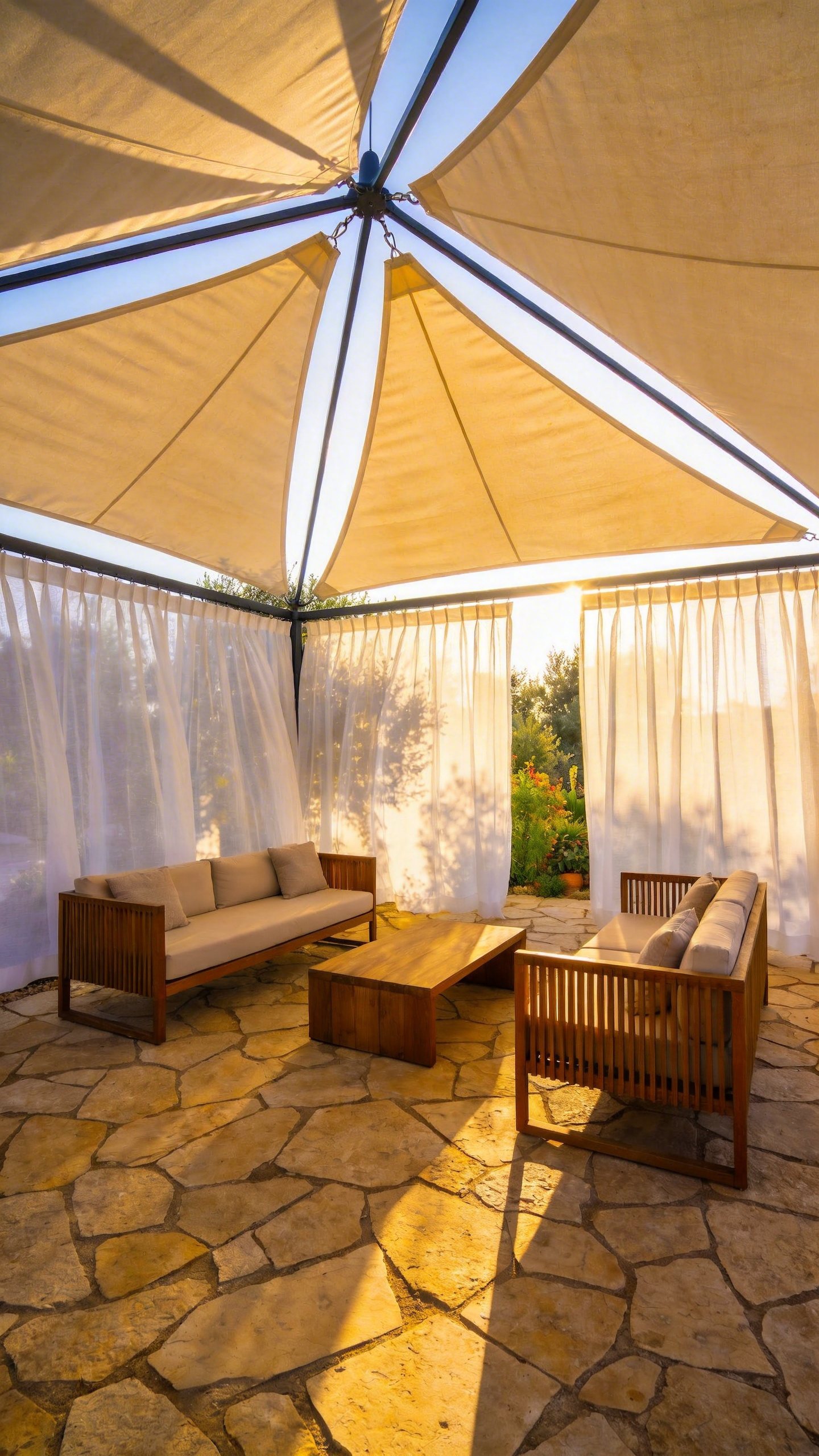
This combination alters the quality of light. Unlike the “Dead Shade” of solid roofs, this creates “Active Light.” Light filtering through canvas creates a flattering “soft-box” effect. This double diffusion mimics a forest canopy, eliminating harsh shadows on faces.
The movement of the fabric influences perceived temperature. Research suggests that seeing fluttering fabric creates a “visual cooling” effect. Material selection is critical. Use solution-dyed acrylic for the sail to ensure a matte finish. For curtains, select FR Outdoor Voile with weighted hems. The fabric creates graceful movement rather than chaotic flapping.
16. Seasonal Texture Swaps: Transitioning from Summer Linens to Heavy Wool Knits for Autumn Patios
Mastering the transition to autumn requires looking past simple color changes. You must engage with the “haptic architecture” of your space. This shift is a move from heat dissipation to retention. Summer linens have stiff fibers that encourage airflow. Wool fibers, conversely, have a “crimp” structure that creates dead air pockets. These pockets insulate body heat against cooling air.
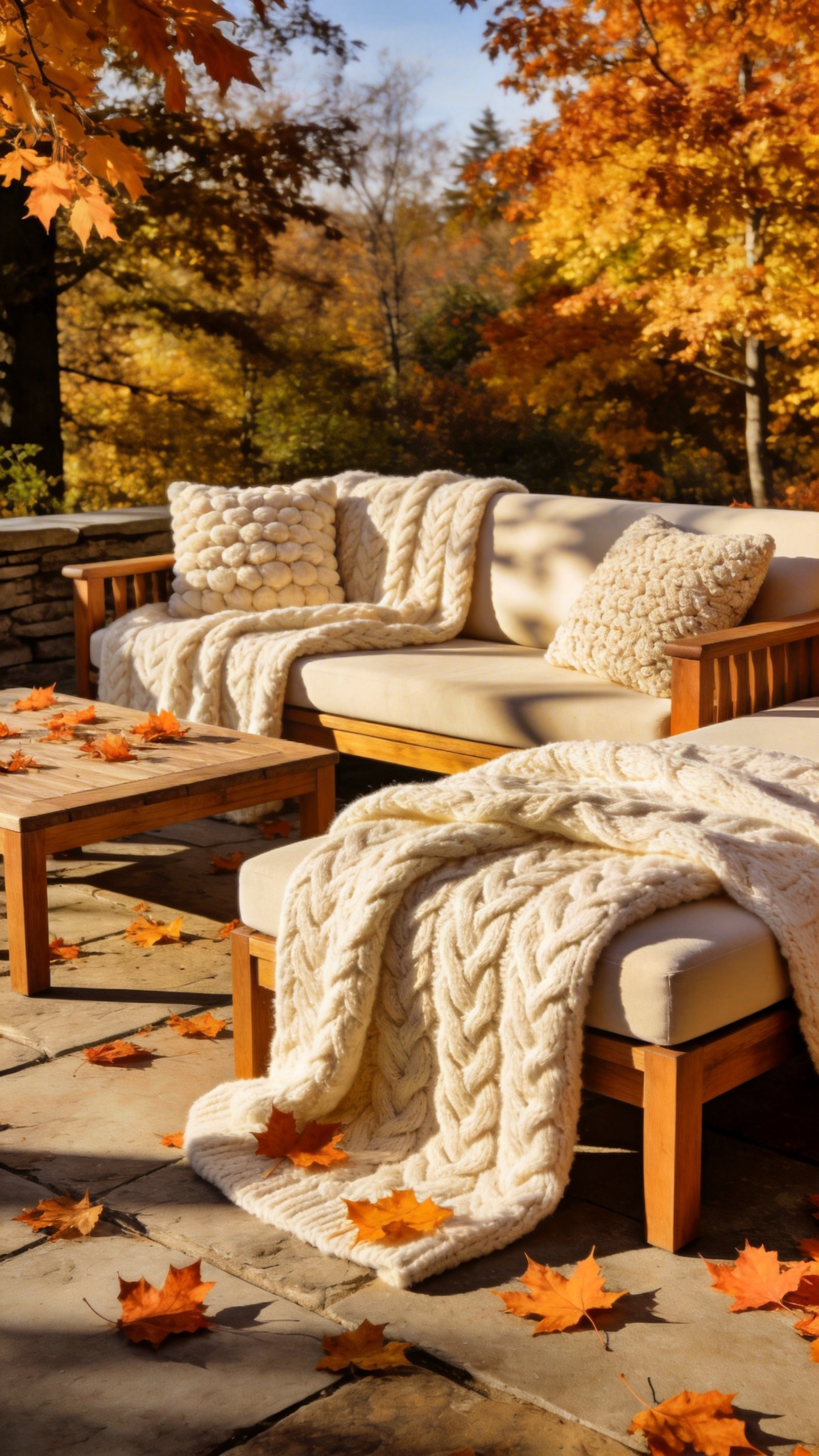
Texture significantly alters the psychological mood. Heavy knits trigger feelings of security, often described as “hygge.” These matte textures interact uniquely with the season’s light. While linen reflects harsh sun, wool absorbs low-angled rays. The fuzzy surface creates a soft, inviting glow.
Treat textiles as a “third skin” for your patio. Keep linens as a base layer. Then, layer on “chunky” cable knits for visual weight. Wool is naturally hygroscopic, meaning it handles dew without feeling damp. For rain-exposed areas, consider solution-dyed acrylics with a “wool-hand.” These offer warmth with weather resistance. This layering creates a sanctuary that encourages cocooning.
17. The Stone-Wood-Metal Triad: The Golden Ratio of Material Mixing for Timeless Appeal
Transforming a flat patio requires more than just placing furniture. The “Stone-Wood-Metal Triad” offers a sophisticated framework. This approach balances elemental materials to ground the space. Successful application follows the 60-30-10 Rule of Visual Weight.
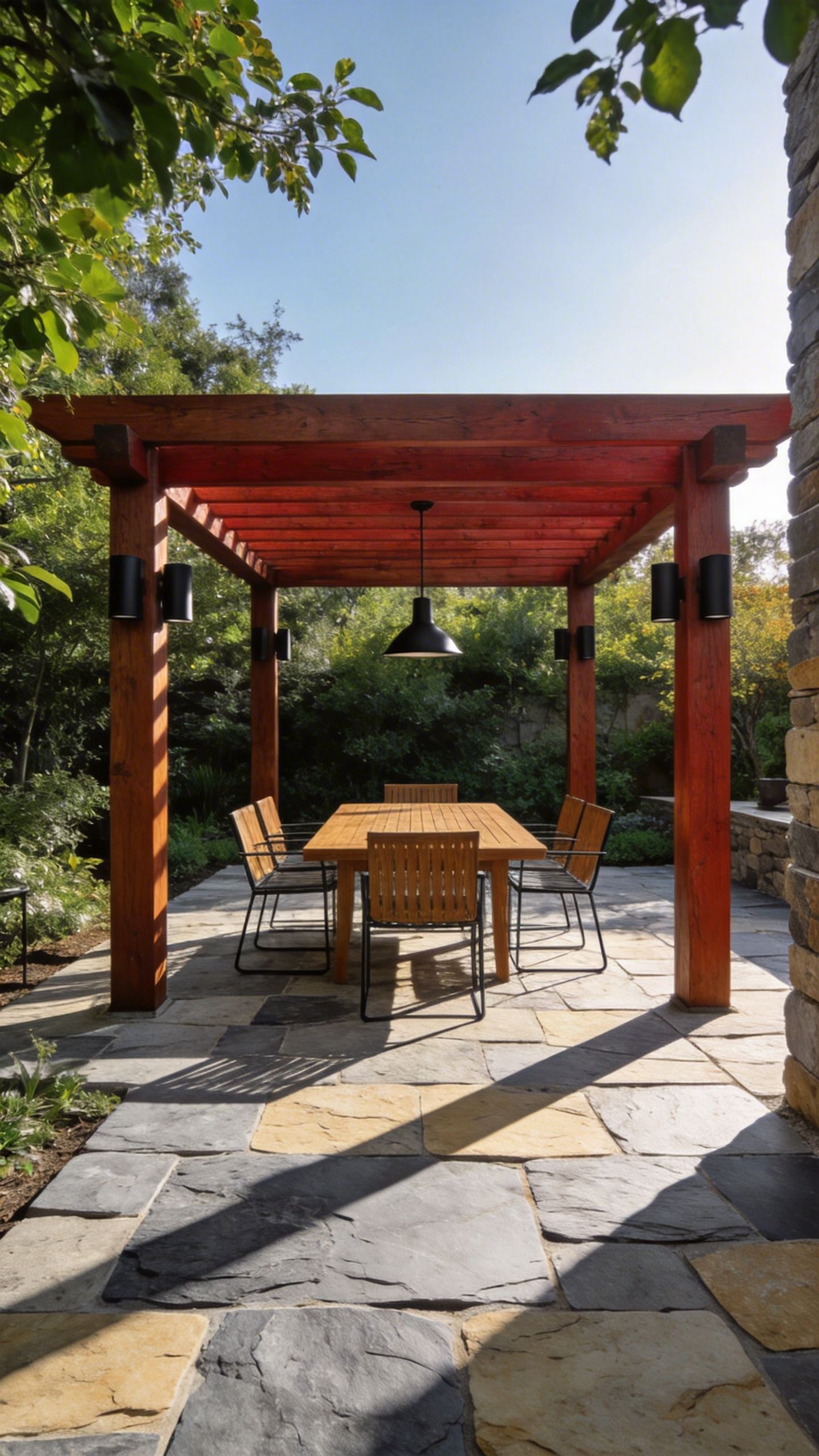
Stone serves as the anchor, comprising 60% of the design. Typically applied to flooring, it provides thermal mass. Stone absorbs heat and releases it slowly. Wood acts as the softener for 30% of the space. It introduces organic variation, countering stone’s coldness. Metal contributes the remaining 10% as a precise “punctuation mark.” It adds a sharp, industrial edge.
The design’s success lies where these materials meet. The “junction” creates the narrative. Using a “shadow gap” prevents materials from fighting visually. This gap also accommodates expansion. Since metal expands with heat, physical separation ensures durability.
This triad satisfies a need for “Biorealism.” The mix offers varied thermal sensations. Stone feels cool, while wood remains soft. These materials record time through aging. Wood silvers and copper develops a patina. Select a consistent “Temperature Palette” to avoid clutter. A warm palette might pair cedar with flagstone and bronze. A cool palette uses gray oak, slate, and stainless steel.
Frequently Asked Questions
How do I make my patio look expensive?
The key to a high-end aesthetic is Material Honesty. Instead of using synthetic replicas, invest in authentic materials like travertine, solid teak, and unsealed brass. These materials develop a natural patina and provide a tactile weight that mass-produced items cannot mimic. Also, using “shock scale” with oversized architectural planters can anchor a small space and provide a sophisticated focal point.
What are the best materials for a luxury patio?
For a luxury market, prioritize materials that engage the senses. High-end hardscaping often includes natural stone like slate or basalt for the ground plane. For furniture, look for Glass Fiber Reinforced Concrete (GFRC) and solution-dyed textiles like outdoor bouclé. These materials offer the perfect blend of aesthetic sophistication and long-term durability against the elements.
How can I create a cohesive indoor-outdoor flow?
To achieve the “Invisible Threshold,” match the tones of your indoor flooring with your outdoor hardscaping. Use large-format porcelain tiles with a matching-veined pattern across both spaces. To ensure safety, use an R9 slip-rating indoors and an R11 rating for the exterior. Aligning grout lines perfectly through flush glass sliders further enhances this architectural harmony.
Conclusion: Creating a Tactile Sanctuary
Creating a tactile sanctuary moves beyond simple decoration. It embraces a curated approach rooted in biological necessity. We shift our focus from visual appeal to neuro-architectural function. Choosing materials like heat-absorbing stone or rustling grasses actively regulates the nervous system. The patio becomes a refuge that engages touch, sound, and scent simultaneously.
This multi-sensory layering transforms these patio decorating ideas into a restorative tool for well-being. Your outdoor area serves as a personal sanctuary for cognitive restoration. The value of the space lies in its ability to nurture through “pink noise” and haptic feedback. Embrace patina and seasonal scents to foster a connection to time. Audit your current space for sensory gaps. Identify one auditory or tactile element to introduce, such as a texture gradient. Allow your sanctuary to evolve, prioritizing physical engagement over static perfection.