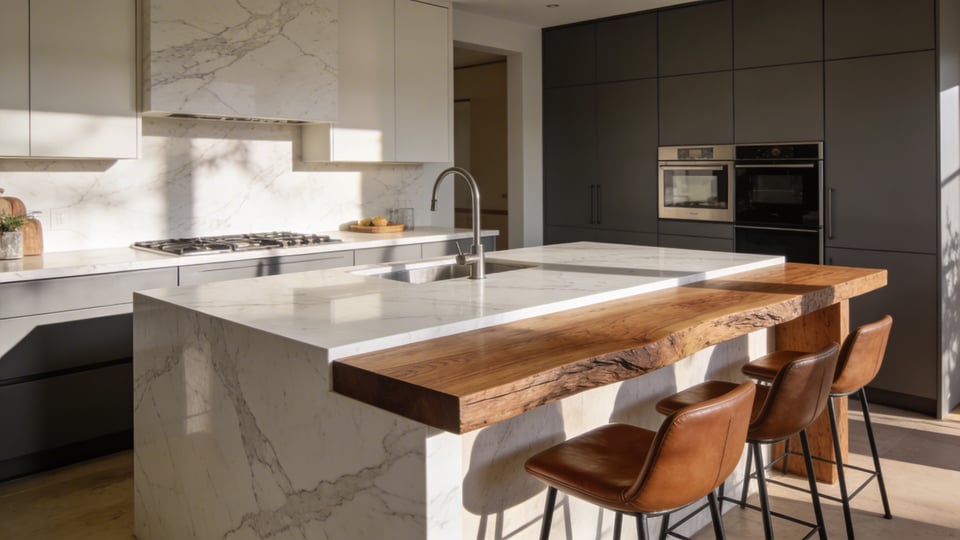
Most homeowners see the kitchen island as a simple prep station. They view it as extra storage or a convenient workspace. But this central feature represents a deeper architectural shift. For the discerning homeowner, a kitchen island with seating is more than utility; it is the focal point of the modern home. Gottfried Semper identified the ancient hearth as the “moral element” of architecture. Today, the island recreates that “sacred focus.” It transforms a hidden “backroom” into a space of intimacy and craftsmanship.
Effective design requires more than efficient measurements. We must look beyond the traditional “Work Triangle” to the “Social Triangle.” The island acts as a permeable barrier between labor and leisure. The ancient cooking fire has transmuted into the warmth of natural stone. The structure serves as a “Domestic Third Place” where work and family connection coexist. The materials we choose for our 7 Kitchen Island Designs That Will Make You Rethink Your Layout must ground us against a fragmented digital world.
This discussion explores the kitchen island as the modern hearth. We analyze how curved seating configurations create a communal “camp-fire” effect. We reveal how tactile surfaces like leathered granite engage the senses. We also consider the acoustic “soundscapes” that turn kitchens into quiet sanctuaries. This guide helps you design spaces that are not just seen, but deeply felt.
Core Philosophy: Why Materiality Dictates Social Flow in the Kitchen
Your island isn’t just furniture. It is a sensory engine. The materials you choose actively govern human behavior. We look to “haptic intelligence” to understand this influence. For example, stone surfaces have high thermal mass. They wick heat from the body and signal a temporary visit. Wood, by contrast, acts as a thermal insulator. It feels warm to the touch, inviting guests to rest their arms and linger.
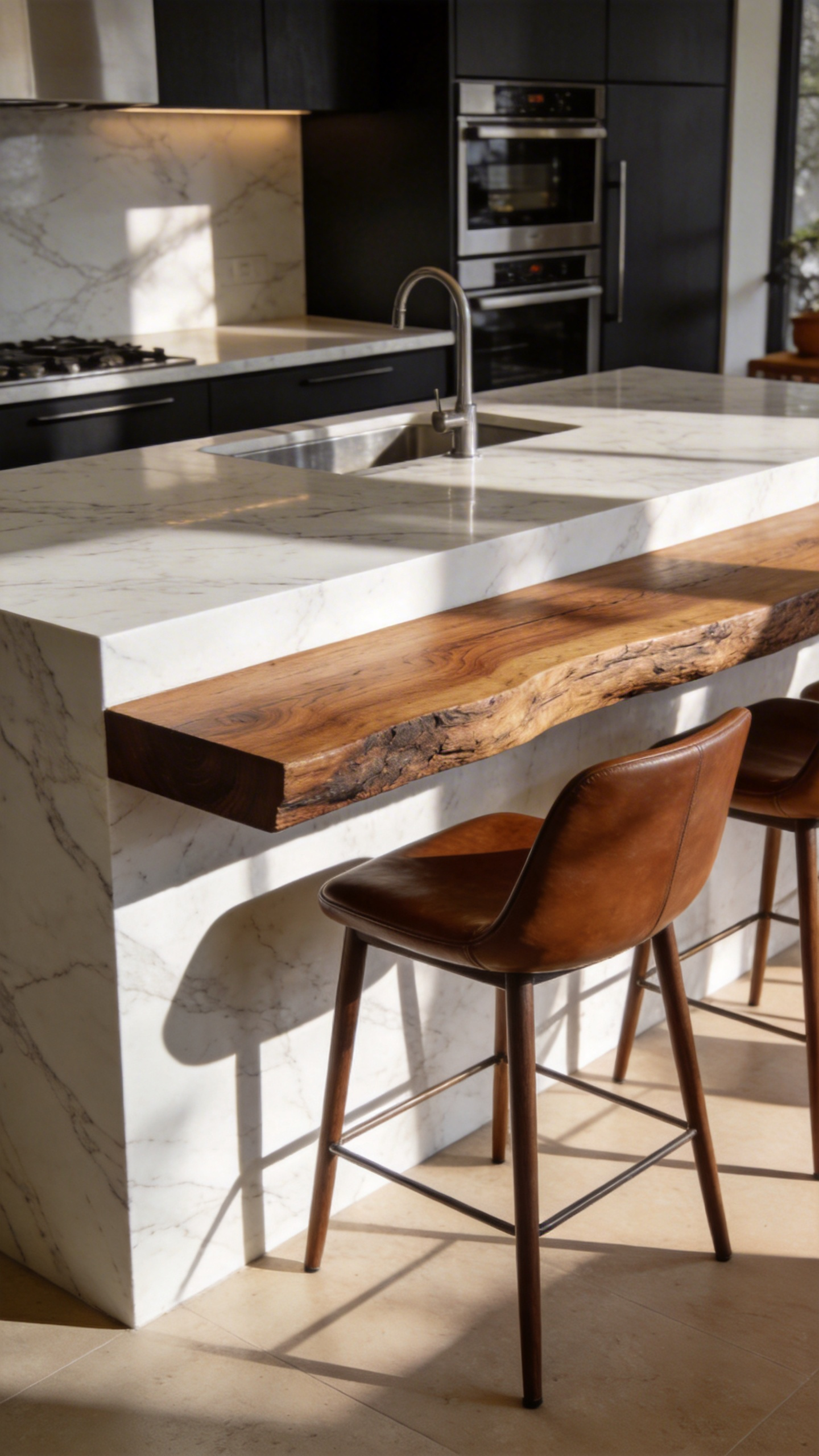
The island’s materiality also dictates acoustic comfort. Polished stone and glass reflect sound waves. This creates a “cocktail party effect,” forcing guests to raise their voices. Textured or porous surfaces help absorb this noise. Conversation becomes intimate rather than exhausting.
Material changes create necessary psychological boundaries. In design, we call this “proxemic zoning.” Transitioning from a cold stone prep surface to a warm wood block creates a clear cue. The cook feels protected in their work zone. Meanwhile, guests understand exactly where they belong in these 23 Dreamy Luxury Kitchen Ideas to Inspire Your Next Renovation. These textures act as a silent conductor for social connection.
I. The Material Foundation: Surface & Texture Combinations
Designing a kitchen island requires balancing clinical precision with sensory warmth. Stone surfaces like marble act as physical heat sinks. Resting bare forearms on cold stone becomes uncomfortable quickly. Sophisticated designs now incorporate “Inlaid Social Zones.” Embedding thick walnut or white oak creates a necessary “thermal bridge.” This transition signals where the chef’s work ends and the socializing begins.
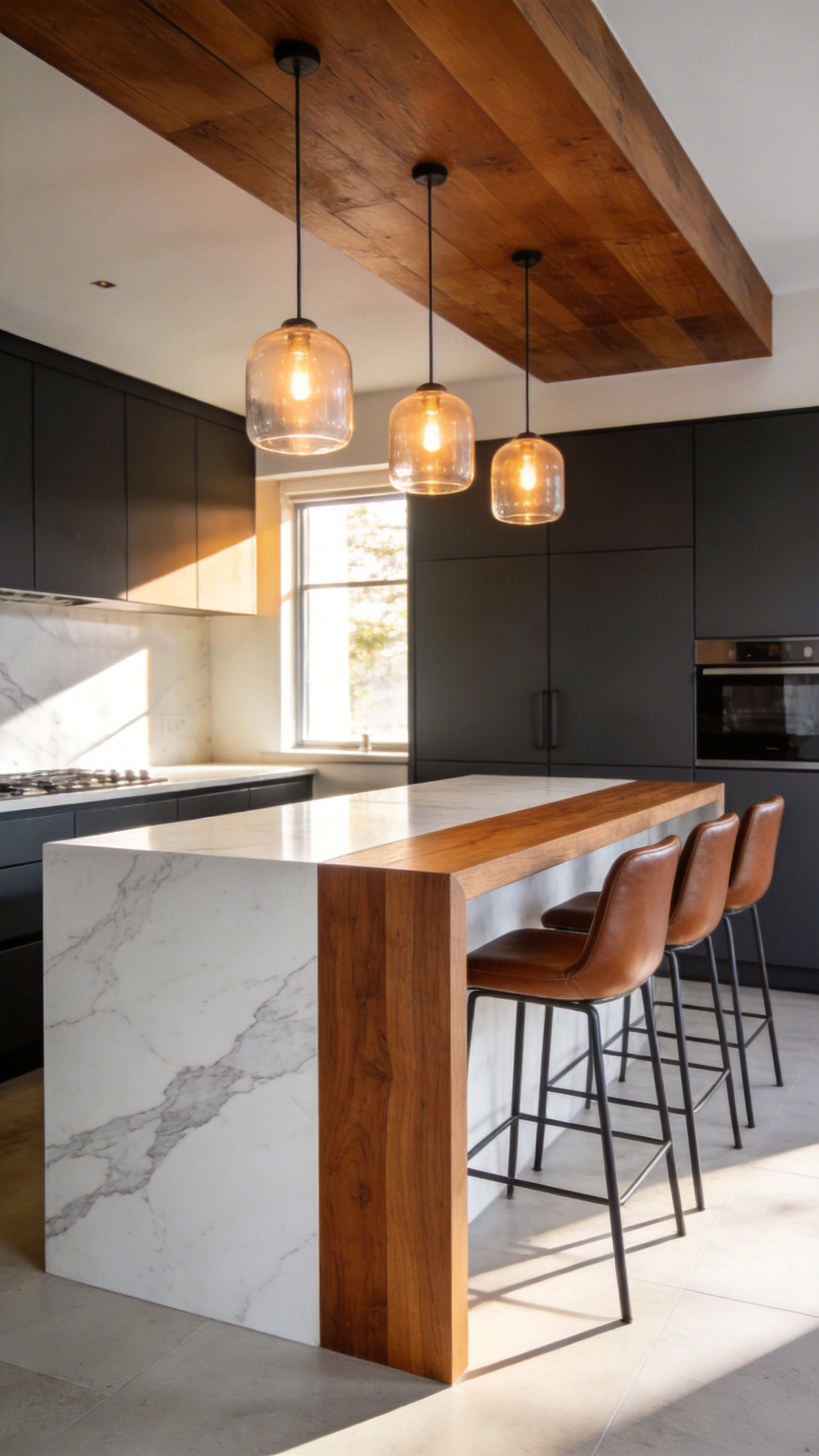
Beyond material choice, surface texture plays a pivotal role in comfort. High-gloss finishes often reflect harsh overhead lighting. This causes visual fatigue. A “leathered” finish offers a softer, matte solution. By brushing stone with diamond-tipped bristles, the surface diffuses light gently. This organic topography also hides fingerprints better than polished surfaces. In a high-touch seating area, this texture maintains a clean look throughout a dinner party.
Designers must also consider the acoustic profile of the space. Hard monolithic islands often amplify noise and create a chaotic environment. Backing the seating area with porous materials like ribbed wood helps break up sound waves. Ideally, apply the “70/30 rule” to visual zoning. Keep 70% as a durable workspace, but dedicate the remaining 30% to richer, softer textures. Layering these materials transforms a sterile block into a piece of curated furniture.
1. The Art of Thermal Contrast: Pairing Cool Marble with Warm Timber
“Thermal contrast” is rooted in physics, specifically the concept of thermal effusivity. This measures how rapidly a material exchanges heat with the human body. Marble possesses high effusivity. It draws heat away from the skin to create a cool sensation. Timber acts as an insulator, reflecting body heat back for a distinctly warmer feel. This science creates a functional “thermal map” across a kitchen island. In practice, the “Elbow Test” drives this design decision. Resting bare arms on cold stone becomes uncomfortable during long meals. Designers use a wooden cantilever for the seating area to offer a physical “warm embrace.”
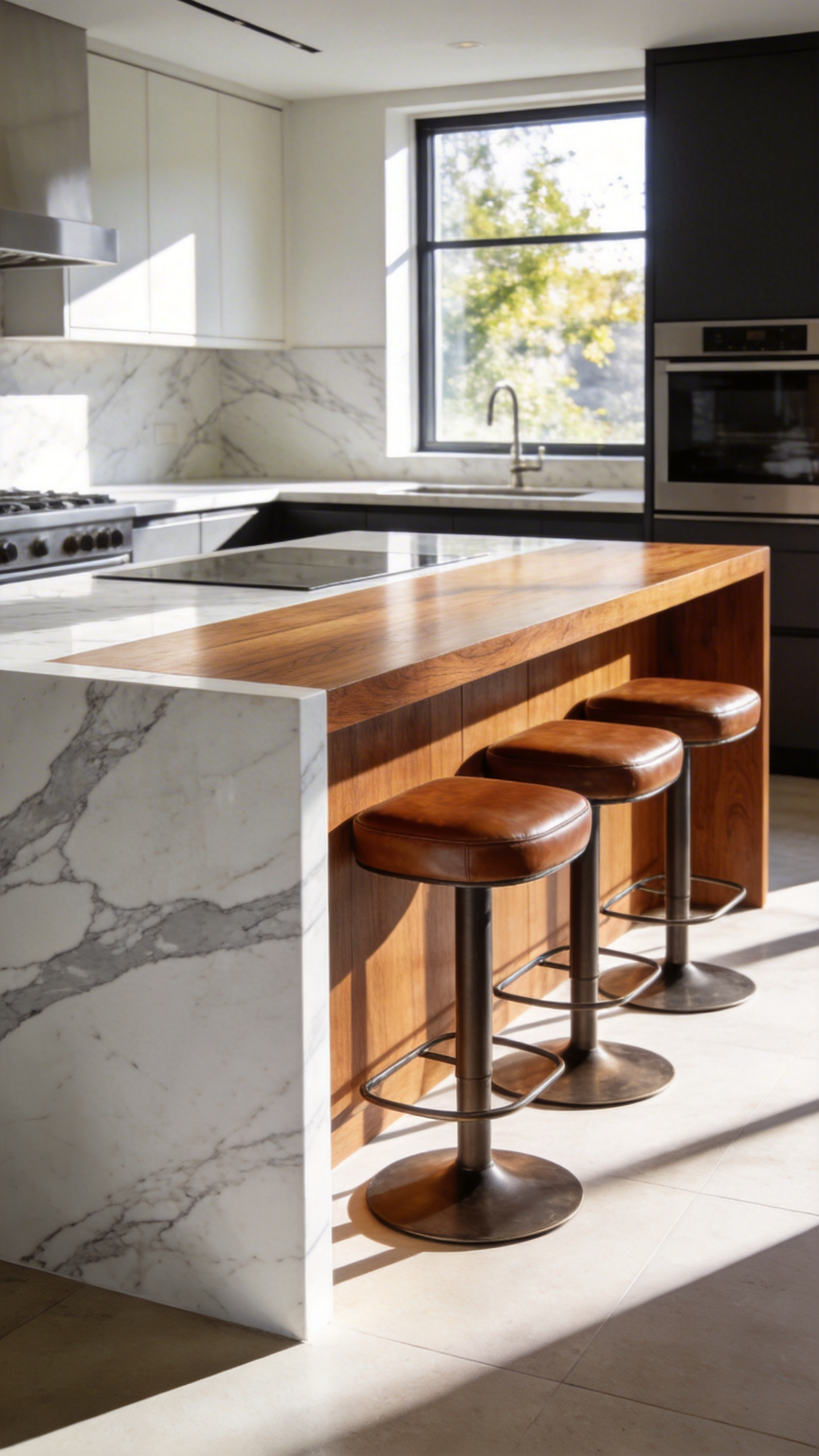
This pairing effectively dictates how an island manages light. Polished marble creates specular reflection. It bounces bright light upward to energize the prep zone. Timber offers diffuse reflection, which absorbs and softens light to create an intimate mood. The material transition signals a psychological shift from “work zone” to “relaxation zone.” This visual balance prevents the kitchen from feeling like a sterile mausoleum or a heavy sauna. The room achieves a “Goldilocks” zone of sensory comfort.
Merging these materials requires precise craftsmanship. Wood is hygroscopic; it expands and contracts with humidity while stone remains rigid. A simple butt join without a buffer often leads to cracking. Authoritative design employs a “shadow gap” or a metal inlay at the junction. This detail acts as a technical necessity and a visual “handshake” between the materials. It elegantly unites the geological weight of stone with the organic warmth of timber.
2. Tactile Layering: Integrating Leather Seating with Polished Stone
Polished stone offers a sleek aesthetic, yet it possesses high thermal conductivity. It acts as a thermal mass, siphoning heat away from human contact. Full-grain leather, however, adapts instantly to body temperature. Pairing leather seating with a stone island creates a necessary “thermal sanctuary.” This strategic balance transforms a physically cold workstation into an inviting social hub where guests linger.
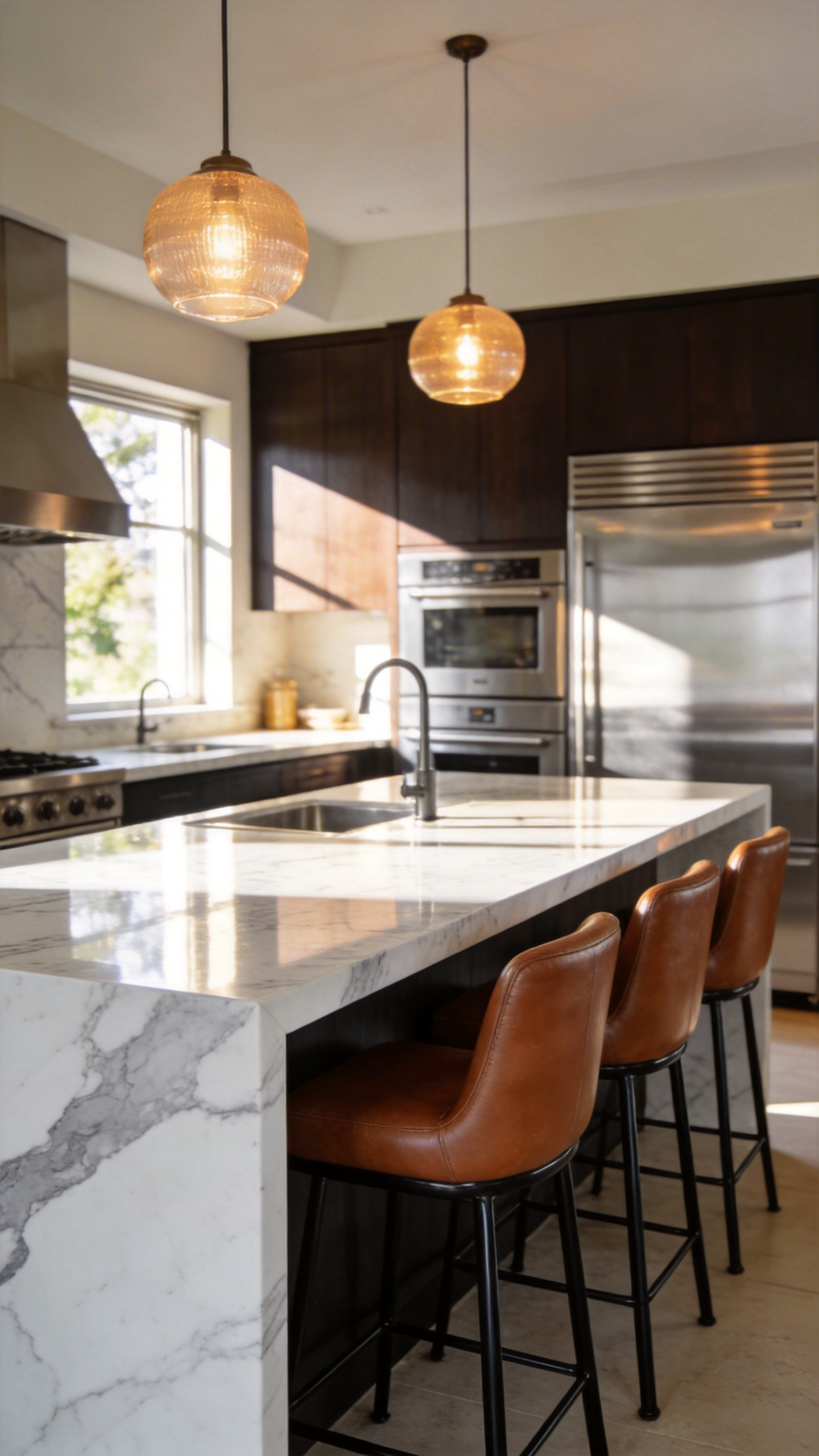
This material combination addresses a common technical failure: poor acoustics. Expansive stone surfaces act as “sound mirrors.” They reflect noise and create harsh echoes. Leather is naturally porous. It absorbs mid-to-high frequency sound waves and effectively quiets the room. By reducing the “clatter” of meal prep, the upholstery tunes the environment for intimate conversation.
The visual interplay grounds the space with organic texture. Smooth marble is visually high-energy, while leather provides a matte, tactile break. Both materials share a unique capacity for “synchronized aging.” Stone may subtly etch, and leather will eventually develop a rich patina. This partnership ensures the kitchen becomes a legacy piece. It tells a story through its evolving textures.
3. The Waterfall Edge: Creating Visual Continuity in Mixed-Media Spaces
The waterfall edge historically echoes the soft, cascading lines of Art Deco furniture. Contemporary designers have swapped those curves for sharp, ninety-degree miters. This creates a “gravitational core” that effectively grounds floating, open-concept floor plans.
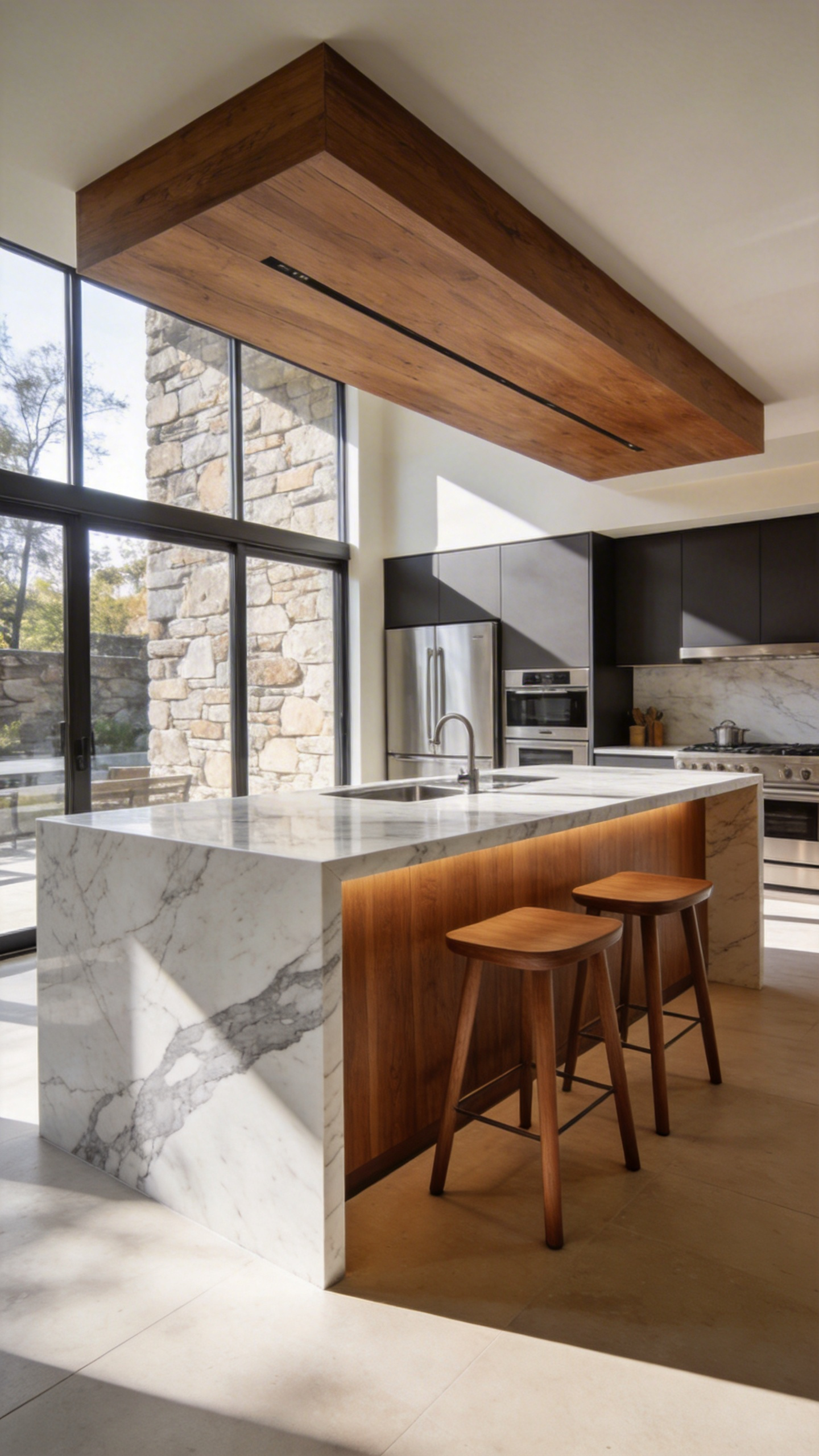
This feature acts as a sensory bridge between disparate materials. High-end designs often pair cool Calacatta marble prep surfaces with warm walnut seating areas. The “cold” stone serves the chef, while the “warm” timber offers a comfortable resting spot for guests. Successful mixed-media integration relies on a “shadow gap.” This recessed channel allows the wood to expand naturally without stressing the stone miter.
Maintaining visual continuity requires engineering precision. Fabricators utilize bookmatching to ensure veins mirror each other perfectly across the vertical turn. The tactile experience extends to hidden areas. Because guests interact with the island’s underside, experts “back-polish” the stone overhang. This ensures the surface feels smooth against the knees, rather than rough.
Hidden steel brackets replace bulky corbels to maintain a floating silhouette. The waterfall edge also serves as a protective shell. By extending to the floor, it shields delicate cabinetry from scuffs in high-traffic zones. The design offers both architectural stability and lasting durability.
4. Metal Finishes: Coordinating Seating Frames with Cabinet Hardware
In the modern kitchen, the island acts as the home’s social “handshake.” Coordinating seating frames with cabinet hardware requires more than simple matching. View this interplay as an exercise in layered storytelling. Designers often use seating as a “bridge” to reconcile disparate elements. For instance, most kitchens possess large, cool-toned stainless steel appliances. You might prefer warm brass hardware. To integrate these opposites, choose stools with blackened steel frames and brass accents. The seating visually mediates between the industrial appliances and the warm cabinetry.
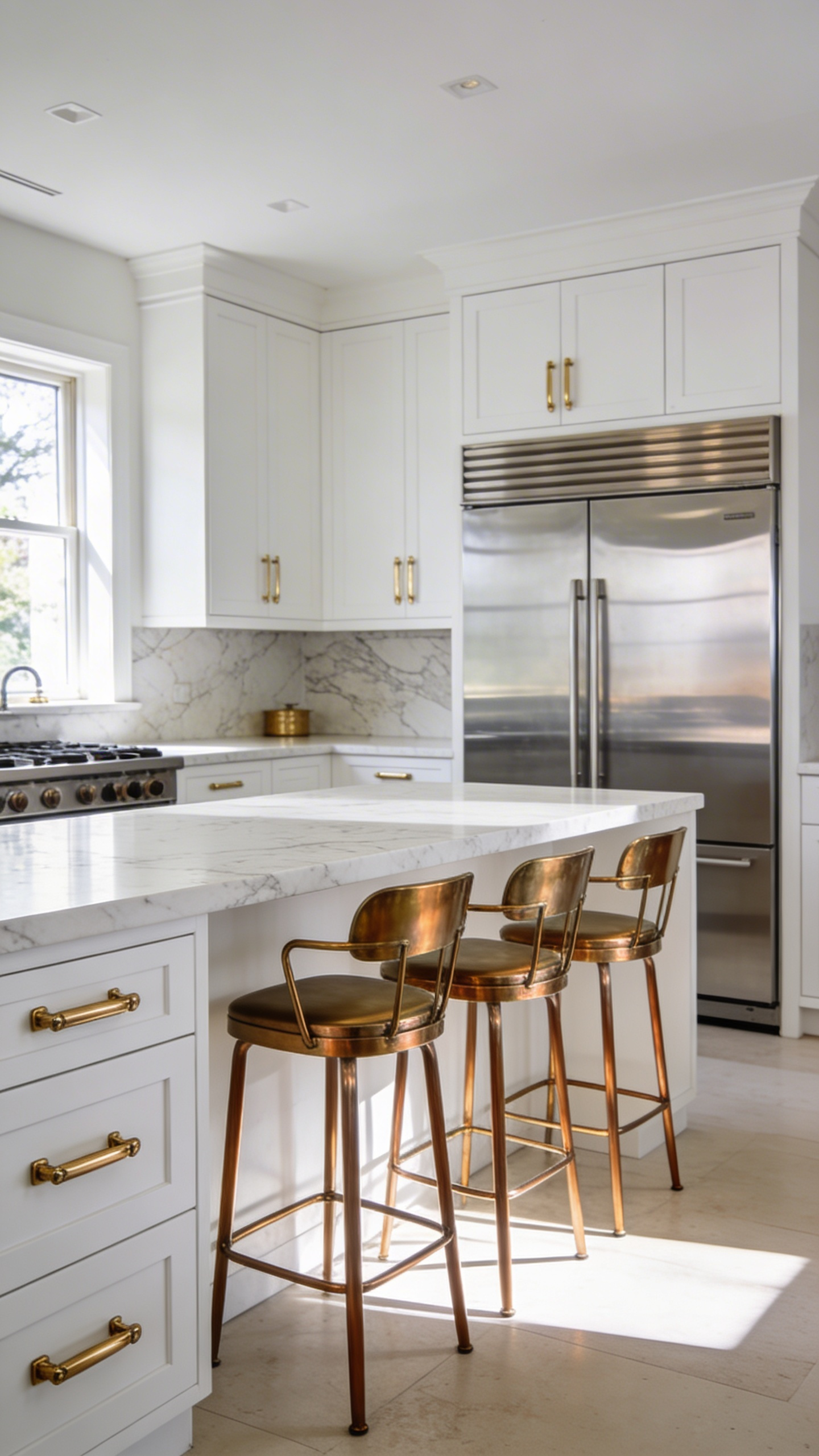
You must manage the room’s sensory hierarchy. Polished finishes create “visual noise” due to high reflectivity. If both hardware and frames shine, the space feels jittery. Pair high-shine “jewelry” on cabinets with brushed or satin seating frames instead. This diffuses light, making the stools feel softer and more grounded. Mixing textures creates a necessary tactile distinction between static hardware and furniture.
Embrace the historical narrative of “Eclectic Traditionalism.” Historically, prestigious estates collected various metals over time. Avoid the “builder grade” monochrome look where every finish matches. Pair Matte Black stools with Honey Bronze hardware for sharp, intentional contrast. This choice defines the island as a curated destination rather than a generic extension.
5. Matte vs. Gloss: Manipulating Light Reflection for Intimacy
Selecting a finish involves manipulating physics to influence the social atmosphere. Glossy surfaces produce specular reflection. This creates a mirror-like effect. It results in harsh glare from overhead lighting, causing visual fatigue during face-to-face conversations. Matte finishes utilize diffuse reflection to scatter light softly across the surface. This “visual silence” eliminates distractions. The human face becomes the primary focal point.
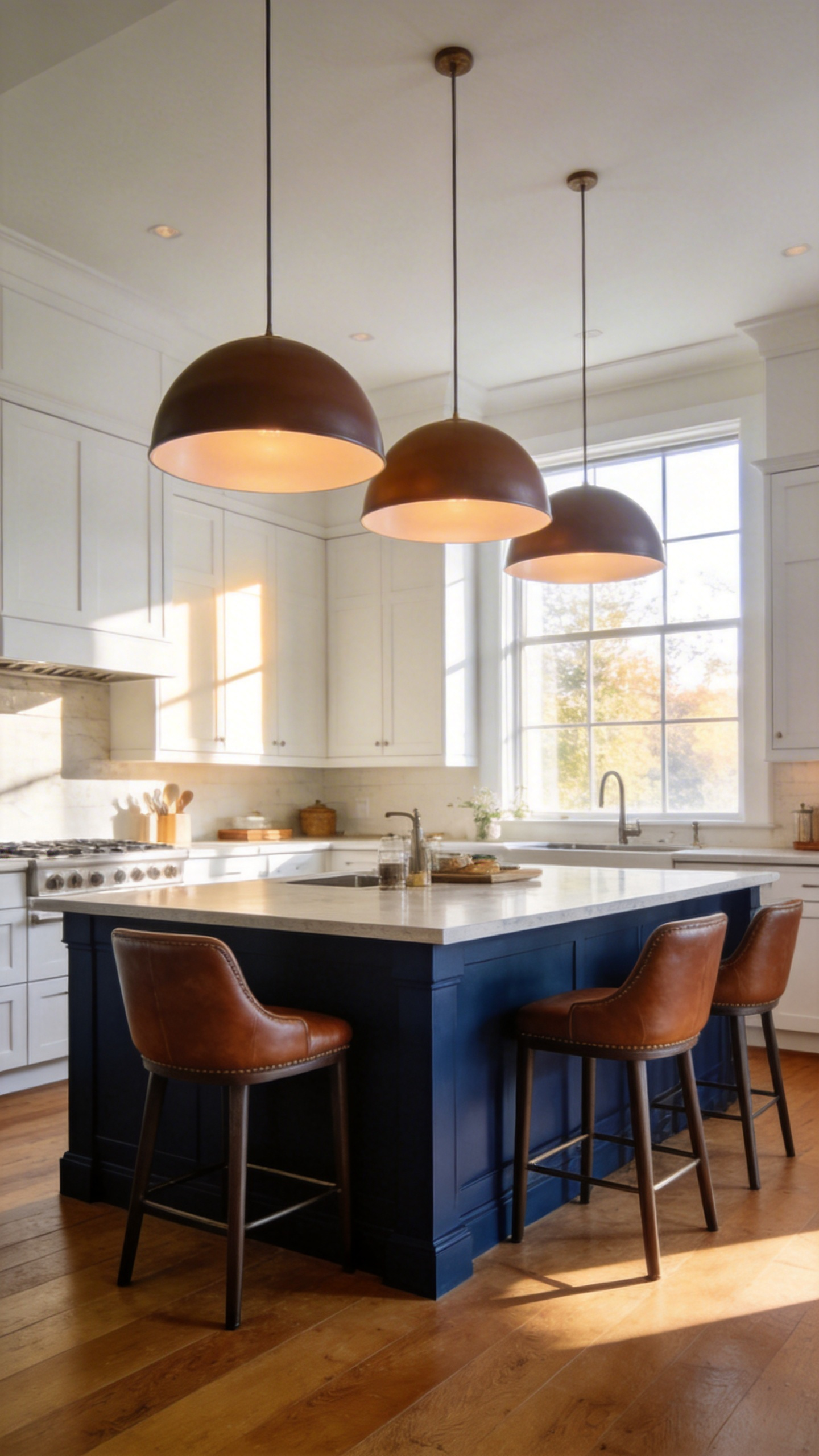
Beyond visual comfort, surface texture dictates the room’s energy through light absorption. Matte surfaces possess a lower Light Reflectance Value, so they act as effective light anchors. When paired with warm pendants, they facilitate a psychological “campfire” effect. The light pools on the surface rather than ricocheting across the room. The seating area feels like a private, enclosed retreat within the larger open plan.
The tactile experience plays a crucial role in defined intimacy. High-gloss finishes once felt cold and clinical. They often discouraged physical contact due to visible fingerprints. Modern “soft-touch” nanotechnological materials create a velvety, non-reflective texture. This tactile warmth invites guests to lean in and rest their elbows comfortably. A matte island feels less like a sterile workstation and more like approachable, lived-in furniture.
II. Structural Dynamics: Engineering Comfort
Modern kitchen islands have evolved into complex structural hubs. The dramatic countertop overhangs designed for seating create significant physical challenges. Engineers refer to the stress applied when a user leans on the edge as moment force. A heavy stone countertop sitting on a narrow base can create a pivot point. Without proper anchoring, this leverage causes the island to sway. Architects often hide steel T-braces inside the cabinetry to prevent this. The surface feels rigid and luxurious to the touch, rather than flimsy.
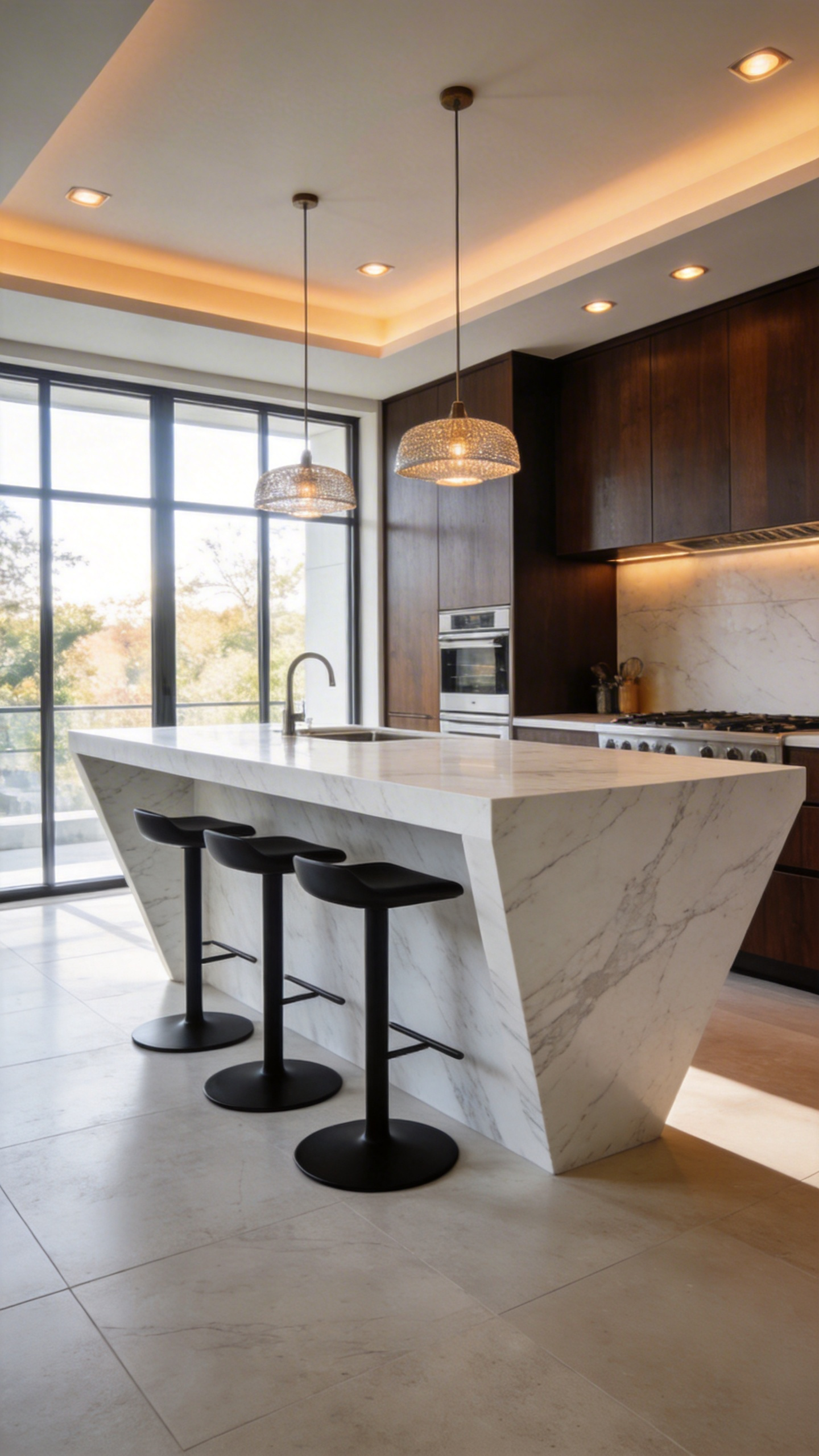
True comfort requires careful social engineering. Dual-tier islands address the awkward height differences between a standing cook and a seated guest. A raised 42-inch tier effectively aligns social sightlines. Conversation creates a sense of equality. This vertical offset serves a functional purpose by hiding culinary clutter. Ideally, it acts as an acoustic buffer, dampening the sharp clatter of food preparation when Maximizing Space and Functionality with a Modern Kitchen Island.
Material selection deeply impacts the sensory experience. Designers incorporate mixed material transitions to manage vibration. Pairing a cold stone prep surface with a thick timber eating bar is strategic. Wood has a lower resonant frequency than stone. It absorbs the chill of the room and dampens sound. Combining these structural and tactile elements creates a space that feels engineered for human connection.
6. Cantilevered Engineering: Maximizing Legroom Without Visual Clutter
Cantilevered engineering solves a century-old design conflict. It balances human comfort with strict architectural purity. This “weightless” aesthetic traces its DNA back to the 1920s Bauhaus movement. Designers like Marcel Breuer removed chair legs to create floating seats using tubular steel. We apply this same “industrial honesty” to the kitchen. The materials perform the heavy lifting, leaving the human experience unencumbered.
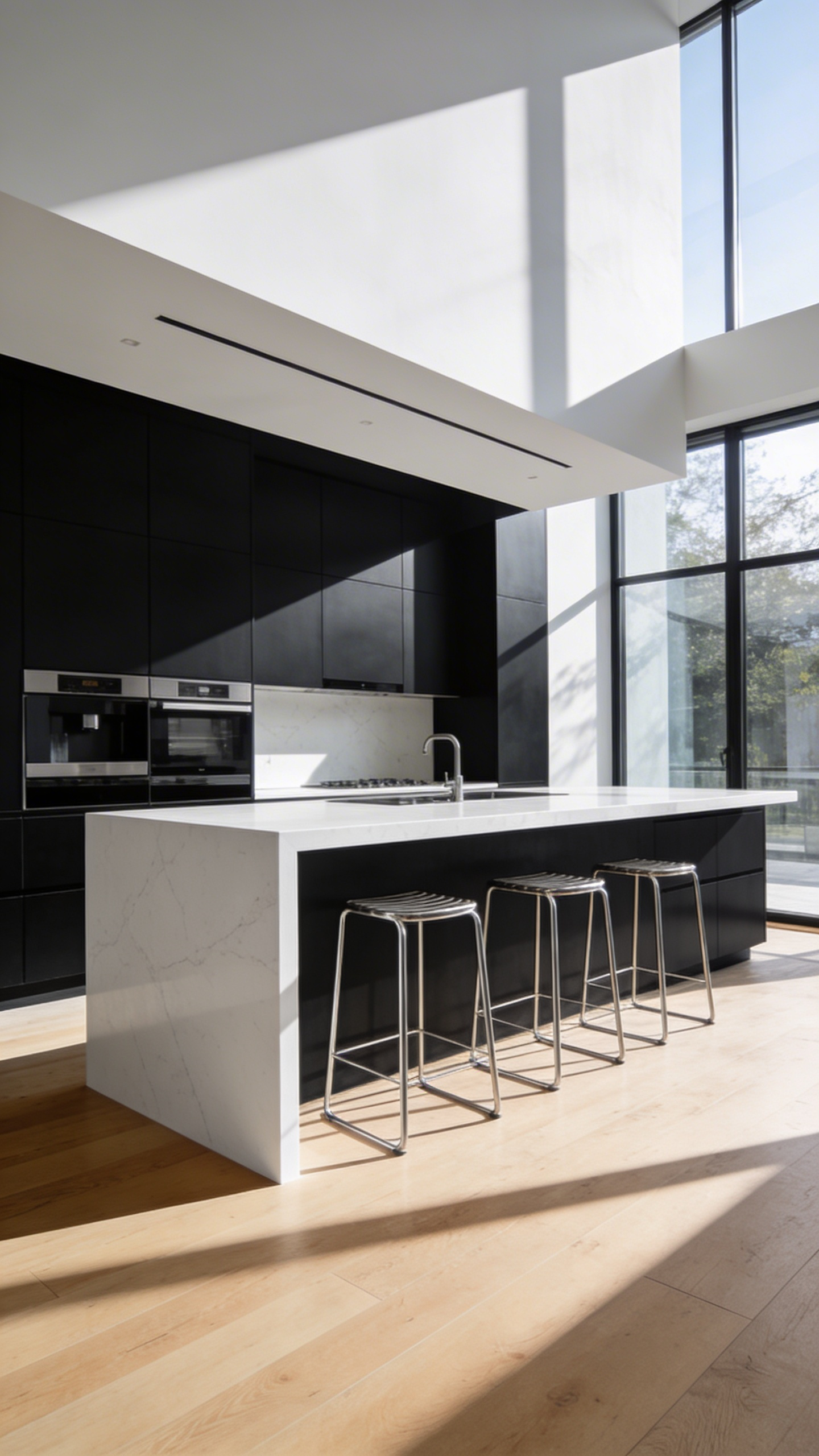
Engineers utilize “hidden bones” to achieve this hovering effect. Typically, 1/2-inch steel I-braces resist the intense “bending moment” where the counter extends. Visual legs or bulky corbels become unnecessary. Structural physics dictates a strict “70/30 Rule” for safety. Ideally, 70% of the countertop mass rests on the cabinetry, while only 30% floats as a cantilever.
Material selection plays a pivotal role in this structural balancing act. Granite is classic, but sintered stones like Dekton are the modern favorites. Because they possess immense flexural strength, these “ultra-compact surfaces” require less reinforcement than natural stone. Functionally, this engineering eliminates the dreaded “knee-knocker” support leg. Stools can slide freely, enabling a 360-degree social flow.
Seeing the floor continue uninterrupted beneath the seating reduces visual noise. This “open-floor-plane” creates a calming, airy atmosphere. Invisible steel support costs more than wood legs, but the result is a high-end, solitaire furniture feel.
7. The Multi-Level Approach: Separating Prep Zones from Dining Heights
The multi-level island offers a sophisticated solution for open-concept homes. It addresses the friction between a messy laboratory and a polished social stage. Separating the 36-inch prep zone from a 42-inch dining tier alters social dynamics. At this raised height, a seated guest’s eye level aligns perfectly with a standing cook. This parity creates an engaging “pub vibe.” Guests linger without feeling like observers. The raised tier acts as a visual shield. It hides vegetable scraps and unwashed pots from the living room view. The adjacent lounge remains a visual sanctuary, reducing cognitive friction for residents.
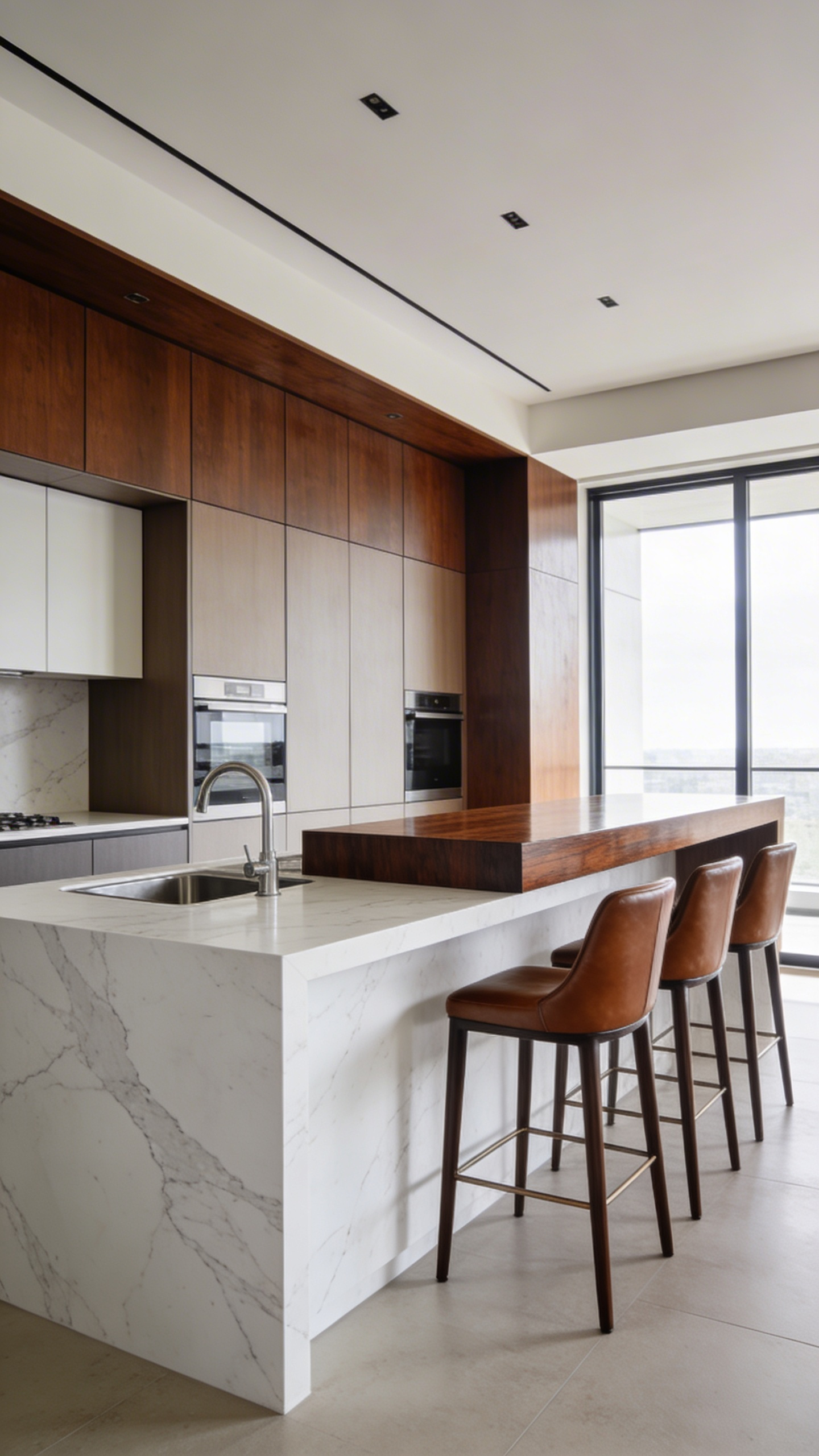
Successful designs often employ distinct material shifts to reinforce these zones. Designers frequently select cold, durable stone for the lower prep level. This material resists heat and handles high-energy cooking tasks efficiently. The upper dining tier often features “warm” materials like reclaimed wood or walnut. This tactile transition provides a crucial haptic signal. Touching soft, organic wood tells the body that work has ended. Wood surfaces also help dampen the acoustic “clink” of dining ware. This layered approach balances the ergonomics of labor with the sensory comforts of leisure.
8. Softening Geometry: Using Curved Ends to Enhance Traffic Flow
Kitchens demand fluid movement. Sharp angles often obstruct natural paths. Rectangular islands create rigid “stop-and-start” traffic patterns. Softening the geometry with curved ends establishes an ergonomic “slipstream.” This design removes the 90-degree “hard stop.” Users can pivot naturally around the perimeter without navigating sharp corners. This adjustment protects against the hip-height “bruise zone.” It creates an environment that feels physically safer, especially for active families.
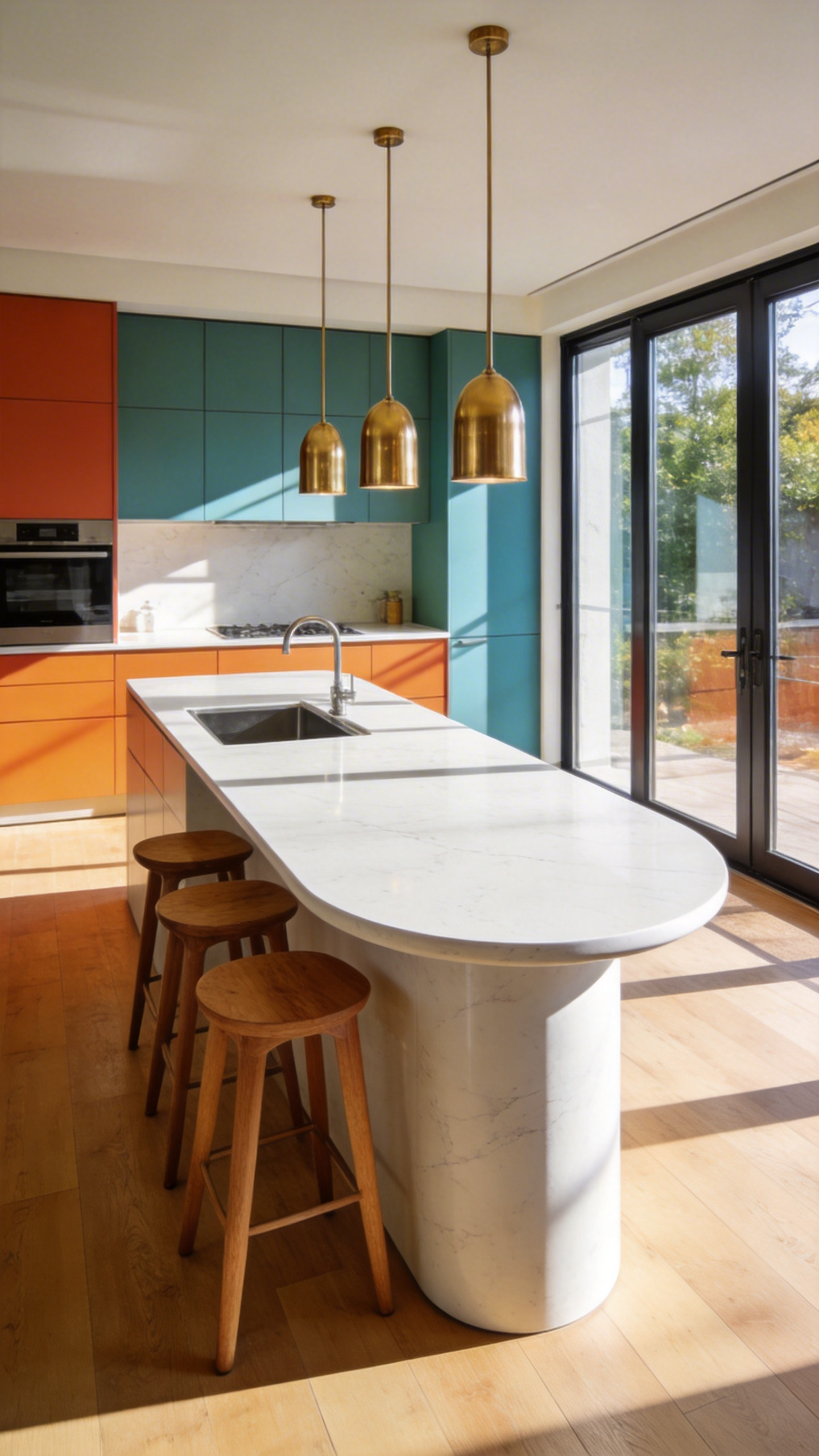
The shape of the island dictates social dynamics. Linear, diner-style seating creates barriers to conversation. A curved overhang fosters a “horseshoe” arrangement. This setup allows for natural eye contact between guests. The island functions as a connective social hub rather than just a utility station. The psychological impact of curves is profound. Because the brain perceives sharp angles as potential threats, rounded forms reduce subconscious stress. This turns the room into a place of rest.
Material selection plays a crucial role in executing these organic shapes. Achieving curves was historically labor-intensive. Today, thermoforming allows solid surfaces to bend into seamless, friendly forms. CNC-milled stone creates a substantial, luxurious texture. The move toward “Warm Minimalism” is both tactile and practical. It ensures the kitchen feels like a sanctuary rather than a clinical worksite.
9. Scale and Proportion: Balancing Island Mass with Visual Weight of Seating
Effective kitchen design negotiates a delicate balance between architectural scale and human scale. The island acts as a fixed, structural monolith within the room. This heavy mass requires careful calibration with the visual weight of the seating.
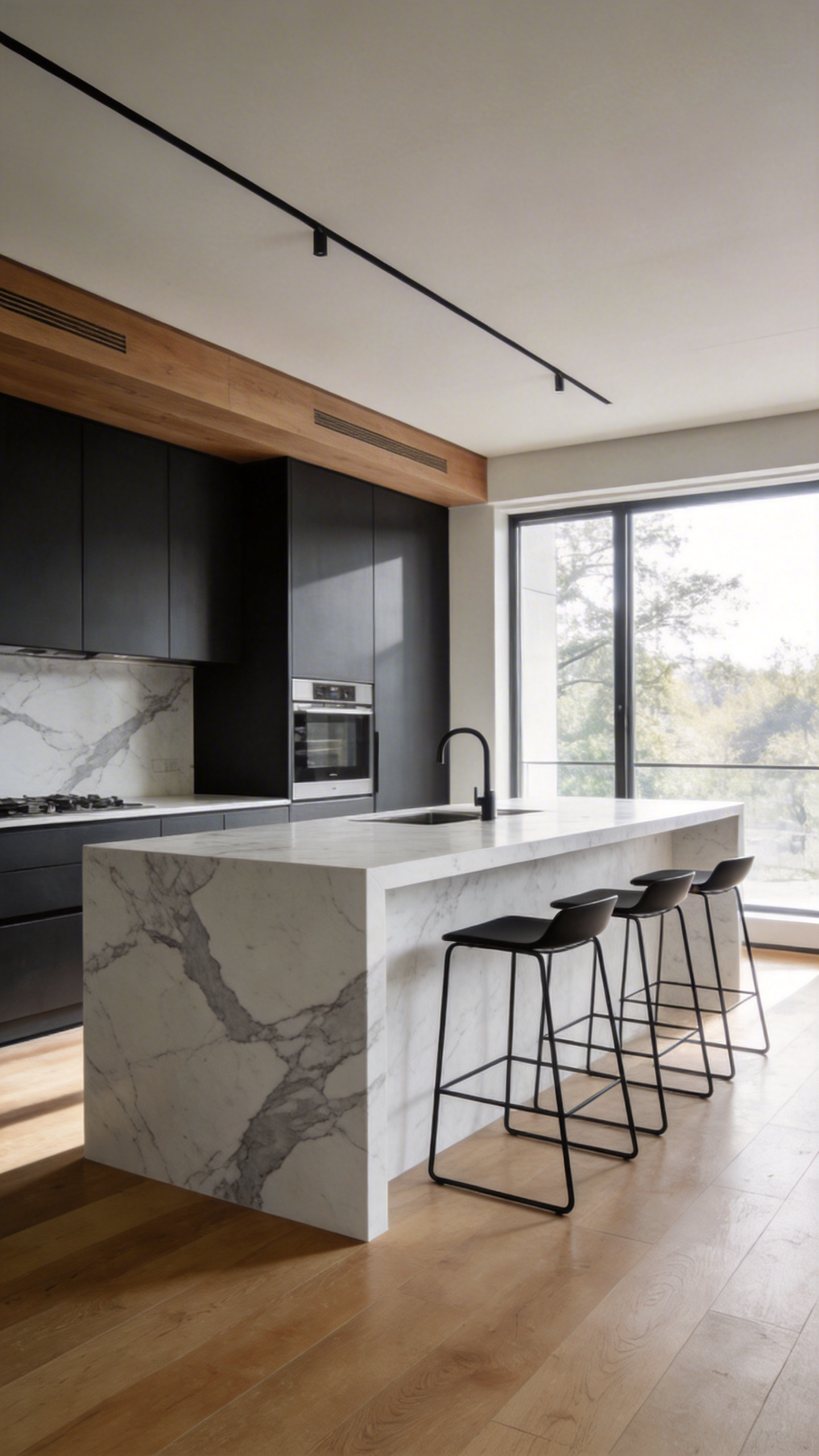
Modern waterfall islands cascade stone to the floor, creating a dense, bunker-like effect. To counter this impenetrability, designers utilize airy seating profiles. Metal-framed or backless stools allow the eye to travel through negative space. These backless designs serve as “ghosts,” preserving the island’s clean architectural silhouette.
High-back upholstered chairs add significant visual noise. While they signal a “destination” for lingering meals, they can easily crowd the focal point. Experts recommend low-back or sculptural options instead. These provide necessary comfort without breaking the countertop’s horizontal sightline.
Physical weight demands attention. Heavy stone slabs often require hidden steel strongbacks to prevent structural imbalance. Current trends favor a “return to legs” or furniture-style pedestals. Supporting the seating end with open legs breaks up the boxy, storage-heavy aesthetic. This approach successfully blends a heavy chef’s tool with a lighter social hearth.
III. The Seating Experience: Ergonomics Meets Aesthetics
The kitchen island has evolved significantly from its utilitarian roots. Historically, kitchens were strictly “back-of-house” zones. The 1950s introduced the “Eat Bar,” transforming the cook into a performer and the seated guest into an engaged audience. Creating a successful social hub requires adhering to precise ergonomic mathematics.
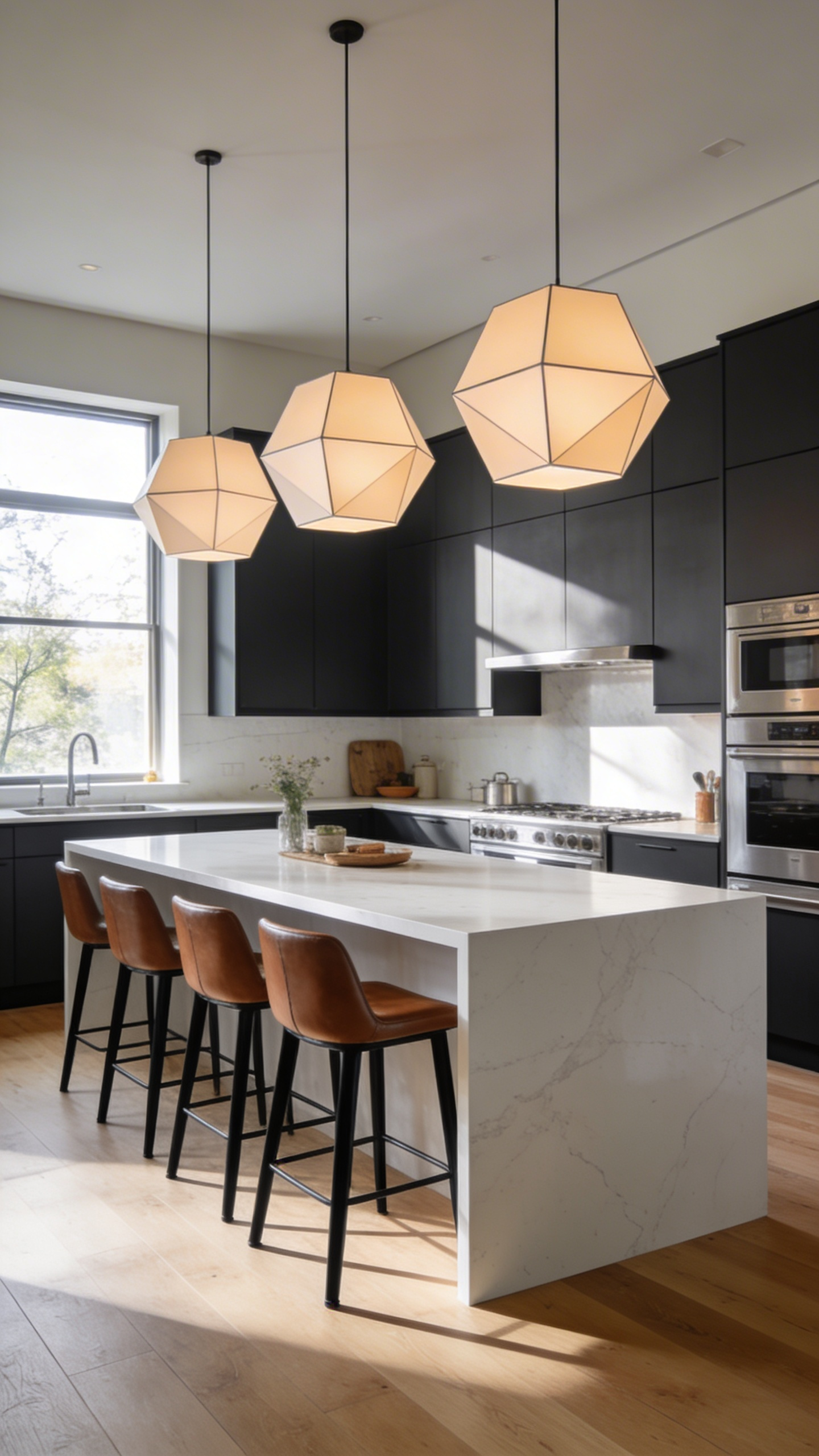
The “10-Inch Rule” dictates the ideal vertical clearance between the seat and the countertop. For a standard 36-inch counter, a seat height of 24–26 inches is essential for comfort. Otherwise, guests suffer from uncomfortable “knee-knocking” or feel oddly low. Proper elevation fosters “Eye-Level Equality.” At bar height, a seated guest’s eyes align perfectly with a standing host. Conversation flows more naturally, creating a sense of social parity.
The tactile experience influences how long guests remain seated. Natural wood edges feel warm due to low thermal conductivity. Stone surfaces pull heat away from the skin, often feeling cold against resting forearms. To mitigate “sharp edge” fatigue, many designers employ rounded or waterfall profiles for the seating edge.
The choice of stool must balance visual lines with human biology. Backless stools preserve clean visual sightlines. They hide neatly under the counter for a monolithic look. However, they lack lumbar support, leading to postural fatigue after just 20 minutes. Low-back stools offer a smart compromise. They provide necessary support without breaking the room’s visual horizon.
10. Performance Textiles: Choosing Upholstery That Ages Gracefully
Kitchen island seating faces a unique set of challenges. It must survive constant sliding friction and volatile cooking odors. Selecting upholstery requires balancing sensory appeal with structural resilience. Unlike leather, fabric shouldn’t develop a vintage patina here. It must maintain a “new-forever” integrity against oils and spills.
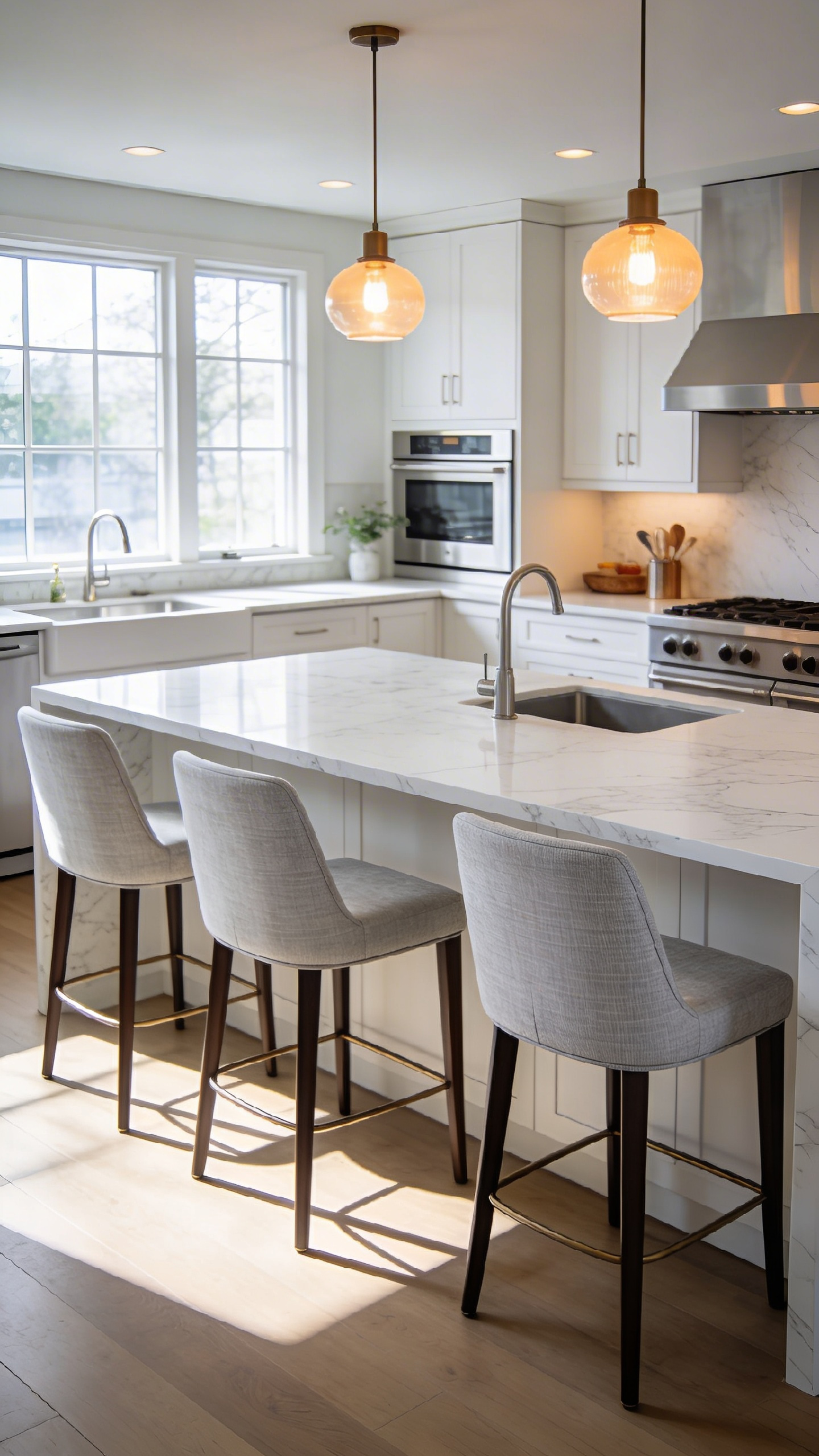
Consider the technology behind the textile. Solution-dyed acrylics resist UV rays, but Crypton technology offers a distinct advantage indoors. It integrates a permanent moisture barrier to protect the underlying foam. Silver ion additives inhibit bacteria, preventing trapped food smells. Your seating avoids absorbing the kitchen’s atmospheric odors.
You must analyze physical durability. Friction from denim often causes synthetic fibers to pill. Prioritize fabrics with a high Pilling Grade over simple rub counts. Performance velvet is a fail-safe option. Its dense pile naturally resists snagging while offering a luxurious tactile experience. For a linen look, choose multi-tonal weaves. These heathered textures provide visual camouflage for inevitable crumbs.
Aesthetic longevity depends on maintenance. Cooking grease eventually oxidizes and binds to fibers. Wash the entire seat annually with pH-neutral soap to remove invisible films. This prevents the fabric from looking dull or dingy over time.
11. The Physics of Support: Backed vs. Backless for Prolonged Conversation
The choice between backed and backless seating fundamentally dictates your kitchen’s social narrative. This structural decision determines how long guests actually linger. Physically, backless stools demand “active sitting.” You must engage core muscles to maintain upright posture. This constant micro-adjustment triggers muscle fatigue after approximately twenty minutes. For quick transitions or breakfast rushes, the kinetic freedom of a backless perch works perfectly.
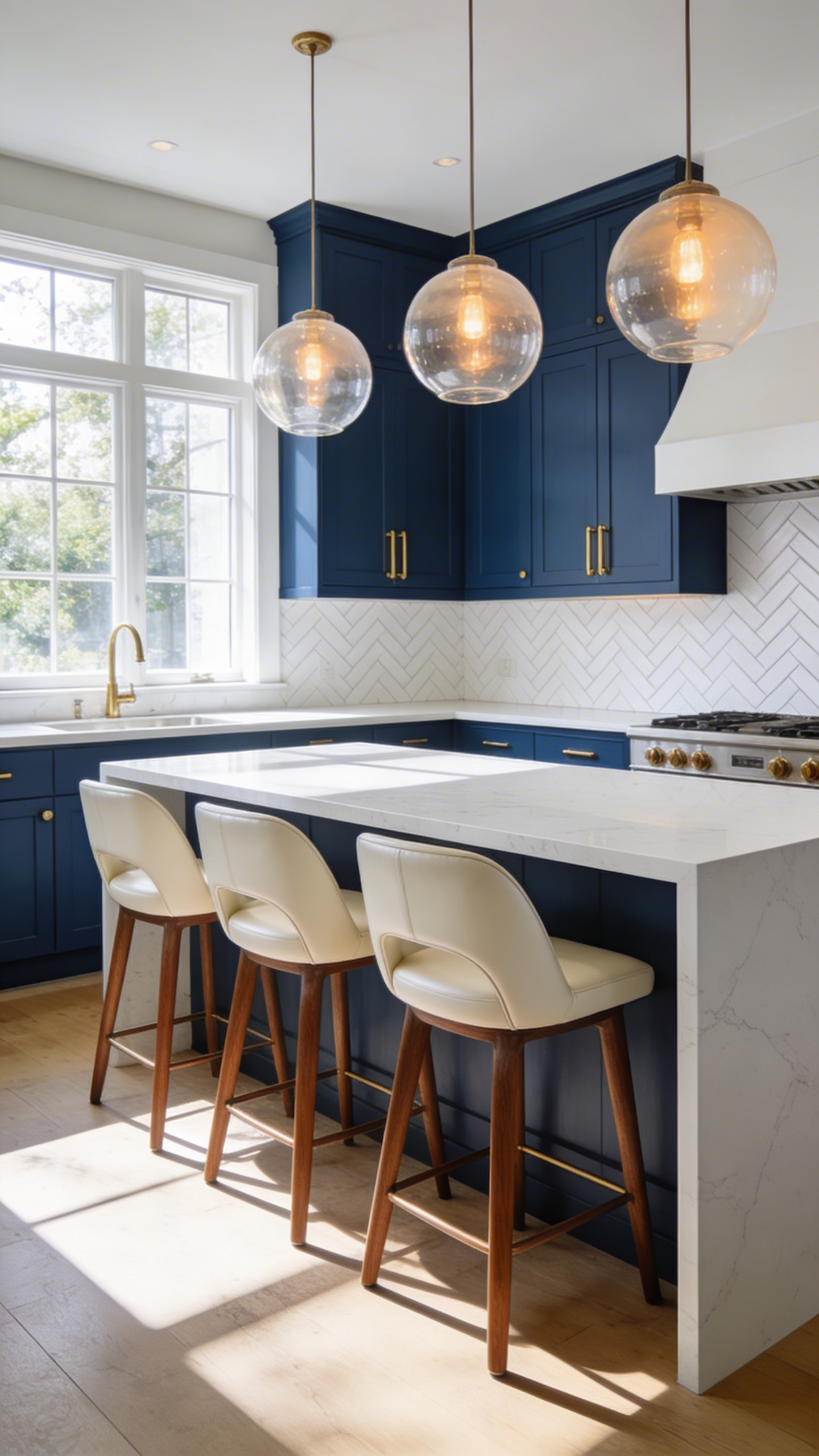
If you desire deep, ninety-minute conversations, physics favors structural support. A well-designed backrest provides a necessary “sacral stop” for the spine. By supporting the lower back, the chair signals the nervous system to rest. The sitter shifts their energy from balancing to engaging socially. Backed stools create a stabilizing “cockpit” effect around the user. This physical security encourages forward-facing intimacy and sustained eye contact.
Introducing high backs can disrupt a room’s visual flow. Architecturally, backless stools preserve the countertop’s uninterrupted horizon line. They create “visual silence.” High backs act as a “picket fence” between the kitchen and living areas. Designers often utilize low-profile backs or clear acrylic materials as a compromise. These options offer necessary lumbar support without breaking the room’s visual plane. Ensure your selection includes a sturdy footrest to maintain healthy circulation during those long evenings.
12. Swivel Mechanisms: Facilitating Dynamic Social Interaction
The swivel mechanism acts as the “silent engine” of a modern kitchen island. It transforms static seating into a fluid social theater. Without this feature, turning to face a guest requires a stiff, noisy adjustment. High-quality mechanisms facilitate “conversational kineticism.” They allow the torso to rotate effortlessly, mimicking biological fluidity. A guest can track a moving cook without physical barriers, turning meal prep into a shared performance.
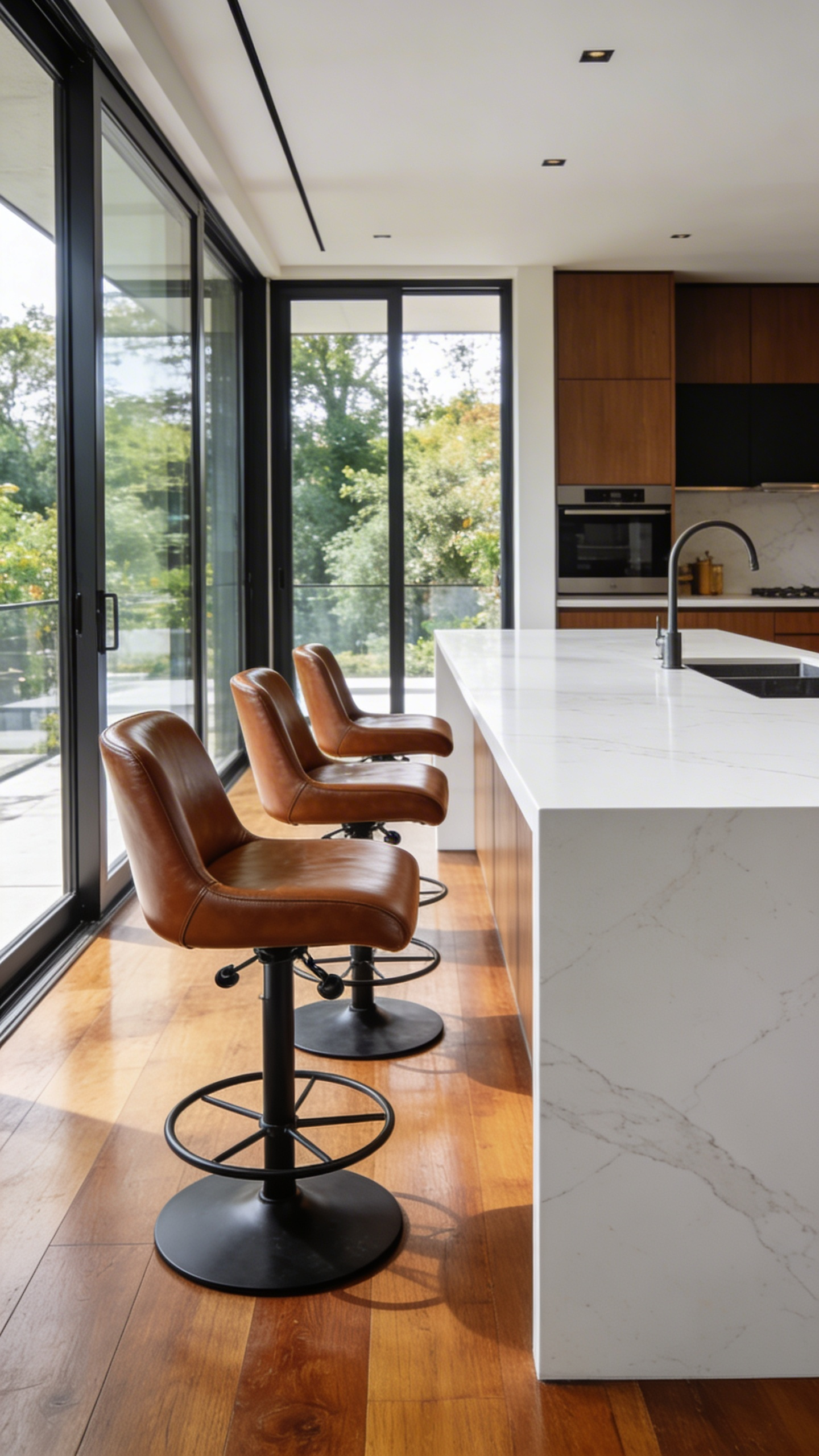
Designers often debate the choice between 360-degree freedom and “memory return” mechanisms. A full 360-degree swivel offers total agency for open-concept homes. However, it can lead to a cluttered aesthetic when seats are left askew. Memory return units automatically rotate the seat back to center when unoccupied. They preserve “visual silence,” ensuring the kitchen looks staged and orderly even after use.
The tactile experience defines true luxury. Entry-level stools often use nylon bushings that may eventually squeak or stutter. High-end versions utilize industrial-grade steel ball bearings encased in lubricated raceways. These create a “silent glide” sensation, feeling akin to moving on oil. A dampening effect prevents wild spinning, communicating stability and craftsmanship the moment you sit.
13. Footrest Integration: The Hidden Detail of Seated Comfort
Ideally, a kitchen island encourages guests to linger. Actual “dwell time” relies heavily on physical grounding. A stable footrest creates a necessary state of “physical quiet” by anchoring the body’s kinetic chain. Without this support, core muscles subconsciously overwork to maintain balance. This exertion causes “happy feet” or fidgeting. Proper support prevents the uncomfortable “pins and needles” sensation caused by seat edges constricting blood flow. The footrest dictates social success just as much as the island’s surface.
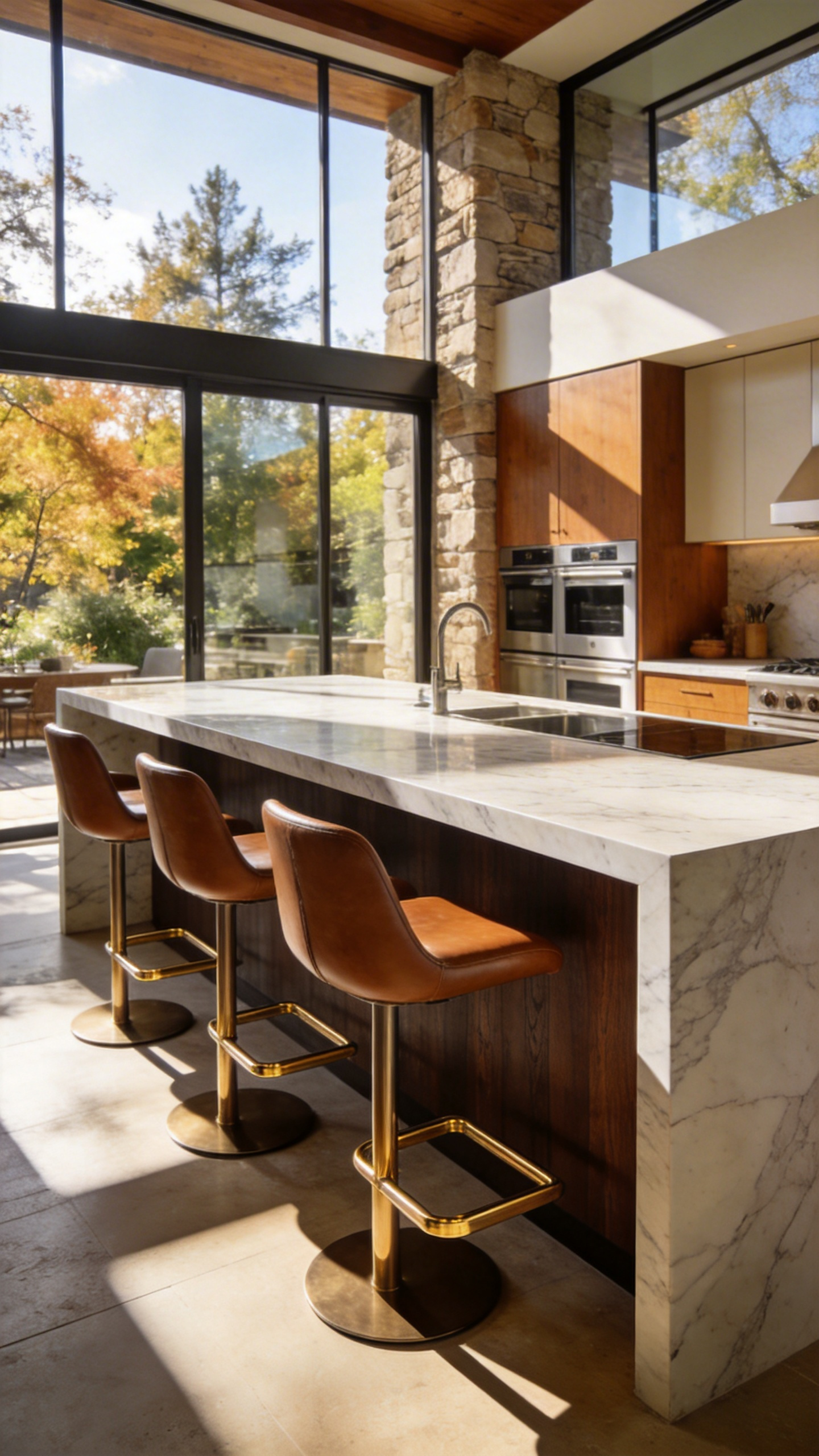
Historically, these rails transitioned from commercial taverns to residential spaces. Yet, many modern designers hesitate to install fixed brass rails. They fear creating a commercial “chain restaurant” aesthetic that disrupts a minimalist home. High-end design favors architectural integration over bolt-on hardware. A cantilevered base creates a deep “shadow gap.” This approach provides a structural, monolithic landing zone for feet without disrupting the visual lines.
Texture and temperature matter immensely. Cold chrome rails often deter guests from resting bare feet. Aged copper or wood offers a restorative, warm sensory experience. Dimensions are critical for ergonomics. The rest should sit 8 to 10 inches below the seat to avoid leg compression. A recessed depth of 6 to 8 inches is required to accommodate the full foot arch. These hidden details transform a beautiful island into a truly habitable space.
IV. Sensory Atmosphere & Lifestyle Integration
The kitchen island has evolved into a “Third Space” for social gathering. Historically, kitchens were isolated laboratories. Adding seating transforms the host from a servant into an active participant. Designers now prioritize the “Social Triangle” over the traditional work triangle. This layout optimizes sightlines between the cook and guests. The seating configuration acts as a behavioral nudge. L-shaped arrangements foster deep conversation by mimicking a round dining table. Linear seating encourages quicker, transient interactions.
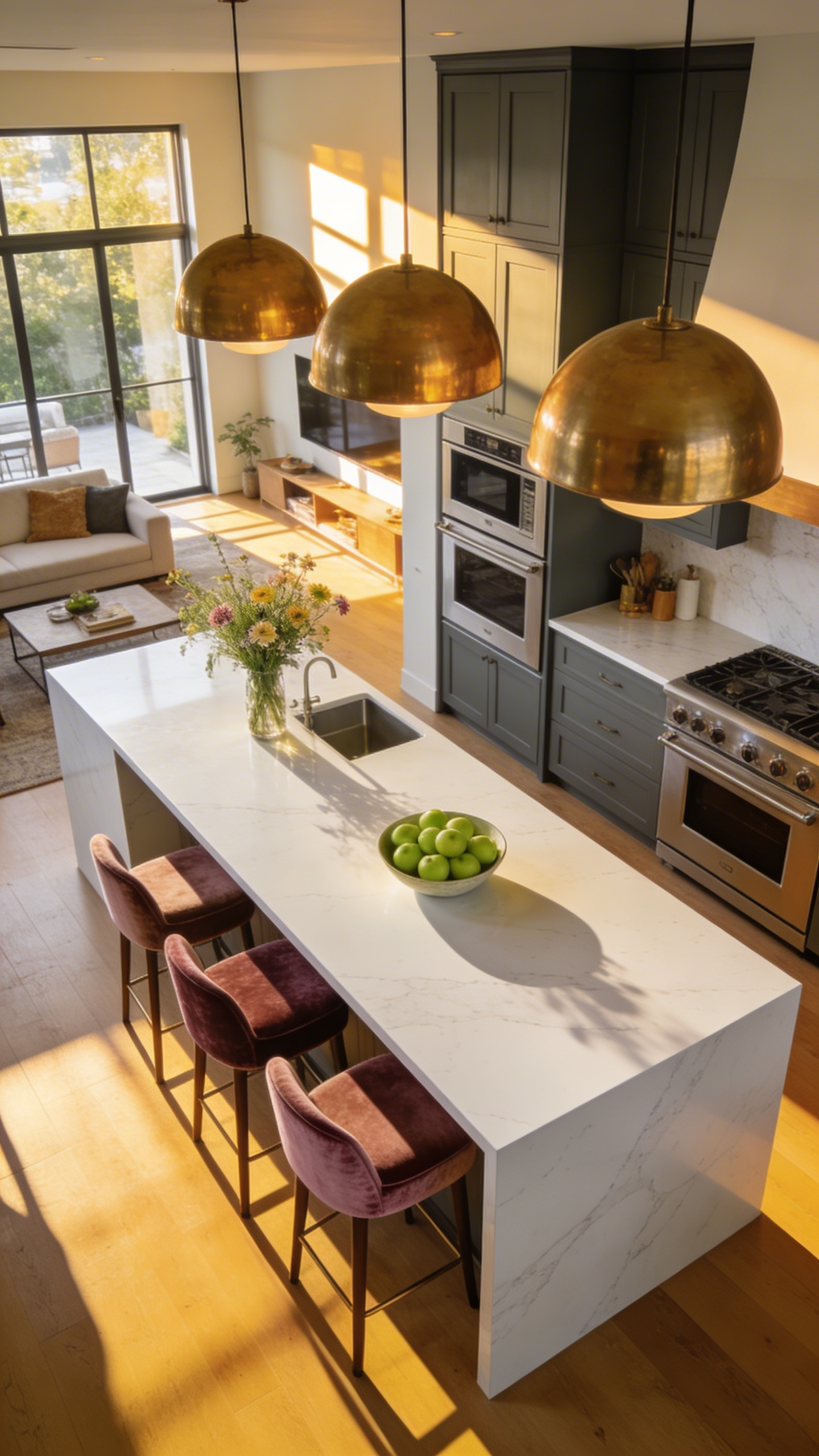
Material selection profoundly influences the sensory experience. Kitchens naturally contain hard, reflective surfaces that amplify noise. Incorporating upholstered stools or leather accents softens the acoustic environment. “Material storytelling” can define zones without physical barriers. Pairing cool marble for prep work with warm reclaimed wood for seating creates tactile contrast. This signals “cool for work, warm for rest.”
Lighting and invisible technology complete the atmosphere. To maintain open visual connections, induction hobs with downdraft extraction replace bulky hoods. Layered lighting shifts the mood from functional to lounge-like. Toe-kick LEDs make the island appear to float, reducing visual bulk. Hidden wireless charging keeps surfaces clutter-free. These elements create a frictionless environment that seamlessly supports modern lifestyles.
14. Pendant Zoning: Defining the Seating Area with Targeted Downlight
Pendant zoning serves as a powerful architectural tool in open-plan spaces. It uses light to create non-physical boundaries. By suspending fixtures over an island, you transform a utilitarian surface into a distinct “room within a room.” This concept roots itself in the “Campfire Effect.” Humans feel biologically drawn to pools of light set against darker backgrounds. This high-contrast illumination anchors people, effectively encouraging intimate conversation.
Material selection is critical to achieve this sanctuary. Opaque shades made of dense materials like spun metal or ceramic function best. Unlike translucent glass, these materials force beams strictly downward, sculpting a sharp, defined footprint. Technical precision enhances this zoning effect. Designers recommend a Definitive Guide to Kitchen Lighting Over Island Design with a 30° to 60° beam angle to illuminate the seating area without causing glare. The light remains focused on the counter and the occupant, not the floor.
These fixtures act as vertical architecture. In modern layouts, they replace missing walls to visually ground the floating island. Proper placement is essential for comfort. Ideally, hang fixtures so the bottom sits at eye level, roughly 60–66 inches from the floor. Center the light over the occupant’s lap to highlight the activity zone. Integrate warm dimming technology. This feature shifts the light’s texture from a bright, neutral 3000K to a rich, candle-like 2200K. This sensory transition signals the psychological shift from morning productivity to evening socialization.
15. Acoustic Management: Using Upholstery to Dampen Kitchen Noise
Modern open-plan kitchens often suffer from unintended “acoustic coldness.” Hard surfaces like granite and stainless steel reflect nearly all high-frequency sounds. This clatter triggers the “Lombard Effect,” where occupants involuntarily raise their voices to compete with background noise. Integrating upholstered seating is a strategic engineering solution to dampen this auditory chaos.
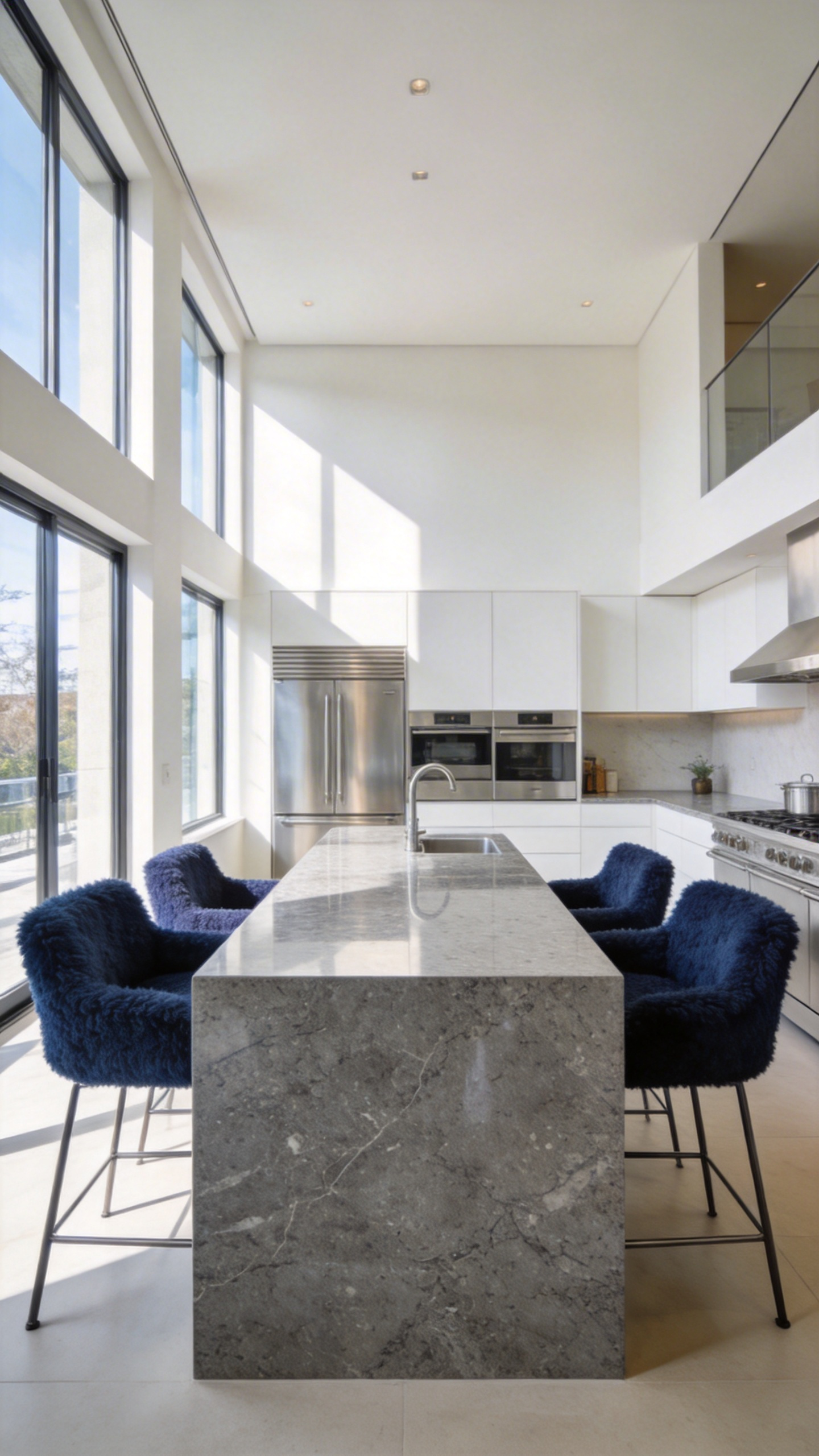
Through a process called viscous loss, porous fabrics like heavy wool or boucle act as localized “sound sponges.” Friction within the fibers converts sound energy into microscopic amounts of heat. For maximum dampening, prioritize high-density textiles over reflective materials like smooth leather. If leather is required for durability, designers often use micro-perforated options to maintain acoustic absorption.
The stool’s internal structure contributes significantly to noise control. Models featuring at least two inches of high-resiliency foam function as “mid-field” buffers. By tucking these soft layers against the island face, you prevent sound from ricocheting toward the living room. Experts recommend solid wood frames over metal, as wood naturally absorbs vibration rather than amplifying it. This “softened” transition creates a distinct mini-acoustic environment. Conversations remain intimate and clear, even amidst the rhythmic symphony of cooking.
16. Hidden Connectivity: Concealing Tech for the Work-from-Island Era
The “Work-from-Island” era has transformed the kitchen island into a high-functioning command center. Achieving this balance requires a sophisticated blend of material science and custom millwork. Electrical codes once mandated unsightly side-mounted outlets. However, the 2023 NEC update restricts below-counter installation, prompting a significant design pivot. Designers now favor pop-up power docks in luxury finishes like knurled brass. These functional necessities become sensory details that complement your faucet fixtures.
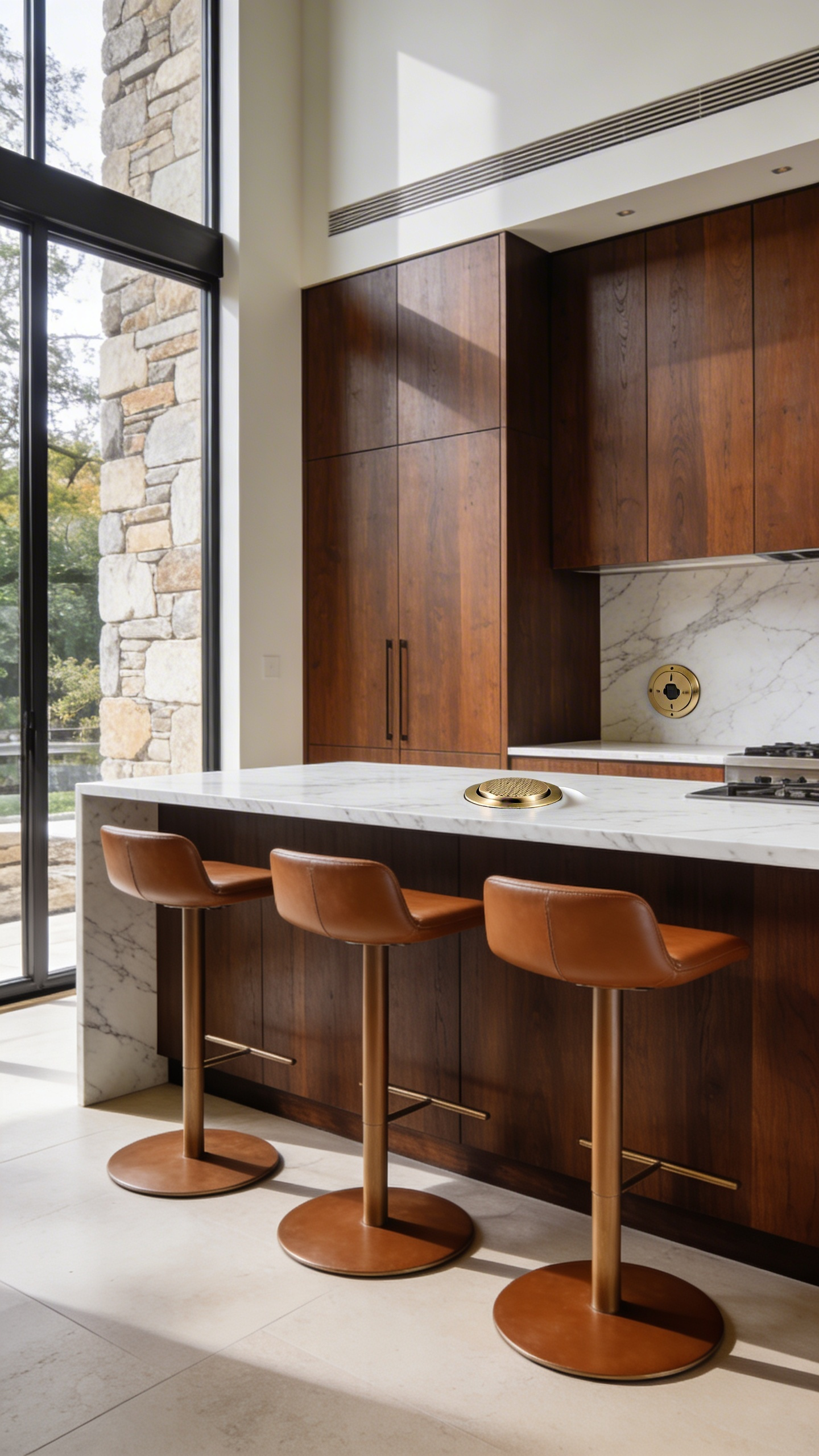
Technology can virtually disappear into the material itself. Inductive charging coils can now function through solid stone surfaces. Fabricators route the stone underside to a precise 10–12mm thickness. Your quartz countertop charges devices without breaking the visual line. High-end fabricators often install “charging halos” that glow through translucent stone to indicate active zones.
“Kinetic” solutions allow the island to shape-shift based on your needs. Motorized sliding countertops can slide open to reveal hidden tech troughs for monitors. Internal “docking drawers” keep laptops charged safely inside cabinetry, effectively protecting them from spills. These hidden innovations ensure the island remains a beautiful social hub, not just a cluttered desk.
17. The Conversation Arc: Semi-Circular Layouts for Better Connection
Traditional kitchen islands often force guests into a rigid, linear formation. This “sociofugal” arrangement mimics a bus stop, limiting interaction to immediate neighbors. The “Conversation Arc” introduces a semi-circular layout designed specifically for connection. Biologically, the human brain naturally favors these softer curves. Studies in neuro-architecture suggest that rounded forms can significantly reduce stress levels. This “sociopetal” shape directs diners toward a common center. It encourages frequent eye contact. The island becomes a communal round table rather than a generic fast-food counter.
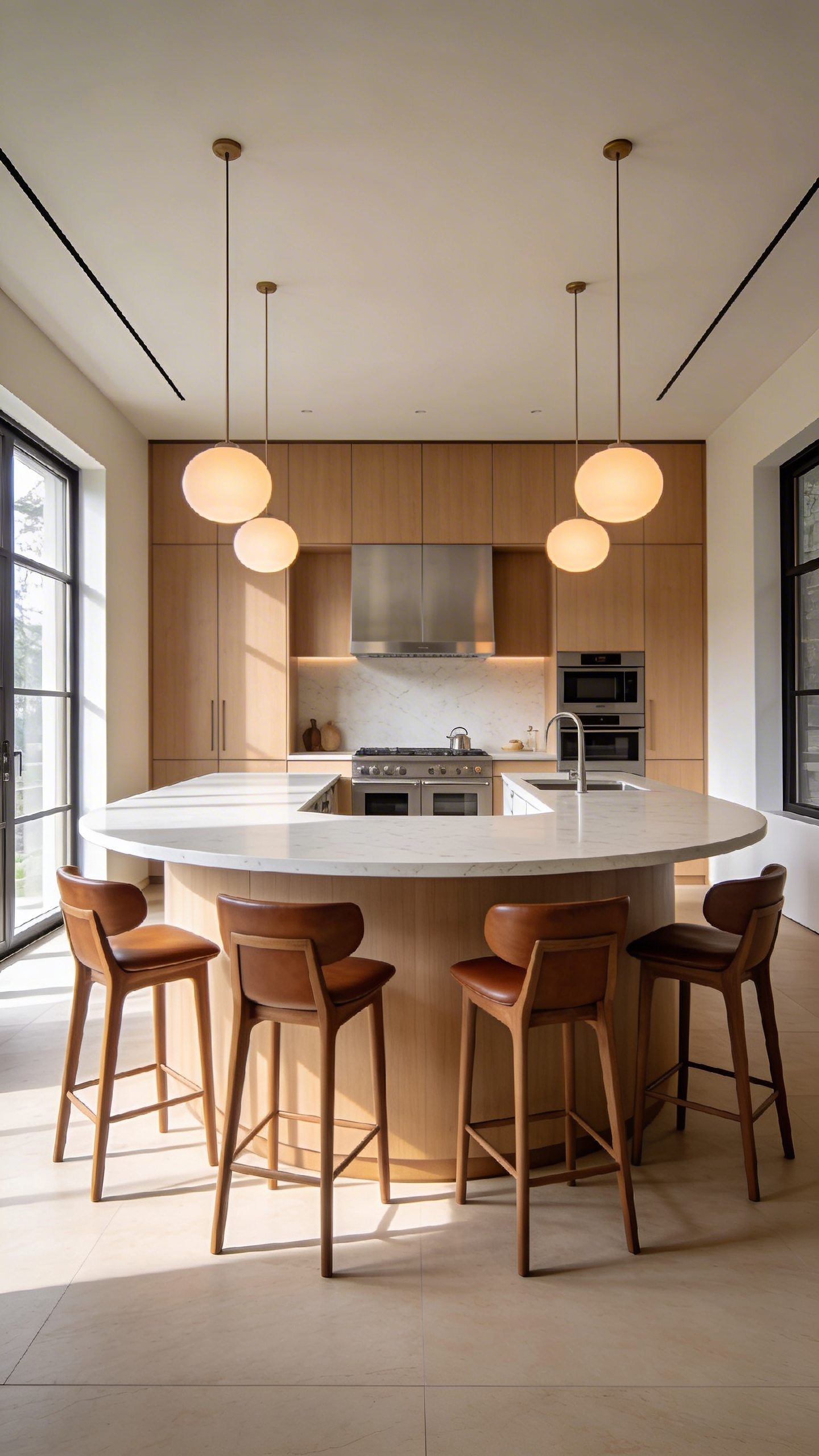
Achieving this organic shape requires specific material expertise. Builders often utilize bendable plywood or flexible tambour panels to navigate the curve for the base. Stone fabricators must employ CNC machines to cut precise, sweeping radii in quartz or granite. Because the curve pushes seating outward, hidden steel supports become essential. These structures allow for a deep overhang without risking stone fractures. This design moves beyond the utilitarian “Frankfurt Kitchen” model. It transforms the room into a sensory experience of true belonging.
Frequently Asked Questions
How much space do you need for a kitchen island with seating?
To ensure comfortable movement, you should allow for a minimum of 36 to 42 inches of clearance between the island and the surrounding cabinets or walls. For the seating area itself, each person requires at least 24 inches of width and 12 to 18 inches of depth for legroom, depending on the height of the counter.
What is the ideal overhang for an island with seating?
The standard overhang for a 36-inch high kitchen island is 12 inches, though many luxury designs opt for 15 to 18 inches for enhanced comfort. If the island is bar height (42 inches), a 12-inch overhang is usually sufficient. Deep overhangs over 12 inches typically require structural support like hidden steel brackets.
Should a kitchen island with seating be the same height as the counters?
While a uniform 36-inch height (counter height) offers a clean, expansive workspace, many homeowners prefer a multi-level design. A raised 42-inch tier (bar height) is excellent for separating the prep zone from the dining area and helps to hide kitchen clutter from the rest of the home.
Conclusion: Curating a Space for Connection
The kitchen island is far more than a functional prep surface. It is a catalyst for intimacy. By shifting guests to a shoulder-to-shoulder orientation, the design lowers social anxiety and encourages organic conversation. Selecting tactile materials like leathered stone or warm wood transforms a cold workspace into a welcoming sensory anchor. This “democratic surface” effectively dissolves the traditional hierarchy between the cook and the guest. These curated design choices turn brief “perching” moments into deep, meaningful connections.
As our homes evolve, the kitchen island with seating will remain the vital “gravity well” for modern family life. Future renovations must prioritize the “Social Triangle” over mere efficiency or visual aesthetics. Consider how elements like overhang depth and edge curvature directly influence physical comfort and lingering. Start by auditing your current layout to see if it fosters interaction or reinforces isolation. Finally, curate a space where the materials invite touch and the architecture invites conversation.