When exploring the most sophisticated bathroom tile ideas, many homeowners believe a bathroom must remain static to be beautiful. We often select materials solely for their ability to look “brand new” indefinitely. However, this mindset creates a cycle of “fast fashion” within our own homes. When surfaces inevitably scratch or fade, we view them as failures. Yet, this approach ignores the inherent value of material aging. In reality, a true sanctuary should engage the senses through depth and evolution. It should utilize artisanal finishes that tell a story over time.
The “Curatorial Promise” offers a robust alternative to this disposable culture. Instead of seeking perfection, this philosophy embraces “living finishes” that mature alongside the home. For instance, unlacquered brass and honed stone develop a rich patina over time. Unlike polished porcelain, these materials do not lose value when they interact with the environment. Thus, “visible history” becomes a feature rather than a flaw. Indeed, expert design involves understanding how distinct textures endure moisture and oxygen. This leads to some of the most enduring luxury bathroom flooring ideas available today.
This guide reveals the strategic application of these material science principles. We examine the “perfect imperfection” of artisan Zellige tiles and their unique light diffusion. Additionally, we analyze the chemical sophistication of Tadelakt plaster as a seamless, hygienic alternative. Furthermore, we explore how tactile surfaces and biophilic design can effectively lower cortisol levels. By shifting from routine to ritual, we create spaces that transcend the trend cycle. Ultimately, your bathroom becomes a collection of enduring, sensory-rich anchor points.
Section 1: The Physics of Materiality & Light
Designing a bathroom requires understanding how light interacts with surface topography. Specifically, this physical relationship defines the room’s resulting atmosphere. Standard machine-pressed tiles often produce uniform specular reflection. Consequently, the space can feel clinical or flat. Conversely, hand-fired tiles like Zellige utilize “sub-specular scattering.” Because surface angles vary slightly, light does not bounce back in a single direction. Instead, it creates a liquid shimmer or “dance.” Therefore, the wall becomes a rhythmic, vibrating texture rather than a static boundary.
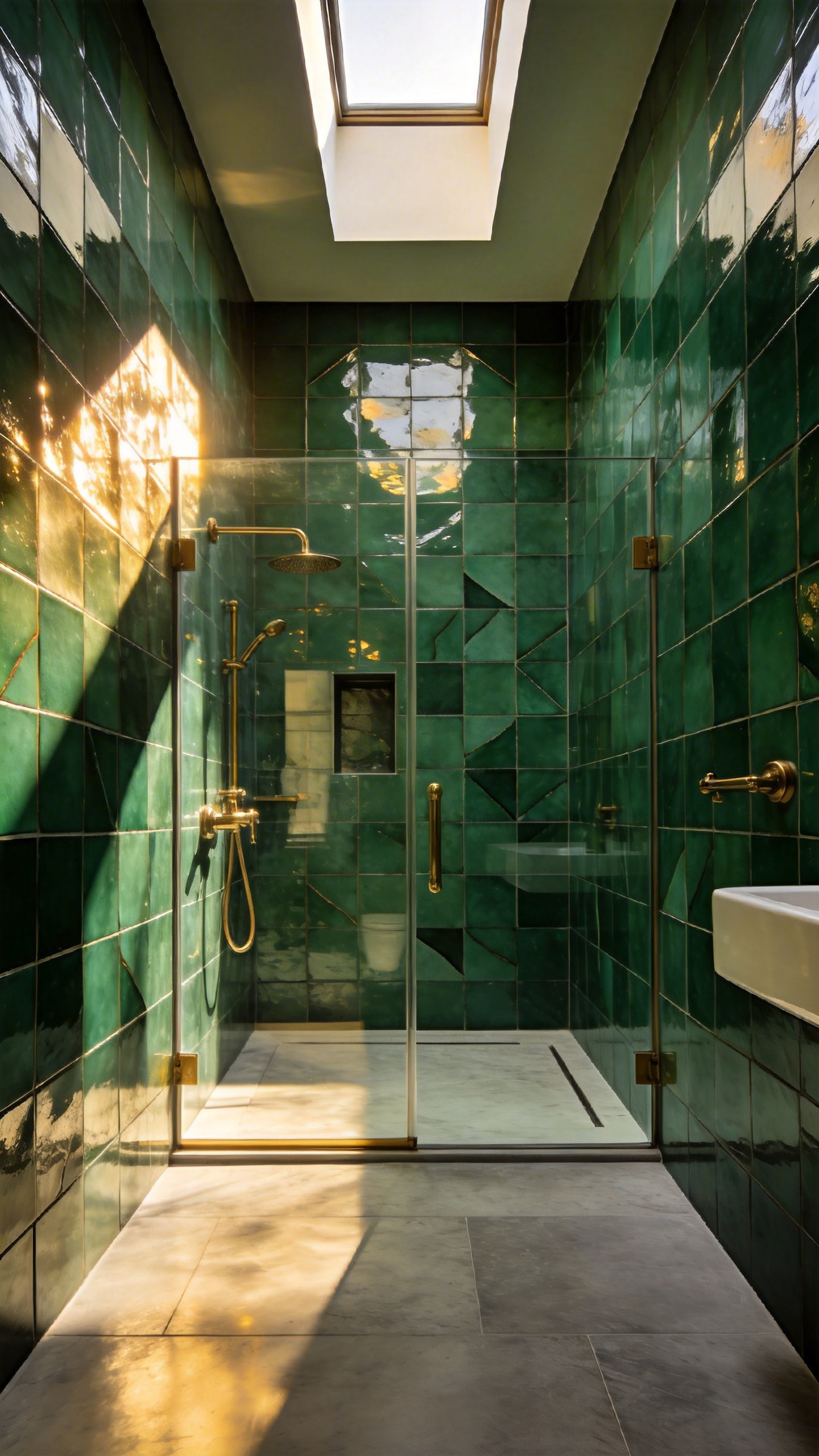
Beyond surface reflection, material depth profoundly alters spatial perception. Uniquely, glass tiles and thick glazes leverage Sub-Surface Scattering (SSS). Unlike opaque porcelain, translucent materials allow light to penetrate the surface. Subsequently, photons scatter and reflect off the adhesive behind the tile. This interaction creates an internal glow. Thus, walls feel less like solid barriers and more like portals. This effectively adds perceived volume to small footprints. Selecting the right soulful bathroom tile designs can turn a confined space into an ethereal retreat.
Finally, water acts as a dynamic lens within the bathroom. When a tile becomes wet, the moisture changes the material’s refractive index. Suddenly, a matte stone surface blooms with vibrant color saturation. Designers often refer to this transformation as the “Riverbed Effect.” Furthermore, water clinging to structured, ridged tiles creates kinetic shadows. Ultimately, mastering these physical properties turns a simple renovation into a rich, sensory environment.
1. The Science of Zellige: Utilizing Glaze Imperfections for Light Refraction
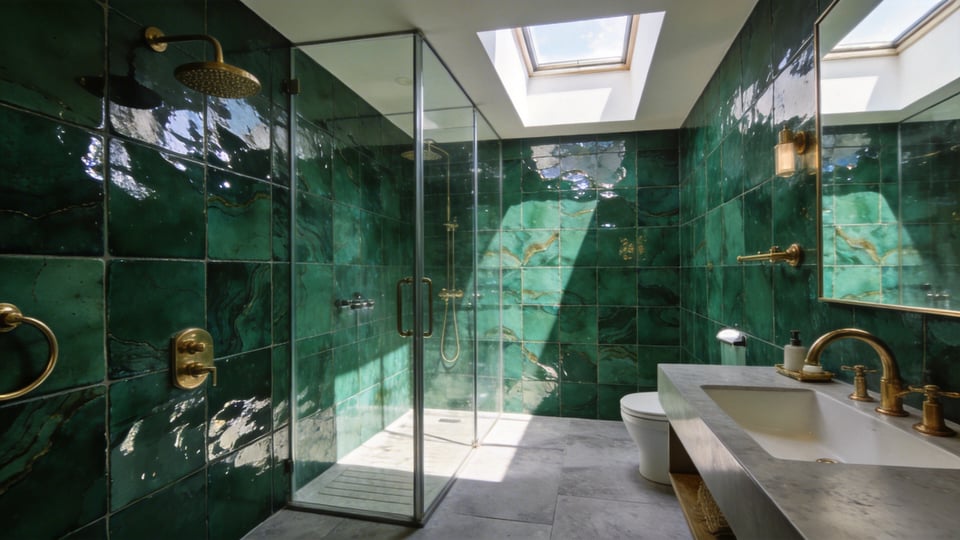
Modern tile production generally prioritizes uniformity to minimize glare. Conversely, the science behind Zellige tiles utilizes imperfections to masterfully manipulate light. This phenomenon begins with optical physics known as “undulated reflection.” Specifically, the hand-molded clay creates a surface full of microscopic ridges and valleys. Consequently, light hits the smooth peaks to produce a mirror-like sparkle. Simultaneously, the uneven depressions scatter light to create a soft, ambient glow. Thus, the surface prevents a bathroom from feeling cold or clinical.
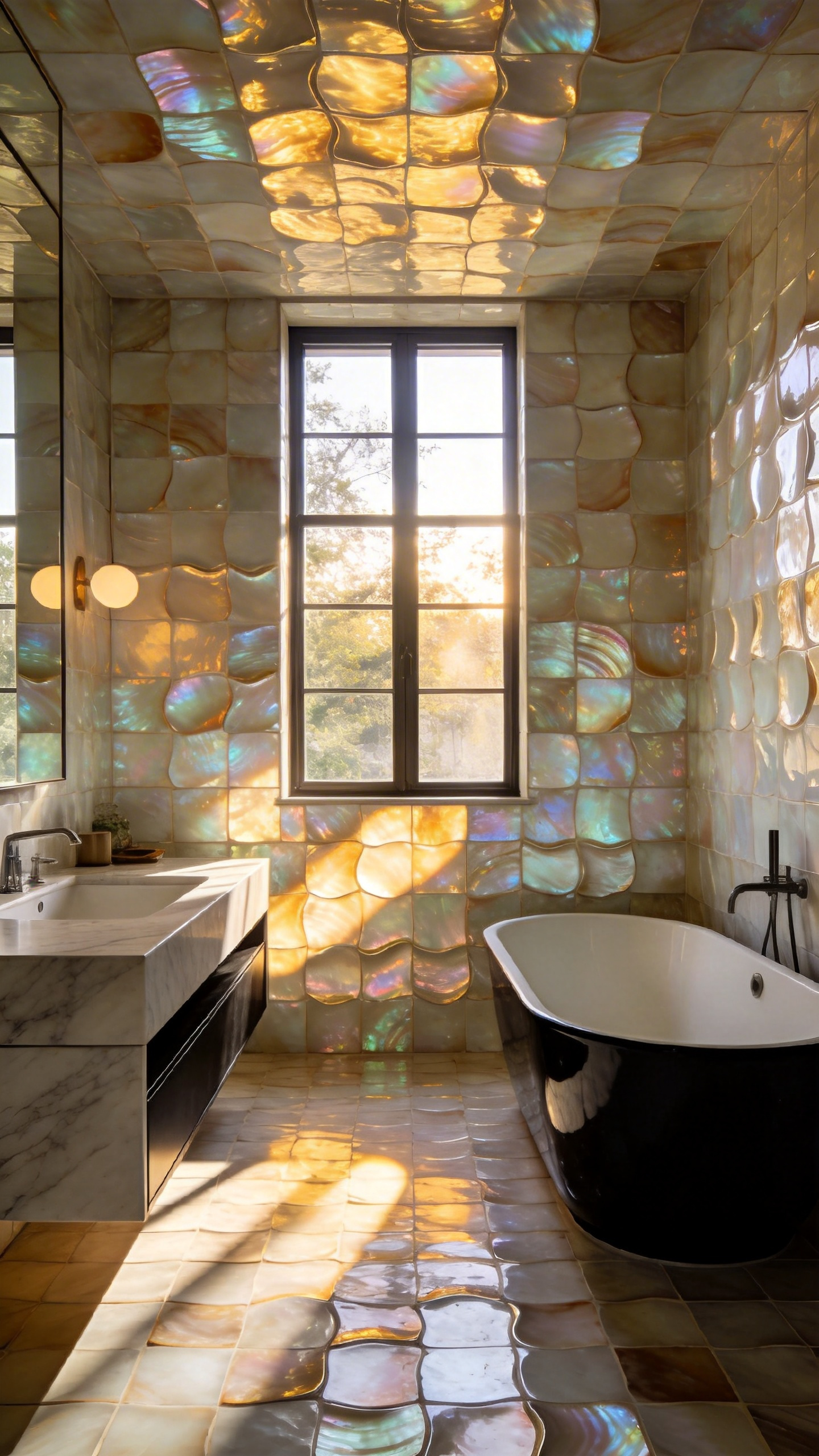
Beyond surface shape, the glaze chemistry adds significant visual depth. During cooling, the glaze shrinks faster than the clay body. As a result, a network of hairline fractures, called “crazing,” appears. Structurally, this is caused by a mismatch in the Coefficient of Thermal Expansion. Visually, however, these cracks act as internal prisms. Effectively, they trap light within the thick glaze layer. This creates a unique “watercolor” effect where the color appears suspended in glass.
Furthermore, traditional firing methods introduce textural variations like tiny pits from outgassing. These surface “defects” anchor shadows and break up harsh overhead lighting. Finally, hand-chiseled edges allow for minimal grout lines. Therefore, the installed wall becomes a continuous, shimmering sea of light. Ultimately, Zellige transforms a functional bathroom surface into an organic, living architectural feature.
2. Large-Format Porcelain: Minimizing Grout Lines for Visual Continuity
Modern bathroom design has shifted from traditional tiling to seamless surfacing. Specifically, large-format porcelain offers a monolithic aesthetic that visually expands space. This look depends heavily on a mechanical process called rectification. During manufacturing, edges are ground to perfect 90-degree angles. Consequently, installers can utilize ultra-narrow, 1/16-inch grout joints. When matched with color-coordinated grout, the grid effectively disappears.
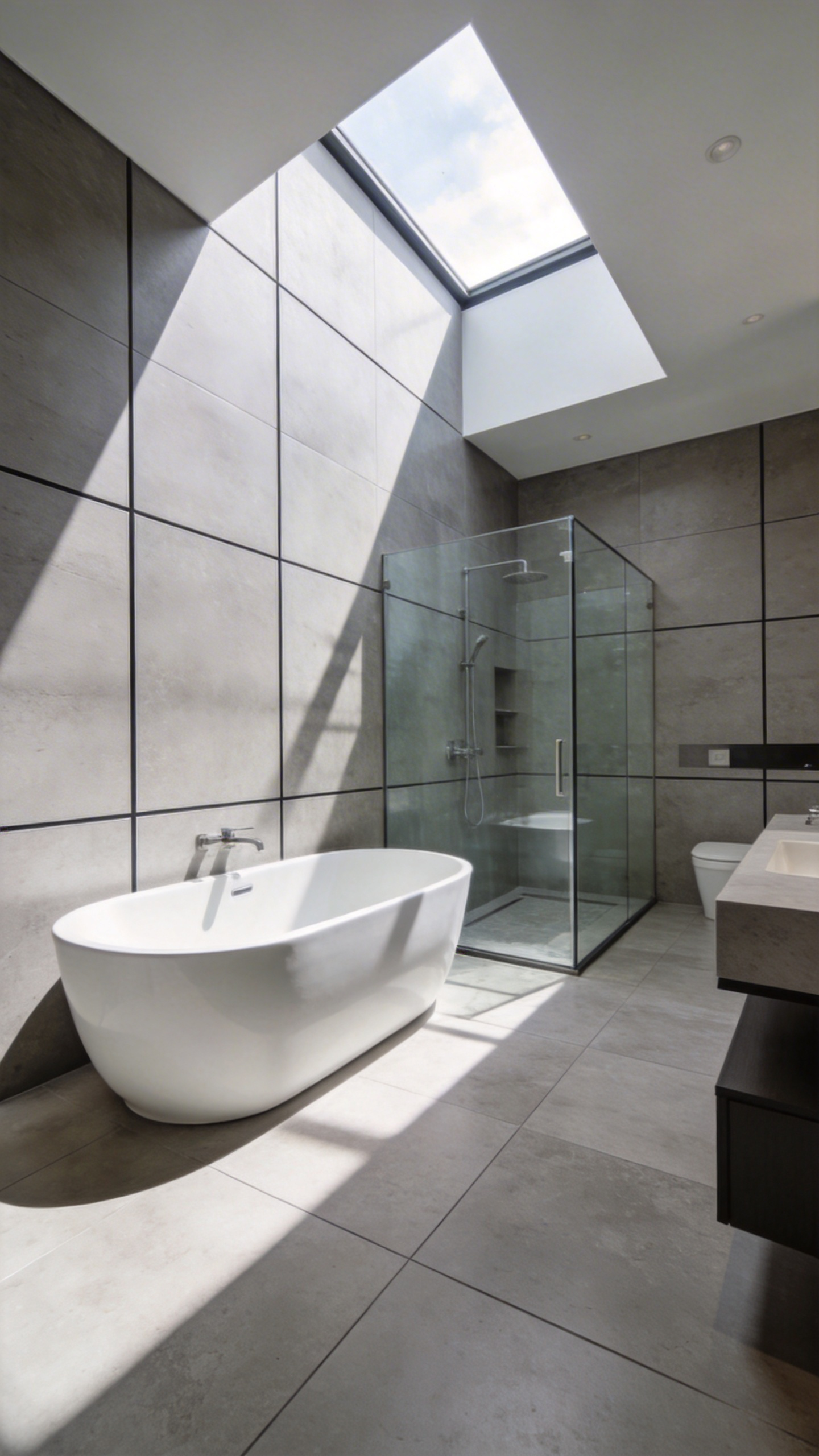
Ideally, this creates a psychological effect known as “scalelessness.” Traditional tile grids create visual noise that defines a room’s limits. Conversely, large slabs eliminate the brain’s ability to measure the space. Thus, even compact bathrooms feel like expansive, open volumes.
Furthermore, digital inkjet technology has eliminated the repetitive “cookie-cutter” look of the past. Manufacturers can now print distinct graphics on every slab. Moreover, advanced “Synchro Digit” technology aligns physical textures with printed visuals. Therefore, the marble vein you see is the exact grain you feel. However, achieving this continuity requires rigorous engineering. Specifically, the subfloor must be perfectly flat to prevent “lippage,” or uneven edges. Ultimately, this material transforms a bathroom into a fluid, uninterrupted sanctuary.
3. Terrazzo Aggregates: Balancing Scale and Density for Visual Weight
While often celebrated for its playful confetti aesthetic, terrazzo requires technical balance in moisture-prone environments. Specifically, success depends on the interplay between aggregate scale and density. First, consider the “visual frequency” of the chips. Micro-aggregates, usually under one-eighth of an inch, create a consistent, textured backdrop. Consequently, this allows sleek fixtures, like floating oak vanities, to take center stage. Conversely, macro-aggregates, known as Venetian terrazzo, offer a distinct “statement” surface. Counterintuitively, these large fragments provide visual rest. This makes small bathrooms feel surprisingly expansive.
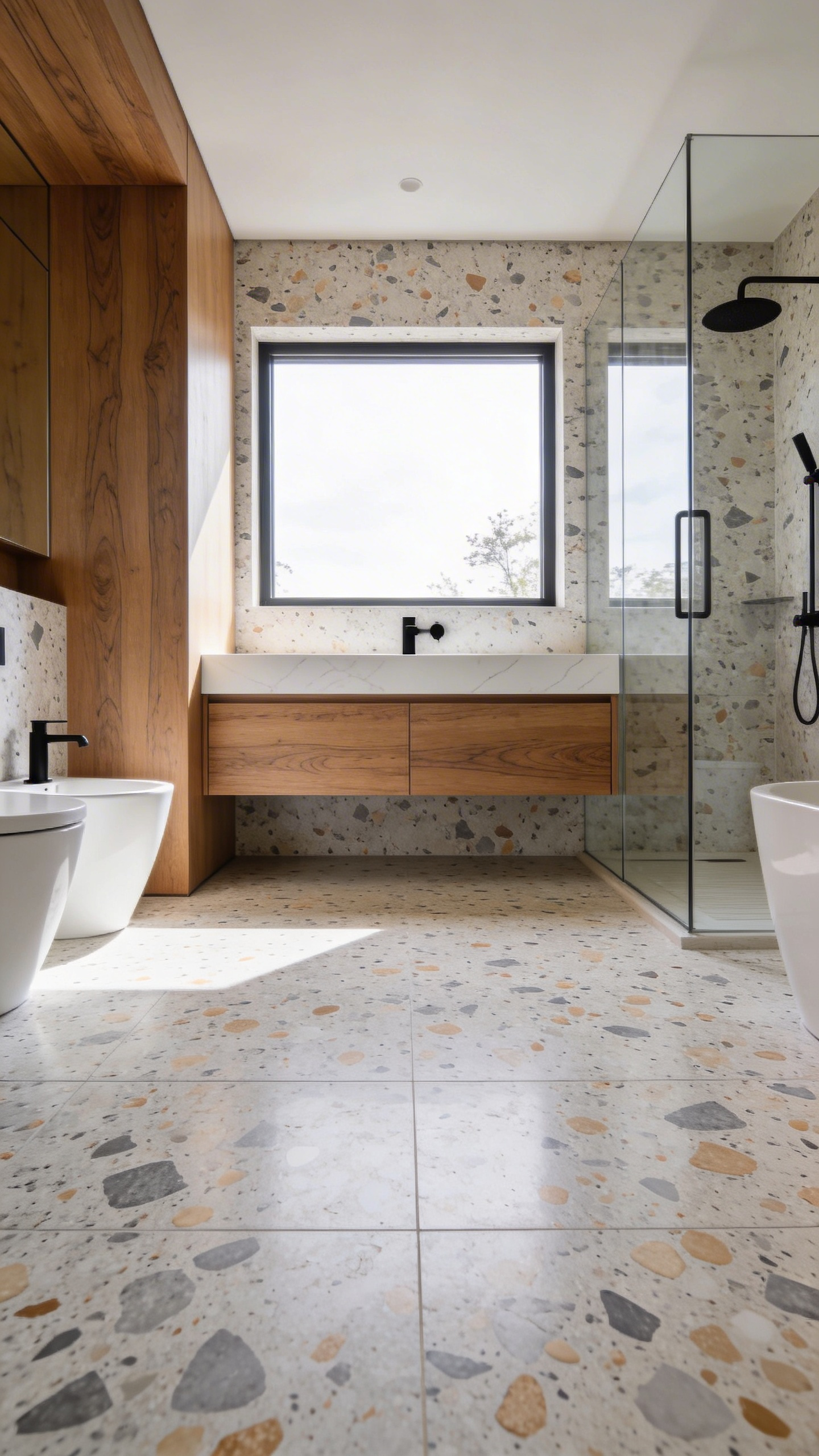
Next, examine the surface density. Industry standards typically demand at least 70% aggregate exposure. Therefore, a high-density tile carries significant “visual weight,” suggesting structural permanence. Furthermore, this density creates a phenomenon called “tactile vision.” Even if polished smooth, the brain perceives a heavy aggregate pattern as grippy. Thus, it provides a psychological sense of safety in wet zones.
Additionally, the material composition drives the room’s atmosphere. Traditional marble chips add a cool, grounding heft. Alternatively, glass or shell aggregates introduce a translucent “shimmer factor.” In fact, these act as tiny mirrors, amplifying light in windowless powder rooms. Finally, the matrix color determines the overall energy. Low-contrast binders create a serene, monolithic look. However, high-contrast mixes generate visual vibration. Ultimately, avoiding excessive visual noise ensures the bathroom remains a relaxing sanctuary.
4. The Honed vs. Polished Debate: Slip Resistance and Light Absorption
The choice between honed and polished finishes creates a distinct technical tug-of-war in bathroom design. Primarily, this distinction lies in surface topography and how it manipulates light. Polished tiles undergo extensive grinding to close their pores completely. Consequently, they create *specular reflection*, bouncing light at precise angles like a mirror to visually expand small spaces. In contrast, honed tiles stop the grinding process earlier. This leaves microscopic peaks and valleys that scatter light rays. Designers often call this a “micro-shadow factory.” It produces a velvety, grounded glow rather than a harsh glare.
However, aesthetics must always balance with safety. Specifically, the industry relies on the Dynamic Coefficient of Friction (DCOF) to measure slip resistance. For wet environments, a rating of 0.42 is the standard safety threshold. Unfortunately, polished marble often falls below 0.3. This effectively becomes a skating rink when wet. Conversely, honed surfaces typically score above 0.5. Therefore, they offer the necessary grip for bare, wet feet. Selecting the right finish is one of many modern bathroom inspirations that redefine the safety and style of your daily routine.
To solve this dilemma, modern layouts often utilize a “finish mix.” For instance, designers specify honed floors for traction paired with polished walls for high-gloss drama. This approach satisfies safety requirements while still allowing walls to amplify light. Additionally, it addresses long-term maintenance trade-offs. While polished surfaces reveal every slight scratch or acidic etch, honed textures disguise daily wear within their patina. Ultimately, selecting the right finish allows a space to age gracefully while prioritizing the user’s physical well-being.
5. Engineered Quartzites: The Durability of Granite with the Veining of Marble
For decades, engineered stone relied on superficial surface printing. Consequently, the material’s edges often revealed a granular, “speckled” interior. However, modern manufacturing has revolutionized this aesthetic limitation. Specifically, advanced 3D printing technology now injects pigments throughout the entire mixture. As a result, the veining flows seamlessly through the slab’s thickness. This technical leap allows for elegant, mitered edges on vanities where the pattern wraps naturally around corners.
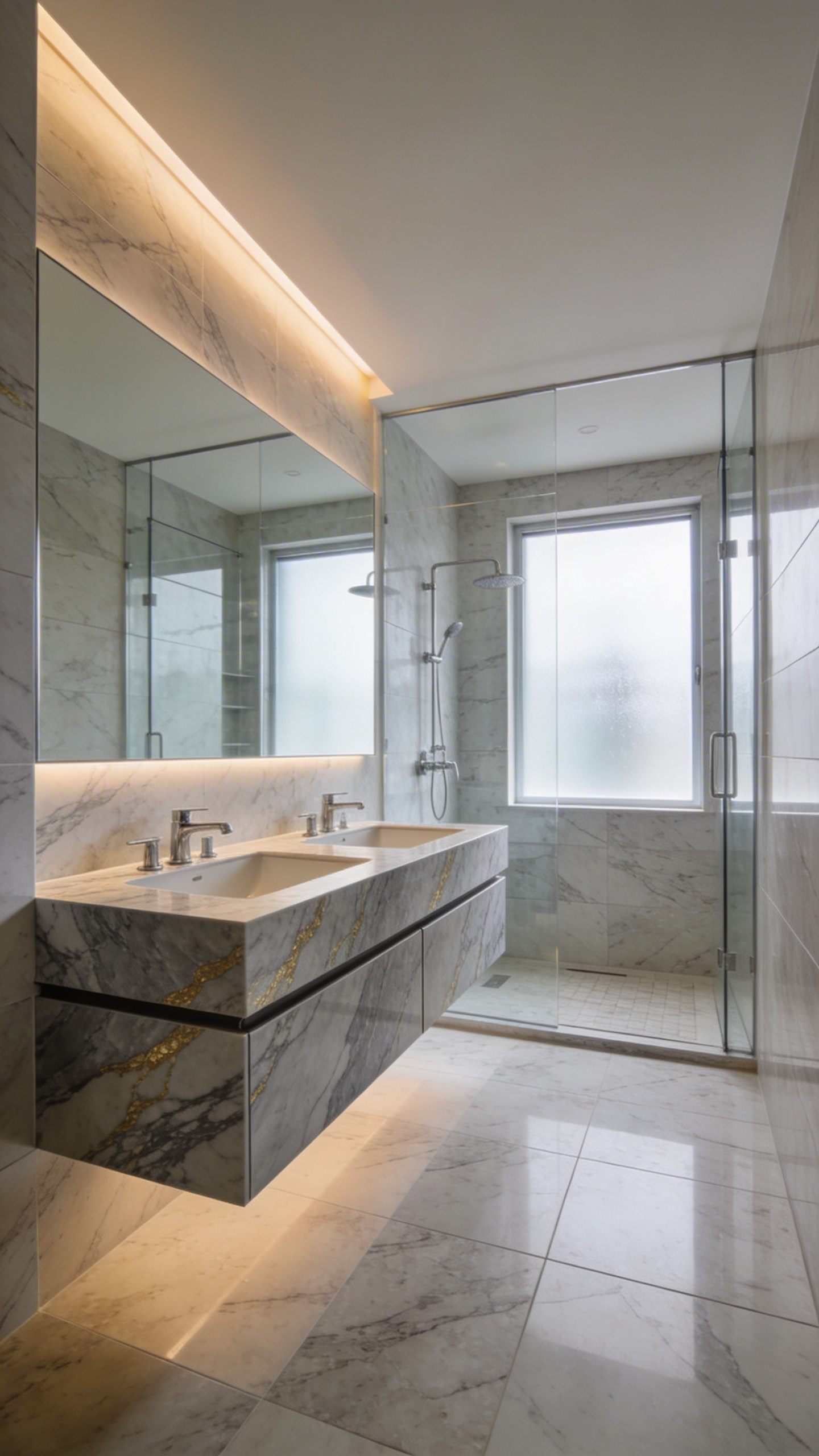
Beyond aesthetics, this material addresses the practical failures of natural stone. While marble is porous and soft, “engineered quartzite” is incredibly dense. In fact, it achieves a Mohs hardness of 7. Therefore, acidic skincare products like vitamin C serums will not etch the surface. Similarly, its non-porous nature prevents water absorption. Thus, high-humidity bathrooms remain free of the dark “phantom stains” often trapped behind natural stone.
Furthermore, these large-format slabs offer a significant hygienic advantage. By utilizing “Jumbo” sizes, designers can clad showers with almost no grout lines. Consequently, mold and mildew have nowhere to hide. However, users must remember one critical technical constraint. Because the material contains polymer resin, it remains sensitive to high heat. Therefore, a hot curling iron left on the surface can cause permanent scorching. Ultimately, for those prioritizing precision over patina, this material offers an unmatched, low-maintenance luxury standard.
Section 2: The Art of Layout & Spatial Perception
In interior design, the bathroom is often an architecturally “fixed” environment. Therefore, tile layout becomes the primary mechanism for manipulating spatial perception. It acts as a sophisticated visual language that can stretch, lift, or ground a room.
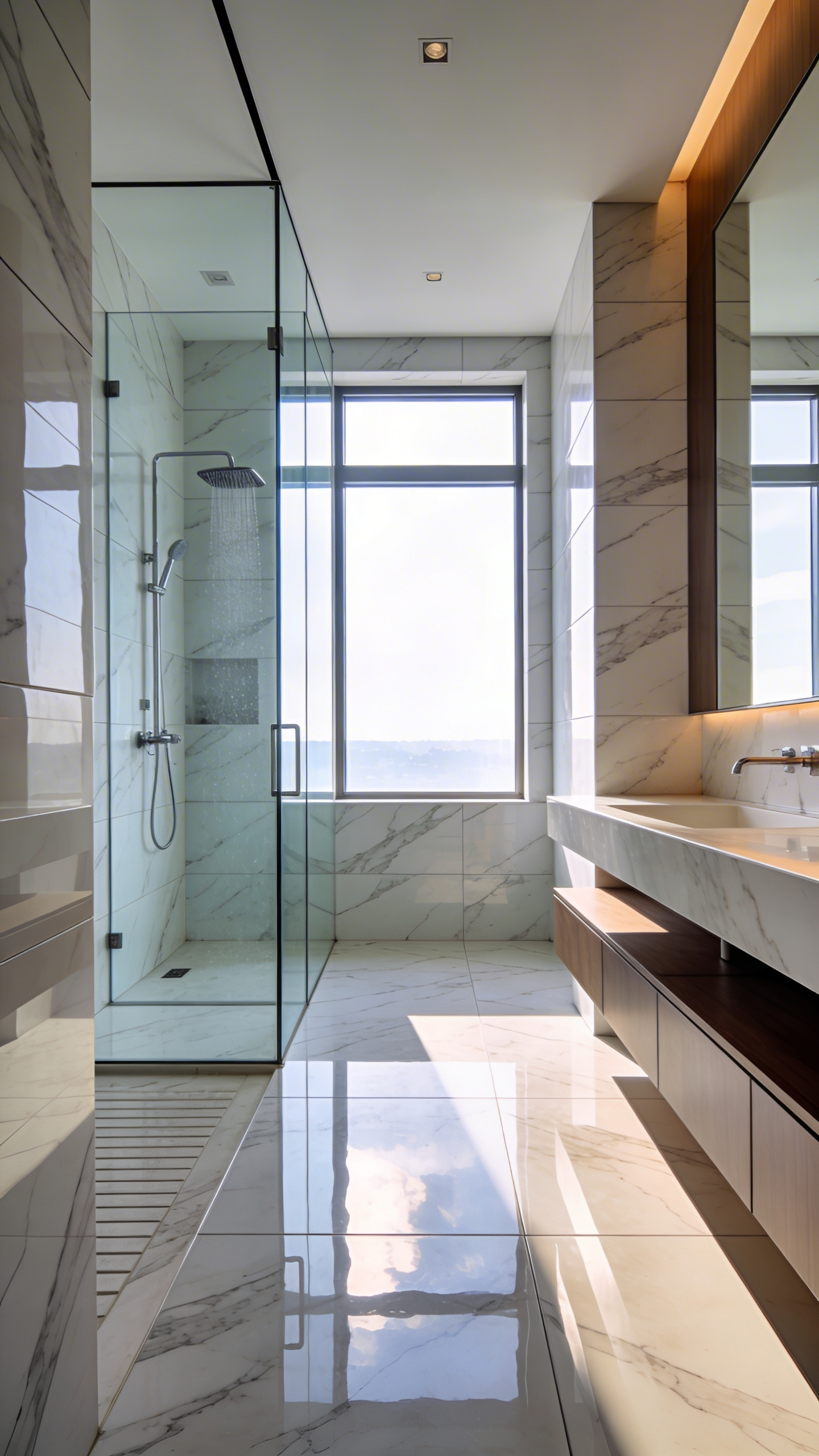
The most significant consideration is the “Grid Effect.” Specifically, high-density layouts like mosaics create frequent visual stops. Consequently, this leads to “cognitive shrinkage,” where a space feels confined by busy details. To counter this, designers often favor Large Format Tiles. By minimizing grout lines, these create a monolithic surface. Effectively, this trick erases the boundaries that define a small room’s limits. However, mosaics still offer sensory grounding. They provide necessary slip resistance and tactile contrast in wet zones.
Beyond scale, orientation dictates how a user reads the room. For instance, vertical stacking draws the eye upward, acting as a cure for low ceilings. Conversely, horizontal tiles function as a visual pull-bar. Placing them lengthwise guides the gaze toward the horizon, creating an illusion of width in narrow spaces. Furthermore, diagonal layouts can make a room appear significantly wider. Because the eye follows these leading lines to the corners, the boxy feel of standard construction breaks down.
Finally, the physics of visual weight affects the atmosphere. Glossy tiles reflect light, softening hard edges in dark corners. Alternatively, textured or 3D tiles interact with lighting to create shifting shadows. This adds sensory depth, preventing the bathroom from feeling static. Ultimately, even grout choice transforms the space. Matching grout expands the field, while contrasting grout anchors it with architectural structure. Integrating advanced bathroom wall decoration strategies can further enhance these visual illusions.
6. Vertical Stacking: Optical Illusions to Elevate Low Ceilings
Low ceilings often make bathrooms feel compressed or darker than necessary. However, you can counteract this layout limitation through the strategic use of vertical stacking. By rotating rectangular tiles 90 degrees, you create a sense of “visual kineticism.” Consequently, the eye naturally travels upward along continuous grout lines without interruption. This upward movement effectively tricks the brain into perceiving greater distance between the floor and ceiling.
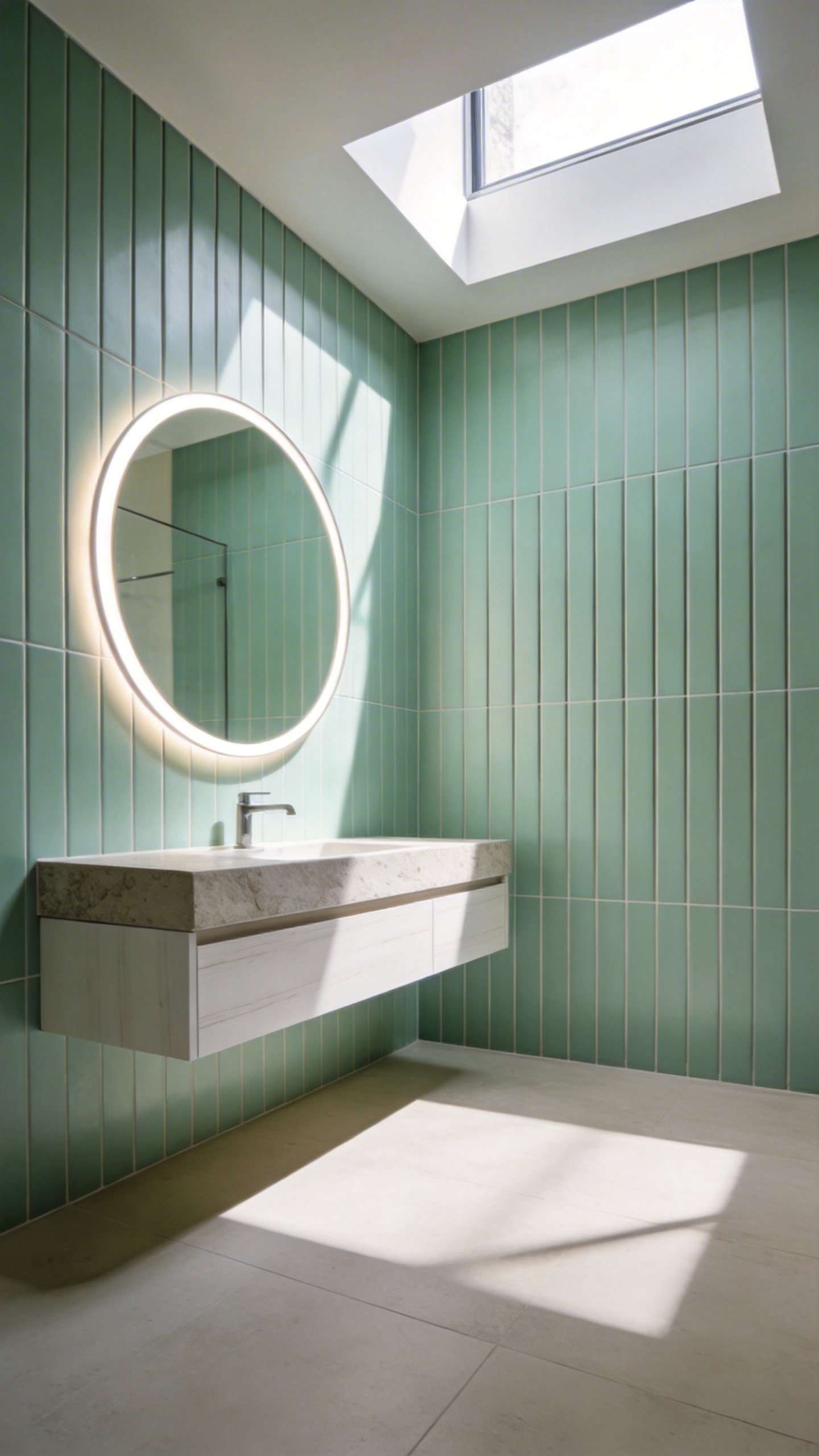
Furthermore, the specific material choice amplifies this optical illusion. Specifically, elongated formats like “finger tiles” or narrow planks provide the best vertical rhythm. When grouped tight, these thin tiles create a rich, corduroy-like texture. Therefore, the wall gains tactile depth without encroaching on the room’s physical footprint. This approach aligns with Japandi principles, using orderly lines to foster a sense of Zen-like “Ma,” or negative space.
Success, however, relies heavily on material precision. Because vertical grids reveal every imperfection, you must use rectified tiles. These mechanically finished edges ensure a perfectly square layout. Without this precision, the long vertical lines will noticeably wander, ruining the clean aesthetic. Additionally, grout selection matters significantly. For a seamless, monolithic look that extends the wall height, choose a matching grout color. Conversely, high-contrast grout emphasizes the architectural structure, though it visually breaks up the surface.
Finally, apply this technique thoughtfully to avoid the “well effect.” In very narrow rooms, wrapping the entire space in vertical lines can feel like standing in a deep shaft. Thus, reserve vertical stacking for a single focal wall, such as the shower enclosure. This balances the room’s proportions while keeping the atmosphere airy and stable.
7. The Envelope Effect: Floor-to-Wall Continuity for Small Footprints
The “Envelope Effect” transcends simple aesthetics. Specifically, it erases the physical boundaries of a small footprint to manipulate perception. Traditionally, the eye anchors where the floor meets the wall, signaling exactly where usable space ends. However, using a single material to blur this junction reduces visual noise. Consequently, the brain perceives a continuous, monolithic volume rather than disjointed planes.
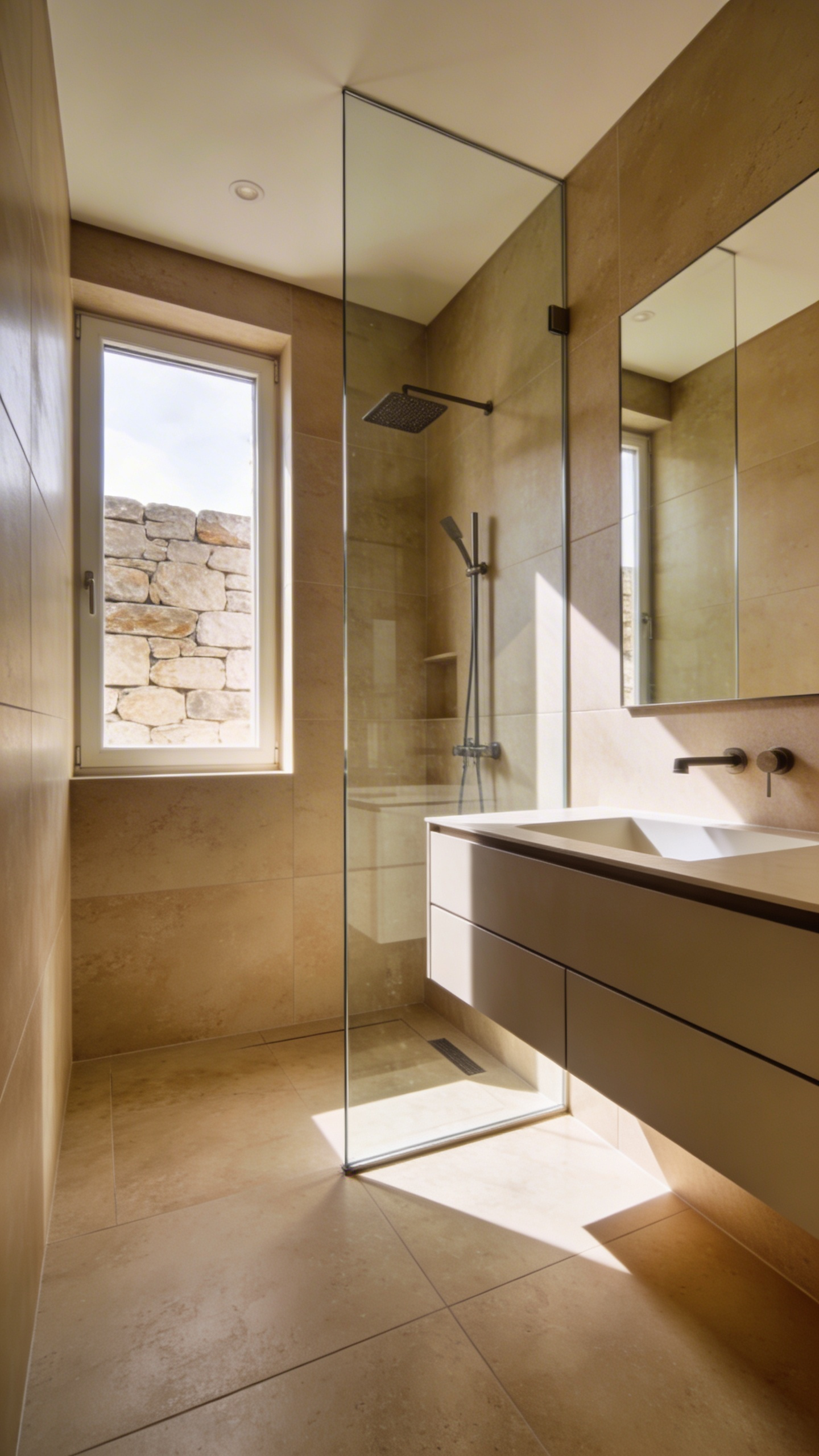
To achieve this seamless look, precision is mandatory. Therefore, designers utilize “rectified” tiles. These feature edges mechanically ground to exact 90-degree angles after firing. As a result, grout joints become microscopic. When grout is color-matched, lines nearly vanish, mimicking a carved stone block. Furthermore, the “Envelope Cut” solves drainage issues without breaking the visual flow. Instead of using small mosaics, installers make diagonal relief cuts in large-format tiles. Thus, the material “folds” into the shower slope like an envelope.
Nevertheless, carrying floor tile up the wall introduces a safety paradox. Wall tiles are often too slippery for wet floors. To navigate this, experts employ a “Split-Finish” strategy. Specifically, select a collection offering two finishes. Use a matte surface with a Dynamic Coefficient of Friction (DCOF) ≥ 0.42 for floor traction. Then, apply a semi-polished version on the walls to reflect light. Because they share the same pigment, the envelope remains visually unbroken. Ultimately, this creates a hygienic, “carved-out” sanctuary that feels expansive.
8. Herringbone Scaling: Adjusting Ratios to Control Visual Movement
The scale of a herringbone pattern acts as a metronome for a room’s visual energy. Specifically, the pattern’s “speed” relies on the tile’s surface area relative to the total space. For instance, small-format tiles create a “micro-herringbone” effect that feels dense and vibrating. Consequently, this high-speed texture creates a jewelry-like focal point perfect for shower niches. Conversely, oversized planks create “whalebone” scaling, which significantly slows the visual rhythm. Ultimately, this allows the eye to rest on the material’s grain, establishing a sense of architectural calm.
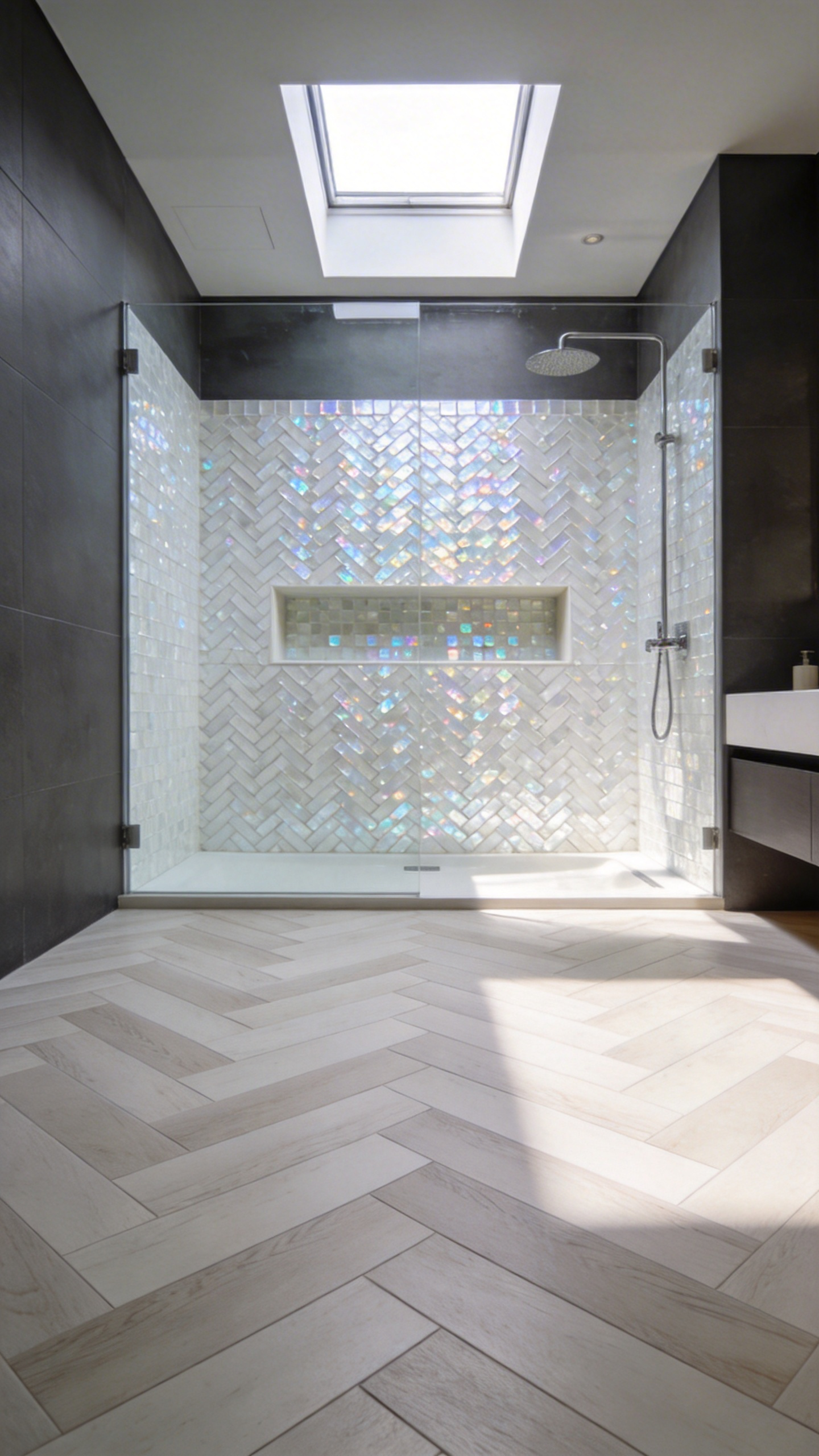
Beyond size, the ratio between width and length dictates the pattern’s directional pull. Traditionally, a 1:3 ratio offers a stable, balanced movement reminiscent of classic French parquetry. However, slender ratios like 1:6 increase the “visual stretch” dramatically. Known as “slimbone,” these elongated tiles act as powerful leading lines. Therefore, laying them toward a distant wall creates a forced perspective illusion. This effectively deepens narrow rooms.
Furthermore, the orientation of the “V” shapes changes how users interact with the space. For example, a 45-degree diagonal orientation pushes the walls outward, making cramped rooms feel airy. Alternatively, a 90-degree alignment provides a tailored order, framing features like freestanding tubs. Finally, the choice of grout determines the pattern’s overall intensity. While high-contrast grout creates graphic vibration, matching colors results in a subtle “ghosted” effect. In fact, this monochromatic approach weaves a sense of structural permanence without overwhelming the senses.
9. The Infinite Shower: Curbless Transitions and Linear Drains
The “Infinite Shower” fundamentally reimagines the bathroom floor as a single, expansive canvas. Specifically, removing the curb eliminates the physical barriers found in traditional layouts. Consequently, the room feels significantly larger and psychologically open. Ideally, this seamless transition relies on the sleek linear drain. Traditional center drains require a complex, four-way slope. Conversely, linear drains allow for a gentle, single-plane ramp. Therefore, designers can utilize massive, uninterrupted stone slabs without risking cracks or awkward cuts.
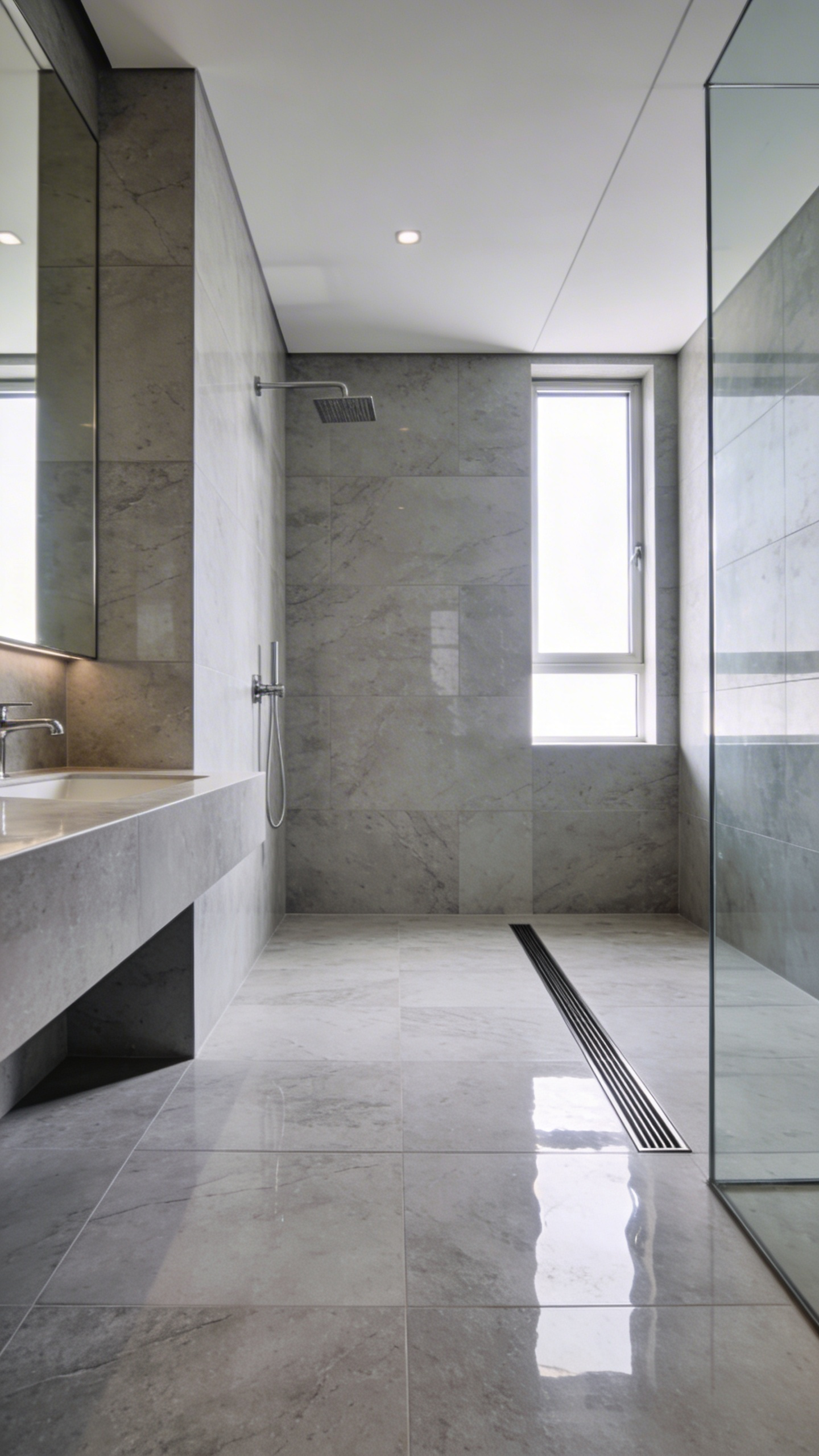
Visually, the result is a stunning vanishing act. In fact, high-end “tile-in” drains incorporate a sliver of the floor material, leaving only thin slits visible. However, visual continuity must not compromise physical safety. Thus, experienced designers often employ a subtle textural shift to delineate the wet zone. For instance, transitioning to a higher-friction surface signals the feet without breaking sightlines.
Originally, this barrier-free approach served medical necessities in utilitarian wet rooms. Yet, influenced by architects like Michael Graves, it now merges universal design with spa-like luxury. Furthermore, proper engineering ensures function matches form. Placing the drain against the back wall prevents overflow, effectively handling high-volume rain heads. Ultimately, this sophisticated layout ensures a home remains functional for a lifetime without sacrificing style.
10. Micro-Mosaics: utilizing High-Grout Density for Grip and Texture
Micro-mosaics represent a sophisticated intersection of engineering and art. Specifically, using tiles smaller than one inch prioritizes mechanical grip over seamlessness. In standard layouts, grout lines are often sparse. However, micro-mosaic patterns increase these lines exponentially. Consequently, thousands of tiny edges act as “mechanical brakes” for the human foot. Furthermore, these recessed channels disrupt surface water tension. This effectively minimizes the hydroplaning effect common on slick, wet slabs.
Beyond safety, this technique introduces rich sensory architecture. Ideally, a bathroom design should engage touch as well as sight. Walking on high-grout density floors provides constant tactile feedback. In fact, designers often refer to this as the “subtle foot-massage effect.” Unlike cold, clinical slabs, the texture feels grounded and organic. Visually, matching grout colors can create a soft, woven appearance. Conversely, contrasting colors highlight the intricate, geometric rhythm.
Historically, high grout content raised valid cleaning concerns. Yet, modern material science has resolved this maintenance trade-off. Specifically, high-performance epoxy grouts are non-porous and antimicrobial. Therefore, they resist staining while maintaining that essential texture. Additionally, small tesserae allow for precise sloping toward drains. This prevents stagnant water pools effectively. Ultimately, treating grout as a primary design element adds both safety and significant perceived value to the space.
Section 3: Tactile Contrast & Material Mixing
Modern bathroom design is moving beyond simple aesthetics to embrace a “sensorial” philosophy. Specifically, this approach prioritizes touch, shifting away from the “hegemony of vision” criticized by architectural theorists. Consequently, designers now utilize a haptic hierarchy. This strategy deliberately places high-texture surfaces in key interaction zones. For instance, fluted tiles or riven slate often feature where hands or bare feet naturally rest.
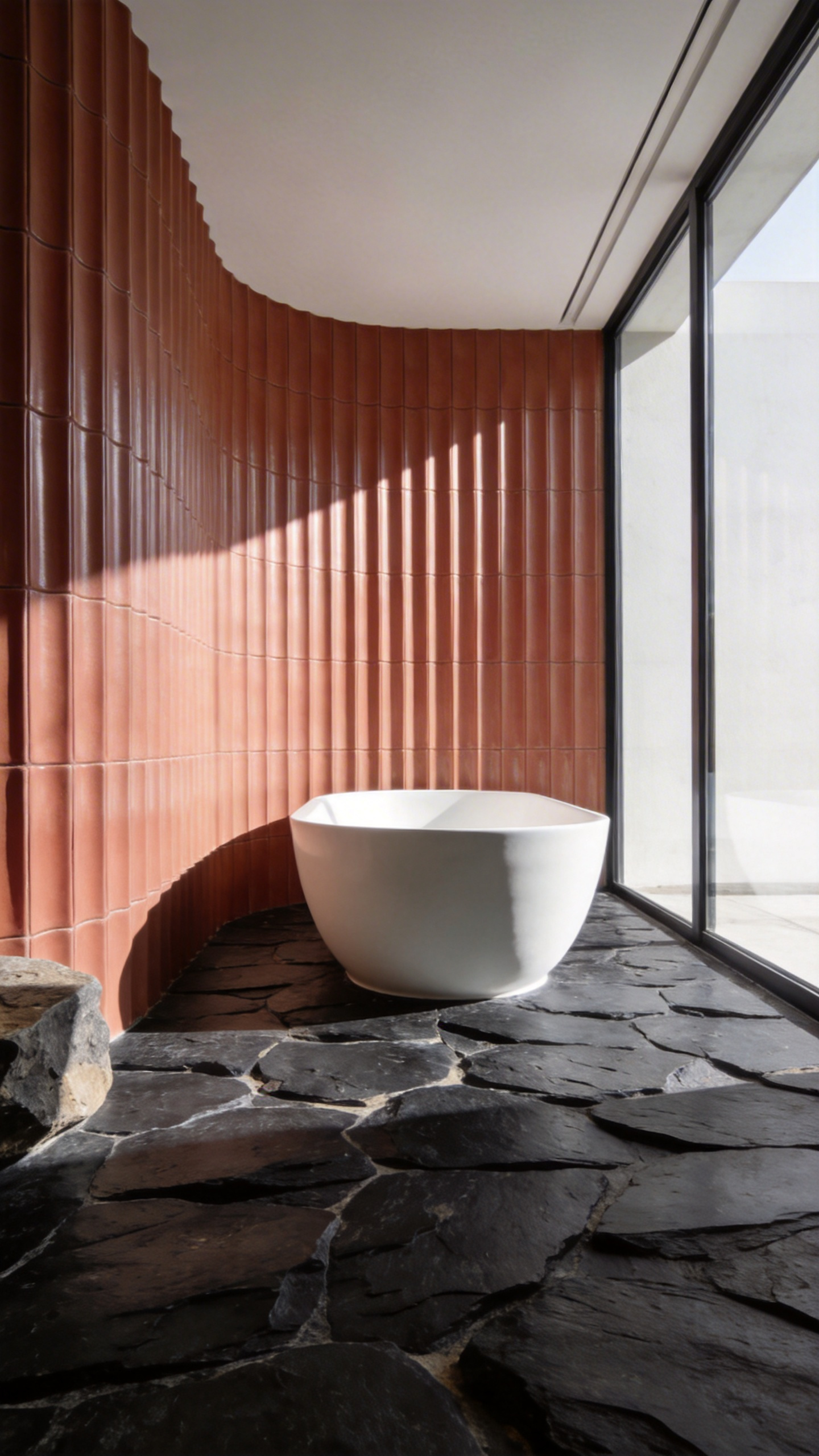
Furthermore, material mixing effectively manages the room’s “climate.” Dense natural stones like marble possess high thermal conductivity. Therefore, they are ideal for underfloor-heated shower areas. Conversely, porcelain wood-look tiles feel naturally warmer to the touch on dry floors. Additionally, texture plays a crucial role in acoustic sculpting. Bathrooms are typically “live” rooms where sound echoes sharply. However, tiles with 3D relief act as acoustic diffusers. They break up sound waves, significantly softening the auditory environment.
Visually, authoritative designs often employ “material bilingualism.” This concept pairs raw, organic textures with precise, industrial finishes. To balance this dialogue, experts frequently apply the 60-30-10 rule. Typically, a neutral matte porcelain acts as the dominant sixty percent. Subsequently, a textured stone creates depth as the secondary thirty percent. Finally, tactile contrast fundamentally alters light perception. 3D tiles create “shadow gaps” when hit by wall-grazing LED strips. Thus, the room’s atmosphere evolves throughout the day, mimicking the natural fluctuations found in nature.
11. Fluted and Ribbed Surfaces: Introducing Shadow Play and Acoustics
Incorporating fluted and ribbed surfaces transforms a bathroom from clinical to sanctuary-like. Historically, these textures echo classical architecture; however, today they serve a distinct sensory purpose. Specifically, the primary appeal lies in their interaction with light. When designers position sconces nearby, the ridges create a “grazing” effect. Consequently, this interplay of light and shadow, known as *Chiaroscuro*, adds dynamic visual depth.
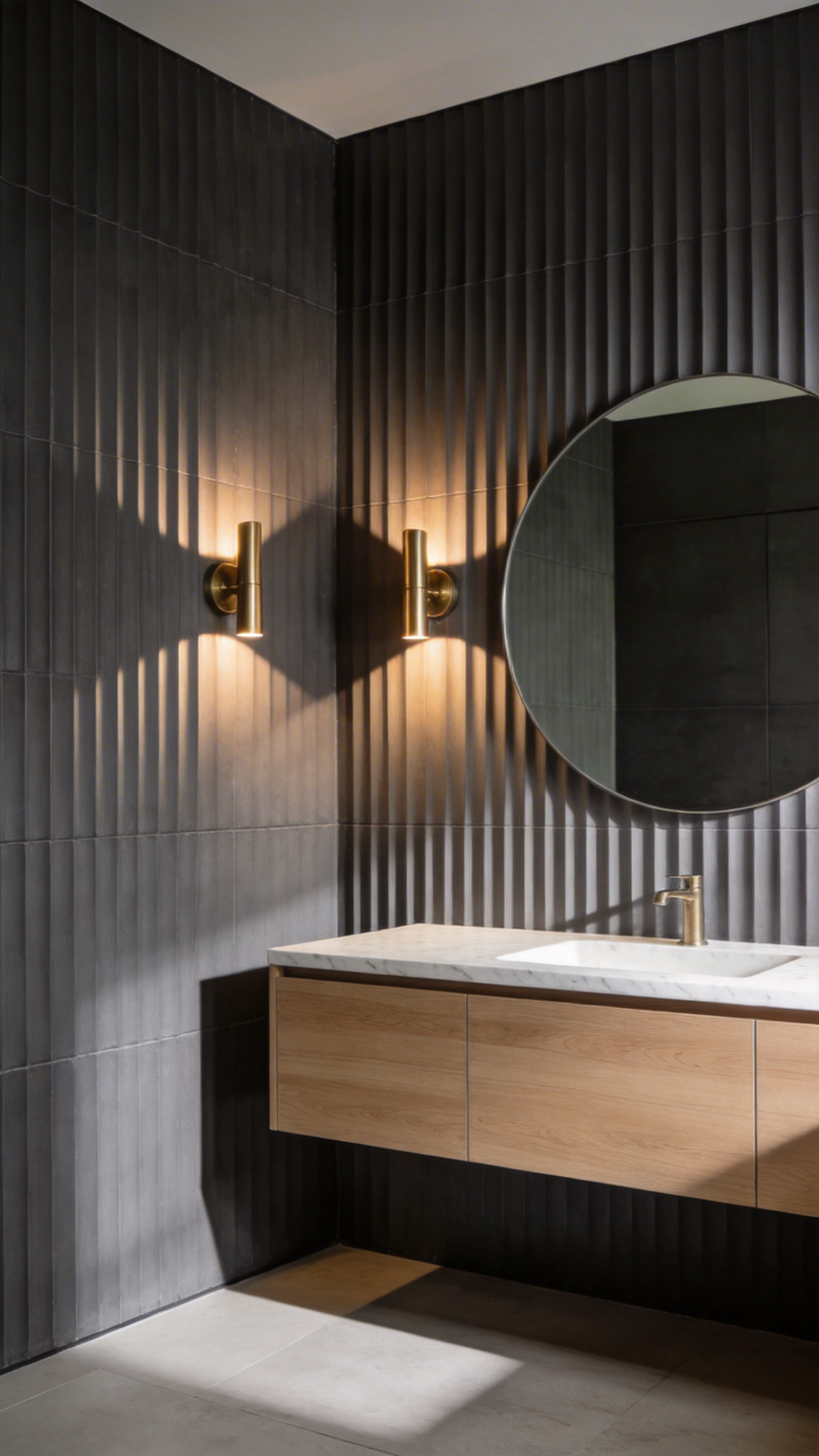
Furthermore, this texture addresses a significant technical challenge: acoustics. Typically, hard surfaces like porcelain and glass create harsh, amplified echoes. Conversely, the undulating surface of ribbed tiles acts as a physical diffuser. Therefore, sound waves scatter upon impact rather than bouncing directly back. As a result, the space sounds softer, significantly reducing auditory stress.
Finally, the design shift is deeply tactile. Because bathrooms are “touch-first” spaces, the physical sensation of the wall matters. Whether using extruded porcelain or milled stone, the texture invites interaction. In fact, on shower floors, this ribbing provides natural slip resistance. Ultimately, these surfaces engage sight, sound, and touch to create a monolithic, calming environment.
12. Metal Inlays: Brass and Copper Transitions in Stone Fields
In high-end bathroom design, expansive “stone fields” can often risk feeling monolithic or cold. To counter this, designers introduce brass and copper inlays as architectural “jewelry.” Specifically, these metallic accents break the visual plane while adding a layer of warmth. The primary appeal lies in the sophisticated sensory collision of materials. While stone naturally acts as a cool heat sink, brass is thermally conductive. Consequently, walking barefoot across the floor offers a rhythmic, tactile shift. You experience the matte stability of stone interrupted by slick, metallic ridges. Furthermore, these inlays serve as “light catchers” amidst the steam. They reflect water and vanity lighting to animate the floor with a “liquid” effect.
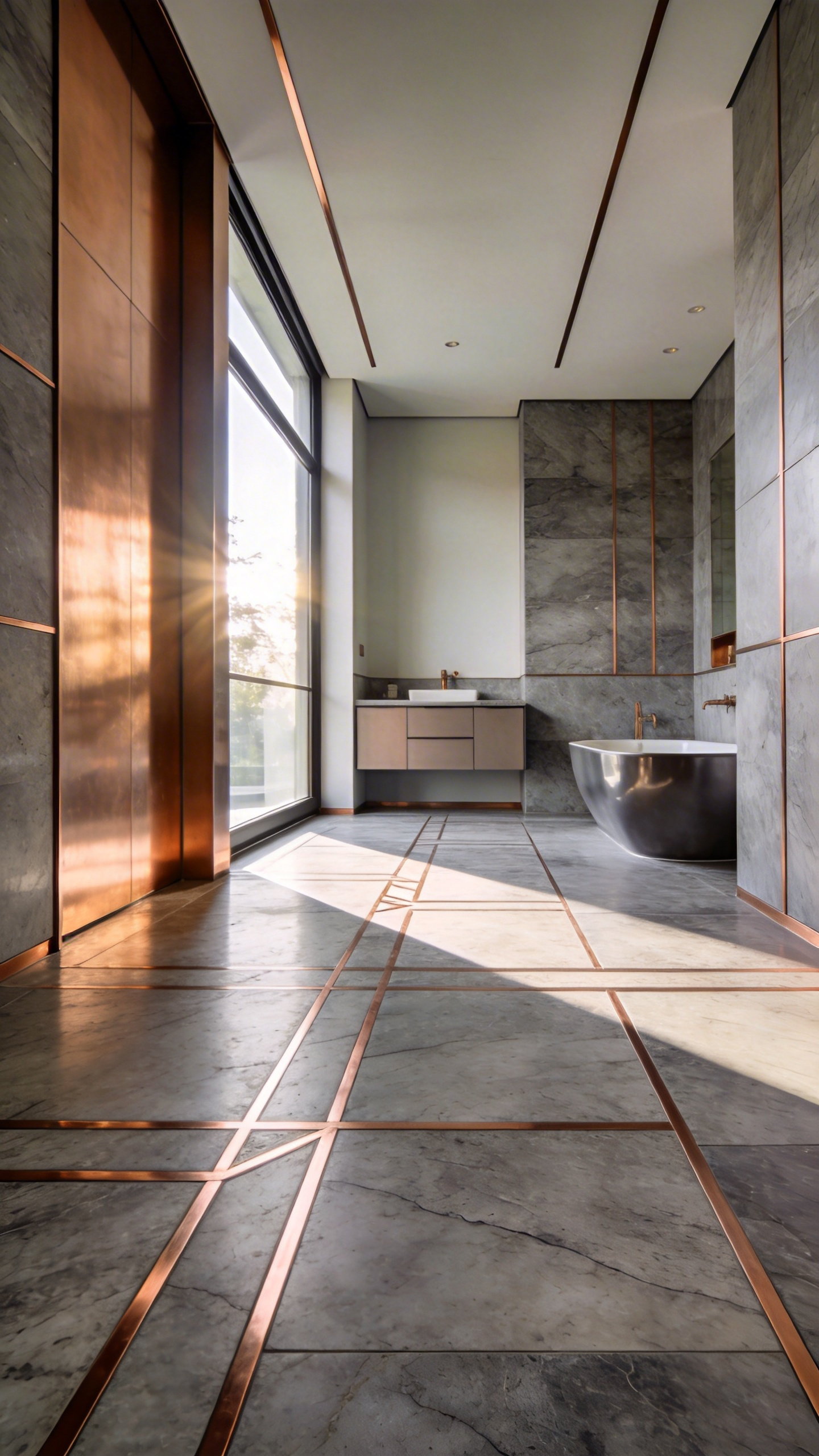
Beyond aesthetics, successful installation requires careful engineering due to thermal expansion. In fact, brass expands significantly faster than natural marble when heated by showers. Therefore, professionals use flexible epoxy grouts to create functional movement joints. This technique allows the metal to “float” safely without cracking the surrounding stone. Finally, designers must decide on the metal’s long-term narrative. Unlike sterile stainless steel, copper and brass are “living metals.” They often develop a rich patina that maps the room’s usage over time. Alternatively, applying lacquer maintains a high-gloss contrast for a permanently polished look. Ultimately**, these transitions turn a simple floor into a bespoke tapestry.
13. Warmth Without Wood: High-Fidelity Timber Ceramics in Wet Zones
High-fidelity timber ceramics represent a profound shift in material engineering. Previously, “wood-look” tiles felt like mere imitations. However, modern manufacturing now bridges the sensory gap between clinical porcelain and organic hardwood. Specifically, the industry has adopted 3D Synchro Digit Technology. Consequently, digital sensors align the physical texture precisely with the printed grain. If you see a knot, you actually feel the indentation. Furthermore, rectified edges allow for tight butt-jointing, creating a seamless, endless floor visual.
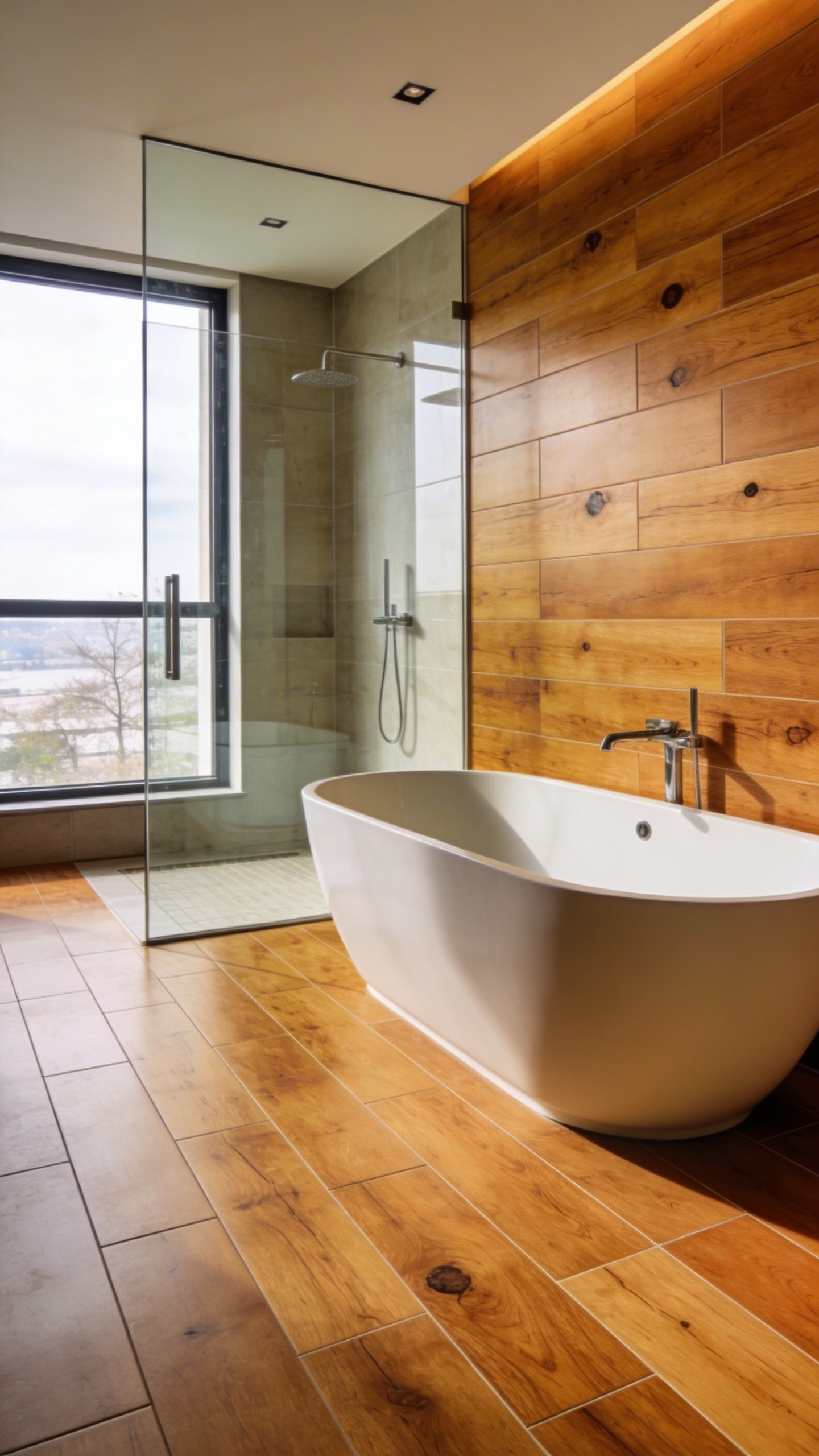
Beyond aesthetics, these materials excel in wet zones. Natural wood absorbs moisture, eventually leading to warping. Conversely, vitrified porcelain absorbs less than 0.5% of water. Therefore, the material remains impervious to rot, even in steam showers. Additionally, manufacturers now use “Smooth-Grip” technology. This provides an R11 slip-resistance rating without a rough texture. Thus, you can run the flooring seamlessly from a dry bedroom into a wet shower basin.
Psychologically, this material supports biophilic wellness. The visual presence of wood grain helps reduce cortisol levels. Yet, the porcelain body offers a distinct thermal advantage. Unlike insulating wood, porcelain possesses high thermal mass. As a result, it conducts radiant underfloor heating efficiently. Ultimately, this creates a sensory paradox. The floor offers the visual warmth of oak with the physical warmth of heated stone.
14. The ‘Rug’ Effect: Defining Zones with Encaustic Borders
In the realm of bathroom design, the “Rug Effect” creates a permanent, decorative textile on the floor. Specifically, this technique uses hand-pressed encaustic cement tiles to define functional zones like a vanity or tub. Unlike porcelain, the color in these tiles is a deep layer of pigmented cement. Consequently, they develop a soft, matte patina rather than fading or chipping over time. This mimics the aging process of an heirloom carpet.
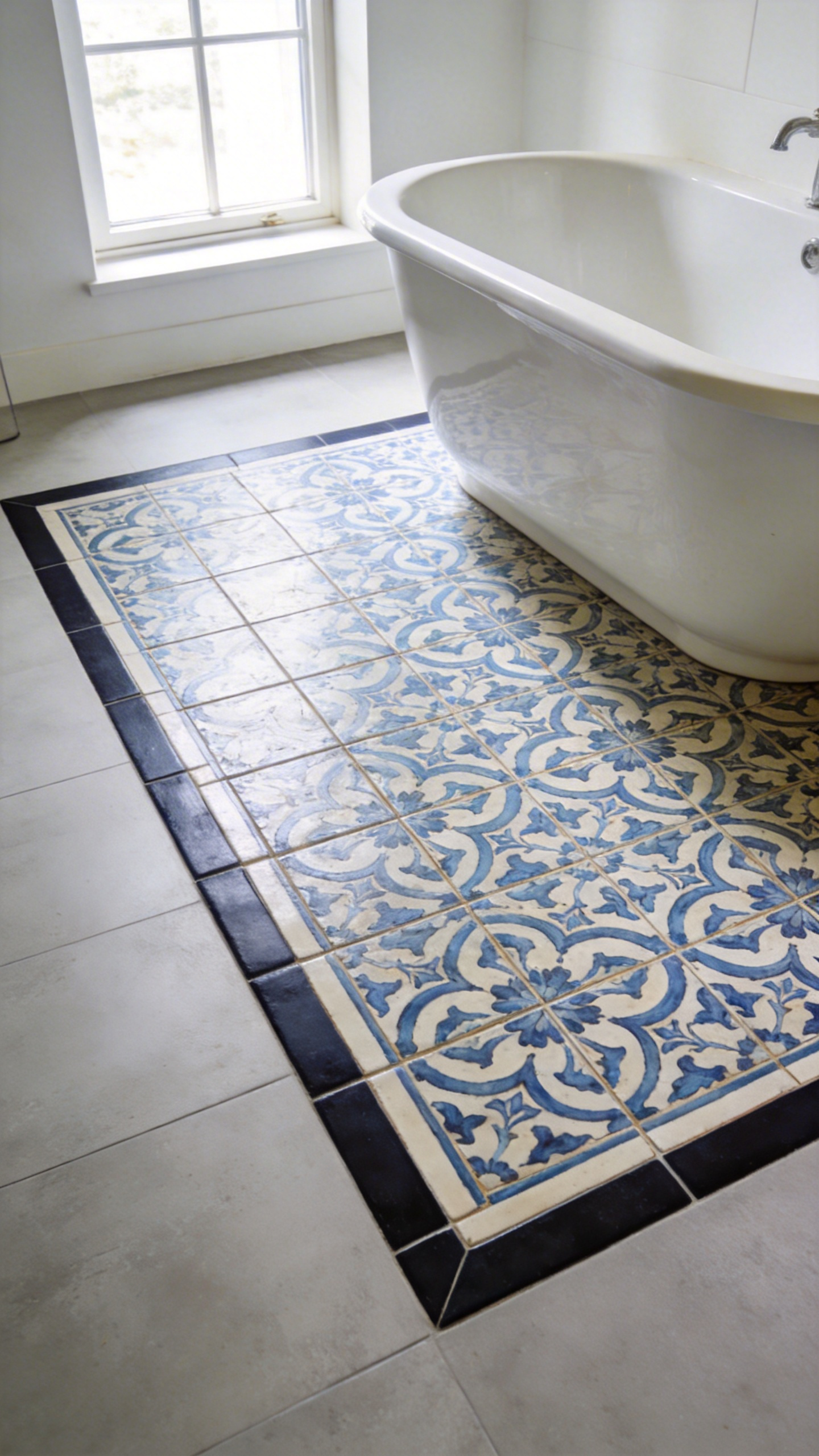
To achieve this authentic look, you must respect the structural hierarchy of a carpet. First, the central “field” acts as the medallion or repeating motif. Next, a framing border locks the pattern in place without being cut. Crucially, a solid-colored “fill” tile surrounds the rug to extend to the walls. This allows installers to trim the edges to fit irregular walls without interrupting the intricate geometric border.
However, there is a technical consideration regarding material depth. Authentic encaustic tiles are roughly 3/4-inch thick, which is significantly deeper than standard flooring. Therefore, the subfloor often requires a “build down” to prevent a dangerous lip at the threshold. Psychologically, this layout anchors the room, turning open spaces into a “dry oasis” for ritual and rest. Furthermore, the cement offers natural insulation, making these “rugs” feel physically warmer to the touch. Ultimately, this approach blends historical artistry with modern architectural function.
15. Organic Meets Geometric: Pairing Curves with Rigid Grids
Designing a bathroom often requires balancing predictable comfort with engaging visual interest. Historically, artisans used “tessellation” to blend rigid shapes with fluid, natural motifs. Today, this combination creates a sophisticated tension. Specifically, a geometric grid offers “processing fluency,” making the space feel safe and stable. Conversely, introducing organic curves creates a delightful “visual riddle” that engages the brain. Consequently, the room feels both structured and relaxed. Furthermore, the materials themselves mimic water. Rigid tiles feel architectural and grounding. However, curved tiles create “specular highlights,” allowing moving points of light to dance. Thus, this pairing supports neurodiverse design by balancing clinical structure with a tactile escape.
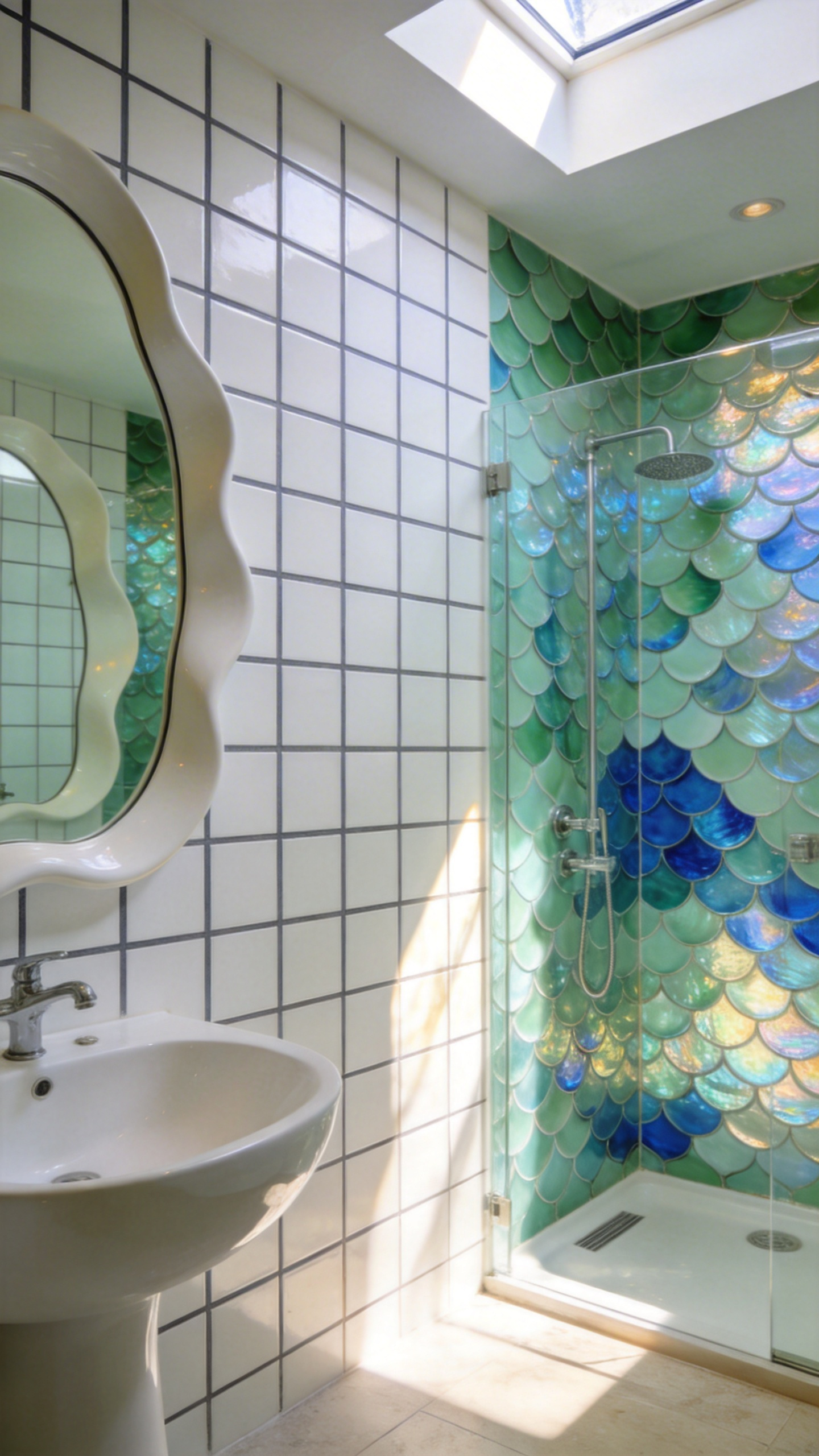
To achieve harmony, experts recommend a “70/30 Shape Ratio.” Ideally, use vertically stacked rectangular tiles for 70% of the space. This grid provides a “mathematical” foundation that makes ceilings appear higher. Next, dedicate 30% to a curved element, like an arched shower niche. This organic feature acts as the focal point. However, the transition requires technical precision. Professionally, “Schluter strips” create a clean shadow gap between these opposing geometries. Additionally, using tone-on-tone grout prevents a chaotic “prison-bar” effect. Ultimately, this ensures the organic element emerges naturally from the rigid grid.
16. Raw Concrete Finishes: Juxtaposing Industrial Texture with Soft Fixtures
Historically, raw concrete in bathrooms was viewed as a cold, industrial necessity. However, it has evolved into a refined architectural choice prioritizing “haptic contrast.” Specifically, this design theme emphasizes the sensory dialogue between rough, unfinished surfaces and refined objects.
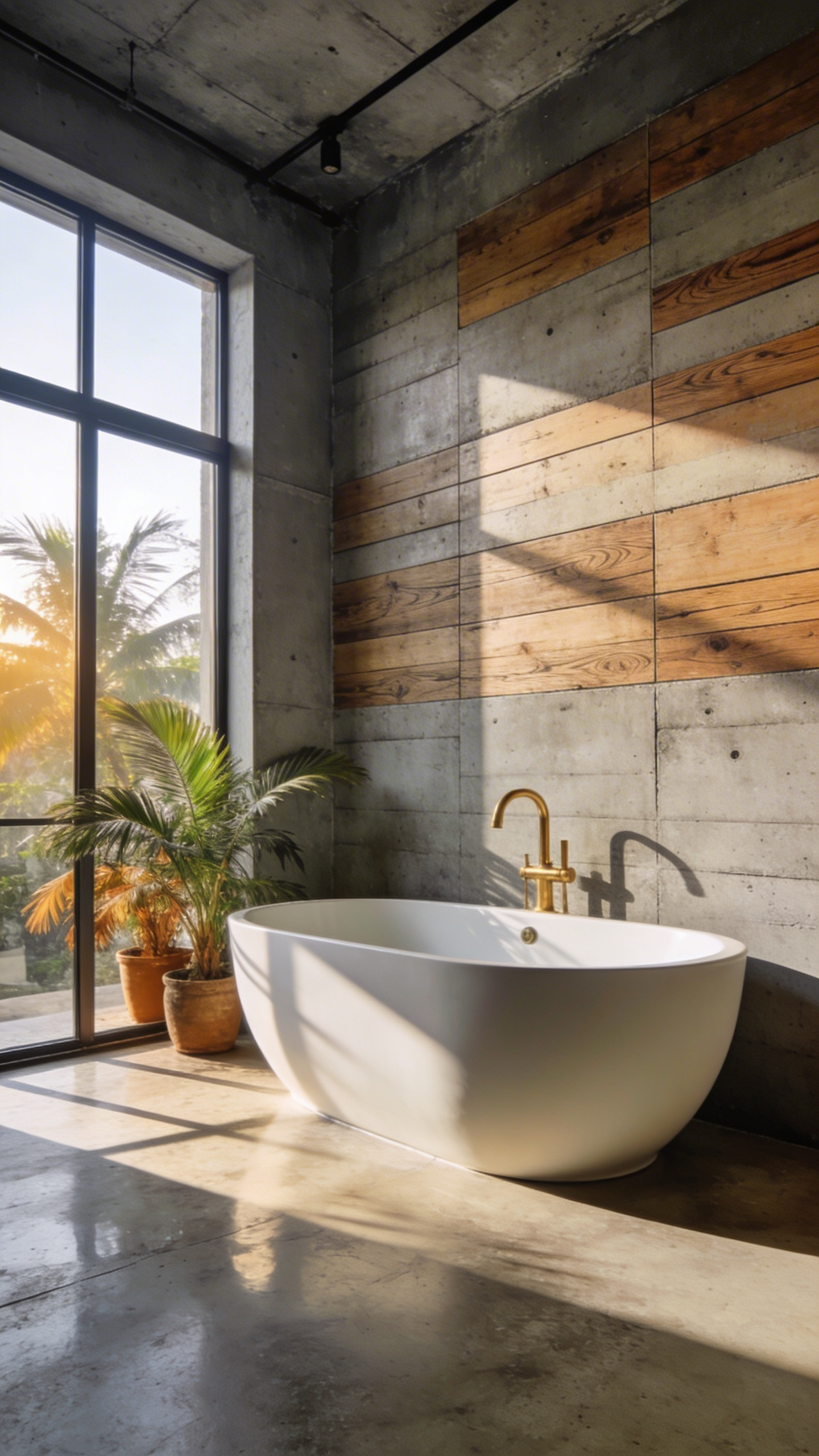
For instance, high-end designs often utilize board-marked concrete-look tiles. These unique surfaces capture the imprinted grain of wooden planks used as molds. Consequently, this mimics the texture of timber within a durable, stone-like medium. Thus, the tile acts as a visual bridge between hard and soft elements.
Psychologically, the success of this look relies on the “Hard-Soft” principle. To humanize a concrete-heavy space, you must introduce fixtures with organic silhouettes. Therefore, pair pitted, matte walls with curved “pebble” mirrors or fluted ceramic sinks. Additionally, incorporate living finishes like brushed brass to warm the palette. These metals develop a patina over time, echoing the “Wabi-Sabi” beauty of aging concrete.
Beyond aesthetics, technical innovations address the inherent coldness of the material. Surprisingly, raw concrete and its porcelain counterparts possess high thermal mass. When paired with underfloor heating, the “cold” industrial floor becomes a radiant heat source. Ultimately, this trend creates a “monolithic” sanctuary. It fosters a sense of stillness, serving as a restorative retreat from a fast-paced world.
Frequently Asked Questions
What are the most durable bathroom tile ideas for a luxury finish?
For long-term durability without sacrificing luxury, engineered quartzite and high-fidelity porcelain are superior choices. These materials are non-porous, resistant to etching from skincare products, and achieve high Mohs hardness ratings, ensuring they maintain their aesthetic integrity in high-moisture environments.
How do I choose bathroom tile ideas for a small space?
To expand a small bathroom visually, prioritize large-format tiles with rectified edges and color-matched grout to minimize visual “noise.” Utilizing the “Envelope Effect,” where the same tile continues from the floor up the walls, erases boundaries and creates a sense of a larger, monolithic volume.
Are matte or polished bathroom tile ideas better for safety?
Matte or honed finishes are generally safer for bathroom floors as they offer a higher Dynamic Coefficient of Friction (DCOF), usually above the 0.42 safety threshold. Polished tiles, while excellent for walls to reflect light, can become dangerously slippery when wet on a floor surface.
Conclusion: Maintenance as a Design Element – Choosing Patina or Perfection
Ultimately, selecting bathroom tile ideas is not merely about cleaning schedules. Instead, it is a definitive choice between a living narrative and a static sanctuary. Materials like marble engage in a chemical dialogue, evolving beautifully with daily use. Conversely, porcelain offers a reliable psychological reset through consistent, engineered perfection. Therefore, maintenance serves as a vital design tool, not a burden. It dictates exactly how your space tells its story over time.
Looking ahead, consider how you define true luxury in your home. Does it lie in the history of a worn, softened edge? Alternatively, does it exist in the freedom of a zero-maintenance surface? Material honesty ensures your bathroom ages gracefully alongside your specific lifestyle. Consequently, your space will feel authentic rather than just durable. To begin, visit a showroom to physically touch unsealed stone versus polished porcelain. Observe your visceral reaction to imperfection before making your final selection on the best bathroom tile ideas for your home.
Final Thoughts: Synthesizing Your Personal Material Palette
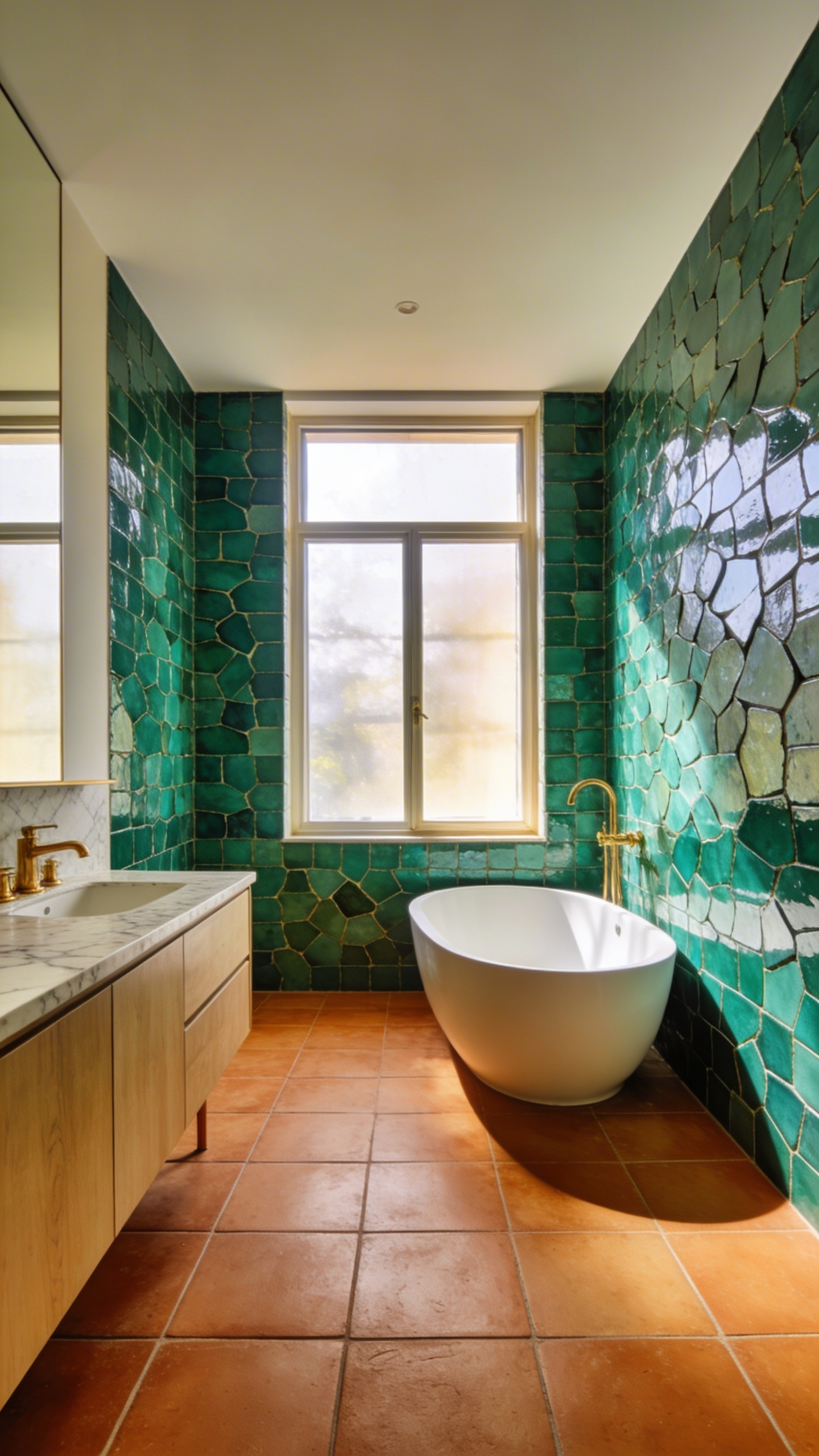
Synthesizing a personal material palette involves more than mere decoration; essentially, it is an exercise in sensory architecture. Therefore, successful design must converge technical performance with psychological comfort. First, consider the room’s acoustic signature. Unfortunately, standard porcelain creates an “echo chamber” by reflecting sound. However, you can mitigate this by introducing irregular surfaces. Specifically, handmade Zellige or Terracotta tiles scatter sound waves through diffraction. Thus, the environment becomes quieter and more spa-like.
Next, focus on the visual rhythm created by layout. Indeed, the pattern dictates how the brain processes dimensions. For instance, a stacked grid communicates precision and lowers mental load. Conversely, a herringbone pattern adds dynamic movement. Consequently, your layout acts as the room’s “visual heartbeat.”
Furthermore, a professional palette requires a strict haptic hierarchy. To prevent sterility, designers often apply the mathematical 60-30-10 rule. Ideally, start with a matte foundation for 60% of the space. Then, layer a honed secondary material for 30%. Finally, use a rough, high-character accent for the remaining 10%. Ultimately, this balance satisfies the biophilic need for texture. By blending reflection, rhythm, and resonance, you transform a utility space into a sanctuary of “Moody Solace.”